
Why Bulk Order Inconsistencies Keep Happening (And Cost More Than You Think)
What causes bulk order inconsistencies is one of the most common operational questions from marketing leaders, HR teams, and operations managers running corporate merchandise programs. Here is a direct answer:
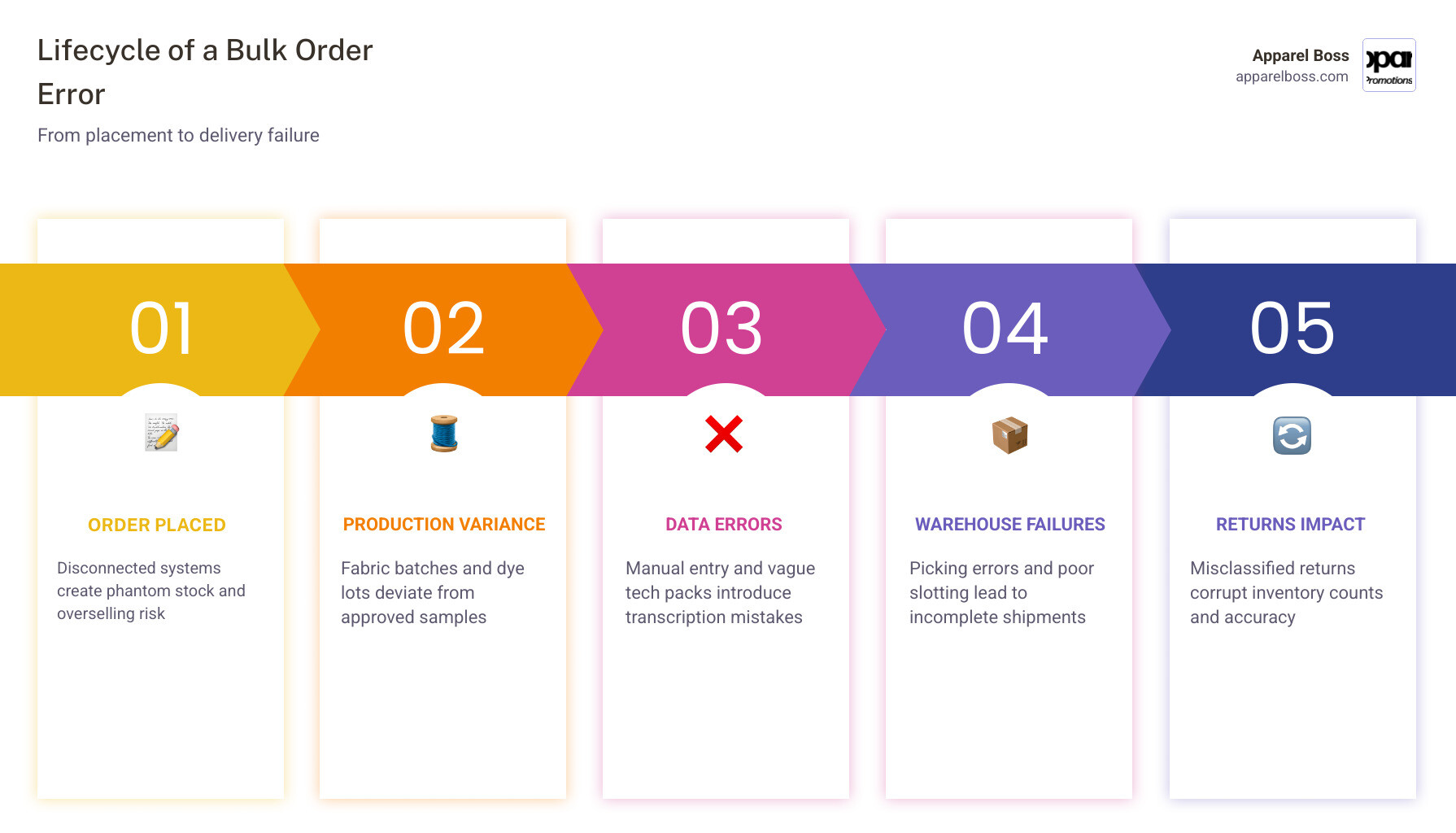
The most common causes of bulk order inconsistencies are:
- Disconnected inventory systems — ERPs and warehouse systems that sync too slowly or not at all, leading to overselling and phantom stock
- Production deviations — fabric batch changes, dye lot weight differences, and manufacturing drift between samples and bulk runs
- Vague documentation — incomplete tech packs, missing specifications, and unclear order intent that leaves room for interpretation
- Manual data entry errors — transcription mistakes and spreadsheet-based workflows that introduce errors at every handoff
- Warehouse execution failures — picking errors, poor slotting, and box configuration logic that doesn't reconcile against actual order lines
- Poor returns handling — re-shelved or misclassified returns that corrupt inventory counts
- Communication breakdowns — unclear briefs between buyers, vendors, and fulfillment teams that compound at volume
These aren't isolated mistakes. They're systemic — and they get worse as your order volume scales.
The business impact is real. The average inventory accuracy rate sits at just 83%, according to 2024 data, with 95% considered top-notch. That gap between where most companies operate and where they need to be translates directly into wrong shipments, employee complaints, and damaged brand credibility.
For teams managing branded apparel programs — onboarding kits, company stores, uniform rollouts — even a small error rate across hundreds of orders creates a serious reputation problem internally and externally.
I'm Salvatore Vento, Marketing Director at Apparel Boss, and over the years I've worked directly with marketing, HR, and operations leaders to identify and eliminate exactly what causes bulk order inconsistencies in corporate merchandise programs. Below, I'll walk through every major cause — and what you can do about each one.
What Causes Bulk Order Inconsistencies in Corporate Merchandising?

When you order a single custom shirt, the process is simple. But when you scale that up to a bulk order of 500 embroidered jackets, 1,000 screen-printed tees, and custom-kitted onboarding packages for your New York offices, the room for error multiplies exponentially.
In my experience running high-volume programs across Long Island and Nassau County, bulk order inconsistencies generally fall into two categories: technical system gaps and physical production deviations.
Technical Gaps: What Causes Bulk Order Inconsistencies in Multi-Channel Systems
Many businesses assume their order errors are simply human mistakes made by a tired warehouse worker. In reality, the breakdown often happens long before anyone touches a box.
When you add multiple channels—such as an internal employee store, an HR onboarding portal, and direct bulk orders—your systems must coordinate in real time. If your Enterprise Resource Planning (ERP) software, Order Management System (OMS), and Warehouse Management System (WMS) are not perfectly integrated, you run into severe coordination failures.
According to research on 7 Causes of Wholesale Order Errors From Inventory Gaps, slow synchronization and disconnected systems are primary culprits. A delay in API syncing means your storefront might show 50 medium-sized polo shirts available when, in reality, those units were already committed to a different department's order an hour ago.
This lack of real-time visibility leads to overselling, backorders, and split-shipments. To understand the root of these tracking failures, you can read A Practical Guide To Inventory Tracking Failure Cause to see how easily inventory data drifts over time.
Furthermore, as discussed in Multi-channel Order Breakage: Why Retailer Orders Fail at Scale, standard integrations often confirm orders before verifying physical feasibility on the warehouse floor. This creates premature promises. When the physical inventory isn't there, you get incomplete shipments, leading to frustrated teams asking, "Is Your Merch Missing: How To Handle Shipping Delays And Store Issues?"
Production Deviations: What Causes Bulk Order Inconsistencies in Apparel Manufacturing
On the physical side of manufacturing, apparel is inherently complex because fabric is a natural, dynamic material. Why does the bulk shipment of hoodies feel slightly thinner or fit differently than the perfect pre-production sample you approved?
Fabric weight—measured in Grams per Square Meter (GSM)—is highly sensitive to environmental factors. For instance, cotton absorbs moisture from the air and can hold up to 8.5% of its weight in water. This means the exact same roll of fabric can read 195 GSM in a humid manufacturing facility and drop to 185 GSM when stored in a dry Suffolk County warehouse.
Additionally, chemical and physical treatments during production alter fabric weight:
- Scouring reduces fabric weight by 4% to 8%.
- Bleaching reduces it even further.
- Enzyme washing can strip away an additional 5% to 10% of the GSM depending on the cycle time and chemical concentration.
Even a tiny measurement mistake during testing has massive consequences. A mere 0.1-gram error on a tiny 100cm² sample translates to a 10 GSM error in the final reading—the difference between a premium, in-spec garment and an out-of-spec, cheap-feeling product.
When you add craftsmanship deviations like stitching tension drift, embroidery machine speed variations, and dye lot weight differences (darker dyes like black add more physical weight to the fibers than white or light grey dyes), you realize why bulk production requires expert, rigorous oversight.
To dive deeper into these manufacturing variables, check out Why Do Clothing Bulk Orders Differ From Samples? Causes & Fixes for Fashion Brands and learn The Real Reasons Your Apparel Sizing Is So Inconsistent.
The Operational Cost of Inventory Discrepancies and System Lag

When your physical stock does not match your digital records, your business loses time and money. The average inventory accuracy rate for businesses is a surprising 83%. While 90% is a realistic aspirational benchmark, top-tier operations aim for 95% or higher.
Operating at an 83% accuracy rate means nearly one out of every five orders faces potential issues, resulting in wasted capital, excess dead stock, and administrative headaches. You can discover how to stop this drain on resources by reading Stop Throwing Money Away By Solving Your Inventory Waste Issues.
Disconnected ERPs and Slow Syncing
When systems rely on legacy batch-based updates (updating inventory once a night rather than in real time), you operate on historical data. If your HR department launches an onboarding campaign in the morning, and your sales team places a bulk client gift order in the afternoon, both departments may pull from the same digital inventory pool.
Without real-time "Available-to-Promise" (ATP) calculations—which subtract pending, un-shipped orders from your physical count—you will inevitably promise the same physical items to two different groups.
The Pick-Pack Confirmation Gap
Another common operational failure is what logistics experts call the "pick-pack confirmation gap." This occurs when your WMS confirms that all items on an order were successfully "picked" from the shelves, yet the recipient still receives an incomplete package.
How does this happen? In many standard warehouses, box configuration rules are weight-based or unit-count-based rather than tied to actual line composition. If a packer consolidates items or closes a box early because of physical space limitations, the system may register the shipment as "complete" simply because the box was closed and labeled.
The system marks the order fulfilled, but your employee opens a box with missing pieces. To learn how to close this gap, read The Pick-Pack Confirmation Gap: Why Multi-Item Shipments Arrive Incomplete. This breakdown is also a primary reason behind Slow Bag Fulfillment And Shirt Production Stalls Explained.
Communication Breakdowns and Vague Documentation
A large portion of bulk order errors stem from a simple lack of clear, structured communication. When specifications are passed back and forth via messy email chains and manual spreadsheets, critical details get lost in translation.
| Feature / Process | Manual Spreadsheet Ordering | Automated Managed Company Store |
|---|---|---|
| Data Entry | Manual transcription (high error risk) | Direct employee input (validated at source) |
| Inventory Visibility | Static, outdated sheet counts | Real-time, live stock levels |
| Approval Workflows | Manual email follow-ups | Automated HR/Manager routing |
| Sizing Accuracy | Self-reported guesswork | Integrated size guides & history |
| Order Tracking | Fragmented carrier links | Centralized dashboard tracking |
Incomplete Tech Packs and Specification Drift
In custom apparel and embroidery, a "Tech Pack" is your blueprint. If your tech pack is vague, the factory is forced to make assumptions.
For example, if you do not specify the exact embroidery stitch count, backing material, thread brand, or precise Pantone color codes, the production line will use standard default settings.
Furthermore, if the factory over-corrects fabric tension at the stenter finishing stage to meet a specific weight target, the garments may look perfect upon arrival but shrink drastically after their first wash.
To prevent this drift, every detail must be locked down in writing before production begins, avoiding the issues detailed in Why Your Custom Shirt Order Is Stuck In Production Limbo.
Manual Data Entry and Order Intent Mismatch
Relying on manual data entry to transfer order information from a purchase order into a manufacturing system is highly risky. A single typo—such as entering "100" instead of "10" for a size XL, or mistyping a shipping address—can derail an entire shipment.
Standard EDI (Electronic Data Interchange) systems often process data perfectly but fail to validate "order intent." They do exactly what they are programmed to do, even if the input data is clearly flawed.
Implementing structured validation processes, as outlined in Fixing common mistakes to reduce order errors in wholesale sales, is essential to ensure your digital orders match your physical expectations.
Warehouse Execution: Picking, Packing, and Quality Control Failures
Even with perfect data and flawless manufacturing, the final stretch of fulfillment is where many bulk orders fail. As order volume scales, warehouse teams face immense pressure to move quickly, which frequently leads to operational drift.
Slotting Errors and Location Drift
In a busy warehouse, "slotting" refers to where specific products are stored. If similar SKUs (such as black t-shirts in sizes Medium and Large, or nearly identical embroidered hats) are placed in adjacent bins without clear visual separation, pickers will eventually grab the wrong items.
If inventory moves are not scanned and recorded immediately, "location drift" occurs. The system believes the inventory is in Bin A, but it has actually been moved to Bin B, leading to delayed shipments and false stockouts.
For a deeper dive into reducing these errors, watch How to Prevent Order Picking Errors in Your Warehouse - YouTube.
Poor Returns Handling and Reverse Logistics
When items are returned, they must be meticulously inspected before being placed back on the shelf. If a returned item with a minor print defect or the wrong size label is sloppily re-shelved without proper quality control, it will simply be shipped out to another customer, repeating the error cycle.
Establishing strict reverse logistics protocols is critical to maintaining a clean inventory pool. For step-by-step guidance on setting up these controls, refer to The Ultimate Guide To Quality Control Fixing Hats And Apparel.
Strategic Solutions: How to Prevent Bulk Order Inconsistencies
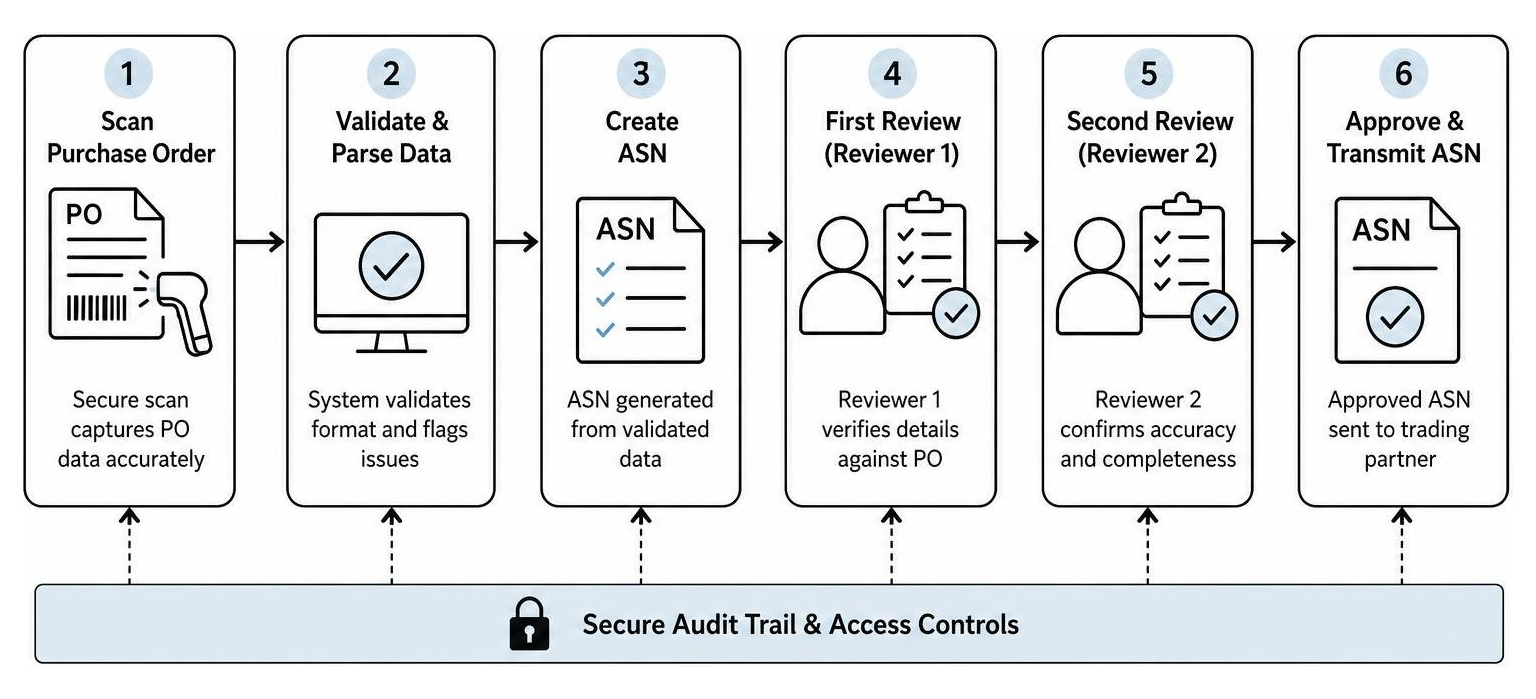
Now that we have identified what causes bulk order inconsistencies, let's focus on the solutions. You do not have to accept an 83% accuracy rate as the cost of doing business. By implementing modern processes and technology, you can protect your brand standards and streamline your operations.
Implementing Standard Operating Procedures (SOPs) and Dual-Review Verification
To eliminate human error, you must establish clear, repeatable standard operating procedures (SOPs).
- Pre-Production Gold Samples: Always require a physical "gold sample" produced on the actual machinery that will run the bulk order. Never rely solely on digital mockups.
- Mid-Production Quality Checks: Arrange for quality control inspections when 20% to 30% of the production run is complete. This allows you to catch embroidery tension issues, color drift, or sizing errors before the entire batch is finished.
- Scan-to-ASN Workflows: Implement scan-to-ASN (Advance Ship Notice) protocols. By scanning barcodes at the packing station to automatically generate the shipping manifest, you eliminate manual checklist errors. To understand the technical value of this process, read ASN & Amazon Vendor Shortage Claims - FLEX. Fulfillment.
To avoid common production delays, you can also review Inside The Factory: 5 Common Causes Of Production Delays And How To Avoid Them.
Transitioning to Managed Company Stores and Custom Kitting
The most effective way to eliminate bulk order inconsistencies is to remove manual coordination entirely. Instead of collecting sizes on spreadsheets and guessing your inventory needs, you can transition to a managed online company store program.
With a custom company store, your employees or department managers log in and select their own pre-approved gear. Sizing tools ensure they order the correct fit, and automated approval workflows keep spending aligned with your corporate budget.
At Apparel Boss, we combine these personalized stores with our premium custom kitting services. We handle the decoration, assembly, and white-glove distribution directly from our New York-based facilities, ensuring every package arrives on time and in perfect condition.
Frequently Asked Questions about Bulk Order Inconsistencies
What is an acceptable inventory accuracy rate for corporate merchandise?
While the average business operates at an 83% accuracy rate, this level of error is highly disruptive for corporate programs. A realistic target is 90%, but premium programs should demand 95% or higher to prevent costly shipping errors and stockouts.
Why do bulk apparel orders differ from the pre-production samples?
Samples are often made by hand by master sample makers in a controlled environment. Bulk orders are run on high-speed assembly lines where machine tension drift, fabric batch variations, and dye lot weight differences (such as dark dyes adding more physical weight than light dyes) can introduce minor variances.
How does the pick-pack confirmation gap lead to incomplete shipments?
This occurs when a warehouse system confirms all items were picked, but the packing station lacks line-level reconciliation. If items are split across multiple boxes or left behind due to weight-based packing rules, the system may mark the order complete even though the recipient received an incomplete package.
Conclusion
Managing a corporate merchandise program shouldn't feel like a constant battle against shipping errors and production defects. When you partner with Apparel Boss, you gain access to a dedicated team that prioritizes quality and consistency at scale.
Led by industry expert Salvatore Vento, we provide a premium, personal alternative to transactional swag sites. From our state-of-the-art decoration and fulfillment facilities in Deer Park, NY, we design, manage, and distribute premium custom apparel and custom kitted gifts that reflect the true prestige of your brand.
Ready to eliminate order errors and elevate your corporate merchandise program? Discover how Apparel Boss company stores eliminate bulk order inconsistencies and streamline your operations today.