Why Delay Reasons Production Apparel Programs Can't Ignore in 2026
The delay reasons production apparel teams face most often are:
- Fragmented supply chains - design, sourcing, manufacturing, and shipping handled by separate parties with poor coordination
- Incomplete tech packs - missing measurements, print placement, or spec details that force costly sampling redos
- Material sourcing bottlenecks - custom fabric development adding 2-4 weeks for dye testing and lab dip approvals
- High minimum order quantities (MOQs) - forcing brands to wait for large production runs before anything ships
- Factory overcapacity - production slots lost to seasonal peaks, holidays like Chinese New Year, or workforce shortages
- Poor communication and lack of digital tracking - manual follow-ups via email and calls that let problems grow undetected
- Last-minute design changes - small spec tweaks after sample approval that cascade into major timeline setbacks
You approved the sample. You confirmed the order. And now? Nothing. Your branded shirts are sitting somewhere in a production queue while your onboarding date, company event, or product launch creeps closer.
This is production limbo - and it costs businesses far more than frustration.
Out-of-stock items alone cost brands and retailers over $634 billion in annual revenue. Inaccurate inventory tied to production delays pushes that figure past $1.1 trillion per year. And when a delay becomes public, companies see shareholder value drop by an average of 12%.
For HR leaders managing onboarding kits, operations teams coordinating branded gear, and marketing managers planning campaign merchandise, a stuck order isn't just an inconvenience. It's a business problem with real financial consequences.
The good news: most of these delays are predictable and preventable with the right systems in place.
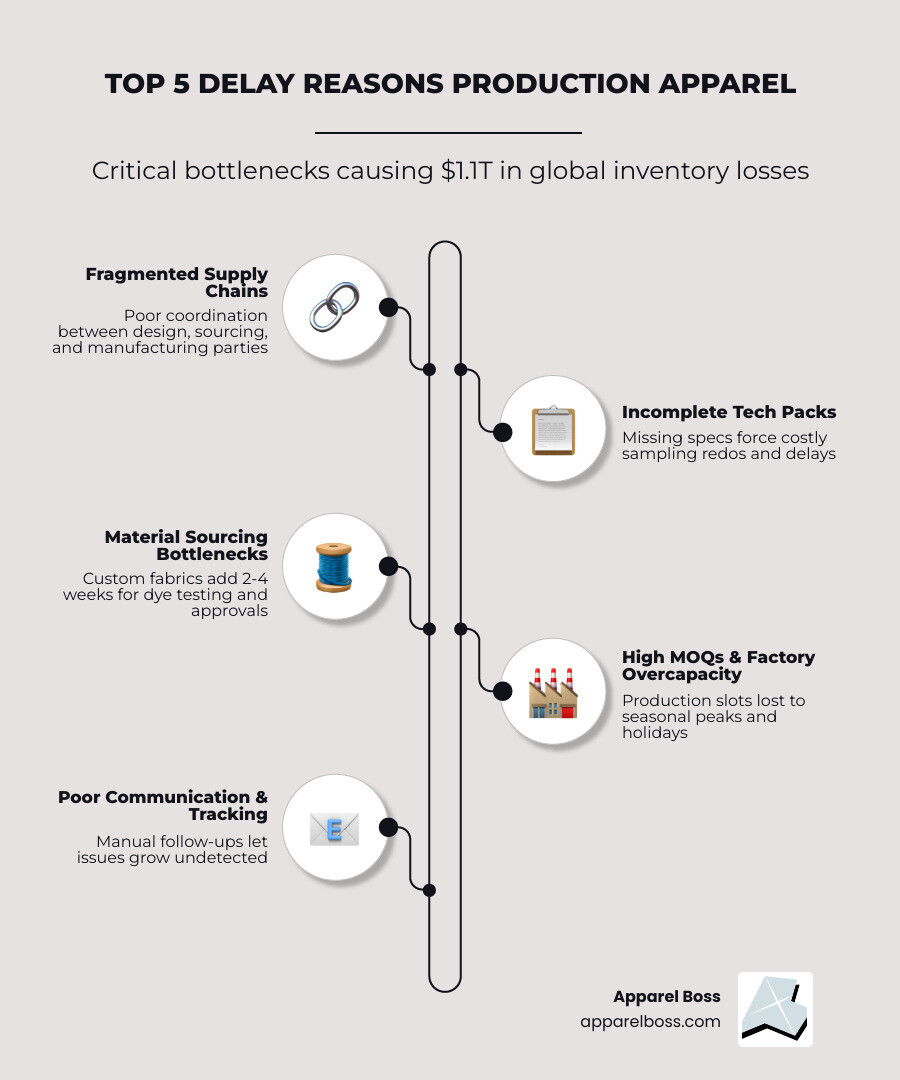
Critical Delay Reasons Production Apparel Brands Face in 2026
In April 2026, the global apparel market moves faster than ever. Yet, many organizations still rely on manufacturing frameworks built for the previous decade. When production stalls, the financial ripple effect is massive. Beyond the $1.1 trillion lost to inventory inaccuracies, research shows that data disconnects—the simple inability to see where an order is in real-time—cost retailers $223 billion annually.
For a mid-sized company, these aren't just abstract numbers. A study of 7,000 companies found that over half experienced a significant drop in trust due to delivery delays, leading to an average revenue loss of $25.7 million per company. When you can't deliver the shirts promised for a New York-based corporate retreat, you aren't just missing a deadline; you're eroding brand equity.
Furthermore, when production runs behind, teams often resort to "panic shipping." Air freight for rushed shipments can cost 3 to 5 times more than sea freight, instantly evaporating your project's profit margin. Understanding the garment production delays: 7 costly truths apparel brands can’t ignore is the first step toward reclaiming your timeline.
Fragmented Supply Chains and Incomplete Tech Packs
The most common delay reasons production apparel projects face start long before a sewing machine ever turns on. Many businesses suffer from fragmented supply chains where the designer is in one city, the fabric is sourced from another, and the factory is halfway across the world. This lack of coordination creates a "relay race" where the baton is dropped at every handoff.
A major culprit is the incomplete tech pack. Think of a tech pack as the blueprint for your garment. If it’s missing precise measurements, print placement details, or specific trim requirements, the factory has to guess. When the factory guesses, they usually guess wrong, leading to multiple sampling rounds and revisions. Each extra sample can add 2 to 4 weeks to your timeline.
Manual tracking via emails and spreadsheets only worsens the problem. Without a centralized system, specification changes made during a phone call might never reach the production floor. This is why slow bag fulfillment and shirt production stalls explained often point back to "paper-trail" communication that fails to scale with modern business demands.
Material Sourcing and Custom Fabric Bottlenecks
Even with a perfect tech pack, your order is only as fast as its slowest component. Raw material sourcing is a notorious bottleneck. If your brand requires a specific custom-dyed fabric, you must account for:
- Yarn sourcing: Finding the base material.
- Lab dips: Creating and approving color swatches (which can take several rounds).
- Dye testing: Ensuring the color holds and doesn't bleed.
Trims—the zippers, buttons, and labels—are often an afterthought but can halt an entire production line. If a specific zipper color is out of stock, the factory cannot finish the garments. Experts at AJG Fashion Consulting note that sourcing custom materials frequently adds a 2–4 week buffer to production. If quality control fails during the fabric inspection stage—perhaps the fabric twists after washing or the shade is inconsistent—the entire batch must be replaced, resetting your timeline to zero.
How High MOQs and Factory Overcapacity Cause Delay Reasons Production Apparel
Traditional manufacturing is built on volume. High Minimum Order Quantities (MOQs) mean your order might sit in a queue until the factory has enough volume to justify turning on the machines. If you only need 200 shirts for a Suffolk County regional meeting but the factory's MOQ is 1,000, you are at the mercy of their scheduling.
Factory overcapacity is another silent killer of deadlines. During seasonal peaks or leading up to major holidays like Chinese New Year (which can shut down production for weeks), factories often overbook their lines. If a larger "whale" client submits a rush order, smaller corporate orders are often pushed to the back.
Internal factory issues also play a role:
- Workforce shortages: Labor availability fluctuates due to local holidays or health-related absences.
- Equipment breakdowns: A single broken cutting machine can stop the entire flow.
- Unskilled labor: High turnover leads to errors that require time-consuming rework.
Operational Strategies to Eliminate Production Limbo
To stop the cycle of delays, businesses must move away from "hope-based" management and toward structured, systemic control. This involves mapping your entire supply chain to identify weak points and centralizing production to reduce the number of handoffs.
By implementing fast fulfillment branded gear, companies can bypass many of the traditional hurdles. The goal is lead time reduction through better planning and smarter partner selection.
Transitioning to On-Demand and Centralized Manufacturing
The most effective way to solve delay reasons production apparel programs face is to centralize the process. Traditional manufacturing is dispersed; on-demand manufacturing brings design, sourcing, and production under one roof.
Automation in the cutting room is a game-changer. Manual cutting is slow and prone to errors that waste fabric and time. Modern precision cutting technology allows for greater accuracy and handles large volumes without the "snowball effect" of delays that manual processes create.
| Feature | Traditional Manufacturing | On-Demand Centralized |
|---|---|---|
| Lead Time | 3–6 Months | 2–4 Weeks |
| MOQ | High (500+ units) | Low or No MOQ |
| Inventory Risk | High (Wasted Stock) | Low (Made to Order) |
| Tracking | Manual/Email | Digital/Real-Time |
| Accuracy | Prone to human error | High-precision automation |
Centralized production also improves inventory accuracy. When you produce only what you need, you avoid the $634 billion trap of overstocking or being out-of-stock.
Solving Delay Reasons Production Apparel with Digital Tracking and Company Stores
If you can't see it, you can't manage it. Data disconnects are a primary cause of production limbo. Digital tracking tools provide a "single source of truth" for every order. Cloud-based transparency allows HR and operations managers to see exactly where their garments are—from the cutting table to final inspection.
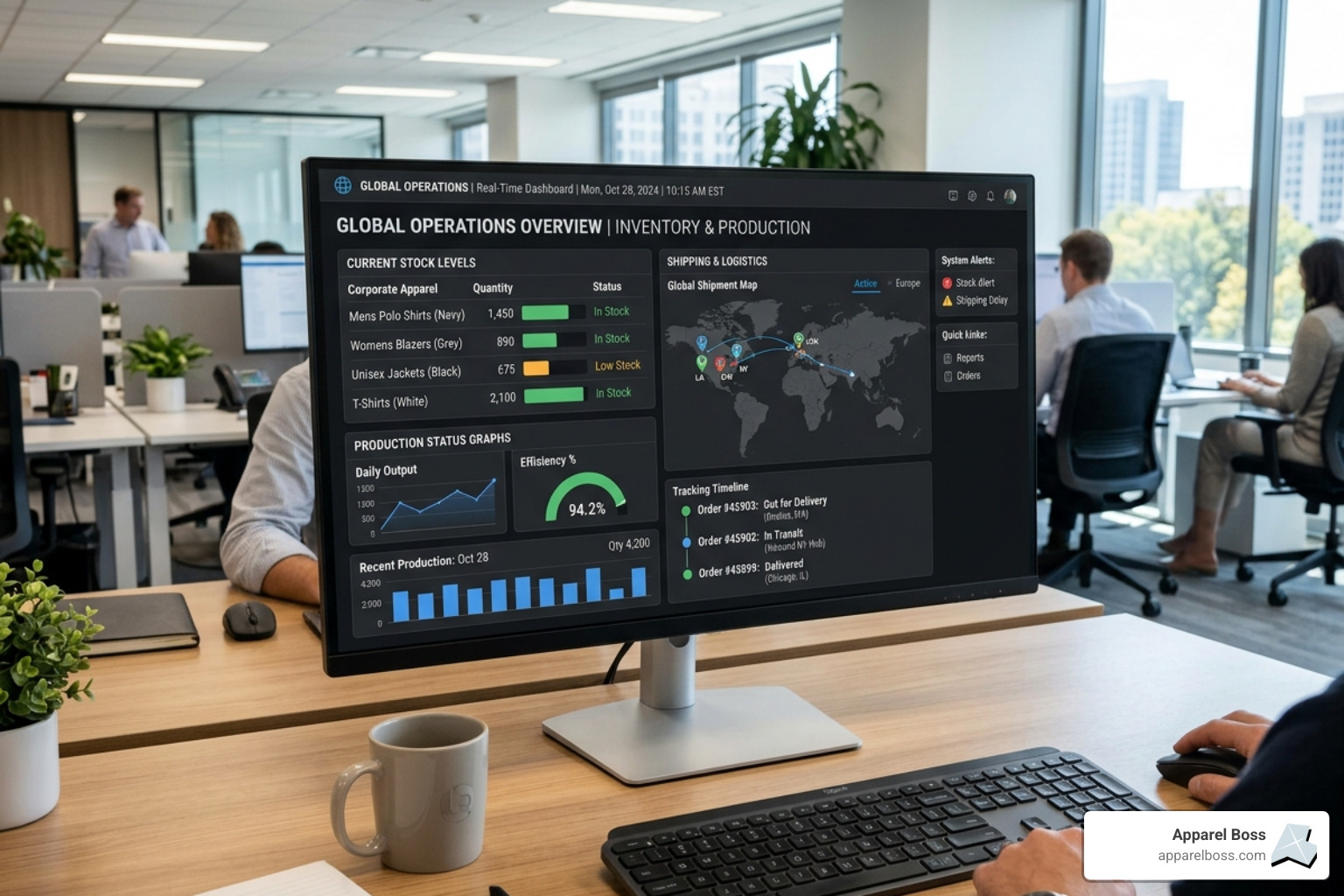
This is where online company stores become a strategic asset. Instead of managing a chaotic spreadsheet of sizes and styles for a Nassau County office, an online store centralizes the data. It automates the ordering process, ensures brand consistency, and provides the "real-time" visibility needed to prevent delays.
When you use the expert way to handle B2B company store setup, you eliminate the administrative friction that typically leads to communication gaps. The system knows the inventory, the production capacity, and the shipping timeline, removing the guesswork for your team.
Building Buffer Time and Dual Sourcing for Resilience
Even the best systems need a safety net. Smart operations leaders build "buffer time" into their launch calendars—typically 2 to 3 weeks—to account for unforeseen shipping volatility or customs delays at New York ports.
Dual sourcing is another critical strategy. Relying on a single factory is a high-risk move. If that factory experiences a breakdown or a regional shutdown, your entire program stalls. By splitting production between two vetted partners or maintaining a "backup" supplier, you create a resilient supply chain.
Using a standardized Time and Action (T&A) calendar helps all parties stay aligned. This calendar should include "freeze dates" where design changes are no longer permitted. As outlined in our guide on overcoming supply chain challenges for custom merch, proactive planning is the only way to beat the "compound risk" of modern manufacturing.
Stop Managing Delays and Start Managing Systems
Production limbo doesn't have to be the "cost of doing business." Most delay reasons production apparel programs struggle with are simply symptoms of a fragmented, outdated process. By centralizing your production, embracing digital tracking, and utilizing online company stores, you can transform your merchandise program from a source of stress into a streamlined operational success.
At Apparel Boss, we specialize in helping businesses in Long Island, New York City, and beyond move away from the chaos of traditional apparel manufacturing. We focus on building structured systems—like custom kitting and company stores—that ensure your team gets what they need, exactly when they need it.
Ready to see how a systematic approach can fix your production delays? Discover how our services can bring transparency and efficiency back to your corporate merchandise program.
Why Your Custom Shirt Order Is Stuck in Production Limbo