Why Inventory Waste Plagues Companies — And What It's Really Costing You
Why inventory waste plagues companies comes down to a handful of compounding problems that most organizations don't catch until serious damage is done:
- Overproduction — ordering or producing more than demand requires
- Poor demand forecasting — relying on outdated data or gut instinct
- Manual tracking — spreadsheets and human error create invisible gaps
- Lack of supply chain visibility — only 6% of companies have full visibility into their supply chain
- Siloed decision-making — purchasing, warehousing, and finance teams working from different data
- Shrinkage — inventory that disappears through damage, theft, or miscounts
The result? Capital locked in stock that isn't moving, storage costs that quietly compound, and customers who don't get what they need when they need it.
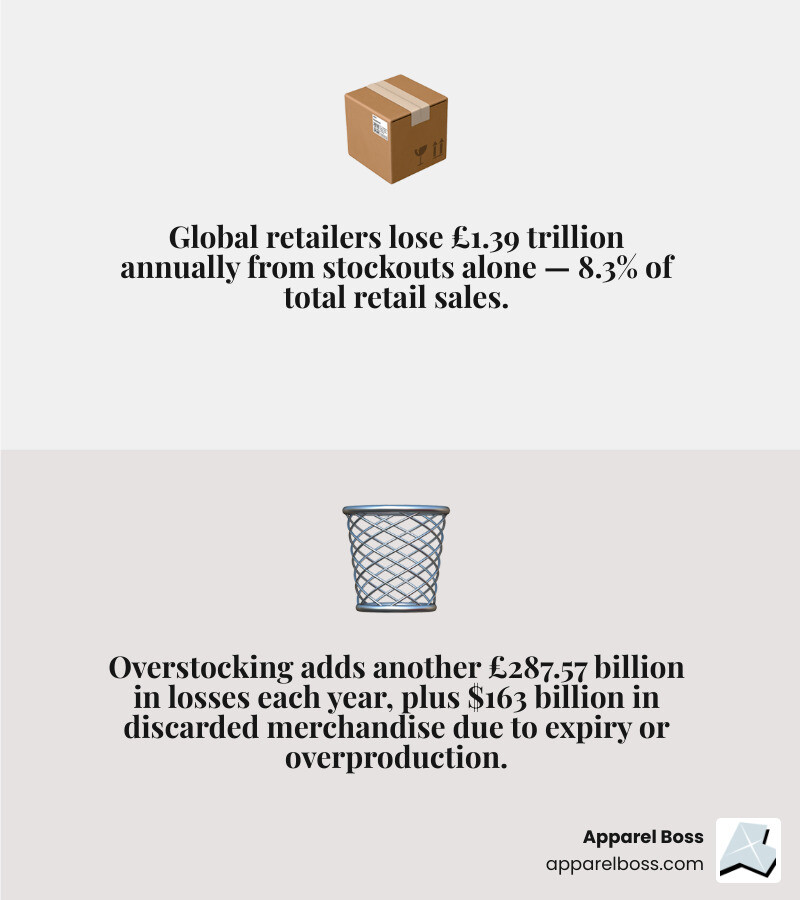
This is not a small problem. Global retailers lose an estimated £1.39 trillion annually from stockouts alone — roughly 8.3% of total retail sales. Overstocking adds another £287.57 billion in losses each year. And around $163 billion worth of merchandise is discarded annually due to expiry or overproduction.
For companies managing corporate merchandise programs — branded apparel, onboarding kits, and custom gear — inventory waste hits differently. Unlike retail, there's no clearance rack. Overstocked branded items with last year's logo or an outgoing employee's name become immediate write-offs. Understocked items delay new hire onboarding, stall marketing campaigns, and erode the professional image your brand depends on.
The waste isn't always visible on a balance sheet. But it shows up everywhere else — in fulfillment delays, in budget overruns, in frustrated operations teams, and in employees who never received their welcome kit.
Understanding Why Inventory Waste Plagues Companies Today
In Lean methodology, inventory is famously categorized as one of the "TIMWOOD" wastes (Transport, Inventory, Motion, Waiting, Overproduction, Over-processing, and Defects). While some see inventory as a safety net, Lean practitioners see it as a "muda"—a non-value-adding activity that consumes space and capital.
Why inventory waste plagues companies in 2026 is often due to the "Just-in-Case" mindset. After the supply chain shocks of the early 2020s, many businesses overcorrected. They traded efficiency for a false sense of security, leading to massive overproduction and eventually, obsolescence. When you hold excess inventory, you aren't just losing the cost of the goods; you are paying carrying costs that can reach up to 41% of a product's value. This includes warehouse rent, insurance, and the labor required to move dusty boxes that should have been sold months ago.
Furthermore, a lack of supply chain visibility means many companies are flying blind. Without real-time data, it is impossible to know if the 500 branded jackets in your Long Island warehouse are actually needed, or if they are simply taking up space while your New York City office faces a shortage.
The Silent Impact of Overstock and Shrinkage
Inventory waste isn't always a single catastrophic event; it’s often a slow bleed. Shrinkage—the loss of inventory due to theft, damage, or administrative errors—is a primary culprit. In 2026, many companies still struggle with "phantom inventory," where the digital records show stock that simply isn't there physically.
According to research on billions wasted from excess inventory and shrinkage, even an 8% inventory loss can translate to $400,000 annually for a medium-sized business. Beyond the direct financial hit, there is product degradation. Fabrics can yellow, adhesives can fail, and branding can become obsolete. If you are holding merchandise for years, the brand reputation risk of distributing "stale" or outdated gear can be just as damaging as the storage fees themselves.
Why inventory waste plagues companies with manual processes
Despite the availability of advanced tools, 43% of small businesses still track inventory manually or don’t track it at all. Relying on spreadsheets is a recipe for disaster. Human error in data entry, siloed information where the HR department doesn't talk to the warehouse, and the sheer time spent "finding things" create massive inefficiencies.
When you stop the swag chaos with professional online company stores, you replace guesswork with a single source of truth. Manual processes can't account for sudden spikes in demand or seasonal shifts, leading to the very imbalances that drain company bank accounts.
The Financial and Operational Toll of Poor Merchandise Management
The cost of mismanagement is a two-sided coin: the cost of having too much and the cost of having too little.
| Metric | Overstocking Impact | Stockout Impact |
|---|---|---|
| Capital | Tied up in stagnant assets | Lost revenue opportunities |
| Storage | High rent and insurance costs | Inefficient "emergency" shipping |
| Customer Experience | Irrelevant or dated offerings | 91% of consumers won't return |
| Operations | Warehouse clutter and labor waste | Frantic, reactive reordering |
Poor inventory management directly impacts your On-Time, In-Full (OTIF) rates. If your warehouse is a mess of overstocked items, finding the right gear for a new hire takes longer, increasing your total cost-to-serve. When you learn how to budget for corporate merchandise without sacrificing quality, you realize that the "cheapest" unit price often leads to the highest waste if you are forced to buy more than you need.
Identifying the root causes of why inventory waste plagues companies
Most inventory issues stem from a few core failures:
- Inaccurate Forecasting: Relying on last year's numbers without accounting for current growth or market shifts.
- The Bullwhip Effect: Small fluctuations in demand at the employee or customer level cause massive over-ordering at the top of the chain.
- Supplier Delays: Unpredictable lead times force companies to "buffer" with too much safety stock.
- Siloed Decision-Making: Purchasing gear because it's "on sale" without checking if there is actually room in the warehouse or a need in the field.
Addressing these inventory management problems requires moving away from reactive ordering and toward data-driven strategy.
The Hidden Costs of Inefficient Fulfillment
Inefficiency in the warehouse translates to a higher administrative burden. If your team is spending 20% of their time just trying to locate items, you are paying for wasted motion. Furthermore, slow bag fulfillment and shirt production stalls are often symptoms of poor inventory visibility. When production stops because one small component is missing—despite a warehouse full of other goods—the "hidden" cost of that delay includes lost labor time and frustrated stakeholders.
Strategic Frameworks to Eliminate the 8 Wastes of Inventory
To solve these issues, companies must adopt Lean frameworks. This starts with moving toward a "pull-based" system like Just-in-Time (JIT) production. Instead of printing 5,000 shirts and hoping they sell, a pull-based system triggers production based on actual demand.
Implementing ABC analysis is another essential step. This involves categorizing your merchandise:
- A-Items: High-value, high-demand items that require tight control and frequent audits.
- B-Items: Moderate value and demand.
- C-Items: Low-value items that can be managed with less frequent oversight.
By performing SKU rationalization—cutting the items that don't move—you free up space for the gear that actually drives employee engagement and brand value.
Leveraging Technology for Real-Time Visibility
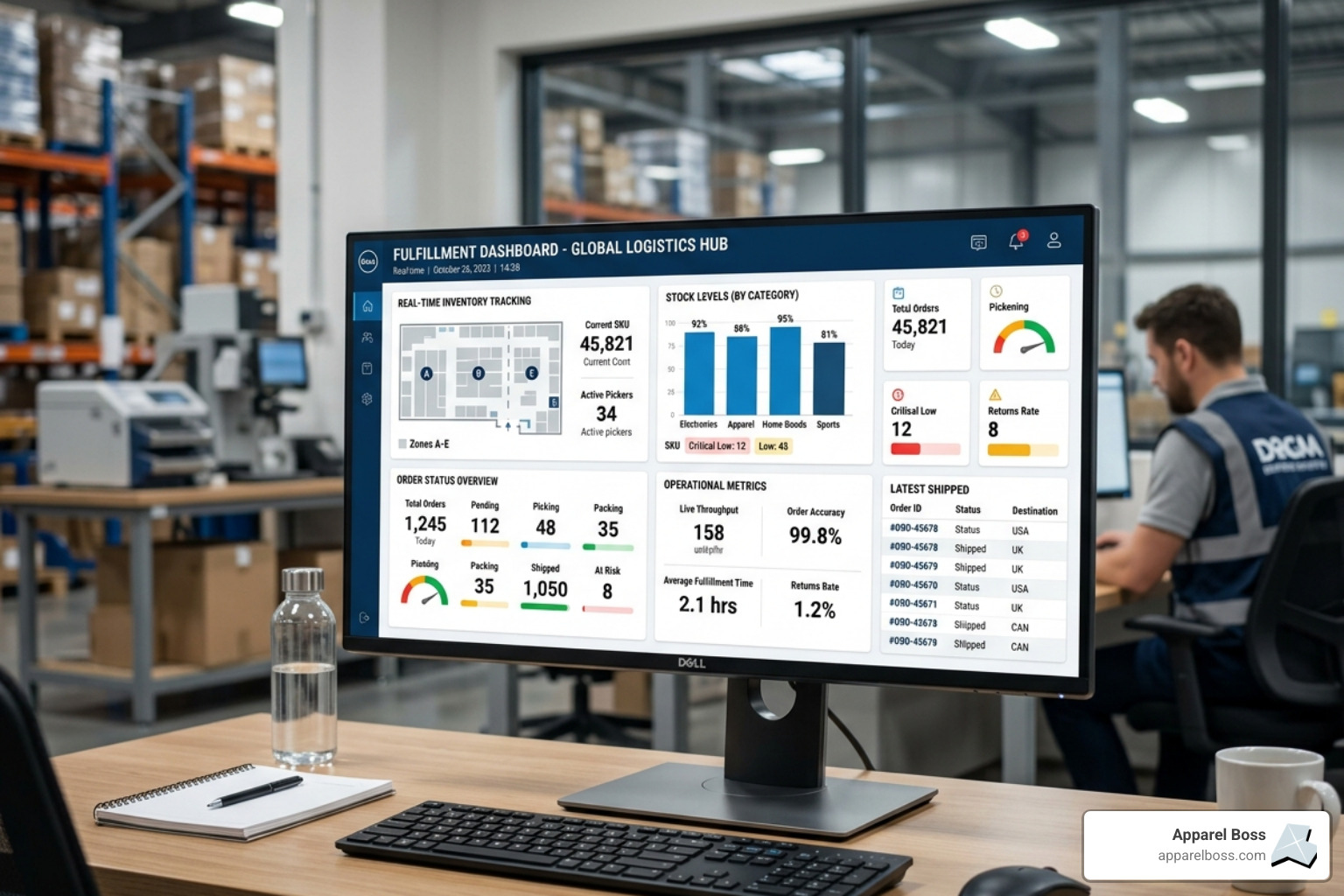
Modern problems require modern solutions. Centralized data platforms allow for dynamic reorder points. Instead of a static "order more when we hit 50 units," AI-driven systems look at sales velocity, lead times, and upcoming events to suggest the perfect reorder moment.
The expert way to handle B2B company store setup involves integrating your inventory with your ordering platform. This ensures that when an HR manager in Suffolk County orders a new hire kit, the inventory is deducted in real-time, and the warehouse in Deer Park is immediately notified for fulfillment.
Why inventory waste plagues companies without structured kitting
Custom kitting—assembling multiple items into a single package—is a major source of waste if not managed correctly. If you pre-assemble 1,000 kits but only hire 200 people, the remaining 800 kits become a liability. The branding might change, or the items inside might expire.
The solution is on-demand assembly. By keeping individual components in stock and only kitting them when an order is placed, you drastically reduce obsolescence risk. This is the core of building a scalable corporate gifting system that doesn't flush your budget down the drain. Using the First-In, First-Out (FIFO) method ensures that older stock is used first, preventing product degradation.
Transitioning to Long-Term Operational Excellence

Achieving operational excellence isn't a one-time fix; it’s a shift in culture. In 2026, this increasingly involves aligning inventory practices with ESG (Environmental, Social, and Governance) objectives. Waste isn't just a financial drain; it's an environmental one. Discarding tons of unused apparel is no longer acceptable to modern consumers or employees.
By adopting sustainable packaging and circular recycling programs, companies can turn their supply chain from a liability into a competitive advantage. Engaging stakeholders across the organization—from the CEO to the warehouse staff—ensures that everyone understands the value of inventory accuracy.
Measuring Success with Key Performance Indicators
You cannot manage what you do not measure. To eliminate why inventory waste plagues companies, you must track specific KPIs:
- Inventory Turnover: How many times your stock is sold and replaced over a period.
- Sell-Through Rate: The percentage of inventory sold vs. the amount received.
- Days Sales of Inventory (DSI): How long it takes to turn inventory into a "sale" (or distribution).
- Shrinkage Rate: The percentage of "lost" items.
Regular accuracy audits and cycle counts should replace the dreaded once-a-year physical inventory. This keeps data clean and actionable.
Scaling Distribution Across Global Teams
For companies with teams across Nassau County, New York City, and beyond, scaling distribution requires a partner who understands global fulfillment. This means offering no-minimum orders to avoid bulk-buy waste and ensuring branding consistency across every location. Real-time tracking and automated replenishment mean that your team can focus on their jobs, not on whether there are enough medium-sized polos in the closet.
Frequently Asked Questions about Inventory Waste
What is the most common cause of inventory waste in B2B merchandise?
The most common cause is over-ordering to meet high Minimum Order Quantities (MOQs). Companies often buy 500 units to get a lower price per piece, only to realize they only needed 100, leaving 400 units to rot in storage.
How do holding costs affect a company's bottom line in 2026?
Holding costs are higher than ever due to record-high warehouse rents and increased labor rates in the New York area. These costs quietly eat into your EBIT (Earnings Before Interest and Taxes) by locking up working capital that could be used for growth.
Can online company stores actually reduce overstock and shrinkage?
Yes. By centralizing the ordering process, online stores provide clear data on what is actually being used. They eliminate "rogue" ordering and provide the visibility needed to set accurate reorder points, which directly reduces both overstock and the "disappearance" of untracked gear.
Conclusion: Achieving Operational Excellence in Merchandise Programs
Why inventory waste plagues companies is a complex problem, but it has a clear solution: structured systems and strategic partnerships. At Apparel Boss, we focus on helping businesses in Deer Park, Long Island, and the greater New York area move away from the "swag chaos" of the past.
By implementing online company stores, custom kitting, and in-house production, we provide the visibility and efficiency needed to scale without the waste. Our goal is to simplify your ordering and distribution so that your brand remains consistent and your budget remains intact.
Stop throwing money away on boxes of unused gear. Streamline your merchandise program with Apparel Boss and turn your inventory into a strategic asset for your business.
Stop Throwing Money Away by Solving Your Inventory Waste Issues