
Why Root Poor Stitching Issues Destroy Brand Consistency — and How to Fix Them
Root poor stitching issues are one of the most common — and costly — quality failures in bulk garment production. They show up as broken stitches, skipped stitches, puckering, open seams, and uneven seam allowances. And in a branded apparel program, even one bad stitch can undermine the professional image your organization works hard to build.
Here's a quick breakdown of the most common root causes:
| Defect | Root Cause Category | Key Trigger |
|---|---|---|
| Broken stitch | Machine/Thread | Poor thread stability, trimming errors |
| Skip stitch | Machine/Needle | Wrong needle size, blunt needle, poor loop formation |
| Puckering | Machine/Cutting | Incorrect SPI, high tension, fabric feeding imbalance |
| Open seam | Operator/Machine | Missing back-tack, insecure seam ends |
| Uneven stitch | Machine/Operator | Inconsistent tension, faulty feed dog, handling error |
| Seam slippage | Material/Machine | Low SPI, wrong thread for fabric type |
These defects don't just cause rework headaches. They drive up production costs, delay fulfillment, and — most critically for growing organizations — they send the wrong message when branded gear arrives looking sloppy.
The good news? Most stitching defects are preventable. They trace back to identifiable, fixable root causes: machine setup, operator handling, material mismatches, or problems that start even before the sewing floor — in cutting or pattern stages.
This guide walks you through exactly how to diagnose, correct, and prevent poor stitching issues in bulk custom apparel production.
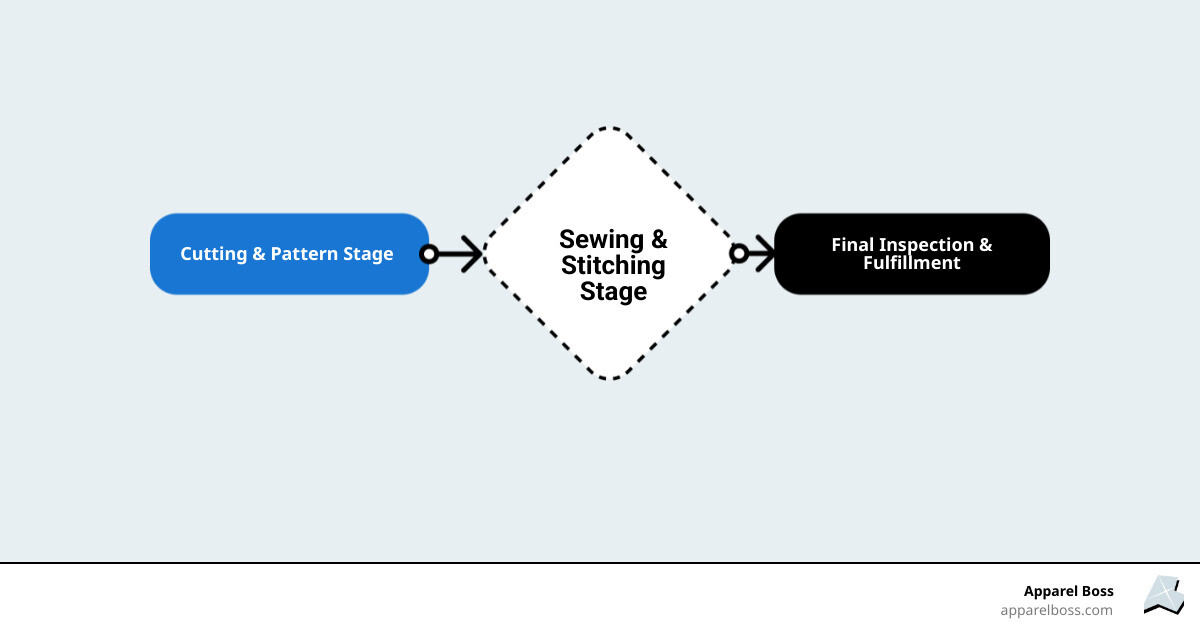
Identifying the Root Poor Stitching Issues in Bulk Production
In the high-stakes world of corporate merchandise, quality isn't just a "nice-to-have"—it is a requirement for brand integrity. When a company orders a thousand polo shirts for a regional conference in April 2026, a 5% defect rate in stitching doesn't just mean 50 ruined shirts; it means 50 frustrated employees and a significant waste of the marketing budget.
Identifying root poor stitching issues early in the production cycle is the only way to minimize these losses. Rework is exponentially more expensive than prevention. If a skip stitch is caught at the machine, it takes seconds to fix. If it’s caught after the garment has been shipped to a satellite office in Suffolk County, the cost includes shipping, administrative time, and a hit to the internal brand reputation.
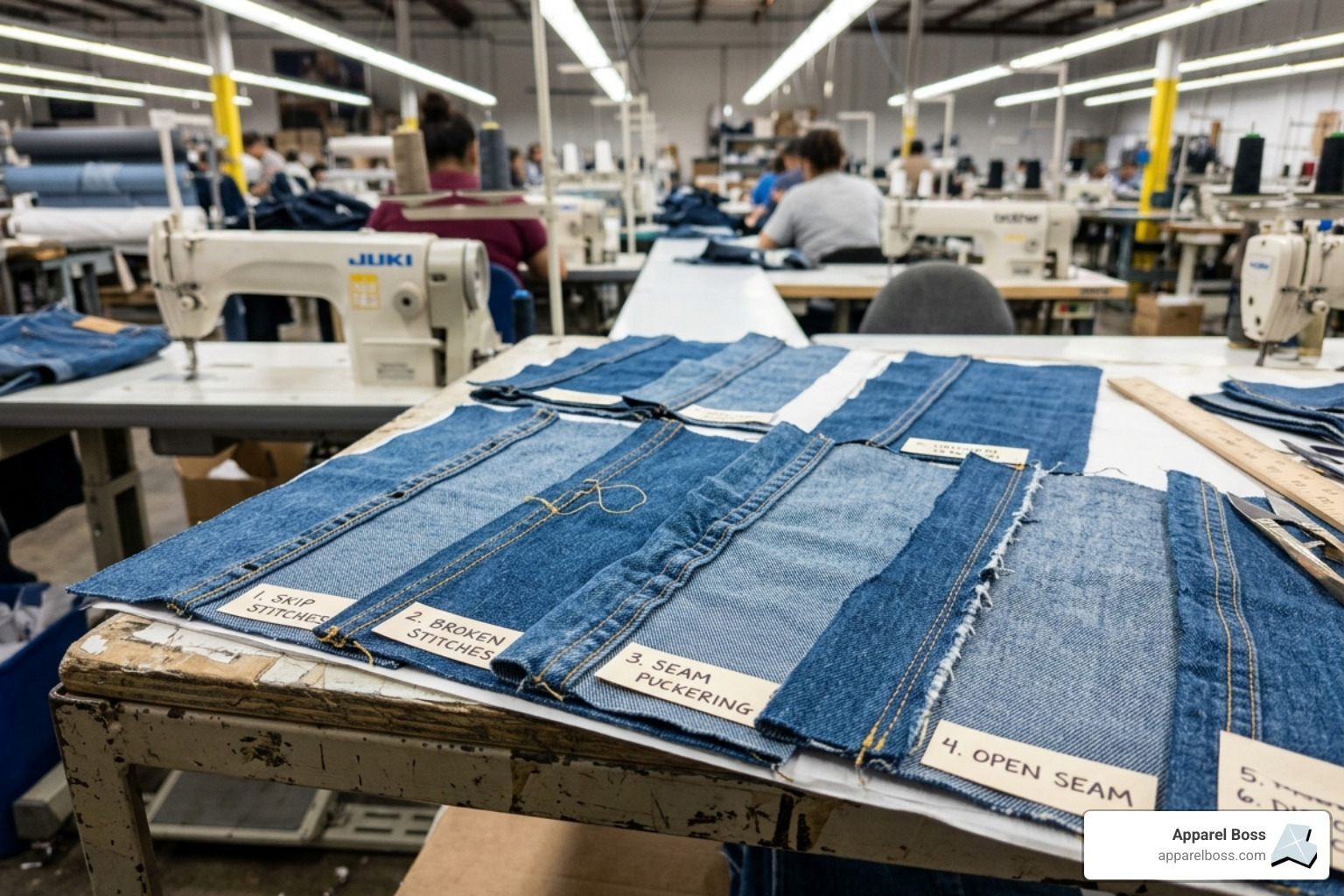
Diagnosing Root Poor Stitching Issues: Sewing vs. Cutting
A challenge for operations managers is determining exactly where a defect originated. Is the seam puckering because the operator pulled the fabric, or was the fabric cut off-grain?
A primary diagnostic tool is checking for symmetry. Because patterns are typically mirrored, an asymmetrical garment—where the left sleeve is tighter than the right—almost always points to a sewing error or Common Mistakes to Avoid When Ordering Custom Merchandise like improper seam allowances. If the sewing looks clean but the garment is out of spec, the issue likely lies in the cutting room.
Marker deviations occur when the blade strays from the printed lines, or when fabric "torques" (twists) because it wasn't rested properly before cutting. To prevent this, factories should include a 10” by 10” scale confirmation square in digital patterns to ensure the printing scale is 100% accurate before the first blade touches the fabric. For businesses managing an online company store, ensuring this level of precision at the manufacturing stage prevents the "size variance" complaints that often plague employee apparel programs.
Mechanical Root Poor Stitching Issues and Tension Imbalance
If you’ve ever flipped over a piece of embroidered headwear only to find a "spaghetti mess" of loops, you’ve witnessed a classic tension imbalance. This is a common mechanical root poor stitching issue.
When the upper thread tension is too loose, loops form on the underside of the fabric. Conversely, if the bobbin tension is too tight, the fabric may pucker. Achieving "stitch harmony" requires the upper and bobbin threads to lock exactly in the center of the fabric. You can Fix Uneven Stitches & Tension Problems for Good by performing a "drop test" on the bobbin case; it should slide down the thread like a slow-motion elevator when bounced.
Machine maintenance is another critical factor. Lint buildup in the tension discs or a slightly bent needle can cause intermittent skipped stitches that are difficult to track. At Apparel Boss, our custom apparel services prioritize equipment calibration to ensure that whether we are producing ten items or ten thousand, the stitch density remains consistent. For more technical troubleshooting, you can learn How to Fix Loose Bottom Stitches: Expert Troubleshooting Guide.
Material and Operator Factors in Stitch Quality
Even the most advanced machine can't compensate for the wrong needle-and-thread combination. Using a sharp needle on a delicate knit fabric will cause "needle holes" or runs, while using a fine needle on heavy denim will lead to frequent breakage.
Operator handling plays a massive role in preventing Causes of Uneven Stitches and How to Fix Them. If an operator pushes or pulls the fabric rather than letting the feed dogs do the work, the result is uneven stitch lengths. Furthermore, the thread itself must possess high heat resistance and proper lubrication to withstand the friction of high-speed industrial sewing. When you How to Choose the Perfect Embroidered Hoodie, you are also choosing the structural integrity of the seams that hold it together.
Scalable Solutions for Maintaining Stitch Integrity
For a business scaling its merchandise program across Long Island or New York City, manually inspecting every single stitch isn't feasible. Instead, organizations must implement scalable quality control systems. This involves tracking Key Performance Indicators (KPIs) like the "Repair Rate" (the percentage of garments requiring rework) and "Seconds Rate" (garments that cannot be fixed).
Implementing Corrective and Preventive Action (CAP/PAP) Plans
A robust QC program relies on two pillars: Corrective Action Plans (CAP) for immediate fixes and Preventive Action Plans (PAP) to stop issues from recurring.
- CAP Example: If a batch of hats shows "thread tails," the immediate action is a manual trimming stage.
- PAP Example: To prevent those tails in the future, the factory might install automatic thread wipers or retrain operators on proper back-tacking (securing the start and end of a seam).
Standard Operating Procedures should include "stress testing" seams after sewing to check for cracked stitches—an indicator that the stitch doesn't have enough elasticity for the fabric. These steps are vital for Tips for Extending the Life of Custom Clothing. Proper custom kits management also ensures that items are inspected before they are bundled and shipped to new hires or clients.
Strategic Merchandise Management with Apparel Boss
Managing root poor stitching issues is just one piece of the puzzle. For CEOs and operations leaders, the real challenge is the administrative burden of managing fragmented apparel orders. Apparel Boss acts as a strategic partner, moving beyond simple production to offer comprehensive merchandise management.
By utilizing an online company store, businesses can ensure that every item ordered—from embroidered jackets in Nassau County to screen-printed tees in Deer Park—meets the same rigorous quality standards. We handle the heavy lifting of fulfillment and inventory management, reducing the risk of wasted stock due to poor quality.
Our systems are designed to provide:
- Consistency: Centralized production means your logo looks identical on every piece.
- Efficiency: Automated ordering through company stores removes the "spreadsheet nightmare" for HR teams.
- Scalability: Whether you're onboarding five employees or five hundred, our custom kitting and distribution services scale with you.
When quality is baked into the process—from the first stitch to the final delivery—your branded merchandise becomes a true asset rather than a logistical headache. To learn more about how we can streamline your program, explore our custom apparel services.
Ready to eliminate the stress of inconsistent merchandise? Apparel Boss helps businesses across New York and Long Island simplify their branded apparel programs through custom kitting and online company stores. Let's build a system that works for your team. Contact us today to explore our solutions.