When Merch Problems Hurt Your Business Operations
Merch problems are one of the most disruptive — and underestimated — operational challenges growing organizations face today.
Quick answers for common merch problems:
- Order not shipped on time — Federal rules require sellers to ship within 30 days unless a timeline was promised. You're entitled to a refund if they can't meet it.
- Wrong or damaged items received — Document everything and contact the supplier immediately. Dispute billing errors with your card issuer within 60 days.
- Unordered products arrived — You are not legally required to pay for or return them.
- Poor quality or mismatched items — This is a quality control failure. Escalate to the vendor and request replacements or a refund.
- Store UX issues (cart errors, sync failures) — These are fulfillment and platform problems that directly reduce order completion rates.
- Inconsistent branding across shipments — A sign of a fragmented procurement process with no centralized oversight.
For growing organizations, these aren't just customer service headaches. They signal deeper gaps in your merchandise program — gaps that waste budget, damage your brand, and create unnecessary work for your operations team.
Think about what happens when a new hire's onboarding kit arrives late, has the wrong logo, or simply never shows up. That's not just a shipping issue. It's a first impression failure.
The same applies to employee recognition programs, client gifting, and branded apparel rollouts. When the backend of your merchandise program is fragile, every order becomes a risk.
The good news? Most merch problems follow predictable patterns — and they have clear, scalable solutions.
Identifying and Resolving Core Merch Problems in B2B Operations
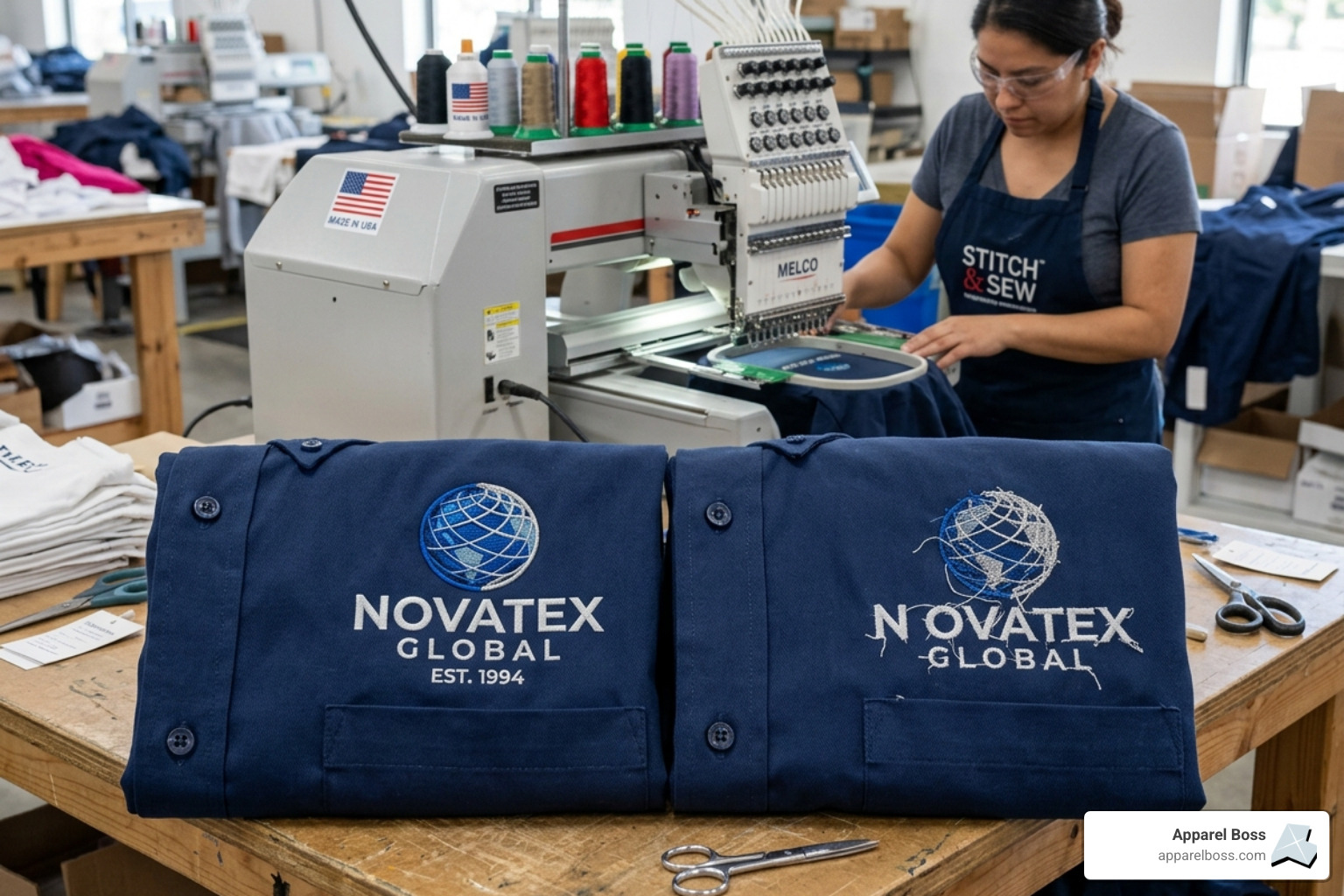
When an operations manager in Suffolk County or a marketing director in Manhattan orders custom apparel, they aren't just buying shirts; they are investing in brand equity. However, the gap between a digital mockup and a physical product is where many Merch Problems take root.
Inconsistent branding is a primary operational pain point. This occurs when a company uses multiple vendors for different regions or departments. A logo embroidered in a Deer Park facility might look slightly different than one printed elsewhere, leading to a fragmented brand identity. According to the Issues With Merchandising - Management Study Guide, these inconsistencies often stem from a lack of centralized procurement and poor vendor communication.
Inventory waste is another silent budget killer. Businesses often over-order to avoid stockouts, only to have "garage-fulls" of unsold or un-gifted tees that eventually become obsolete. This mismanagement of resources often happens because the business lacks real-time data on what employees actually want or need.
Navigating Shipping Delays and Fulfillment Merch Problems
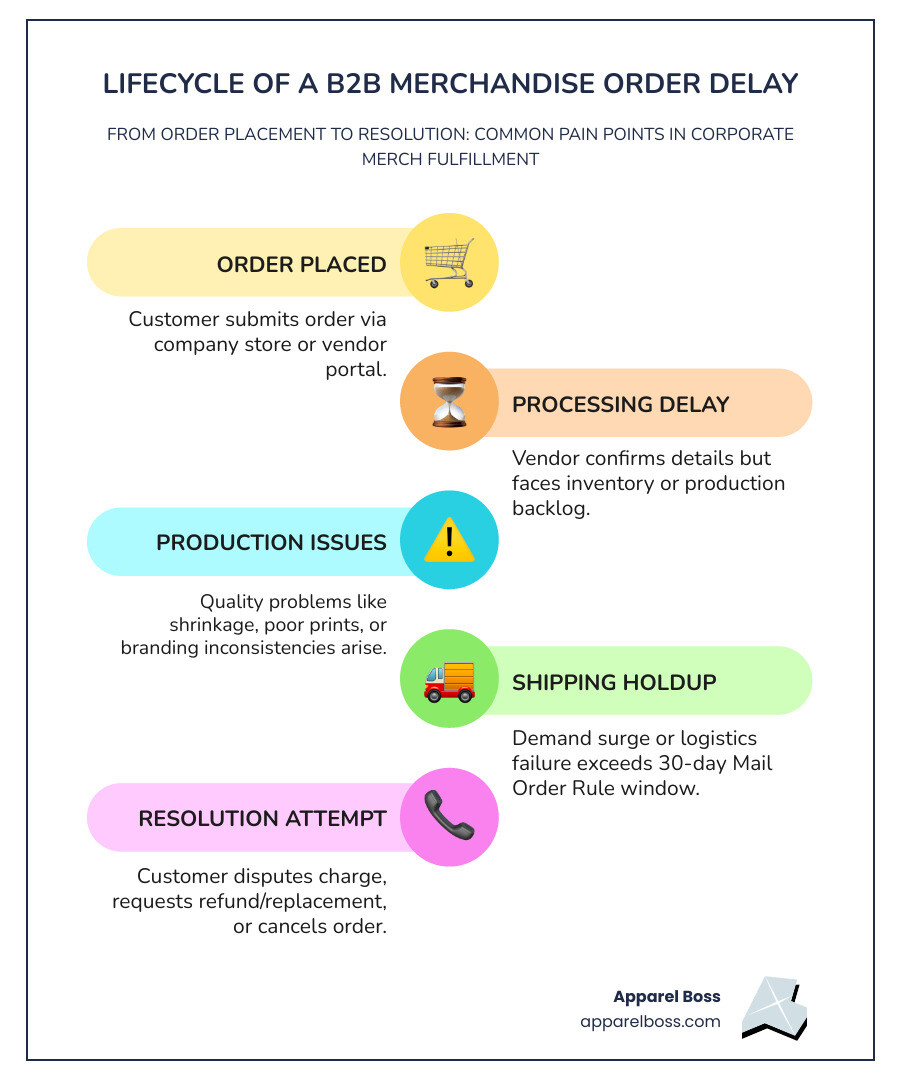
Shipping delays are perhaps the most visible Merch Problems. Under the Federal Mail, Internet, or Telephone Order Merchandise Rule, sellers are legally required to ship orders within the timeframe they promised. If no time is specified, the "30-day rule" applies. If a vendor cannot meet this deadline, they must notify the buyer, provide a revised shipping date, and offer the option to cancel for a full refund.
These delays often peak during high-demand surges. For example, during the 2026 Super Bowl season, major merchandise providers faced a 400% increase in demand for certain team jerseys compared to the previous year. This led to significant stockouts and public apologies, as detailed in the Super Bowl Merch Struggles: Fanatics Issues Apology - Apparelist.
For businesses in Nassau County or NYC, these delays can derail a product launch or a corporate event. To mitigate this, companies should focus on overcoming supply chain challenges for custom merch in 2025 by partnering with providers who offer in-house production. Localized production in places like Long Island reduces the number of "middle-man" touchpoints where delays typically occur.
Quality Control and Production Merch Problems
Quality control issues turn a high-intent purchase into a liability. Common complaints include:
- Fabric Weight: Receiving a thin, "disposable" feeling shirt when a premium heavyweight cotton was expected.
- Print Durability: Graphics that crack or fade after a single wash due to improper curing.
- Sizing Inconsistency: A "Large" from one batch fitting like a "Small" from another.
The technical choice between decoration methods is often the root cause. For instance, understanding what’s the difference between screen printing and direct to film is crucial for B2B decision-makers. Screen printing is excellent for high-volume, simple designs, while Direct to Film (DTF) allows for high-detail, full-color gradients that don't crack easily.
If a business receives damaged or defective goods in New York City, they have specific rights. According to Damaged or Defective Goods · NYC311 - NYC.gov, consumers and businesses should first attempt to resolve the issue directly with the merchant. If the merchant refuses to replace the item or issue a refund for a defective product, a formal complaint can be filed with the Department of Consumer and Worker Protection.
UX and E-commerce Friction in Company Stores
Many Merch Problems start before the order is even placed. User Experience (UX) friction in a company store can lead to low employee adoption and high administrative support tickets.
A famous usability case study on the Zara app revealed that only 1 out of 7 users could successfully edit an item in their shopping cart without encountering a problem—a staggering 14% success rate. Common UX pain points include:
- Inability to Edit in Cart: Forcing a user to delete an item and re-browse the entire store just to change a size or color.
- Poor Product Syncing: Showing items as "In Stock" that are actually backordered, leading to fulfillment "ghosting."
- Lack of Mobile Optimization: Most employees browse company stores on their phones; if the interface is clunky, they simply won't use their "swag credits."
- Incomplete Product Data: Missing size charts or fabric descriptions, which leads to high return rates.
When an online store lacks professional integration, it creates a manual workload for the HR or Ops team who must then manually fix orders or answer "where is my stuff?" emails.
Scalable Solutions for Modern Merchandise Management
To solve these recurring Merch Problems, businesses must move away from "one-off" ordering and toward structured, automated systems. Apparel Boss specializes in this transition, helping companies in Suffolk County and beyond move from disorganized spreadsheets to streamlined online company stores.
By centralizing production and fulfillment, you eliminate the "too many cooks" problem that leads to branding inconsistency.
Manual Fulfillment vs. Automated Company Stores
| Feature | Manual "Spreadsheet" Method | Automated Company Store |
|---|---|---|
| Ordering | Manual emails and forms | Self-service portal for employees |
| Inventory | Guessed; often leads to waste | Real-time tracking and on-demand options |
| Branding | Inconsistent across vendors | Centralized brand guidelines and assets |
| Distribution | HR ships boxes from the office | Direct-to-recipient global fulfillment |
| Reporting | Non-existent or manual | Instant ROI and spend analytics |
Implementing Recipient Choice to Eliminate Waste
One of the most effective ways to solve Merch Problems related to low engagement and wasted inventory is to implement a "Recipient Choice" model. Instead of sending every employee the same generic hoodie, businesses can use a points-based system.
This approach, often facilitated through custom kitting services, allows recipients to log into a branded portal and choose the item that fits their lifestyle. Maybe a remote developer wants a high-quality tech organizer, while a field sales rep needs a durable jacket.
By giving employees a choice, you ensure the merchandise is actually used, which increases the "cost-per-impression" value of the item. It also prevents the common mistakes to avoid when ordering custom merchandise, such as ordering 500 "Medium" shirts only to realize your team is mostly "XL."
Centralizing Procurement for Brand Consistency
For companies with multiple locations in Nassau County or NYC, centralized procurement is non-negotiable. When every department "does their own thing," the brand suffers.
Centralization allows for:
- Bulk Pricing Power: Even if items are shipped individually, the total volume can lower the unit cost.
- Structured Timelines: Planning ahead for seasonal needs, such as following winter merch tips for businesses, ensures that your team isn't waiting for jackets in mid-January.
- In-House Quality Control: By using a partner with custom apparel services that handle production in-house, you ensure that every stitch and print meets a single, high standard.
Legal Protections and Dispute Resolution for Businesses
Even with the best systems, disputes can happen. Decision-makers should be aware of their legal protections to resolve Merch Problems efficiently.
The Fair Credit Billing Act (FCBA) is a powerful tool for businesses using credit cards for procurement. It allows you to dispute billing errors, including:
- Charges for items never delivered.
- Charges for items that were not as described or arrived damaged.
- Mathematical errors on the invoice.
You generally have 60 days from the date the first statement containing the error was mailed to you to file a written dispute. Debit cards do not offer the same level of legal protection as credit cards, making credit the preferred method for B2B merch transactions.
Always keep detailed records of your orders, including the original product description, the promised delivery date, and all communication with the vendor. If you receive unordered merchandise, federal law treats it as a "free gift." You are not required to pay for it or return it, though a professional courtesy email to the vendor is usually the best first step.
Turning Merch Problems into Operational Wins
Merch problems don't have to be a permanent fixture of your business operations. Most of the friction — from shipping delays to "sour" quality — is a symptom of an outdated, manual process.
By partnering with a strategic provider like Apparel Boss, businesses can offload the administrative burden of merchandise management. We help you build online company stores that actually work, create custom kits that employees love, and maintain absolute brand consistency through our in-house production facilities on Long Island.
Whether you are looking to streamline your onboarding process or scale a global employee recognition program, the solution starts with moving away from "buying stuff" and toward "building a system."
Ready to stop managing spreadsheets and start scaling your brand?
Contact Apparel Boss today to see how our custom company stores and fulfillment systems can eliminate your merch problems for good.
Is Your Merch Missing? How to Handle Shipping Delays and Store Issues