
Why Production Delays Derail Corporate Merchandise Programs
What leads to production delays is one of the most pressing operational questions for any organization managing a corporate merchandise program. The short answer:
The most common causes of production delays are:
- Supply chain disruptions - extended supplier lead times, raw material shortages, and pre-shipment failures
- Poor internal planning - ad-hoc scheduling, unrealistic timelines, and skills gaps
- Equipment failures - unplanned downtime that can halt entire production lines
- Factory prioritization - suppliers deprioritizing smaller orders in favor of high-value contracts
- IT and ERP failures - system outages that break inventory visibility and trigger stockouts
- Design changes - late-stage modifications that require retooling and restart production cycles
- Communication gaps - between buyers, suppliers, and factories that mask emerging problems
For HR, operations, and marketing leaders managing branded apparel programs, these delays are not just a supplier headache. They translate directly into missed onboarding dates, inconsistent brand representation, and frustrated employees waiting on kits that never arrive on time.
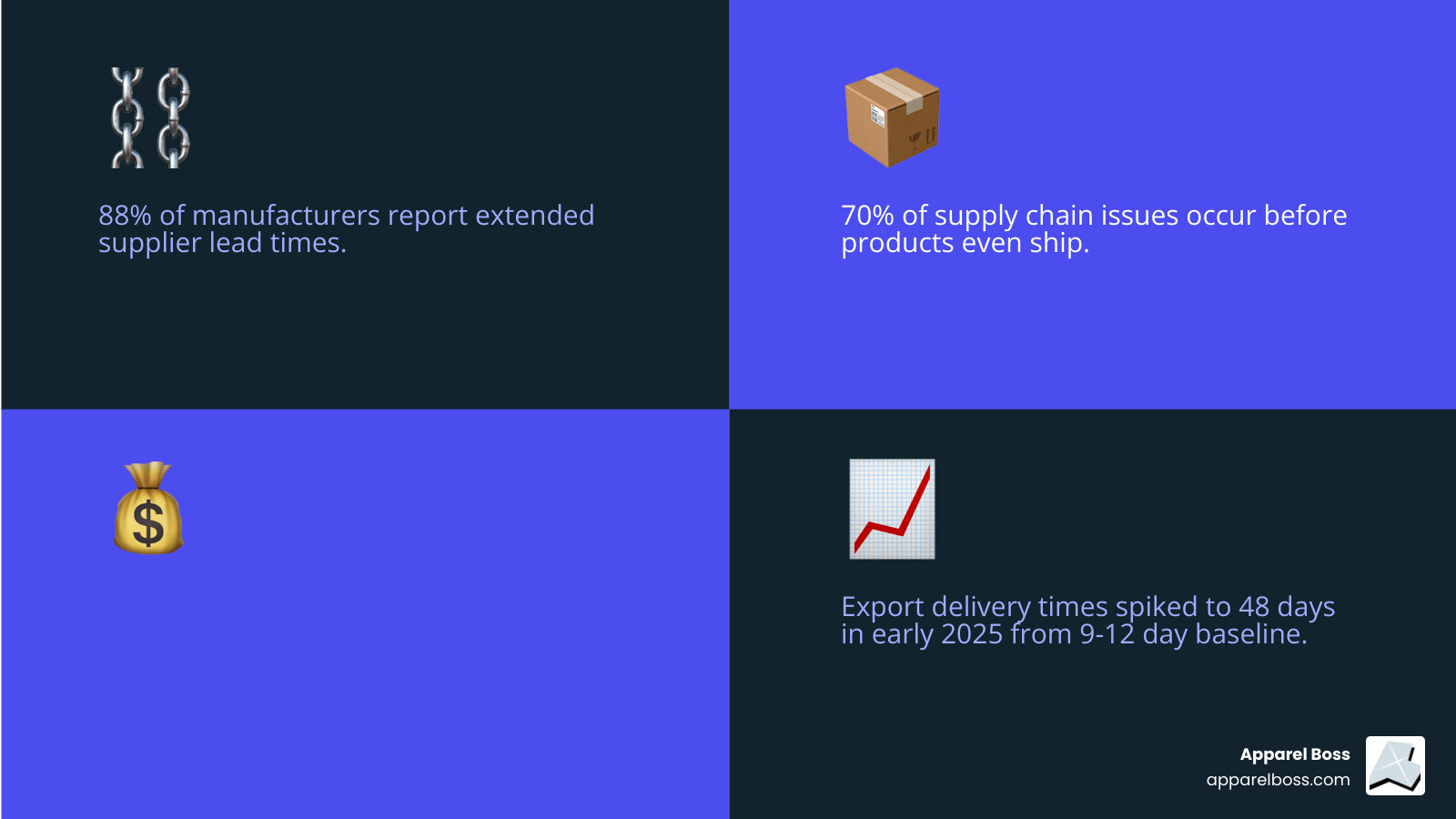
The numbers tell a clear story. 88% of manufacturers report extended supplier lead times. Up to 70% of supply chain issues happen before a product even ships. And poor inventory practices cost businesses globally over $1 trillion every year in excess stock and stockouts.
When a production delay hits a corporate merchandise program, the ripple effect moves fast. One missed shipment becomes a delayed product launch, a disrupted onboarding cycle, or a brand activation that falls flat.
Understanding why these delays happen is the first step to building a merchandise program that can withstand them.
Identifying What Leads to Production Delays in Corporate Merch
When a marketing director in New York City or an operations manager in Suffolk County orders custom apparel, they often assume the process is a straight line from design to delivery. In reality, the "line" is a complex web of global dependencies.
A primary driver of what leads to production delays is the sheer volatility of the modern supply chain. Currently, in April 2026, we are seeing the compounding effects of several years of industrial shifts. For example, recent data shows that export delivery times spiked to an average of nearly 48 days in early 2025— a massive jump from the traditional 9-to-12-day baseline.
The Hidden Bottleneck: Pre-Shipment Issues
Many businesses blame the "shipping" phase for delays, but research indicates that up to 70% of supply chain issues occur pre-shipment. This means the delay happened while the garment was sitting on a sewing table or waiting for a specific thread color to arrive at the factory.
Inventory inaccuracies further complicate this. Without real-time tracking, a company might believe they have 500 blank hoodies ready for embroidery, only to find the "stock" was a data entry error. This lack of visibility is why global businesses lose $1.1 trillion annually to excess stock and stockouts.
Traditional vs. On-Demand Manufacturing
To understand how to stay on schedule, one must compare the two primary manufacturing models used in the apparel industry:
| Feature | Traditional Manufacturing | On-Demand Manufacturing |
|---|---|---|
| Minimum Order Quantity (MOQ) | High (often 100+ units) | Low to Zero |
| Lead Times | 4–12 weeks | 1–2 weeks |
| Inventory Risk | High (dead stock) | Low (produced as needed) |
| Visibility | Opaque (siloed data) | Real-time (integrated systems) |
| Flexibility | Rigid | High (easy design tweaks) |
How Internal Planning Errors and Scheduling Optimism Lead to Production Delays
Internal factors are often the most frustrating causes of delays because, theoretically, they are within a company's control. However, "scheduling optimism" frequently blindsides project managers. This is the tendency to plan for the "best-case scenario" where every machine runs perfectly and every employee shows up for their shift.
Ad-hoc planning—ordering merchandise only when a crisis arises—accounts for roughly 25% of all production delays. This reactive approach slashes manufacturing throughput by 20% to 30% because the factory must break its existing flow to accommodate a "rush" job, which ironically creates a new bottleneck.
Furthermore, the labor market remains a significant hurdle. Over 50% of executives report a critical lack of skilled workers. In areas like Long Island and Nassau County, the shift in the economy toward service jobs has made finding experienced apparel production staff more difficult. This skills gap means that even if the machines are ready, there may not be enough qualified hands to operate them.
The logistical environment of the New York metro area adds another layer of complexity. According to research on supply chain delays, NYC remains one of the most impacted regions in the U.S. due to congestion and aging infrastructure, making internal scheduling even more precarious.
External Disruptions: Material Shortages and Equipment Failure
Even the best-laid plans can be derailed by external "force majeure" events or mechanical failures. Equipment breakdowns are responsible for up to 80% of manufacturing downtime. In high-stakes environments, such as automotive or specialized tech production, unplanned downtime can cost a staggering $260,000 per hour. While apparel production costs per hour are lower, the cumulative loss of a stalled embroidery line or a broken screen-printing press can still devastate a quarterly budget.
Material shortages also play a massive role. If a specific organic cotton blend or a particular zipper brand is out of stock, the entire production run stops. This is especially true for companies that do not use strategies to overcome supply chain challenges, such as diversifying suppliers or maintaining a "safety stock" of raw materials.
IT and ERP (Enterprise Resource Planning) failures are the modern "ghost in the machine." When a server goes down or a database fails to sync, the factory loses visibility into what needs to be made. Teams often resort to manual spreadsheets during these outages, which introduces human error and creates a "data debt" that takes weeks to correct.
Factory Psychology and Order Prioritization
One of the most misunderstood aspects of what leads to production delays is "factory psychology." Factories are businesses, and like any business, they prioritize their most profitable or reliable clients.
In regions like China, factories often follow the "First Process" rule. Once a production run begins, the sequence is locked into the ERP system to avoid chaos. If a "VIP" client submits a massive order while your smaller order is in queue, the factory may "cherry-pick" parts or labor to satisfy the larger contract. In fact, 45% of firms admit to canceling or delaying lower-value orders to prioritize VIP contracts during periods of high demand.
Understanding how to manage production delays in China requires recognizing that aggressive pressure rarely works. Pushing a factory too hard often triggers defensive behaviors, such as "ghosting" (ignoring emails) or cutting corners on quality to meet a deadline. Instead, professional leverage—such as consistent ordering patterns and clear, structured communication—is the only way to maintain your place in the priority line.
Strategies to Mitigate Delays and Maintain Efficiency
Staying on schedule requires moving from a reactive "firefighting" mode to a proactive, systems-based approach. The goal is to build a "buffer" into the process so that when a disruption occurs—and it will—it doesn't break the entire program.
Using Real-Time Visibility to Prevent What Leads to Production Delays
The most effective way to combat delays is through data. Real-time visibility allows managers to see exactly where an order is in the value chain. Organizations using automated inventory management systems typically see a 30% decrease in stockouts.
By integrating tools like Cin7 or specialized corporate store platforms, businesses can sync their sales data directly with production schedules. This eliminates the "information lag" where a marketing team promises a shirt to an employee that the warehouse doesn't actually have in stock.
Adopting On-Demand Manufacturing and Predictive Maintenance
To truly scale, businesses should consider shifting away from massive bulk orders that sit in a warehouse gathering dust. On-demand manufacturing allows for smaller, targeted batches that match actual consumer or employee demand. This reduces the risk of "dead stock" and ensures that production lines are always moving on items that are actually needed.
On the technical side, predictive maintenance is a game-changer. Rather than waiting for a machine to break (reactive maintenance), sensors and AI can now predict when a part is likely to fail. Replacing a $50 belt on a Saturday is much cheaper than a $50,000 production halt on a Monday morning.
The 85% Utilization Rule
A common mistake in production management is trying to run a factory at 100% capacity. This leaves zero room for error. Following the "85% utilization rule" ensures there is a 15% buffer for "hot" orders, machine calibration, or minor material delays. When a system is red-lined at 100%, a single 10-minute delay in the morning creates a two-hour backlog by the afternoon.
Effective Communication Protocols
To avoid the "factory psychology" traps mentioned earlier, communication must be structured. This means:
- Standard Operating Procedures (SOPs): Clear instructions for every step of the branding process.
- Milestone Tracking: Not just asking "is it done?" but tracking raw material arrival, "first article" approval, and final QC.
- Positive Incentives: Offering bonuses for early delivery or consistent quality, rather than just using "late fees" as a threat.
Conclusion: Scaling Your Merchandise Program
Managing a corporate merchandise program shouldn't feel like a constant battle against the clock. When you understand what leads to production delays, you can stop treating the symptoms and start curing the cause.
The transition from a chaotic, manual process to a streamlined, automated system is what allows a business to scale. Whether you are managing onboarding kits for a team in New York City or distributing safety gear across Suffolk and Nassau Counties, the principles remain the same: visibility, planning, and the right strategic partners.
Apparel Boss specializes in helping businesses navigate these complexities. By centralizing your merchandise through online company stores, we eliminate the manual bottlenecks that cause delays. Our systems provide the real-time data needed to keep your program on track, ensuring that your brand is always represented consistently and your team is never left waiting.
If you’re ready to move away from the stress of "almost finished" and into a world of "delivered on time," it may be time to rethink your merchandise infrastructure. A structured strategic partner for company stores can transform your merch from an operational burden into a high-performing asset.
To see how a centralized system can solve your production challenges, explore our corporate store solutions and take the first step toward a delay-free future.