Why Inventory Tracking Failure Is Costing Your Business More Than You Think
Understanding the inventory tracking failure cause in your merchandise program is the first step to stopping a problem that quietly drains revenue, wastes resources, and erodes operational trust.
The most common causes of inventory tracking failure include:
- Human error - Manual data entry mistakes account for 60%–80% of all inventory inaccuracies
- Manual processes - 43% of small businesses still rely on spreadsheets or no tracking system at all
- ERP data gaps - Systems record what is entered, not what physically exists on the shelf
- Lack of real-time data - Batch updates create windows where system records and physical stock diverge
- Integration failures - Disconnected platforms create fragmented data that no single team can trust
- Poor demand forecasting - Reactive ordering leads to overstocking, stockouts, and emergency spend
- Warehouse layout and process issues - Misplaced items, unrecorded returns, and receiving errors compound over time
Businesses lose an estimated $1.77 trillion globally each year due to poor inventory management. That number is not driven by rare disasters. It is the result of small, repeated failures in how stock is recorded, moved, and verified across operations.
And for growing organizations managing corporate merchandise programs — branded apparel, onboarding kits, employee gear — these failures are especially costly. When your system shows 300 units available and only 94 exist in the warehouse, the downstream effects hit employee experience, brand consistency, and fulfillment timelines all at once.
I'm Salvatore Vento, Marketing Director at Apparel Boss, where I've spent years diagnosing inventory tracking failure causes inside corporate merchandise programs and rebuilding the operational systems that prevent them. In this guide, I'll walk you through exactly where these failures originate and what a structured, scalable solution looks like.
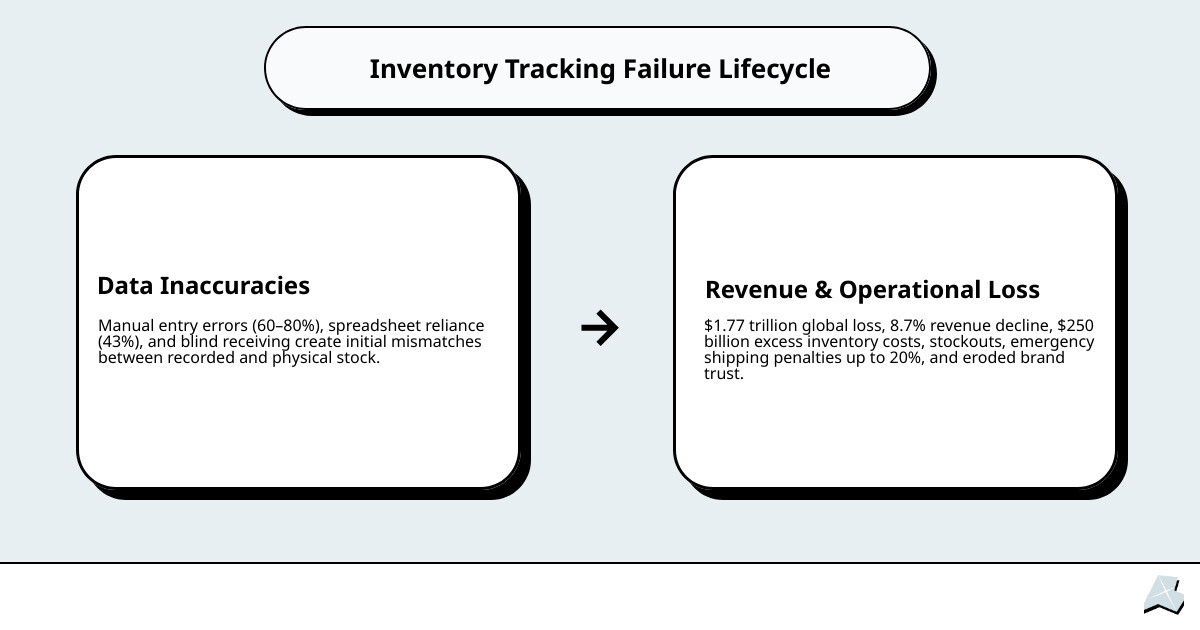
The Financial Impact of Inventory Tracking Failure Cause
When I talk to operations leaders in New York and Long Island, the conversation often starts with "we just need more hoodies." But the real problem is usually a $1.77 trillion global issue hiding in their stockroom. In retail and corporate merchandise environments, inventory inaccuracies result in an estimated 8.7% loss of revenue each year.
The financial bleed happens in two directions: overstocking and stockouts. Globally, excess inventory costs businesses over $250 billion annually. This is capital tied up in boxes that aren't moving, taking up expensive warehouse space in places like Suffolk County or Nassau County. On the flip side, stockouts are just as damaging; 34% of consumers—or in our case, employees and clients—will switch brands or lose faith in a program when faced with unavailable items.
| Metric | Manual/Paper Tracking | Automated Systems (Apparel Boss) |
|---|---|---|
| Accuracy Rate | 63% – 80% | 99.5% – 99.9% |
| Labor Cost | High (Manual entry & audits) | Low (Scanning & real-time sync) |
| Shipping Costs | High (20% expedited penalty) | Optimized (Planned fulfillment) |
| Data Visibility | Delayed/Fragmented | Real-time Dashboard |
By solving your inventory waste issues, you aren't just cleaning up a warehouse; you are reclaiming lost margins.
The Hidden Costs of Phantom Inventory
One of the most frustrating versions of an inventory tracking failure cause is "phantom inventory." This occurs when your system insists you have 50 units of a specific jacket, but the shelf is empty. Industry benchmarks place inventory carrying costs for phantom stock between 1.5% and 3% of your annual inventory value. On a $5 million inventory, that’s a $150,000 annual drain.
Even worse is the operational halt. I've seen production teams in Deer Park ready to assemble 200 onboarding kits, only to find they are missing the core apparel item. The result? Emergency procurement and unplanned production stoppages that cost thousands of dollars per incident.
Expert Insight: The 20% Expedited Shipping Penalty
Pro-Tip: Companies relying on reactive ordering spend up to 20% more on expedited shipping to compensate for data inaccuracies. Transitioning to a "Safety Stock" model with automated alerts can eliminate these emergency overheads and keep your merchandise program on track.
Root Causes of Merchandise Discrepancies
If you are seeing a mismatch between your records and your physical stock, you aren't alone. Research shows that human error is responsible for 60% to 80% of inventory accuracy problems. Whether it's a typo during receiving or a staff member forgetting to log a "quick" pull for a VIP client, these manual touches are the primary inventory tracking failure cause.
Process failures often stem from poor warehouse layout or lack of standardized methods. If your warehouse isn't organized logically, items get misplaced, leading to "unrecorded" inventory that sits in a corner while you accidentally reorder more. This is a common hurdle in inventory and adoption issues where the system is only as good as the people using it.
Identifying the Primary Inventory Tracking Failure Cause in Manual Systems
Despite the technology available in 2026, 43% of small businesses still use a manual system or nothing at all. Relying on spreadsheets creates "data silos" where the person ordering the merch has different info than the person shipping it.
The fix is moving from "batch entry" (logging everything at the end of the week) to "point-of-movement capture." This means every time an item moves, it is scanned.

Expert Insight: The "Blind Receiving" Trap
Pro-Tip: Blind receiving—where staff do not see the expected quantity on a purchase order—forces a physical count that prevents "lazy" data entry. This ensures that if a supplier ships 114 units instead of the 144 ordered, it is caught immediately at the dock.
Why ERP Systems Fail to Validate Physical Stock
Many of our clients in New York City use powerful ERP (Enterprise Resource Planning) systems. However, an ERP is often a "single source of truth" that isn't actually true. ERPs are great at tracking the logic of a transaction, but they don't have eyes on the shelf.
Common ERP inventory problems arise because entries may be incorrect, or stock movement isn't recorded in real-time. If an order is shipped but the deduction doesn't happen until the "end-of-day sync," you have a window where you might oversell. This lack of shelf-level visibility is a silent inventory tracking failure cause that leads to delayed fulfillment and increased costs.
How Integration Gaps Become an Inventory Tracking Failure Cause
Integration gaps occur when your online store doesn't talk to your warehouse management software (WMS) or your ERP. Without proper middleware or real-time APIs, your data becomes fragmented. You might see "In Stock" on your company store, while the warehouse is actually empty.

Expert Insight: The Immutable Transaction Log
Pro-Tip: To maintain 99.9% accuracy, ensure your inventory system uses immutable transaction logs. Corrections should be recorded as new entries rather than overwriting history. This creates a clear audit trail, making it easy to identify exactly when and where a discrepancy occurred.
Scalable Solutions for Corporate Merchandise Programs
At Apparel Boss, we believe the solution to inventory tracking failure cause isn't just "better spreadsheets." It’s about building a centralized system that removes the opportunity for error.
By utilizing online company stores, businesses can automate the entire ordering process. When an employee orders a jacket, the system automatically deducts that unit from the live inventory, triggers a pick-ticket in our in-house production facility, and updates the stock level across all platforms simultaneously.
Implementing Real-Time Data Integrity
We achieve near-perfect accuracy by combining technology with a phased operational approach. This includes:
- Barcode & Mobile Scanning: Capturing data at the "point of work."
- ABC Classification: Prioritizing high-value or high-velocity items for more frequent checks.
- Cycle Counting: Replacing the disruptive "annual physical count" with small, daily verifications.
Expert Insight: Phased Automation Strategy
Pro-Tip: Don't automate a broken process. Conduct a "Movement Audit" first to identify where physical items move without a digital record. Only after you’ve mapped the physical flow should you implement barcode scanning at those specific touchpoints.
Frequently Asked Questions about Inventory Failures
What is the most common cause of inventory discrepancies?
Human error is the leader, accounting for 60%–80% of inaccuracies. This usually manifests as manual data entry mistakes, "memory-based" logging, or lack of proper training on the tracking software.
How does poor demand forecasting impact stock levels?
Without data-driven forecasting, businesses fall into reactive ordering. This leads to overstocking (tying up capital and risking obsolescence) or stockouts, which cause 34% of people to switch brands or lose trust in your internal program.
Can technology alone solve inventory tracking failures?
No. Technology like RFID or WMS is a tool, not a cure. You need organizational commitment to process excellence and a "verification layer"—physical checks that ensure the digital record matches reality.
Conclusion
Managing a corporate merchandise program shouldn't feel like a guessing game. When you identify the root inventory tracking failure cause in your organization, you can move from crisis management to strategic scaling.
At Apparel Boss, we act as a strategic partner for businesses across New York and Long Island, helping them trade manual headaches for scalable company store systems. By centralizing your ordering, utilizing in-house production, and implementing real-time tracking, we reduce your administrative workload and ensure your brand stays consistent.
Ready to eliminate inventory blindness and scale your merchandise program? Consult with our experts at Apparel Boss today to build a system that works as hard as you do.
A Practical Guide to Inventory Tracking Failure Cause