
Why Bulk Apparel Mistakes Cost More Than You Think
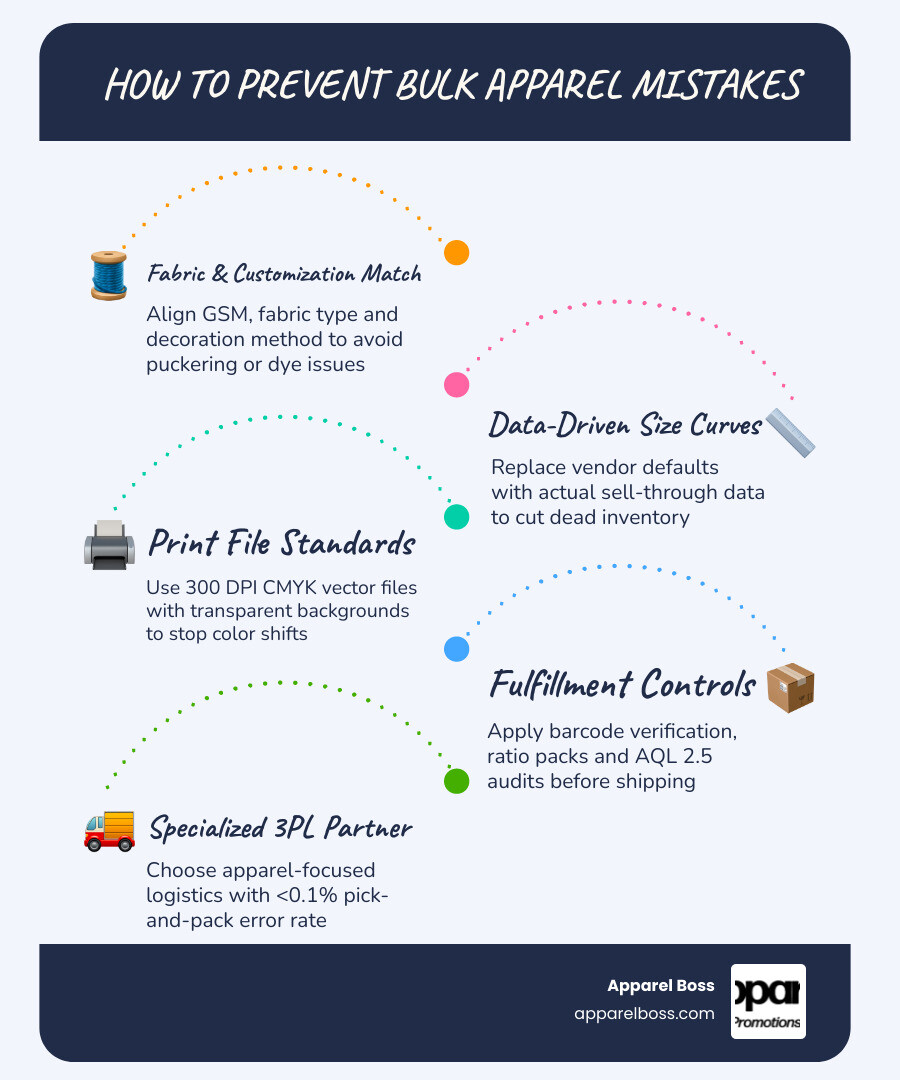
How to prevent apparel bulk mistakes comes down to five core disciplines: verifying fabric and customization compatibility, building accurate size curves, standardizing print file specs, enforcing bundling and fulfillment controls, and partnering with a logistics provider built for apparel complexity.
Here is a quick reference before we go deeper:
- Establish fabric and customization compatibility — match fabric weight and composition to your decoration method before placing any bulk order
- Optimize sizing curves and inventory planning — use real sell-through data, not vendor defaults, to avoid dead stock
- Standardize print file setup — submit 300 DPI CMYK files with transparent backgrounds to prevent color shifts and blurry prints across every unit
- Control fulfillment and bundling accuracy — implement barcode verification, ratio packs, and AQL 2.5 audits to catch errors before shipment
- Partner with a specialized apparel logistics provider — work with a 3PL that understands SKU complexity, not a generic warehouse operation
Bulk apparel ordering looks simple on the surface. Pick a style, choose a quantity, send a logo file, and ship. But at scale, that simplicity is an illusion.
A single error in a bulk run — a wrong fabric choice, a misaligned size curve, a low-resolution print file — doesn't produce one bad garment. It produces thousands of them. Industry data shows that a 1% pick-and-pack error rate alone can cost brands hundreds of thousands of dollars annually in returns, chargebacks, and lost customer lifetime value. And that number compounds fast during peak seasons, when Black Friday online spending hit $11.8 billion in 2025.
For operations leaders and marketing teams managing corporate merchandise programs, the stakes are high. Wasted inventory, inconsistent quality, and fulfillment errors don't just drain budget — they damage brand credibility with the people you're trying to impress.
The good news is that these mistakes are predictable and preventable when you know where they originate.
I'm Salvatore Vento, Marketing Director at Apparel Boss, where I work directly with CEOs, operations teams, and marketing leaders to build structured merchandise programs that eliminate the inefficiencies most companies don't catch until it's too late — and preventing apparel bulk mistakes is the foundation of every program we build. In the steps below, I'll break down exactly where bulk orders go wrong and how to stop it before it happens.
Step 1: Establish Fabric and Customization Compatibility
The foundation of any successful bulk apparel order is the relationship between the fabric and the decoration method. Many brands assume that any logo can go on any garment. In reality, ignoring how textiles react to heat, pressure, ink, and thread is one of the most common ways bulk runs are ruined.
When selecting garments, you must pay close attention to fabric weight, measured in GSM (grams per square meter). Heavyweight fabrics can support high-density embroidery, whereas lightweight, stretchy materials will pucker and pull under high thread tension. If you are aiming for a premium retail feel, combed ring-spun cotton offers a smooth surface that holds ink beautifully, whereas carded open-end cotton can yield a rougher texture and uneven print coverage.
Failing to analyze these physical properties beforehand leads to severe production bottlenecks. To understand what happens when these variables are ignored, see our guide on Common Mistakes to Avoid When Ordering Custom Merchandise.
Aligning Fabric Composition with Decoration Methods
Different fabrics require entirely different printing technologies:
- 100% Cotton: This is the gold standard for Direct-to-Garment (DTG) printing and traditional screen printing. It absorbs water-based inks perfectly, resulting in vibrant, breathable designs.
- Polyester and Performance Blends: Synthetic fibers are highly heat-sensitive. When cured under screen printing dryers, the polyester dyes can turn into gas and bleed through the print ink — a phenomenon known as dye migration. If you are customizing polyester activewear, your decorator must use low-bleed inks and specialized barrier underbases.
- CVC (Chief Value Cotton) and 50/50 Blends: These fabrics offer excellent dimensional stability and wrinkle resistance. However, they require careful ink calibration to ensure the print does not crack when the fabric stretches.
To avoid these technical pitfalls, it is critical to keep your procurement process aligned with your production goals from day one.
How Prevent Apparel Bulk Mistakes with Pre-Production Samples
I cannot stress this enough: never approve a bulk run based on a digital mockup. A digital proof cannot show you how a thread color catches the light, how an ink layer feels against the skin, or how a fabric behaves after a wash cycle.
To protect your budget, always request a physical pre-production sample. Once you receive it, perform a rigorous wash test. Measure the garment before and after washing to calculate the exact shrinkage rate. Check for color bleeding, raw edges, and loose embroidery threads.
Taking this step ensures that your bulk shipment matches your brand standards. For a deeper look at establishing strict quality thresholds, read The Ultimate Guide to Quality Control Fixing Hats and Apparel.
Step 2: Optimize Sizing Curves and Inventory Planning

One of the quietest ways bulk programs lose money is through size planning errors. If you order an equal number of Small, Medium, Large, and Extra-Large garments, you will inevitably end up with a pile of dead inventory in the extreme sizes while running out of your core sizes on day one.
Sizing inconsistencies across different manufacturers make this even more challenging. If you want to know why a "Medium" from one supplier fits like a "Small" from another, read our analysis on The Real Reasons Your Apparel Sizing Is So Inconsistent.
Moving Beyond Vendor-Default Size Curves
Many wholesale suppliers will push you to accept a generic, pre-packaged size curve (such as a standard 10% XS, 20% S, 30% M, 25% L, 15% XL). Following these default recommendations is a major risk.
Instead, build your size curves from actual historical sell-through data or direct recipient surveys. You must also calculate your net demand by factoring in returns by size. For instance, if your Extra-Large garments have a 22% return rate while your Small garments only have an 8% return rate, your net purchasing curve must adjust to prevent over-ordering larger sizes.
To learn how to structure this data-driven planning, read the comprehensive guide on Size & Pack Optimization for Apparel: How to Stop Leaving Revenue on the Rack | RetailNorthstar.
How Prevent Apparel Bulk Mistakes in Size Allocation
To minimize size-related waste in corporate programs, consider these strategies:
- Utilize Unisex Fits Carefully: Unisex garments typically follow men's sizing standards. If you are ordering uniforms for a female-dominant team, unisex styles will often run one size too large and drape poorly.
- Profile Your Demographic: A tech startup’s sizing distribution will look vastly different from a manufacturing firm's team. Tailor your order ratios to the actual physical profile of your recipients.
- Leverage On-Demand Collection: Instead of guessing, use an online company store to gather exact sizes from your employees or clients before production begins.
By aligning your ordering with actual demand, you can stop throwing money away on garments that will sit in a storage closet. For actionable steps on streamlining this process, see our guide on how to Stop Throwing Money Away by Solving Your Inventory Waste Issues.
Step 3: Standardize Print File Setup and Technical Specifications
A state-of-the-art printing press cannot fix a low-resolution, poorly prepared artwork file. In high-volume production, a file setup error will replicate across every single unit, turning your entire bulk run into expensive scrap fabric.
To prevent these delays and errors, you must establish clear technical guidelines for your design assets. For a look at how prepress mistakes stall factory timelines, read about the Inside the Factory 5 Common Causes of Production Delays and How to Avoid Them.
Eliminating Resolution and Color Shift Errors
To ensure your designs print with absolute clarity, enforce the following file standards within your creative team:
- Vector Files are Mandatory: Whenever possible, submit artwork in native vector formats (such as .AI, .EPS, or layered PDFs). Vector files can scale infinitely without losing quality.
- Convert Fonts to Outlines: If your decorator does not have your brand's exact font installed, their software will automatically replace it with a default font, ruining your branding. Always convert all text to outlines before exporting.
- Work in CMYK Color Mode: Computer monitors display colors in RGB (Red, Green, Blue), but production printers use CMYK (Cyan, Magenta, Yellow, Black) inks. Designing in RGB leads to severe color shifts when printed. Always design in CMYK and use PMS (Pantone Matching System) codes for exact color replication.
- Provide Transparent Backgrounds: If you submit a JPEG file of your logo, it will print with a solid white box around it on colored garments. Always provide high-resolution PNGs or vector files with transparent backgrounds.
Step 4: How Prevent Apparel Bulk Mistakes in Fulfillment and Bundling
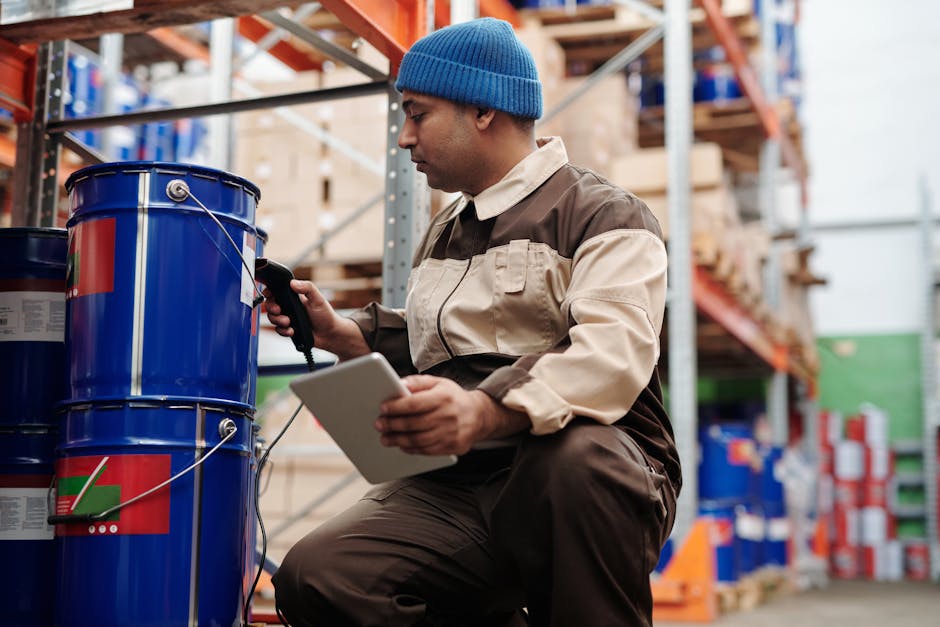
Once production is complete, the risk shifts to fulfillment. In high-volume distribution, minor packing errors quickly turn into major financial liabilities. If you are shipping to retail distribution centers or managing corporate kits, incorrect bundles will lead to chargebacks, shipping penalties, and delayed rollouts.
To secure this stage of the pipeline, you must implement strict quality control procedures, such as AQL (Acceptable Quality Limit) 2.5 random audits. This standard ensures that random carton samples are thoroughly verified for correct bundle counts, size ratios, and barcode readability before leaving the facility.
Establishing an error-free packaging and bundling workflow is critical to ensuring that your bulk shipments arrive exactly as ordered without costly delays.
Establishing Error-Free Bundling Workflows
The way your bulk garments are packed dictates how smoothly they will be received. You must choose the right packaging structure based on your distribution model:
| Packaging Type | Best Used For | Key Advantage | Risk Factor |
|---|---|---|---|
| Bulk Packs | E-commerce fulfillment, Amazon FBA, single-size inventory replenishment | Maximizes storage space; easy to count and store | High risk of individual picking errors during final dispatch |
| Ratio Packs | Retail store distribution, corporate event rollouts, regional offices | Simplifies local distribution; pre-sorted size mixes (e.g., 1S-2M-2L-1XL) | Requires precise pre-sorting at the factory level |
To keep these bundles organized, every carton must feature clear labeling, including the purchase order (PO) number, style number, size breakdown, carton weight, and SSCC (Serial Shipping Container Code) barcodes for automated tracking.
Step 5: Partner with a Specialized Apparel Logistics Provider
Many businesses make the mistake of using a generic third-party logistics (3PL) provider to handle their apparel. Generic warehouses are built to manage uniform, rigid boxes. They quickly fall apart when introduced to the soft, highly variable nature of apparel.
Apparel fulfillment introduces massive SKU complexity. A single jacket style offered in five sizes and three colors instantly creates 15 distinct SKUs. Multiply that across a full catalog, and you are managing thousands of highly similar items that look identical under standard warehouse lighting.
To protect your brand's supply chain, you must partner with a vendor that understands these unique operational demands. For guidance on choosing the right partner, read How to Choose the Right Merchandise Vendor for Your Business.
Benchmarking Pick-and-Pack Accuracy
In high-volume apparel logistics, human sight alone is not enough to prevent errors. A picker trying to distinguish a Navy Blue Medium from a Black Medium in a dimly lit aisle will eventually make a mistake.
Your logistics partner must utilize item-level barcode or RFID scanning at every single touchpoint — from receiving and putaway to picking and final pack verification.
To measure your operations effectively, you must benchmark your error rates. Leading apparel operations require a pick-and-pack error rate below 0.1% to 0.3% of lines picked. To understand how to calculate this metric and evaluate your current logistics setup, read What Is a Reasonable Pick and Pack Error Rate for an Apparel Brand? to establish clear performance standards for your fulfillment operations.
Frequently Asked Questions about Bulk Apparel Ordering
What is the standard size ratio for bulk corporate apparel?
While there is no single ratio that fits every group, the standard industry starting point for bulk corporate apparel is the 1-2-2-1 ratio (1 Small, 2 Medium, 2 Large, 1 Extra-Large). However, you should always adjust this baseline based on your team's specific demographic data and past ordering history to prevent excess inventory in extreme sizes.
How do I prevent fabric shrinkage in bulk orders?
To minimize shrinkage, choose garments made from pre-shrunk combed cotton, or opt for polyester-cotton blends like CVC (Chief Value Cotton), which offer superior dimensional stability. Always request a physical sample and perform a standardized wash-and-dry test to measure shrinkage before approving a bulk production run.
Why do print colors look different on bulk garments than on screen?
This discrepancy happens because computer screens display colors using the RGB color model (light-emitting), while production printing presses use the CMYK color model or physical Pantone inks. Additionally, certain fabrics can cause dye migration, where the fabric's dye bleeds into the print ink during the heat-curing process. To ensure accuracy, always specify exact Pantone (PMS) color codes in your design files.
Conclusion
Preventing bulk apparel mistakes is not a matter of luck — it is the result of strict, repeatable systems. From matching your decoration method to the right fabric composition to establishing data-driven size curves and standardizing your print files, every step in the process requires careful attention to detail.
At Apparel Boss, led by industry expert Salvatore Vento, we specialize in helping elite brands solve the "Quality-at-Scale" dilemma. Based in New York — serving businesses across Long Island, Suffolk County, Nassau County, and Deer Park — we bridge the gap between premium brand standards and operational scalability.
Whether you are looking to launch an Online Concierge Store to eliminate sizing guesswork or need bespoke Custom Kitting solutions with white-glove distribution, we ensure that every piece of merchandise reflects the prestige of your brand.
Ready to build a scalable, waste-free corporate merchandise program? Read our guide on How to Build a Scalable Company Merchandise Program Without Wasting Budget, or contact Apparel Boss today to discuss how we can streamline your custom apparel programs.