
What Employee Onboarding Really Means — and Why It Matters More Than You Think
Employee onboarding is the structured process of integrating new hires into your organization — covering everything from paperwork and IT setup to cultural immersion and role clarity — typically spanning the first 90 days to a full year of employment.
Quick answer:
| What | Details |
|---|---|
| Definition | The end-to-end process of integrating new employees into a company |
| Starts | At offer acceptance (not the first day) |
| Duration | 90 days minimum; up to 12 months for full acclimation |
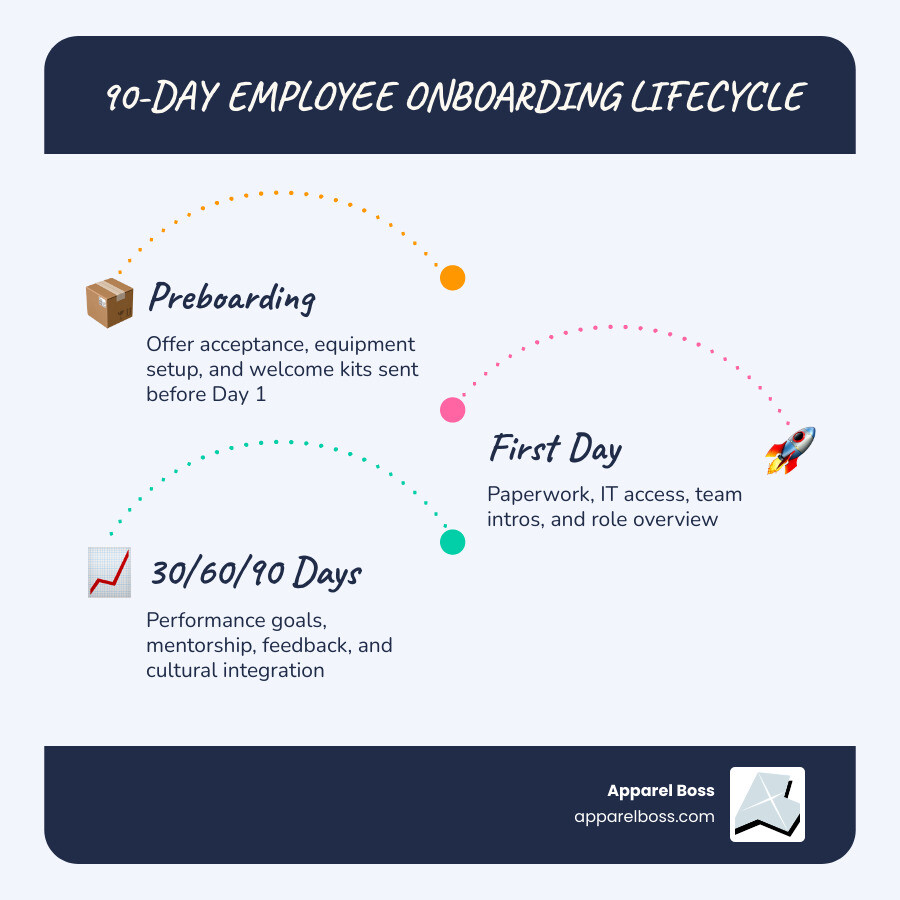
| Key phases | Preboarding → First day → 30/60/90-day milestones |
| Goal | Role clarity, cultural fit, productivity, and long-term retention |
Here's the hard truth: only 12% of employees strongly agree their company does a great job of onboarding them. That's not a minor gap — it's a systemic failure most organizations don't even realize is costing them talent, productivity, and money.
And the cost of getting it wrong is significant. New hires who feel underprepared don't quietly struggle — they leave. Only 29% of new employees say they felt truly supported to excel in their new role.
But when onboarding is done well, the results are measurable. Organizations with a structured onboarding process report 50% greater new-hire productivity, and employees who experience a strong onboarding program are nearly three times as likely to say they have the best possible job.
For growing organizations managing teams across multiple locations — or onboarding at scale — there's an additional layer of complexity: how do you deliver a consistent, brand-aligned experience to every new hire, every time? That's where operational systems, not just HR intentions, make the difference.
The Strategic Importance of Employee Onboarding

In the competitive landscape of April 2026, employee onboarding has evolved from a simple HR checklist into a high-stakes strategic imperative. It is the first real-world test of your organization's Employee Value Proposition (EVP). When a new hire walks through the door—or logs in from a home office in New York City or Long Island—they are looking for confirmation that they made the right career choice.
Effective integration isn't just about making people feel "welcome"; it's about reducing the "time to productivity." Without a clear path, new hires spend their first weeks navigating ambiguity instead of contributing to business goals. This is why Understanding Employee Onboarding is critical for any leader aiming to build a high-performing culture. Furthermore, Why Corporate Branded Apparel Matters in this context cannot be overstated; physical symbols of belonging help bridge the gap between "newcomer" and "team member" almost instantly.
Differentiating Onboarding from Orientation
A common operational pitfall is treating orientation and onboarding as the same thing. They are not.
- Orientation is an event. It is usually a one-time session focused on administrative paperwork, I-9 and W-4 compliance, and a brief overview of the company handbook. It answers the question, "Where do I park?"
- Onboarding is a journey. It is a long-term integration process that can last up to 12 months. It focuses on cultural immersion, building relational trust, and mastering role-specific skills. It answers the question, "How do I succeed here?"
Impact on Retention and Productivity
The data is clear: 69% of employees are more likely to stay with a company for at least three years if they experienced great onboarding. Conversely, one in five companies report that new hires may not even show up on day one, and half lose them by day two if the experience is disorganized.
Structured programs lead to a 50% increase in new-hire productivity. By providing the right tools and clear expectations early, you eliminate the friction that causes early-stage burnout. For employers, following a comprehensive guide ensures that no critical steps—from benefits education to mentor matching—fall through the cracks.
Phases of the Employee Onboarding Process
To scale employee onboarding effectively, organizations must view it as a phased execution. A "sink or swim" mentality leads to wasted recruitment costs and high turnover. Instead, follow a structured roadmap that guides the employee from the moment they sign the offer letter to their one-year anniversary.
| Milestone | Focus Area | Key Activities |
|---|---|---|
| Preboarding | Engagement & Logistics | Tech setup, welcome kits, paperwork completion |
| Day 1 | Connection & Culture | Team intros, office tour, "first win" tasks |
| Day 30 | Role Clarity | Training completion, goal setting, buddy check-ins |
| Day 60 | Integration | Increased workload, performance feedback |
| Day 90 | Independence | Full role ownership, 90-day review |
Preboarding and the First Day Experience
Onboarding begins the second the offer is signed. This "preboarding" phase is the best time to handle the logistical "heavy lifting." Sending equipment and branded welcome kits to their home before day one builds immense excitement.
On the first day, the goal is "connection over compliance." Rather than burying a new hire in manuals, focus on social integration. A team lunch or a curated "unboxing" experience of company gear can make a lasting impression. This is also the time to ensure their workstation is 100% ready—nothing kills momentum faster than a new hire sitting at a desk with no computer access.
The 30-60-90 Day Roadmap
As the initial excitement fades, the 30-60-90 day roadmap provides the necessary structure to keep the hire engaged.
- 30 Days: Focus on acclimation. The employee should understand the "who's who" and have a clear grasp of their immediate responsibilities.
- 60 Days: Focus on contribution. Start assigning meaningful projects and provide regular feedback loops.
- 90 Days: Focus on autonomy. By this point, the employee should be operating with minimal hand-holding.
Following a phased guide allows managers to measure progress objectively rather than relying on gut feeling.
Essential Components of a Comprehensive Checklist

A comprehensive employee onboarding checklist is the backbone of a repeatable, scalable process. Without it, the experience becomes inconsistent—one hire gets a mentor and a welcome kit, while another is left to figure out the printer on their own.
Roles and Responsibilities in Integration
Onboarding is a "triathlon" involving multiple stakeholders:
- HR: Handles compliance, benefits, and the high-level cultural introduction.
- Managers: Responsible for role-specific training, setting performance goals, and daily integration.
- Buddies/Mentors: Peers who provide informal support and help the new hire navigate the "unwritten rules" of the office.
- Executives: Should provide a "big picture" overview of company vision and values to inspire long-term commitment.
A detailed checklist ensures each stakeholder knows exactly when and how to engage with the new hire.
Operationalizing Brand Consistency
For companies in New York and Suffolk County, maintaining brand consistency across a distributed workforce is a major operational challenge. If one employee receives a high-quality embroidered jacket and another receives a low-quality screen-printed tee, it creates a "class system" within the team.
Providing high-quality apparel is about more than just clothing; it's about professional standards. Businesses must solve the "merchandise problem"—wasted inventory and inconsistent sizing—by implementing structured systems for distribution. This ensures that every hire, whether in a Manhattan office or a remote site on Long Island, feels like part of the same unified brand.
Leveraging Technology in Employee Onboarding
In 2026, manual onboarding is an unnecessary drain on resources. Technology allows for personalized, automated experiences that scale. Tools like Microsoft NEO and SharePoint templates can act as a "virtual onboarding buddy," nudging hires through their journey and providing a central hub for all resources.
Best Practices for Remote and Hybrid Teams
Remote onboarding requires even more intentionality because the "hallway conversations" don't happen naturally. Digital workflows must be supplemented by physical touchpoints. This is where custom kitting services become essential. Shipping a curated box of essentials directly to a remote hire’s door bridges the physical gap and creates an immediate sense of belonging.
Streamlining Distribution and Fulfillment
The biggest headache for HR and Operations is the logistics of "stuff." Managing piles of shirts in a closet or spending hours at the post office is not a scalable way to handle employee onboarding.
The solution is to handle company store setup without the stress. By using automated ordering portals, new hires can select their own sizes and styles, which are then fulfilled and shipped automatically. This reduces administrative workload, eliminates wasted inventory, and ensures every employee gets exactly what they need, when they need it.
Measuring Success and Avoiding Common Pitfalls
You cannot improve what you do not measure. Companies often make the mistake of assuming that if a new hire hasn't quit by month three, the onboarding was a success. However, true success is measured by "time-to-productivity" and "engagement scores."
Common Mistakes to Avoid
- Information Overload: Dumping 50 PDFs on a new hire on day one leads to immediate burnout. Pace the information.
- Lack of Preparation: If a hire arrives and their laptop isn't ready, you've sent a clear message: "We weren't expecting you, and you aren't a priority."
- Inconsistent Experiences: Ensure every hire, regardless of their department or location, receives the same high-level support.
- Neglecting Culture: Don't just teach the "what" of the job; teach the "why." If they don't buy into the values, they won't stay.
Key Performance Indicators (KPIs)
To evaluate your program, look at:
- Retention Rates: What percentage of hires stay past the one-year mark?
- Training Completion: Are hires finishing their modules on schedule?
- New Hire Surveys: Gather feedback at the 30 and 90-day marks.
- Operational ROI: How much time is HR saving by using automated company stores versus manual distribution?
Frequently Asked Questions about Employee Onboarding
How long should the onboarding process last?
While many companies stop after the first week, experts agree that onboarding should last at least 90 days, with some organizations extending it to a full year to ensure long-term acclimation and career development.
What is the difference between onboarding and orientation?
Orientation is a short-term administrative event (paperwork and policies), while onboarding is a comprehensive, long-term strategy to integrate an employee into the company's culture, social fabric, and specific job functions.
How can we improve onboarding for remote employees?
Focus on "digital-first" communication using tools like Teams or Slack, but don't forget the physical connection. Sending branded kits and scheduling virtual "coffee chats" can help remote hires feel connected to the team despite the distance.
Conclusion
Strategic employee onboarding is the foundation of organizational excellence. It is the bridge between a successful hire and a long-term, high-performing team member. By moving away from ad-hoc, manual processes and toward structured, tech-enabled systems, businesses can ensure that every new hire is equipped for success from the moment they sign their offer.
Apparel Boss helps organizations eliminate the friction of manual merchandise management by implementing automated Company Stores and fulfillment systems. Our services ensure that every new hire—whether in New York City, Suffolk County, or working remotely—feels connected to the brand from day one through seamless, professional distribution.
Ready to streamline your team's integration experience? Let’s discuss how a custom-built company store can take the logistical weight off your HR team while elevating your brand.