Why the Best Promotional Bags Drive Employee Adoption and Brand Visibility
The best promotional bags aren't just giveaways — they're tools your employees and customers actually carry into the world, putting your brand in front of new audiences every single day.
Here's a quick look at the top bag types for corporate use:
| Bag Type | Best For | Key Feature |
|---|---|---|
| Canvas Tote | Trade shows, onboarding kits | Large print area, durable |
| Non-Woven Polypropylene Tote | High-volume events, budgets | Lightweight, cost-effective |
| 600D Polyester Duffel | Employee gifts, travel | Structured, long-lasting |
| Drawstring Bag | Youth events, sports | Lightweight, easy to carry |
| Backpack | Tech events, commuters | Laptop compartment, daily use |
For organizations managing branded merchandise at scale, bag choice is a strategic decision — not just a budget line item.
A poorly chosen bag gets tossed after the event. A well-chosen one becomes part of someone's daily routine, showing up at grocery stores, gyms, and commutes. That's the difference between a one-time impression and ongoing brand exposure.
The challenge most growing organizations face isn't finding a bag — it's finding the right bag, ordering it consistently, and getting it into employees' hands without a logistical headache. Inconsistent quality, slow fulfillment, and wasted inventory are real operational pain points that affect how merchandise programs perform.
This guide breaks down how to choose promotional bags that actually get used — and how to distribute them efficiently as part of a scalable merchandise program.
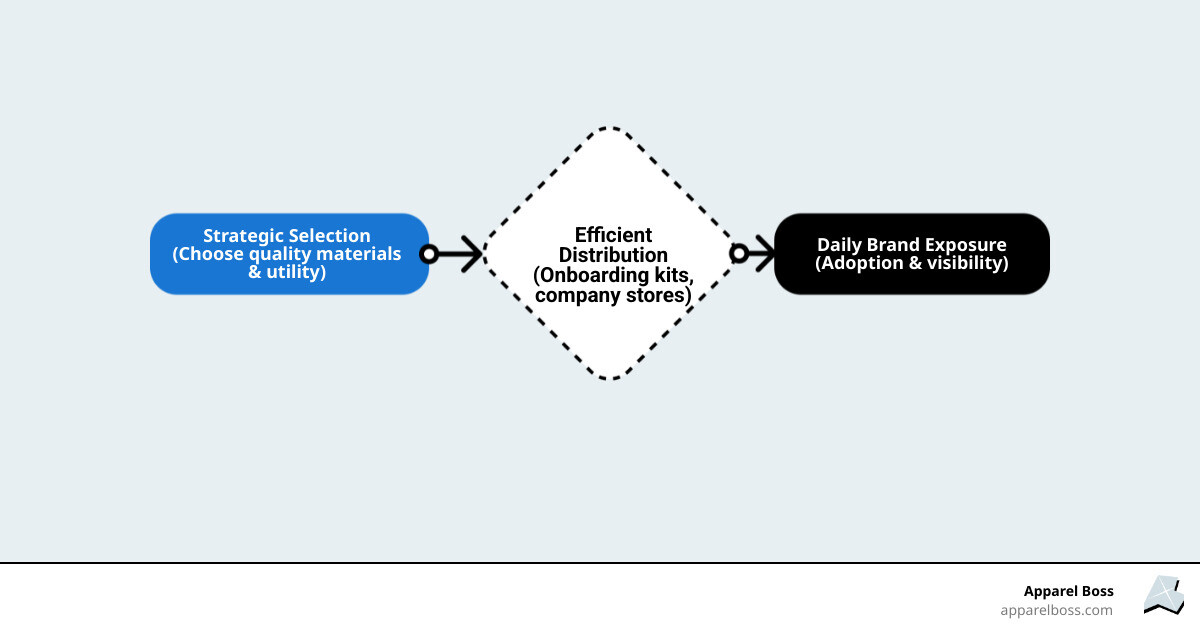
Strategic Selection: Identifying the Best Promotional Bags for High Adoption
When a company invests in merchandise, the real goal is not distribution - it is adoption. Employees and customers need to use the item repeatedly for it to deliver operational and branding value. Low adoption rates often come from a race to the bottom on price, which produces flimsy bags that fail after limited use. To improve outcomes, decision-makers need to evaluate quality, utility, and consistency instead of unit cost alone.
A major operational pain point for many New York-based businesses is inconsistent quality. When one batch of bags arrives with vibrant logos and sturdy seams, but the next batch features crooked printing and fraying handles, brand integrity suffers. This inconsistency often happens when companies juggle multiple disconnected vendors instead of centralizing production and approval workflows.
To evaluate the best promotional bags in a business setting, teams should focus on durability, intended use, and repeatability across orders.
| Feature | 600D Polyester (Premium) | 80 GSM Polypropylene (Value) |
|---|---|---|
| Durability | High; tear-resistant and heavy-duty | Moderate; lightweight and water-repellent |
| Common Use | Executive gifts, laptop bags, travel | Trade shows, grocery retail, event distribution |
| Texture | Fabric-like, professional | Plastic-fiber feel, soft-textured |
| Lifespan | Years of daily use | Months of intermittent use |
Choosing quality over quantity helps the merchandise function as a practical brand asset instead of disposable swag. If an employee is comfortable carrying a bag to a meeting in Manhattan or a gym in Suffolk County, the company gains repeated impressions. If the bag breaks quickly, the investment is lost and the brand experience becomes negative. For many organizations, standardizing quality through a single production and fulfillment partner is what prevents that outcome.
The Best Promotional Bags for Daily Utility and Commuting
For the modern workforce, utility drives adoption. The best promotional bags for ongoing use are usually those sized for commuting, onboarding, and day-to-day storage. A high-utility format is approximately 15" x 13", large enough for a laptop, notebooks, or a change of clothes without becoming bulky.
Reinforced handles are a practical requirement. If a bag cannot reliably support a professional's daily essentials, it will not become part of a routine. For large-scale programs, such as employee onboarding or event distributions, polypropylene totes can still serve a role when they are specified correctly and matched to the right use case. Material selection should be guided by the program objective, not just the cheapest available option.
Understanding Why Custom Merchandise Drives Branding is useful in this context: repeat use creates ongoing exposure. From an operations perspective, that means selecting merchandise with enough utility to justify the effort and budget required to source, brand, and distribute it. Teams evaluating product durability can also reference independent material guidance from Wikipedia's overview of nonwoven fabric, which helps explain why different bag constructions perform differently.
Technical Specs: Why Material Choice Defines the Best Promotional Bags
To move beyond low-value swag and toward practical branded equipment, companies should pay attention to denier ratings and construction details. Denier is a unit used to describe the linear mass density of fibers; in simple terms, higher denier materials are generally thicker and more durable for demanding use.
Bags made from 600 Denier Polyester Canvas represent a clear step up in structure and longevity. They often include reinforced seams, heavier straps, and optional organizational features that make them more useful in a work setting. For employees who commute, travel, or go from the office to the gym, additions like laptop compartments, zippered sections, or a stable base insert can significantly increase adoption.
This level of specification aligns with Branding Beyond Clothing: Custom Hats, Bags and More. The operational takeaway is simple: when a merchandise program is built around items people can rely on, the company gets more use, more visibility, and better return from every order.
Customization Methods for Professional Branding
The right bag still fails if the decoration quality is poor. Inconsistent branding - such as off-center logos, weak ink coverage, or colors that do not match brand standards - is a common frustration for marketing and operations leaders.
There are several primary methods for customizing Promotional Products:
- Screen Printing: Ideal for large, bold logos on tote bags. It offers high durability and is cost-effective for bulk orders.
- Embroidery: Best for premium backpacks and duffels. It provides a textured, professional finish that holds up over time.
- Heat Transfer: Useful for complex, full-color designs or smaller runs where detail matters.
- Direct-to-Film (DTF): A flexible option for vibrant, high-resolution prints on a range of materials.
Selecting the right decoration method for the fabric and intended use reduces quality issues and reorders. It also supports stronger program consistency when managed through one partner for custom apparel services, including in-house embroidery, screen printing, and direct-to-film printing. A bag with durable, professional branding is far more likely to stay in circulation than one with a peeling or poorly applied logo.
Operational Efficiency: Distributing Merchandise Without Wasted Inventory
Even the best promotional bags can become a burden if the distribution process is broken. Many companies suffer from "closet syndrome"—boxes of unorganized bags sitting in a storage room in Long Island, forgotten and gathering dust. This results in wasted inventory and significant financial loss.

The impact of inefficient distribution includes:
- Administrative Workload: HR or marketing teams spending hours packing bags for new hires.
- Slow Fulfillment: Employees waiting weeks to receive their "welcome" gear.
- Inconsistent Experience: One new hire gets a high-quality backpack, while another gets a leftover drawstring bag because the inventory wasn't tracked.
Reducing Administrative Load with Custom Kitting
A scalable solution to these challenges is custom kitting. Instead of shipping loose items, a company can create standardized "Welcome Kits" or "Anniversary Kits" that include one of the best promotional bags pre-packed with other essentials like Top Trends in Custom Water Bottles.
By outsourcing the kitting and fulfillment process, businesses in New York and beyond can ensure that every employee receives a consistent, high-quality brand experience. This removes the logistical burden from internal teams, allowing them to focus on core operations rather than shipping logistics.
Centralizing Orders via Online Company Stores
To truly solve the problem of wasted inventory and ordering friction, organizations are turning to custom online company stores. Apparel Boss specializes in creating these centralized hubs where managers or employees can order exactly what they need, when they need it.
An online store solves several operational pain points:
- Inventory Management: Real-time tracking prevents over-ordering and stockouts.
- Brand Consistency: Only approved designs and high-quality bag options are available for purchase.
- Simplified Ordering: No more back-and-forth emails or spreadsheets to collect sizes and preferences.
When an employee can log in and select a high-quality laptop bag or a premium notebook (understanding Why Custom Notebooks Are a Must-Have for professional settings), the perceived value of the merchandise skyrockets. It feels like a benefit rather than a generic handout.
Conclusion: Partnering for Scalable Merchandise Programs
Improving employee adoption of company merchandise requires a shift in perspective. It isn't just about finding the "cheapest" bag; it's about identifying the best promotional bags that solve a problem for the user—whether that’s a durable tote for the morning commute or a professional duffel for business travel.
When quality merchandise is paired with efficient systems—like custom kitting and online company stores—the results are transformative. Companies see higher ROI through increased brand visibility, lower administrative costs, and a more unified team culture.
Apparel Boss helps organizations in New York City, Long Island, and surrounding counties move away from the "swag closet" model and toward a professional, scalable merchandise program. By handling everything from in-house production (embroidery and screen printing) to fulfillment and distribution, Apparel Boss ensures your branding remains consistent and your inventory remains optimized.
Ready to streamline your company’s merchandise and improve employee adoption? More info about custom apparel services can help you build a program that scales with your business.
The Psychology of Swag: How to Improve Employee Adoption of Company Merchandise