Why High Quality Custom T-Shirts Are Worth the Investment
High quality custom t-shirts are the difference between branded apparel your employees actually wear and a box of forgotten shirts collecting dust in the supply closet.
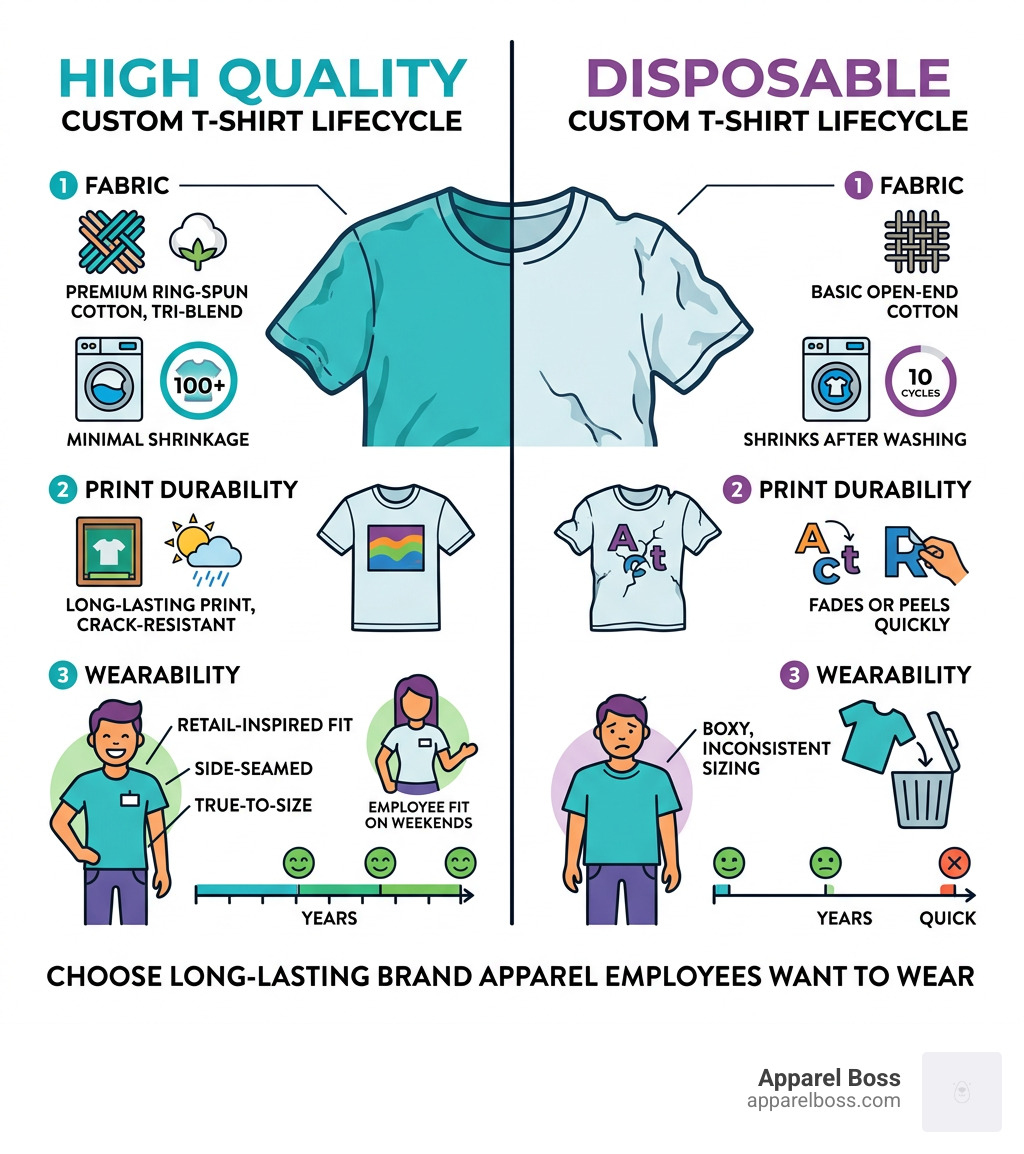
Here's a quick look at what separates premium from disposable:
| Factor | High Quality | Budget/Disposable |
|---|---|---|
| Fabric | Ring-spun cotton, tri-blend, pre-shrunk | Basic open-end cotton, shrinks after wash |
| Print durability | 100+ wash cycles, crack-resistant | Fades or peels within weeks |
| Fit | Retail-inspired, side-seamed, true-to-size | Boxy, inconsistent sizing |
| Brands | Bella+Canvas, Next Level, Comfort Colors | Generic unbranded blanks |
| Employee wearability | Worn on weekends, builds brand pride | Worn once, then discarded |
For HR managers juggling inconsistent branding, slow fulfillment, and rising costs, the choice matters. A poorly made shirt doesn't just waste budget — it undermines your brand every time it's worn (or not worn).
The good news? Getting premium branded apparel right doesn't have to be complicated. This guide breaks down exactly what to look for.
I'm Steven, and at Apparel Boss I've spent years working with growing companies to build smarter branding and merchandising strategies around high quality custom t-shirts that employees genuinely want to wear. Whether you're outfitting a team of 10 or 10,000, the principles are the same — and I'll walk you through all of them.
The Anatomy of High Quality Custom T-Shirts: Fabric and Fit
When we talk about high quality custom t-shirts, we aren't just talking about a logo. We are talking about the "hand feel," the drape, and the longevity of the garment. If a shirt feels like sandpaper or fits like a square box, it won't make it past the first laundry cycle before being demoted to a "painting shirt."
Understanding Fabric Textures and Weights
The foundation of any great shirt is the yarn. Most budget shirts use "open-end" cotton, which is scratchy and prone to pilling. High-quality options utilize ring-spun cotton, where the fibers are continuously twisted and thinned, resulting in a significantly softer and stronger rope of cotton fibers. If you want the absolute pinnacle of softness, look for combed and ring-spun cotton, which removes impurities and short fibers.
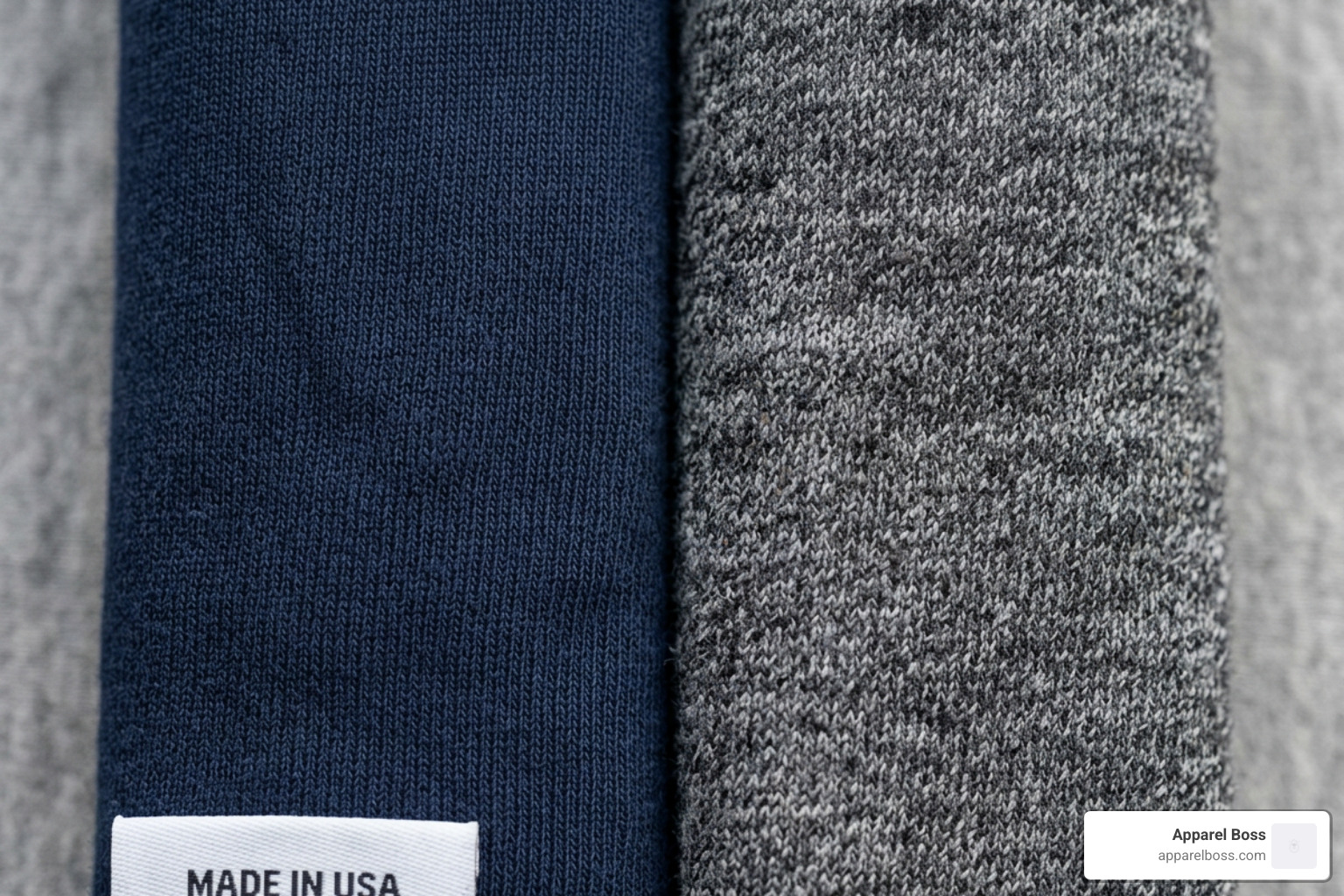
- Tri-blends: These are a mix of polyester, cotton, and rayon. They offer a vintage, heathered look and are incredibly lightweight and stretchy.
- Fabric Weight (GSM): Weight is measured in Grams per Square Meter. While some prefer a "heavyweight" feel (around 200+ GSM) for durability, many modern "retail-fit" shirts sit in the mid-range (140-160 GSM) for a breathable, everyday feel.
- Construction Details: Quality is in the stitching. Side-seamed construction follows the natural curves of the body, unlike "tubular" shirts that are just a cylinder of fabric. Shoulder-to-shoulder taping covers the raw edges of the sewing at the neck and shoulders, providing extra comfort and helping the shirt retain its shape over hundreds of wears.
At Apparel Boss, we prioritize these construction details because we know that more info about custom apparel services starts with selecting a garment that stands the test of time.
Performance and Sustainability
For teams on the move, moisture-wicking performance fabrics made of 100% polyester or poly-blends are essential. These technical fabrics pull sweat away from the skin and dry quickly. Furthermore, there is a growing demand for sustainable organic cotton and recycled polyester (often made from recycled plastic bottles). These eco-friendly options don't sacrifice quality; in many cases, they offer a superior, premium feel that aligns with a company's ESG goals.
Premium Brands for High Quality Custom T-Shirts
Not all "blanks" are created equal. Through millions of prints and thousands of customer reviews, several brands have emerged as the gold standard for employee favorites:
- Bella+Canvas 3001: The industry favorite for "retail fit." It's 100% combed and ring-spun cotton, side-seamed, and comes in an incredible array of colors.
- Next Level 3600: A direct competitor to the 3001, known for its slightly more athletic cut and excellent durability.
- Comfort Colors 1717: Known for its "garment-dyed" process, which gives the shirt a lived-in, vintage feel and a soft, muted color palette. It's a heavyweight favorite.
- Gildan Softstyle: A more budget-friendly entry into the "soft" category, offering a significant upgrade over the standard heavy cotton shirts without a massive price jump.
Choosing the Right Fit for Diverse Groups
One size rarely fits all. To ensure everyone on your team feels confident, we recommend offering a variety of fits. Unisex sizing is the standard, but providing ladies' contoured cuts--which feature shorter sleeves and a more tapered waist--shows a level of thoughtfulness that employees appreciate.
| Fit Type | Best For | Characteristics |
|---|---|---|
| Slim Fit | Modern tech teams, fashion-forward brands | Tapered sleeves, narrower body, longer length. |
| Relaxed Fit | Construction, events, general giveaways | Roomier through the chest and waist, traditional silhouette. |
| Athletic Fit | Fitness brands, active teams | Highlights shoulders and arms, tapers slightly at the waist. |
We also cater to everyone with extended sizes from XS to 6XL and tall options for those who need extra length without the extra width.
Professional Printing Methods for Premium Results
You can have the best fabric in the world, but if the print peels off after three washes, it's a failure. High-quality printing is a science that involves chemistry, heat, and precision.
The Art of the Print
- Screen Printing: This remains the gold standard for bulk orders. Using water-based inks allows the design to soak into the fabric for a "soft-hand" feel, meaning you can't feel the ink when you run your hand over it. For darker shirts, plastisol is often used for its vibrancy and durability, but we use advanced techniques to ensure it remains flexible and crack-resistant.
- Discharge Printing: This is a specialized form of screen printing where the ink actually bleaches the original dye out of the shirt and replaces it with the new color. The result? A print with zero "feel" that is part of the fabric itself.
- Embroidery: For a more elevated, "executive" look, embroidery provides clean, detailed stitching. We use high-end embroidery digitizing to ensure that even complex logos are rendered with crisp edges and no bunching.
You can explore our professional printing services to see how we handle everything from vibrant color matching to long-lasting finishes.
Designing for Optimal Print Clarity
To get high quality custom t-shirts, your artwork needs to be top-tier. We always recommend vector files (AI or EPS formats). Unlike "raster" images (JPEGs or PNGs), vectors can be scaled to the size of a billboard or shrunk to a pocket print without losing a single pixel of clarity.
If you are using high-resolution images, ensure they are at least 200-300 DPI. While the web uses RGB color models, professional printing often relies on CMYK or Pantone matching to ensure the "Company Blue" on your screen matches the "Company Blue" on the cotton.
When you start designing your custom t-shirts with Apparel Boss, our team provides a free artist design review. We check for font legibility, transparent backgrounds, and potential printing pitfalls before the first drop of ink hits the mesh.
Screen Printing vs. DTG: Which is Better?
It depends on your goals.
- Screen Printing is the winner for bulk order efficiency. Once the screens are set up, we can print hundreds of shirts quickly. It's ideal for bold, simple graphics with 1-6 colors.
- DTG (Direct-to-Garment) is essentially a giant inkjet printer for shirts. It is perfect for small batch flexibility (even single shirts) and designs with complex photographic detail or unlimited colors.
| Feature | Screen Printing | DTG (Direct-to-Garment) |
|---|---|---|
| Best For | 24+ pieces, simple logos | 1-24 pieces, photos, gradients |
| Durability | Extreme (100+ washes) | High (50+ washes) |
| Color Limit | Limited by screens | Unlimited |
| Feel | Can be "heavy" (Plastisol) or "soft" (Water-based) | Very soft, integrated feel |
Logistics: Pricing, Turnaround, and Quality Guarantees
Ordering custom gear shouldn't be a headache. We've refined our logistics to ensure that "high quality" also means "high reliability."
Pricing and Turnaround
The cost of high quality custom t-shirts is influenced by three main factors: the garment choice, the number of print locations/colors, and the total quantity. We offer significant volume discounts—the more you order, the lower the price-per-shirt becomes.
While some providers have massive minimums, we understand the need for flexibility. However, keep in mind that "no-minimum" orders typically utilize DTG printing, which has a higher per-unit cost than bulk screen printing.
Our standard turnaround is a fast 2-3 weeks, but we offer lightning rush options for those "we needed these yesterday" moments. We also provide free shipping thresholds to help keep your project under budget. You don't just have to take our word for it; you can read our customer testimonials to see how we've handled thousands of orders with precision.
Ensuring Quality with Service Guarantees
We stand behind every stitch and every drop of ink. Our quality assurance process includes several checkpoints:
- Garment Testing: We only source from brands we trust.
- Print Accuracy: Every design is reviewed by a human artist.
- Final Inspection: We check for ink consistency and garment defects before shipping.
- On-Time Delivery: If we promise a date, we hit it.
Common Ordering Mistakes to Avoid
In our years of experience, we've seen a few recurring "oops" moments that can delay an order or affect quality:
- Low-Resolution Uploads: Pulling a tiny logo off a website usually results in a blurry print. Always look for the original design files.
- Ignoring Size Charts: Every brand fits differently. A "Large" in a slim-fit Bella+Canvas is different from a "Large" in a boxy Gildan Ultra Cotton.
- Over-Complicated Designs: Sometimes less is more. A clean, bold logo often looks more "premium" than a shirt cluttered with text.
- Missing Deadlines: If you have an event on the 15th, don't wait until the 10th to order!
For more guidance, check out more info about apparel services to ensure your next order is seamless.
Frequently Asked Questions about High Quality Custom T-Shirts
What makes a t-shirt "high quality" compared to budget options?
It comes down to the "Three Fs": Fabric, Fit, and Finish. High-quality shirts use ring-spun cotton (softer/stronger), feature side-seams (better shape), and use superior printing methods that won't crack or fade after a few trips through the dryer.
How long do custom printed t-shirts typically last?
A high-quality screen-printed shirt using premium inks can easily last 100+ washes—effectively the life of the garment. DTG prints typically last 50+ washes before slight fading begins, which is still years of regular wear.
Can I mix different shirt styles and colors in one bulk order?
Absolutely! As long as the print design and ink colors remain exactly the same, you can mix and match sizes, shirt colors, and even styles (like mixing hoodies and t-shirts) to reach your bulk discount goals.
Conclusion
At the end of the day, your company's apparel is a walking billboard for your culture. Choosing high quality custom t-shirts isn't just a purchase; it's an investment in your brand's reputation and your employees' satisfaction.
At Apparel Boss, we specialize in white-glove service and in-house production. We don't just print shirts; we build and manage custom online company stores that make outfitting your team as easy as clicking a button. From premium branded merchandise to fast, reliable shipping, we are here to ensure your team wears your logo with pride.
Ready to elevate your company swag? Discover the Apparel Boss Custom Solutions today.
High Quality Custom T-Shirts That Your Employees Will Actually Wear