
Why HR Automated Onboarding Kits Are Replacing Manual Welcome Processes
HR automated onboarding kits have become one of the most effective tools companies use to eliminate the operational chaos of welcoming new employees at scale.
Here is what you need to know quickly:
- What they are: Pre-configured welcome packages (physical and digital) triggered automatically when a new hire is added to your HR system
- Why they matter: Organizations with strong onboarding processes improve new hire retention by 82% and boost productivity by over 70%
- The core problem they solve: Manual kit assembly, missed deliveries, and inconsistent first-day experiences that drive early turnover
- Who needs them: HR, operations, and people leaders managing distributed teams, high-volume hiring, or rapid growth phases
The reality most HR leaders face is not a strategy problem. It is a logistics problem.
When a new hire signs their offer letter, someone still has to collect a t-shirt size over Slack, confirm a shipping address, chase down IT for access credentials, and physically pack a box. That process consumes hours of HR time per hire — time that should go toward building culture, not taping boxes.
The result is predictable. Kits arrive late. Sizes are wrong. Remote employees start their first day without the gear or access they need. And 29% of employees who quit within their first 90 days often cite poor onboarding as the reason.
This guide breaks down exactly how to evaluate, compare, and implement an automated onboarding kit system — one that connects your HR software to physical kit fulfillment with zero manual intervention.
I'm Salvatore Vento, Marketing Director at Apparel Boss, where I help HR and operations teams build structured merchandise programs that eliminate the fulfillment chaos behind HR automated onboarding kits and replace it with a scalable, on-brand system. In the sections ahead, I'll walk you through the technical architecture, the right questions to ask vendors, and the operational standards that separate a truly automated kit program from one that just scales your existing errors.
What is an HR Automated Onboarding Kit?
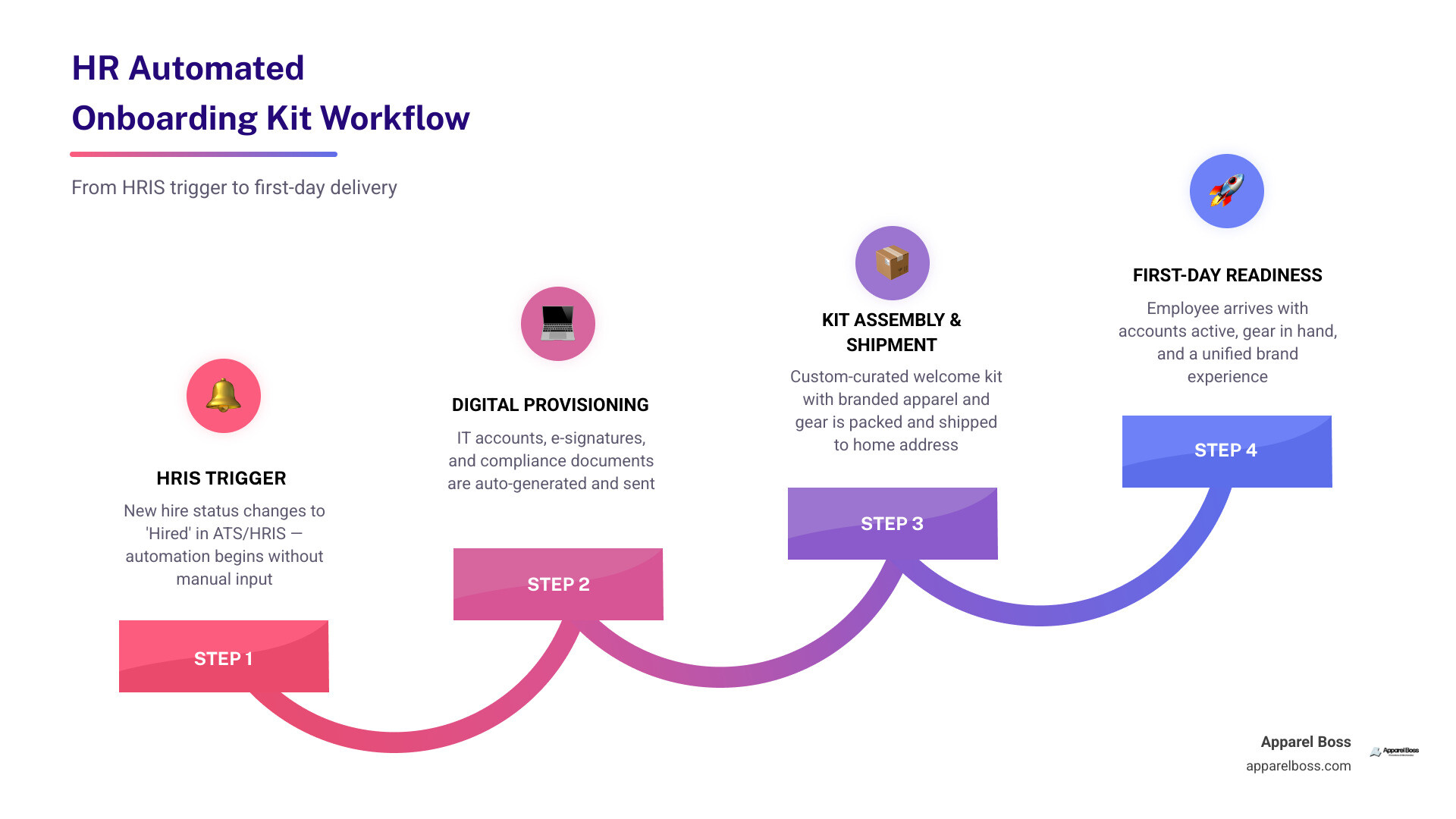
An HR automated onboarding kit is a unified, hands-off workflow that orchestrates both the digital and physical welcoming of a new employee. In traditional corporate environments, onboarding is plagued by administrative lag. Offers are signed, but weeks pass before IT accounts are created, and even longer before a box of cheap, generic promotional items is thrown together and shipped.
Automation changes this dynamic entirely. Instead of treating onboarding as a series of disconnected, manual tasks, automated systems treat it as a single, continuous trigger. The moment your new hire's status shifts to "Hired" in your applicant tracking system (ATS) or human resources information system (HRIS), the system automatically triggers a series of events. Accounts are provisioned, compliance documents are generated, and a high-end, custom-curated welcome kit is prepared and shipped to the employee’s home address.
This ensures complete first-day readiness. When remote employees open their laptops on day one, they are not met with login errors or missing gear. Instead, they start their journey with a cohesive, professional introduction to your brand. To understand how this fits into your broader human resources strategy, explore The Ultimate Guide to Employee Onboarding.

Core Components of HR Automated Onboarding Kits
An effective automated kit is not just a box of swag; it is a carefully coordinated blend of utility and brand integration. The best programs split their kits into three distinct layers:
- Digital Access and IT Provisioning: Instant generation of company credentials, secure single sign-on (SSO) credentials, and automated access to critical communication channels like Slack or Microsoft Teams.
- Physical Hardware Delivery: Coordinated shipping of laptops, monitors, and essential tech accessories, timed to arrive 3 to 5 days before the employee's official start date.
- Premium Branded Apparel and Workspace Gear: High-quality daily-use items that make employees feel valued and connected. I always recommend prioritizing retail-grade custom apparel—such as custom-embroidered jackets, premium hoodies, and structured hats—alongside functional workspace gear like professional notebooks and insulated drinkware.
To see what goes into a high-impact physical package, read my guide on the Best Employee Welcome Kits for a Five-Star First Day.
The Business Impact of Automated Welcome Kits
The transition from manual welcome processes to automated kits has a massive impact on your bottom line. Industry data shows that organizations with robust onboarding processes improve new hire retention by 82 percent and boost productivity by over 70 percent. Conversely, companies with inadequate onboarding programs risk losing their new hires within their first year. In fact, 29% of employees have quit a job within their first 90 days due to poor onboarding experiences.
When you automate the delivery of a premium physical kit, you eliminate the friction that causes early disengagement. Those who start their first day with a complete kit and on-time delivery show twice the engagement in their first 90 days. It turns what is typically a stressful, disorganized week into a moment of brand advocacy. New hires naturally share their high-end welcome gear on professional networks like LinkedIn, organically boosting your talent acquisition efforts.
How to Choose: Digital-Only Software vs. Physical Kit Logistics Platforms
When looking to automate your onboarding, you will find a sharp division in the market. Many HR teams make the mistake of choosing a software-only tool, expecting it to handle physical logistics, only to find themselves still packing boxes in a dusty supply closet.
| Feature | Digital-Only Onboarding Software | Physical Kit Logistics Platforms (Apparel Boss) |
|---|---|---|
| Primary Focus | Document signing, compliance, IT provisioning | Physical merchandise, custom apparel, kit assembly, and shipping |
| Inventory Management | None | Real-time tracking of physical blanks and finished kits |
| Customization | Standard digital templates | Premium custom embroidery and retail-grade product decoration |
| Logistics Handling | None (HR must ship physical items manually) | Complete white-glove warehousing, packaging, and worldwide distribution |
| HR Time Savings | Saves time on paperwork | Saves 10+ hours per week by eliminating manual packing and shipping |
Evaluating Digital-Only Onboarding Portals
Digital-only onboarding portals are built to streamline administrative workflows. They excel at automated document generation, legal compliance, and e-signatures. Platforms like AI Employee Onboarding — Hirix use smart, sequential workflows where completing one task automatically triggers and unlocks the next.
For technical teams looking to build custom internal portals, tools like the Employee Onboarding Boilerplate — HR SaaS Starter Kit | Archiet provide robust database structures for tracking tasks and compliance logs. While these platforms are essential for eliminating paperwork bottlenecks, they remain completely isolated from your physical supply chain.
Integrating Physical Logistics with HR Automated Onboarding Kits
To truly eliminate operational friction, you must bridge the gap between digital triggers and physical execution. This is where a managed, physical logistics platform becomes essential.
Instead of forcing your HR team to act as a fulfillment center, a platform that connects directly to your digital directory—such as an online company store integrated with your HRIS—automates the entire physical lifecycle. When a new hire is added to your portal, the physical logistics system handles the rest: warehousing your inventory, assembling the custom kits, and tracking the shipment straight to the employee's doorstep. You can learn more about building these centralized digital hubs by reading about how to design a New hire portal: Create onboarding hubs that engage employees.
The Technical Architecture: HRIS Integration and Automated Triggers
The magic of HR automated onboarding kits lies in the background integrations. To achieve a truly hands-off workflow, your physical fulfillment system must connect directly to your HR tech stack via secure API connections.
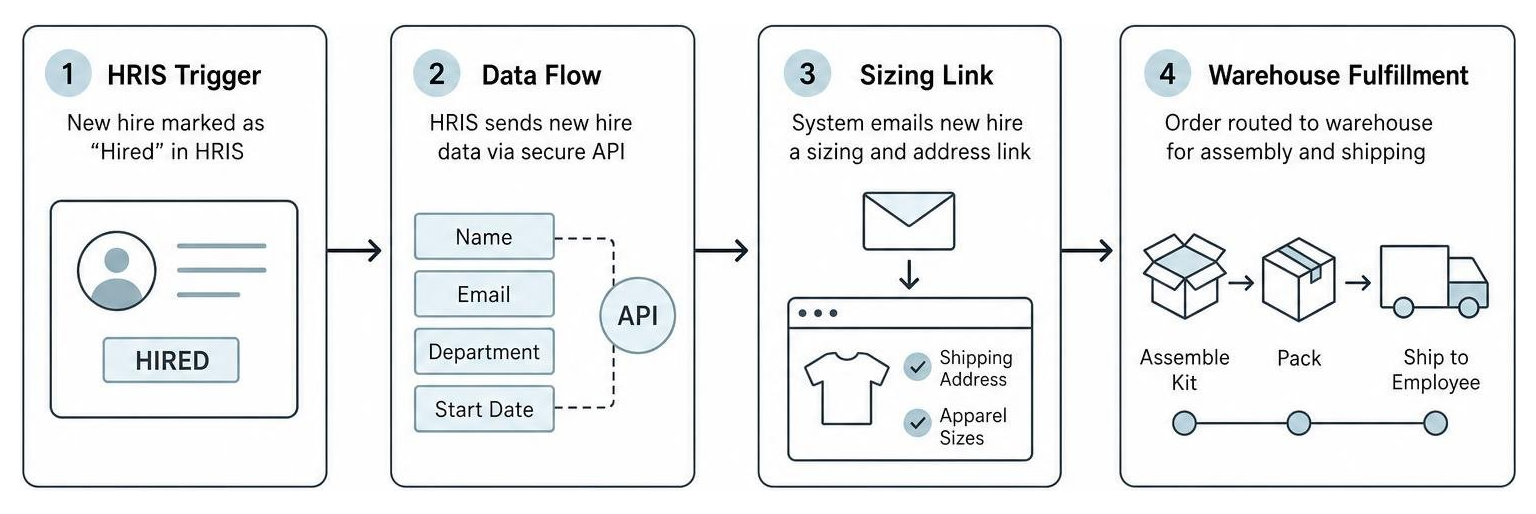
This architecture ensures that data flows seamlessly without human intervention. The process works in a simple, automated sequence:
- The Trigger: A candidate signs their offer letter in your applicant tracking system (such as Greenhouse or Lever), which automatically updates their status to "Hired" in your HRIS (like BambooHR or Workday).
- The Data Flow: The HRIS triggers a secure API webhook that sends the new hire's name, email, department, and start date to your custom company store database.
- The Sizing Link: The system automatically emails the new hire a secure, white-labeled landing page link. Here, they verify their shipping address and select their preferred apparel sizes.
- The Fulfillment: Once submitted, the order is automatically routed to our warehouse, where the kit is assembled, packed, and shipped.
By using role-based logic, you can automatically customize the kits. For example, developers can automatically receive specialized tech accessories and custom hoodies, while your sales team receives premium travel mugs and custom-embroidered polo shirts. For an in-depth look at how these systems connect, see my In-Depth Guide to Corporate Onboarding Kit Platform Integrations and learn How to Delay Custom Kits Without Ruining Your Automation.
Overcoming Compliance and Operational Challenges in Kit Automation
Automating physical goods across state lines or international borders introduces compliance and logistical challenges that most traditional swag vendors cannot support.
First, there is the risk of rogue spending. When department heads try to bypass corporate systems to order custom gifts from unvetted local vendors, they often violate brand guidelines and blow past budgets. By routing all physical kitting through a centralized, automated company store with built-in budget caps and manager approval chains, you lock in brand compliance and financial oversight automatically.
Second, global compliance requires strict adherence to local tax and shipping regulations. For companies with international hires, managing customs declarations, import duties, and specific regional requirements can stall deliveries. Implementing a structured compliance framework, such as the checklists found in the Global Onboarding & Offboarding Kit 2026 - HR Blue Prints, ensures your international shipping processes remain fully compliant with local labor and tax laws.
Frequently Asked Questions about HR Automated Onboarding Kits
What metrics should we track to measure onboarding kit success?
To measure the return on investment of your automated onboarding kit program, I recommend tracking four key operational metrics:
- Time-to-Productivity: How quickly a new hire completes their initial training and starts contributing to their role.
- Task Completion Rates: The speed at which new employees complete their preboarding compliance and documentation.
- Employee Net Promoter Score (eNPS): Feedback gathered during 30, 60, and 90-day check-ins regarding their first-day and onboarding experience.
- Retention Metrics: Comparing the first-year turnover rate of employees who received automated, premium welcome kits against those who did not.
How do we handle sizing and shipping address collection automatically?
The old way of collecting sizes involved endless back-and-forth emails, resulting in incorrect fits and expensive returns. The modern, automated solution is to use secure, self-selection landing pages.
When the HRIS trigger occurs, the new hire receives a personalized link to a white-labeled online portal. They input their own shipping details and select their apparel sizes from a live catalog. This eliminates data-entry errors, guarantees a perfect fit, and removes the burden of manual data collection from your HR team.
Can we automate physical kits without maintaining expensive inventory?
Yes. Traditional kitting models required companies to buy hundreds of items upfront, leading to high storage fees and obsolete merchandise when logos or roles changed.
At Apparel Boss, we solve this with a managed, scalable approach. We hold high-quality, blank retail-grade apparel in our warehouse. When an onboarding trigger occurs, we apply custom, artisan-level decoration—such as premium embroidery—on-demand. This "decorate-on-demand" model eliminates upfront inventory risks, cuts out storage fees, and ensures you never waste budget on dead stock.
Conclusion
Automating your onboarding kits is no longer a luxury reserved for tech giants. In July 2026, it is a operational necessity for any growing business that wants to protect its recruiting investment, eliminate administrative burnout, and build a unified company culture.
At Apparel Boss, we don't believe in cheap, throwaway swag. Led by my commitment to artisan-level decoration, we provide a premium, white-glove alternative to transactional commodity sites. We combine the ease of automated HRIS-triggered company stores with custom, retail-grade apparel and managed kitting services that ensure your brand is represented with the prestige it deserves.
If you are ready to stop tape-gunning boxes and start scaling your employee experience, let's build an automated system tailored to your business. Discover Apparel Boss Custom Kitting Services today and let's discuss how we can streamline your corporate merchandise program.