Why Distribution Inefficiency in Apparel Kits Is Costing Your Organization More Than You Think
Distribution inefficiency apparel kits is one of the most overlooked operational problems in corporate merchandise programs — and one of the most expensive.
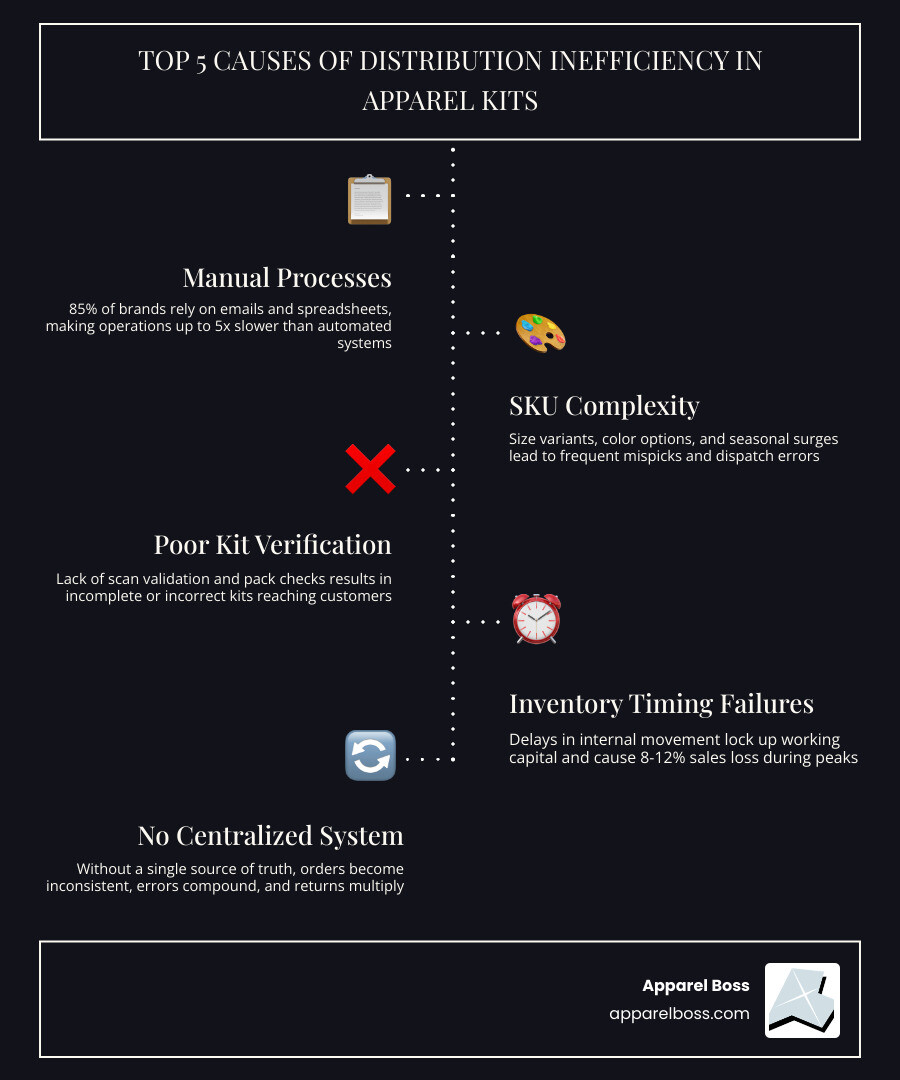
Quick answer: The main causes of distribution inefficiency in apparel kits are:
- Manual processes — 85% of brands still rely on emails and spreadsheets, making operations up to five times slower than automated systems
- SKU complexity — size variants, color options, and seasonal demand swings create frequent mispicks and dispatch errors
- Poor kit verification — missing scan validation and pack completeness checks lead to incomplete or incorrect kits reaching recipients
- Inventory timing failures — delays in internal movement lock up working capital and cause 8–12% sales loss during peak periods
- No centralized system — without a single source of truth, orders are inconsistent, errors compound, and returns multiply
If you're managing onboarding kits, uniform programs, or branded merchandise at scale, the problem rarely starts with the product itself. It starts before the box is sealed — in how kits are assembled, verified, routed, and tracked.
India's organized retail sector alone loses over US $215 million annually due to internal logistics inefficiencies. In one documented case, a 150-store fashion brand saw return times balloon from 0.2 to 13 days during a single sale period, tying up millions in working capital on inventory that was simply stuck in transit — not lost, not damaged, just delayed.
For growing organizations managing corporate apparel programs, the stakes are just as real. A new hire who doesn't receive their onboarding kit on day one. A product launch where branded kits arrive after the event. A remote team that gets the wrong size run because no one caught the error before dispatch.
These aren't random mistakes. They're the predictable result of manual, disconnected fulfillment systems.
This guide breaks down exactly why distribution inefficiency happens in apparel kitting — and what scalable, system-driven solutions actually look like in practice.
Solving distribution inefficiency apparel kits and the Cost of Manual Errors
In the business environment of April 2026, relying on "tribal knowledge" and manual entry is a recipe for disaster. When a company manages corporate apparel, it isn't just shipping a box; it is managing a complex web of sizes, styles, and branding requirements.
The research is clear: approximately 85% of brands still depend on emails and spreadsheets to manage their internal logistics. This reliance makes operations up to five times slower than automated systems. In a warehouse setting, manual processes achieve only a 30%–40% successful pickup rate on the first attempt. Compare that to automated systems, which boast a success rate of over 90%, and the gap becomes a chasm.
Manual errors aren't just annoying; they are a direct hit to the bottom line. Invoice errors occur in 10%–15% of cases, resulting in roughly 1,500 disputes each month for large-scale operations. When a human has to manually type in a SKU or verify a kit's contents without a digital safety net, the risk of "distribution inefficiency apparel kits" skyrockets.

For organizations in the New York metro area—from Suffolk County to the busy streets of Manhattan—these delays are amplified by the high cost of space and labor. Every hour a kit sits on a bench because of a spreadsheet error is an hour of wasted overhead. This is why custom kits must be handled through structured, software-driven workflows rather than ad hoc email chains.
Why SKU Complexity Drives distribution inefficiency apparel kits
Apparel is uniquely difficult to kit because of the "Matrix Problem." Unlike shipping a single electronic gadget, a single shirt design can exist in five colors and six sizes. That is 30 different SKUs for one item. When you multiply that by the various components of a kit—a jacket, a hat, and a bag—the permutations become staggering.
This SKU complexity is the primary driver of "artificial stockouts." This happens when the inventory physically exists in the warehouse, but because it was mislabeled or placed in the wrong bin during a seasonal surge, the system thinks it is gone.
The impact is measurable:
- Sales Loss: Delays in inventory movement lead to an estimated 8%–12% loss in potential sales during peak periods.
- Dispatch Errors: High SKU counts often lead to "incorrect store deliveries," where a truck leaves fully loaded, but half the cartons belong to a different location or contain the wrong size variants.
- Planogram Disruptions: When a corporate office or retail branch receives the wrong kit components, it disrupts the entire display or onboarding schedule.
Research on incorrect store deliveries in apparel retail highlights that these errors are rarely the result of lazy staff. Instead, they are the result of systems that cannot handle the velocity of modern apparel cycles, which have shortened from 90 days to just 15–20 days.
The Financial Impact of Logistics Bottlenecks on Corporate Programs
Logistics inefficiencies are a "silent killer" of working capital. In the organized retail sector, annual losses exceed Rs. 2,000 crore (approximately US $215 million). For a single brand, continuing to rely on manual systems can result in losses between $539,000 and $1.62 million annually.
These losses stem from three main areas:
- Tied-up Capital: Inventory stuck in "logistics limbo" cannot be used or sold.
- Reverse Logistics: The cost of shipping an incorrect kit back and then sending the right one is often double or triple the original shipping cost.
- Dispute Management: Spending administrative hours resolving 1,500 monthly invoice disputes takes leaders away from high-value growth tasks.
| Logistics Method | First-Attempt Pickup Success | Speed Comparison | Annual Loss Potential |
|---|---|---|---|
| Manual (Spreadsheets) | 30% - 40% | Baseline | High ($500k+) |
| Automated (WMS/AI) | 90%+ | 5x Faster | Minimal |
Strategic Solutions: Automation, Postponement, and Scalable Fulfillment
To solve distribution inefficiency apparel kits, organizations must move away from the "pick and pack" mentality and toward a "systems and strategy" approach. This often involves a "mixed-model" operation—using high-end automation for repetitive data tasks while leveraging human expertise for quality control and the tactile nature of apparel.
Strategic sourcing also plays a role. Buyers who focus on "relationality"—building deep, tech-integrated partnerships with their suppliers—showed much higher resilience during global disruptions than those who relied solely on transactional, just-in-time (JIT) models.
Implementing Postponement to Mitigate distribution inefficiency apparel kits
One of the most effective ways to balance flexibility with speed is a "postponement" strategy. Instead of pre-assembling 5,000 kits and letting them sit in a warehouse (taking up space and risking obsolescence), components are stored individually. The kits are only "built" once an actual order is placed.
This approach offers several benefits:
- Waste Reduction: You don't end up with 500 "Large" kits when everyone suddenly needs "Extra Large."
- Customization: It allows for last-minute additions, like a personalized note or a specific event-themed insert.
- Sustainability: By reducing overproduction, brands can avoid the "fast fashion" trap seen in industries like professional sports, where kit lifecycle sustainability is often undermined by massive waste and unsold stock.
Leveraging Technology for Pack Completeness and Accuracy
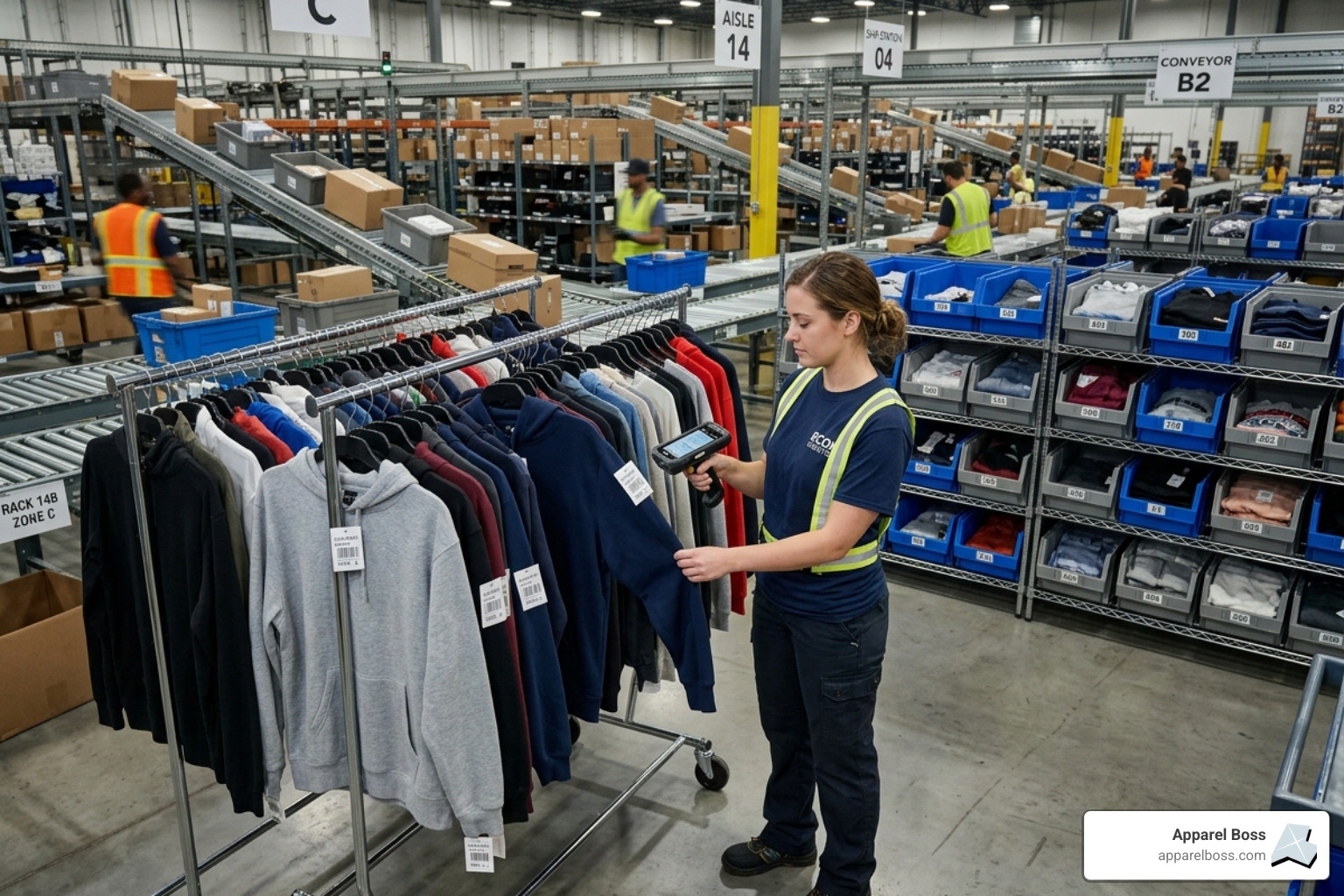
The "final mile" of the kitting process is the most dangerous for errors. A picker might grab the right shirt but forget the branded water bottle that goes with it. To fix this, modern fulfillment centers use "pack completeness checks."
This involves a two-layer verification system:
- Scan Validation: Every item must be scanned into the box. If the SKU doesn't match the order, the system locks the shipment.
- Weight Gates: The system knows exactly what the final kit should weigh. If a kit is missing a single component, the weight will be off by a few grams, triggering a manual review.
According to research on reducing returns with pack checks, these "hard stops" in the process are the only way to reliably eliminate the "silent errors" that lead to high return rates and poor brand perception. Additionally, AI courier allocation can be used to select the best shipping route in real-time, ensuring that once a kit is perfectly packed, it actually arrives on time.
Transitioning from Spreadsheets to Online Company Stores
The ultimate solution to distribution inefficiency apparel kits is removing the "middleman" of manual data entry. For many organizations in Long Island or New York City, this means implementing an online company store.
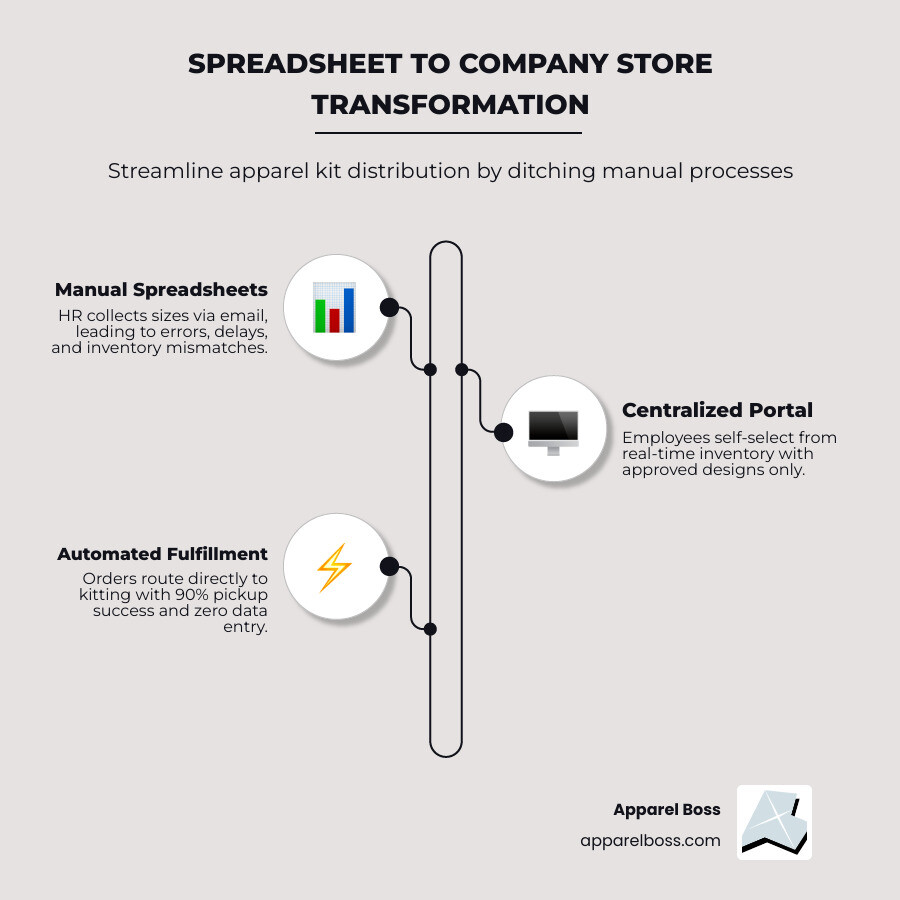
Instead of an HR manager collecting sizes in a spreadsheet and emailing a vendor, employees or department heads log into a centralized portal. The system handles the logic:
- Real-time Inventory: If a size is out of stock, the user knows immediately.
- Branding Consistency: Only approved designs and colors are available.
- Automated Routing: Orders flow directly into the fulfillment system without human intervention.
This move to professional online company stores transforms a chaotic manual process into a streamlined, 24/7 operation. It ensures that "swag chaos" is replaced by a predictable, scalable infrastructure.
Building a Resilient Merchandise Infrastructure
At Apparel Boss, we have seen how distribution inefficiency apparel kits can stall the growth of even the most successful organizations. Whether it's a production stall in a custom shirt run or a slow bag fulfillment process, the root cause is almost always a lack of structure.
By moving toward automated kitting, implementing postponement strategies, and centralizing ordering through company stores, businesses can turn their merchandise programs from a headache into a strategic advantage. This isn't just about shipping shirts; it's about protecting your brand's reputation and ensuring your team has what they need, exactly when they need it.
If your organization is currently feeling the friction of manual logistics—missing components, delayed shipments, or spreadsheet fatigue—it is time to optimize your custom kitting strategy. Building a resilient infrastructure today ensures you can scale tomorrow without the weight of fulfillment errors holding you back.
How to Delay Custom Kits Without Ruining Your Automation