
Why a B2B Apparel Fulfillment Partner Matters for Corporate Programs
A B2B apparel fulfillment partner manages the storage, quality checks, kitting, ordering, and delivery of branded apparel and merchandise for business programs. In practical terms, the right partner helps your team run an online company store, ship employee onboarding kits, replenish inventory across locations, and keep every order on-brand without creating more work for HR, marketing, or operations.
Unlike a standard warehouse that simply moves cartons, corporate apparel fulfillment requires control over details that protect your brand:
- Accurate size, color, and decoration tracking
- Consistent embroidery, printing, packaging, and kit assembly
- Inventory visibility across departments, locations, and programs
- Reliable shipping for bulk orders and individual employee deliveries
- Simple reordering through a managed company store or portal
For decision-makers, the goal is not just faster shipping. It is a dependable system that prevents wasted inventory, wrong-size shipments, inconsistent branding, and last-minute distribution problems. A capable fulfillment partner becomes the operational layer behind a scalable merchandise program.
I’m Salvatore Vento, Marketing Director at Apparel Boss, where I help teams build more reliable branded apparel and merchandise programs. My work with a B2B apparel fulfillment partner approach centers on improving quality control, reducing administrative friction, and making high-volume reorders easier as programs grow.
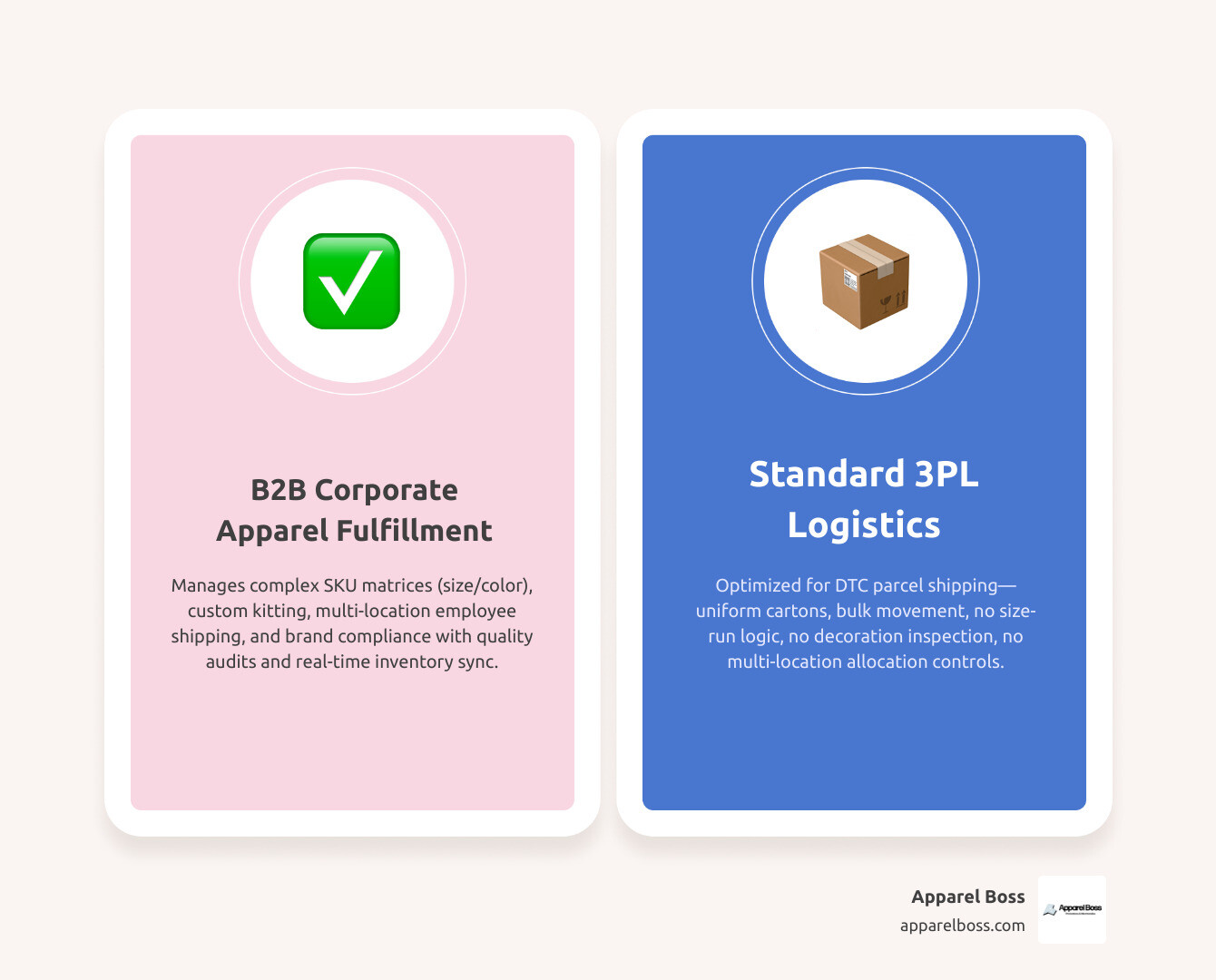
B2B Corporate Apparel Fulfillment vs. Standard 3PL Logistics: Key Differences and Program Challenges
Standard third-party logistics (3PL) providers are optimized for traditional direct-to-consumer (DTC) parcel shipping—packing uniform cardboard boxes and rushing them out the door. However, managing enterprise corporate apparel programs introduces structured requirements that generic warehouses simply are not equipped to execute.
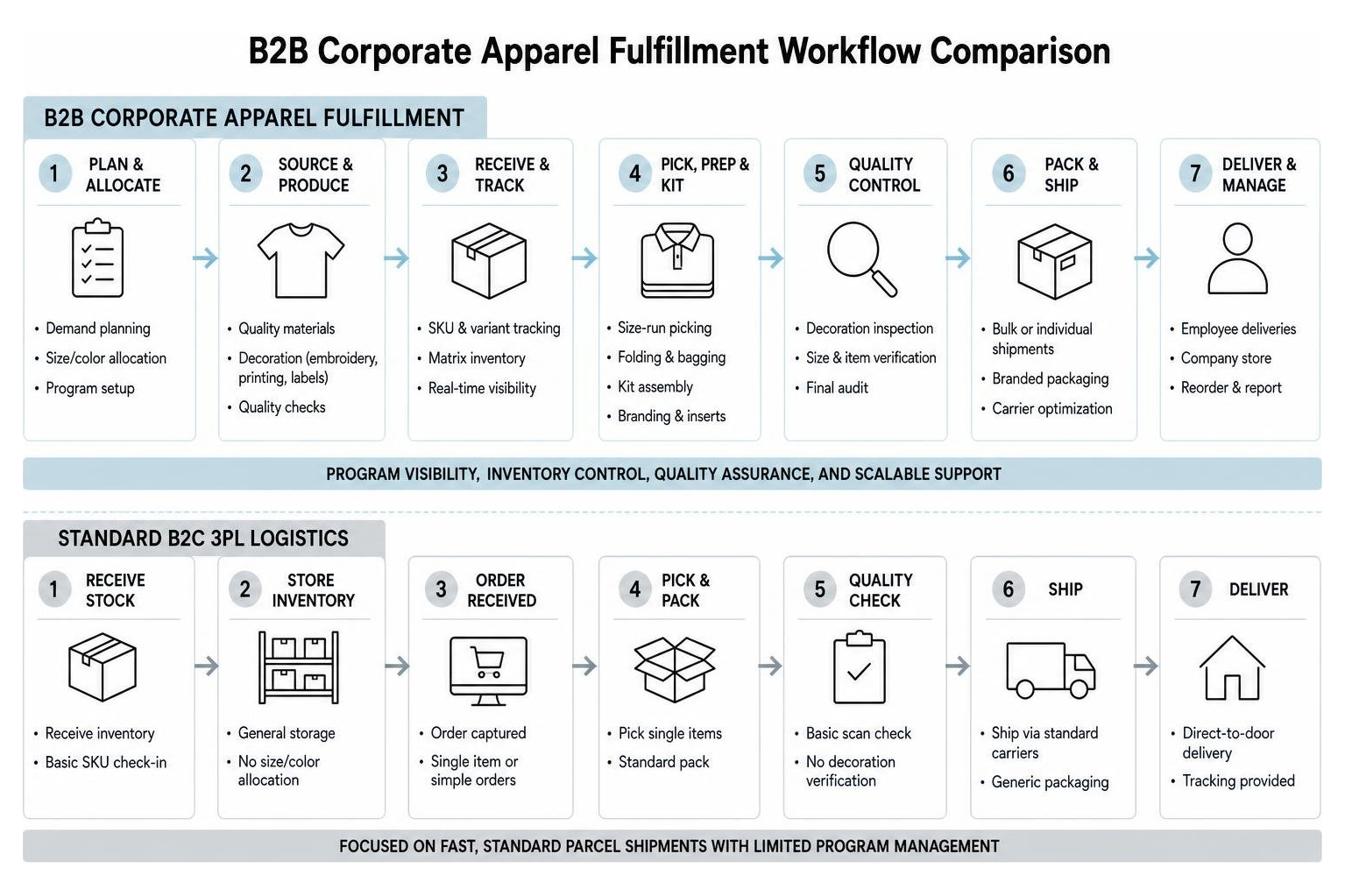
When evaluating a specialized B2B apparel fulfillment partner, understanding the operational differences between bulk business distribution and basic B2C fulfillment is essential:
| Operational Feature | Standard B2C 3PL Logistics | B2B Corporate Apparel Fulfillment |
|---|---|---|
| Order Structure | Single-item parcel shipments directly to consumers | Mixed-SKU bulk orders, size-run distributions, and targeted employee drops |
| Inventory Complexity | Basic SKU picking by product type | Deep matrix allocation across styles, colors, unisex/women's sizing, and decoration methods |
| Handling Requirements | Standard box packing with generic protective void fill | Garment-specific folding, steam-freshening, protective polybagging, and custom kitting |
| Recipient Experience | Standard shipping notification and parcel tracking | Managed concierge portals, centralized approval workflows, and branded unboxing |
| Quality Control | Automated barcode scanning at pack-out | Multi-point inspection of custom embroidery, logo alignment, and item finish |
Running corporate merchandise through general parcel warehouses frequently results in fragmented distribution, stockouts in popular sizes, and high administrative overhead. Partnering with a provider offering specialized B2B fulfillment services bridges the gap between premium branding and execution.
Managing High SKU Complexity and Size/Color Variants in Corporate Programs
Corporate apparel catalogs carry inherent SKU complexity. A single corporate outerwear style offered in two colors across seven sizes (XS through 3XL) creates 14 distinct SKUs. Expand that across a complete corporate merchandise program, and your team is suddenly managing hundreds of active inventory variants.
Without matrix logic and real-time variant tracking, programs suffer from uneven size depletion—where medium and large sizes sell out immediately while peripheral sizes sit idle. A dedicated partner utilizes high-accuracy inventory controls and structured SKU hierarchy to maintain balanced stock levels and eliminate stockout bottlenecks before seasonal company store drops.
Overcoming Multi-Location Inventory Bottlenecks
Multi-location organizations face constant friction when distributing corporate gear across regional offices, satellite branches, and remote team members. When inventory is managed across disjointed spreadsheets, overselling and allocation delays inevitably follow.
Integrating your ordering portal with a streamlined fulfillment engine ensures automatic channel allocation. To establish an efficient inventory foundation, learning how to choose the right merchandise vendor for your business helps safeguard your program against inventory fragmentation across corporate sites.
Strategic Criteria for Selecting a B2B Corporate Apparel Fulfillment Partner
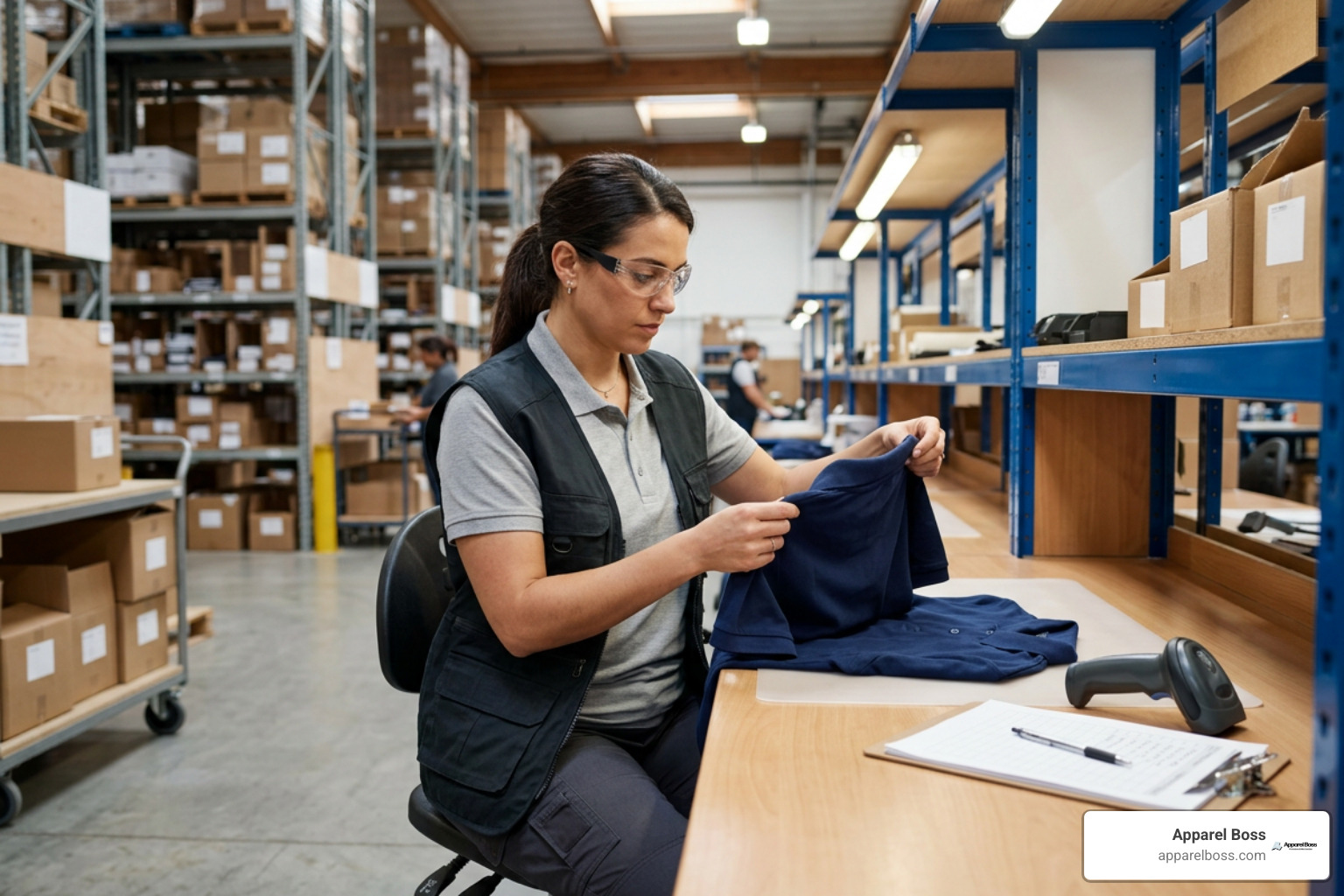
Selecting the right partner requires looking beyond warehouse storage rates. You need an operational partner capable of maintaining strict quality standards at scale while integrating directly into your corporate workflow.
When auditing fulfillment facilities, prioritize partners that combine modern logistics technology with specialized garment expertise, such as high-touch custom kitting solutions.
Key Technology Requirements for Your B2B Apparel Fulfillment Partner
Your fulfillment partner's tech stack directly dictates how smooth your corporate program runs. Key technological capabilities to demand include:
- Seamless Company Store Integration: Direct API connections between online portals and warehouse management software (WMS).
- Real-Time Inventory Synchronization: Live stock level updates to prevent order backlogs and ghost inventory.
- Automated Order Routing: Intelligent routing rules that automatically assign orders to the appropriate fulfillment workflow based on department budget codes.
- Multi-Department Portal Access: Centralized admin dashboards that grant managers visibility into usage metrics and regional spending patterns.
Value-Added Services Offered by a Premium B2B Apparel Fulfillment Partner
Commodity warehouses pick and ship. A premium B2B apparel fulfillment partner provides value-added services (VAS) that protect your physical brand assets:
- Decoration & Embroidery Quality Audits: Inspecting stitch density, thread tension, and logo placement prior to packaging.
- Kitting & Custom Unboxing Assembly: Assembling multi-item welcome kits, executive gift boxes, and event bundles with precision.
- Garment Re-Conditioning: Professional fold-and-bag standards, lint-rolling, and steam-freshening so apparel arrives ready-to-wear.
- Custom Labeling & Re-Tagging: Adding custom woven labels or printed neck tags for a custom, retail-grade feel.
Reviewing a comprehensive step-by-step guide to promotional swag management service illustrates how integrated value-added services eliminate internal labor for your team.
Eliminating Quality Control Errors, Ensuring Brand Consistency, and Streamlined Logistics
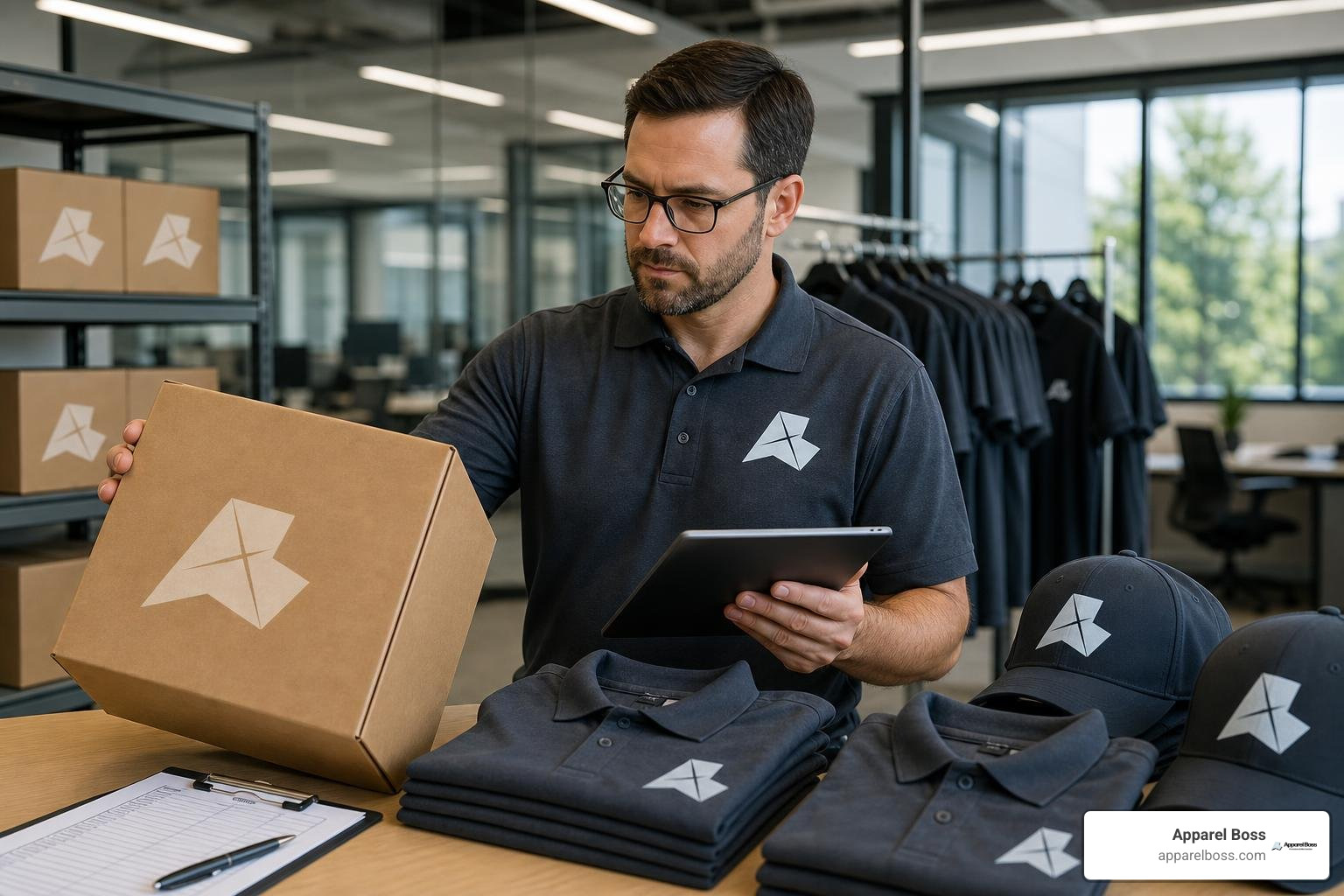
Nothing undermines a corporate brand initiative faster than an executive receiving a kit with crooked logo embroidery or an employee opening an onboarding package missing half its contents. Quality control in corporate fulfillment is about maintaining total brand alignment.
Maintaining Brand Standards and Eliminating Fulfillment Errors
High-volume B2B orders demand rigorous accuracy controls. Unlike individual consumer orders, corporate shipments often serve strict event deadlines or office launch dates.
A specialized fulfillment process incorporates multi-point verification checkpoints—from inbound receiving through final master case packing—ensuring that items meet precise decoration, sizing, and quantity specs before dispatch.
Garment Quality Control and Custom Kitting Operations
Garments require specialized care during storage and assembly. Standard pick-and-pack operators often cram delicate apparel into undersized mailers, causing heavy creasing and damaged decoration.
By combining specialized garment handling with automated assembly, brands gain access to fast custom apparel production and fulfillment for brands in a hurry, ensuring fast turnarounds without sacrificing presentation.
Dedicated Corporate Merch Facilities vs. General 3PL Warehouses
Where your inventory is stored directly impacts its condition and longevity. Storing high-end corporate apparel in general industrial warehouses alongside dusty auto parts or unsealed liquid goods risks fabric degradation and odor contamination.
Infrastructure Built for Garment Care and Program Scaling
Dedicated apparel facilities are engineered specifically for textile preservation and efficient garment picking:
- Climate-Controlled High-Density Racking: Protecting technical fabrics and decorated garments from dust, moisture, and extreme temperatures.
- Garment-On-Hanger (GOH) & Clean Storage Options: Preserving structured outerwear and tailored garments without permanent folding creases.
- Optimized Apparel Pick Paths: Grouping apparel by style and size matrix rather than standard pallet bins to drastically improve pick speed and picking accuracy.
Supporting Corporate Program Growth and Nationwide Distribution
As your organization expands, your merchandise distribution network must keep pace. Utilizing strategically located distribution hubs in the New York region—including dedicated facilities across Long Island, Suffolk County, and Nassau County—allows ground shipping to reach major corporate centers within 1 to 2 business days.
Connecting centralized fulfillment hubs to streamlined online concierge company stores establishes a complete corporate ecosystem that scales effortlessly as your headcount grows.
Frequently Asked Questions About B2B Apparel Fulfillment
What is the main difference between B2B corporate apparel fulfillment and standard 3PL logistics?
Standard 3PL logistics focus primarily on direct-to-consumer parcel shipping of individual boxed items. B2B corporate apparel fulfillment handles complex size matrices, customized embroidery inspection, custom kitting, multi-location office distribution, and integration with managed online company store portals.
How does a B2B fulfillment partner ensure quality and order accuracy for company programs?
A specialized partner enforces multi-point quality control checks, including visual logo verification, barcode scanning across individual SKU size runs, photo documentation during assembly, and weight-based pack-out audits to eliminate missing or incorrect items.
Why is specialized garment handling necessary for corporate apparel programs?
Apparel requires fabric-safe storage environment controls, precise folding, protective polybagging, and gentle handling to prevent embroidery distortion, creasing, or fabric damage during storage and transit.
Conclusion: Scaling Corporate Apparel and Merch Distribution
Managing a corporate apparel program should never burden your internal team with logistics chaos, lost inventory, or quality control headaches. By moving away from transactional promo distributors and partnering with a dedicated B2B apparel fulfillment partner, you turn physical merchandise into an asset that reinforces your brand's prestige.
At Apparel Boss, led by industry expert Salvatore Vento, we eliminate the "Quality-at-Scale" dilemma for organizations that demand absolute quality. Our white-glove corporate distribution systems—anchored by custom embroidery, managed custom kitting, and streamlined online concierge company stores—ensure every piece arrives in pristine condition.
Ready to elevate your corporate merchandise program with reliable execution? Connect with our team today to explore how a tailored B2B fulfillment system can streamline your enterprise distribution.