
Understanding Custom Apparel Production Fulfillment vs. Traditional Manufacturing
Custom apparel production fulfillment is the end-to-end process of manufacturing, storing, picking, packing, and shipping branded garments directly to customers or employees - and for growing organizations, getting it right is one of the most operationally complex challenges they face.
If you need the short version before diving deeper:
What custom apparel production fulfillment includes:
| Step | What Happens |
|---|---|
| Production | Garments are manufactured or decorated (screen printing, embroidery, DTG, etc.) |
| Receiving | Finished items are logged and stored at a fulfillment center |
| Inventory Management | Stock levels are tracked in real time via a WMS or integrated platform |
| Order Processing | Customer or employee orders trigger automated pick-and-pack workflows |
| Shipping | Orders are dispatched via carrier networks, domestically or internationally |
| Returns Handling | Reverse logistics manage exchanges, defects, and restocking |
The stakes are high. Traditional manufacturing models force brands to over-order, sit on inventory, and manage multiple vendors across production, decoration, and logistics. The result is wasted budget, delayed delivery, and a fulfillment process that breaks down as soon as demand spikes.
One widely cited industry stat puts this in sharp focus: roughly 1 in 5 garments produced through traditional models is discarded without ever being sold. That kind of overproduction is not just a cost problem - it's a scaling problem. For additional context on how excess inventory contributes to broader waste issues in the apparel sector, the U.S. Environmental Protection Agency's overview of textile waste is a useful reference.
For operations teams, HR leaders, and marketing managers running branded merchandise programs, the question is not whether to outsource fulfillment. It's how to find a system that connects production directly to distribution without creating more administrative overhead in the process.
This guide breaks down how modern custom apparel production fulfillment works, which model fits your volume and goals, and what to look for in a fulfillment partner built for business programs - not one-off orders.
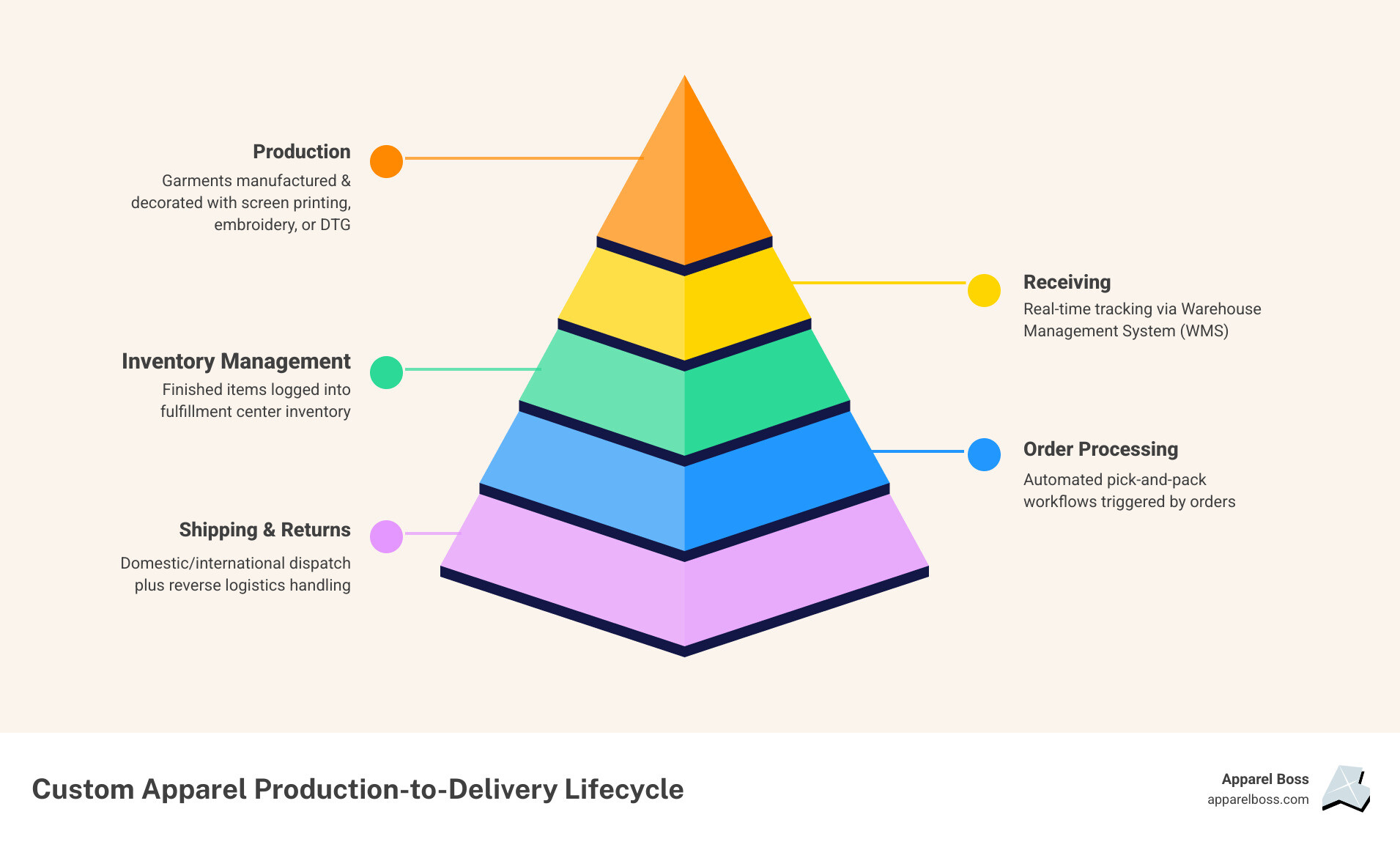
In the past, apparel production was a fragmented mess. A company would buy blank shirts from one vendor, send them to a local print shop in Long Island or Suffolk County for decoration, and then haul the boxes back to their own office. Someone from HR or marketing would then spend their Friday afternoon "picking and packing" orders for new hires.
Modern custom apparel production fulfillment replaces this chaos with a vertically integrated system. Instead of acting as a middleman between three different companies, businesses now partner with providers that handle the entire lifecycle under one roof. This shift moves the burden of Our Fulfillment Services from your office closet to a professional facility equipped with a Warehouse Management System (WMS).
The primary difference lies in risk management. Traditional manufacturing requires high Minimum Order Quantities (MOQs), forcing you to guess how many "Medium" hoodies you might need six months from now. Integrated fulfillment models allow for more agile sourcing, often starting with lower MOQs-sometimes as low as 50 units-to help brands test designs without the "inventory graveyard" effect.
The Impact of In-House Production on Lead Times
When production and fulfillment happen in the same building, the "logistics lag" disappears. In a traditional setup, shipping finished goods from a printer to a separate warehouse can add a week to your timeline. By Mastering Your Brand with In-House Apparel Production, brands can see bulk orders completed in as little as 15-20 business days.
For businesses in the New York tri-state area, local production means even faster transit times. When the facility is in Deer Park or Nassau County, the "last mile" of delivery to your Manhattan office or Long Island regional hubs is significantly compressed. This speed is non-negotiable for organizations that need to react to sudden growth or event-driven demands.
Eliminating Wasted Inventory through Strategic Sourcing
Overproduction is the silent killer of corporate budgets. As noted earlier, 20% of garments in traditional models are wasted. This happens because companies order "safety stock" to avoid the pain of reordering.
Modern fulfillment solves this by utilizing "on-demand" production for slower-moving items and bulk production only for high-demand staples. This hybrid approach ensures you aren't paying to store 500 shirts that no one wants to wear, while still maintaining enough stock for your core team needs.
Strategic Models for Custom Apparel Production Fulfillment: POD vs. Bulk
Choosing the right model depends on your specific business goals. Are you launching a permanent employee store, or do you need 1,000 shirts for a single conference?
| Feature | Print-on-Demand (POD) | Bulk Manufacturing |
|---|---|---|
| Inventory Risk | Zero | Moderate to High |
| Upfront Cost | Low | High |
| Unit Cost | Higher | Lower |
| Turnaround | 3-10 Days | 15-20 Days |
| Customization | Standard | Unlimited |
Most successful programs use a mix of both. For example, you might use Direct to Film & Screen Printing for your high-volume annual uniforms, while using POD for seasonal "fun" designs.
The Role of Print-on-Demand in Custom Apparel Production Fulfillment
Print-on-demand (POD) has evolved far beyond basic t-shirts. Technologies like DIGISOFT printing now offer vibrancy and durability that rival traditional screen printing, but without the need for MOQs.
For an HR leader, POD is a lifesaver. It allows you to offer a wide variety of styles, colors, and sizes on a company store without ever cutting a check for inventory. The item is only produced after the employee clicks "order." This "pull" system is the ultimate solution for brands that want to offer variety without the financial headache, enabling organizations to test new designs or seasonal offerings without committing to large inventory overhead.
Optimizing Costs within Custom Apparel Production Fulfillment
To keep costs under control, you must look beyond the "price per shirt." Professional fulfillment involves several fee layers:
- Pick & Pack Fees: The labor cost of grabbing the item and putting it in a box.
- Storage Fees: The monthly cost of your inventory taking up shelf space.
- Packaging Costs: Branded boxes, polybags, or tissue paper.
If your inventory isn't moving, storage fees will eat your margins. This is why Slow Bag Fulfillment and Shirt Production Stalls Explained is such a common complaint—bottlenecks in production lead to higher storage costs for the components that are just sitting there waiting.
Solving Operational Pain Points with Integrated Technology
The "secret sauce" of modern fulfillment isn't the printing press—it's the software. A robust Warehouse Management System (WMS) ensures that when an order is placed on your website, the warehouse team sees it instantly.

Streamlining Distribution via Online Company Stores
The most efficient way to manage custom apparel production fulfillment is to Stop the Swag Chaos with Professional Online Company Stores. Instead of collecting sizes on a spreadsheet, you provide employees with a centralized, branded portal.
These Company Stores allow for:
- Budget Controls: Give departments "points" or credits to spend.
- Approval Workflows: Ensure managers sign off on large orders.
- Real-Time Inventory: If a shirt is out of stock, it disappears from the store automatically.
Automated Order Processing and Error Reduction
Manual data entry is where fulfillment goes to die. Top-tier providers boast an error rate of less than 0.001% because they use barcode scanning at every stage—from the moment the fabric is cut to the moment the shipping label is applied.
When you Simplify Ordering: Corporate Custom Apparel Stores, you're not just buying shirts; you're buying a system that can handle 40,000+ units daily without breaking a sweat.
Scaling Global Distribution and Custom Kitting
As companies grow, they often need to ship to remote employees across the country or even worldwide. This is where Custom Kits become essential. A "New Hire Kit" might include a branded hoodie, a notebook, and a welcome letter, all beautifully presented in a custom box.
Enhancing Brand Identity with Custom Packaging
The "unboxing experience" isn't just for influencers; it's a powerful tool for employee engagement. Customizing your packaging with private labeling, branded hang tags, and unique inserts makes a standard delivery feel like a gift. This level of customization ensures that every touchpoint reinforces your brand's premium positioning and professional image.
Managing High-Volume Events and Product Drops
Sometimes you need gear yesterday. Whether it's a sudden trade show or a last-minute team-building event, you need Fast Fulfillment: Branded Gear Because Your Team Needed Those Shirts Yesterday.
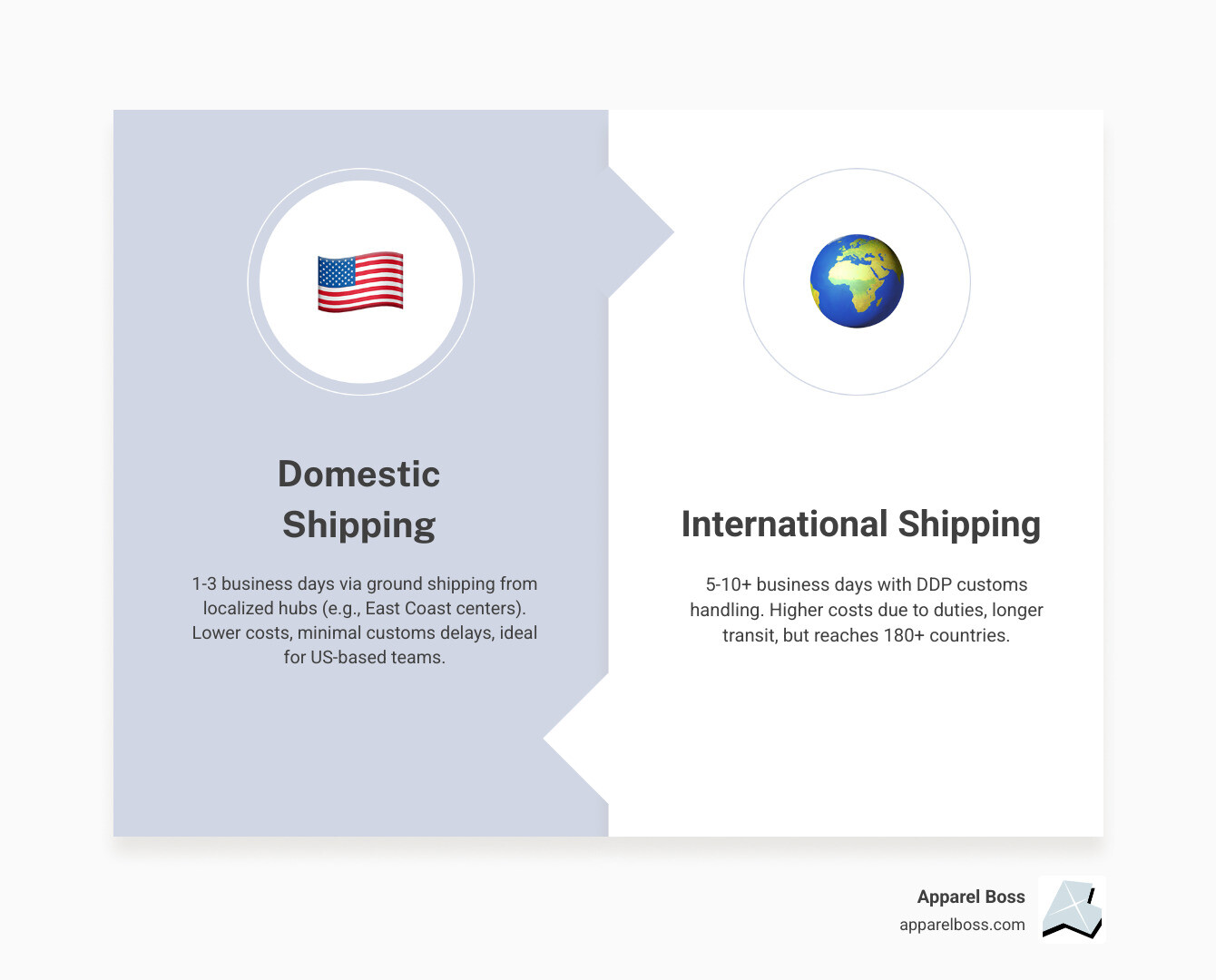
Strategic fulfillment providers use dual-hub systems or localized centers (like those in Long Island and New York City) to ensure that ground shipping reaches your destination in 1-3 days.
Frequently Asked Questions about Custom Apparel Production Fulfillment
What are the typical minimum order quantities (MOQs) for custom production?
While traditional factories might demand 500+ units, many modern providers offer low-MOQ options starting at 50 to 100 units per design. This is ideal for startups or specialized corporate teams that don't need a mountain of inventory, allowing for greater flexibility in program management and budget allocation.
How do fulfillment services handle returns and exchanges?
Professional providers manage "reverse logistics." This means they provide a return portal for your employees, inspect returned items for quality, and either restock them or handle the exchange. This service is often integrated into the WMS, ensuring your inventory levels remain accurate and your team isn't bogged down by administrative tasks.
What is the standard turnaround time for domestic vs. international orders?
Domestic orders typically arrive in 3-5 business days once they leave the facility. International shipping can take 7-14 days depending on customs and local carrier networks. Working with a vertically integrated production partner ensures that the initial outbound leg is as fast as possible for US-based teams, particularly those operating in major hubs like New York.
Conclusion
Managing a corporate merchandise program shouldn't feel like a second full-time job. By moving to a structured system for custom apparel production fulfillment, businesses can eliminate the "swag chaos" that leads to wasted budgets and frustrated employees.
Apparel Boss acts as a strategic partner, helping you transition from fragmented ordering to a streamlined, scalable system. Whether you are looking to launch an online company store, automate your employee onboarding kits, or simply find a more reliable way to produce and ship your branded gear, our focus is on reducing your administrative workload so you can focus on your core business.
Ready to stop counting boxes and start scaling your brand? Explore Our Fulfillment Services and see how we can simplify your operations today.