Why Most Companies Are Overpaying for Swag — And How to Fix It
A promotional swag management service is a centralized system that handles the sourcing, storage, customization, and distribution of branded merchandise — replacing the fragmented, manual processes most companies still rely on today.
Here's what a modern swag management service typically includes:
| Function | What It Solves |
|---|---|
| Online company store | Eliminates ad-hoc ordering and rogue spend |
| Automated fulfillment | Removes manual shipping coordination |
| Inventory tracking | Prevents stockouts and warehouse clutter |
| Brand controls and approvals | Ensures logo and design consistency |
| HRIS and DAM integrations | Triggers automatic swag sends for onboarding and events |
| Global distribution | Handles customs, duties, and multi-region delivery |
The scale of the problem is larger than most teams realize. The average company spends upwards of $185,000 annually on promotional products — yet much of that budget is absorbed by storage fees, overproduction, shipping errors, and items that never get used.
Managing swag manually is an operational bottleneck disguised as a marketing function. HR teams are tracking inventory in spreadsheets. Marketing teams are chasing vendors for mockups. Operations teams are storing boxes in office closets. The result is wasted budget, delayed onboarding kits, and branded merchandise that fails to make an impression.
A structured swag management service shifts that entire workflow into a single, scalable system — giving operations, HR, and marketing teams back the time they're currently losing to logistics.
I'm Salvatore Vento, Marketing Director at Apparel Boss, where I've spent years helping scaling teams replace inefficient, one-off merchandise orders with structured promotional swag management service programs built for consistency, speed, and measurable ROI. In the sections below, I'll walk you through exactly how to evaluate, implement, and optimize a swag management system for your organization.
The Operational Cost of Traditional Swag Sourcing
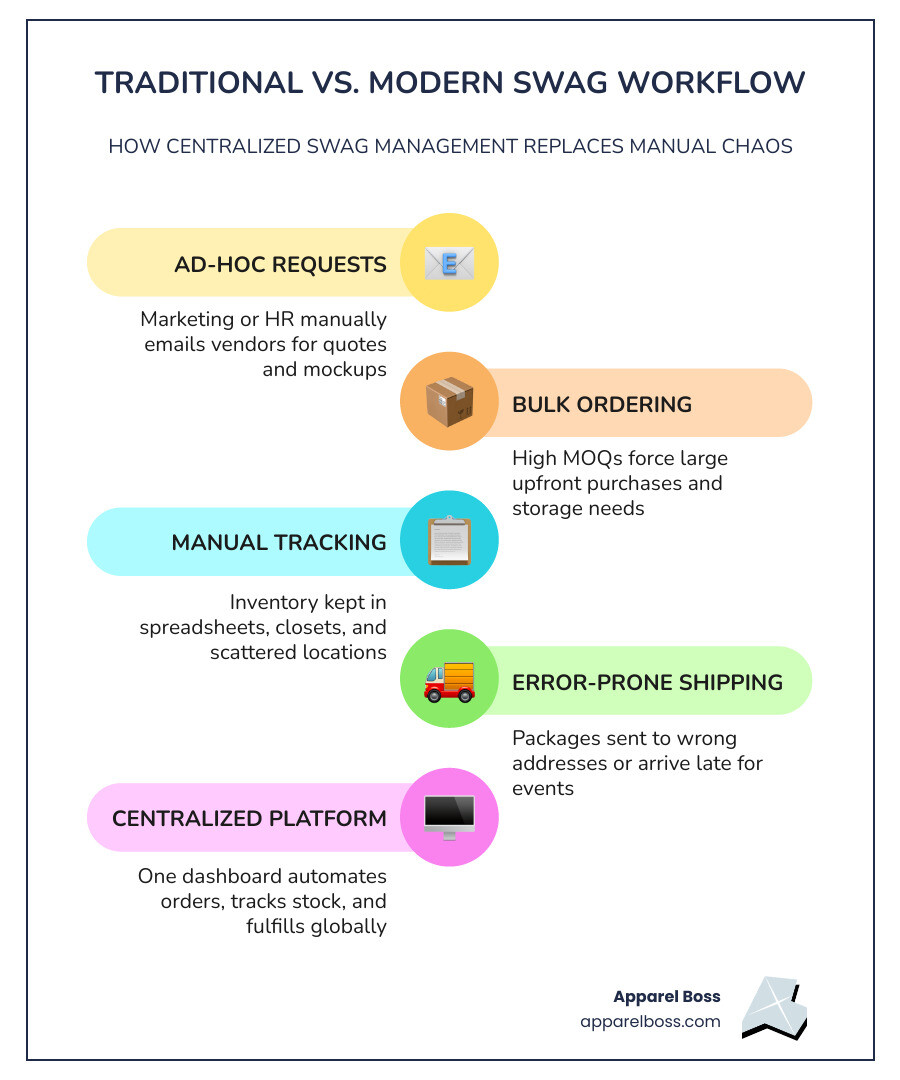
When companies purchase promotional products through traditional, ad-hoc methods, they often overlook the hidden operational drains. Traditional sourcing is highly manual: someone from your marketing or HR team must find a local vendor, email back and forth to finalize designs, approve physical or digital mockups, purchase in high bulk minimums, and then figure out where to store the products.
These manual touchpoints create massive administrative overhead. If you are trying to coordinate custom apparel across multiple offices in Long Island, Suffolk County, or New York City, the labor hours quickly add up. Furthermore, without a centralized system, shipping errors run rampant. Packages are sent to the wrong remote employee addresses, or items arrive late for critical corporate events.
To understand the true impact of these operational inefficiencies on your bottom line, it is essential to calculate The ROI of Branded Merchandise. When your team spends hours acting as fulfillment clerks, the return on your marketing investment drops significantly.
The Impact of Manual Inventory Tracking
If you have ever stepped into a corporate office and seen a closet overflowing with random boxes of branded t-shirts, water bottles, and notebooks, you have witnessed the failure of manual inventory tracking.
- Cluttered Closets & Wasted Space: Premium office space in New York is too expensive to be used as an unorganized fulfillment center.
- Storage and Warehousing Fees: If you use a standard third-party logistics (3PL) center that does not specialize in promotional items, you will face high, complex storage fees that eat into your budget.
- Frequent Stockouts: Without automated alerts, you only realize you are out of onboarding hoodies when a new hire starts, leading to rush production fees.
- Manual Audits: Forcing an administrative assistant to count pens and notebooks every quarter is an inefficient use of company time.
Sizing and Quality Inconsistencies
One of the biggest issues with bulk ordering apparel without a structured platform is sizing. Companies often order a generic bell-curve distribution of sizes (e.g., medium, large, extra-large), only to end up with a surplus of smalls and triple-XLs that sit in storage forever.
Even worse, when you work with multiple uncoordinated vendors, the quality fluctuates wildly. A logo printed by one vendor in Nassau County might look entirely different from an embroidered logo sourced by a different team member. This inconsistency leads to brand dilution. If your employees receive cheap, ill-fitting apparel, they simply won't wear it, leading to low adoption rates and wasted capital.
What is a Promotional Swag Management Service?
A promotional swag management service unifies the entire lifecycle of custom corporate merchandise into a single digital platform. Instead of emailing spreadsheets and vendor invoices, you log into a centralized dashboard to design, order, store, and ship your items.
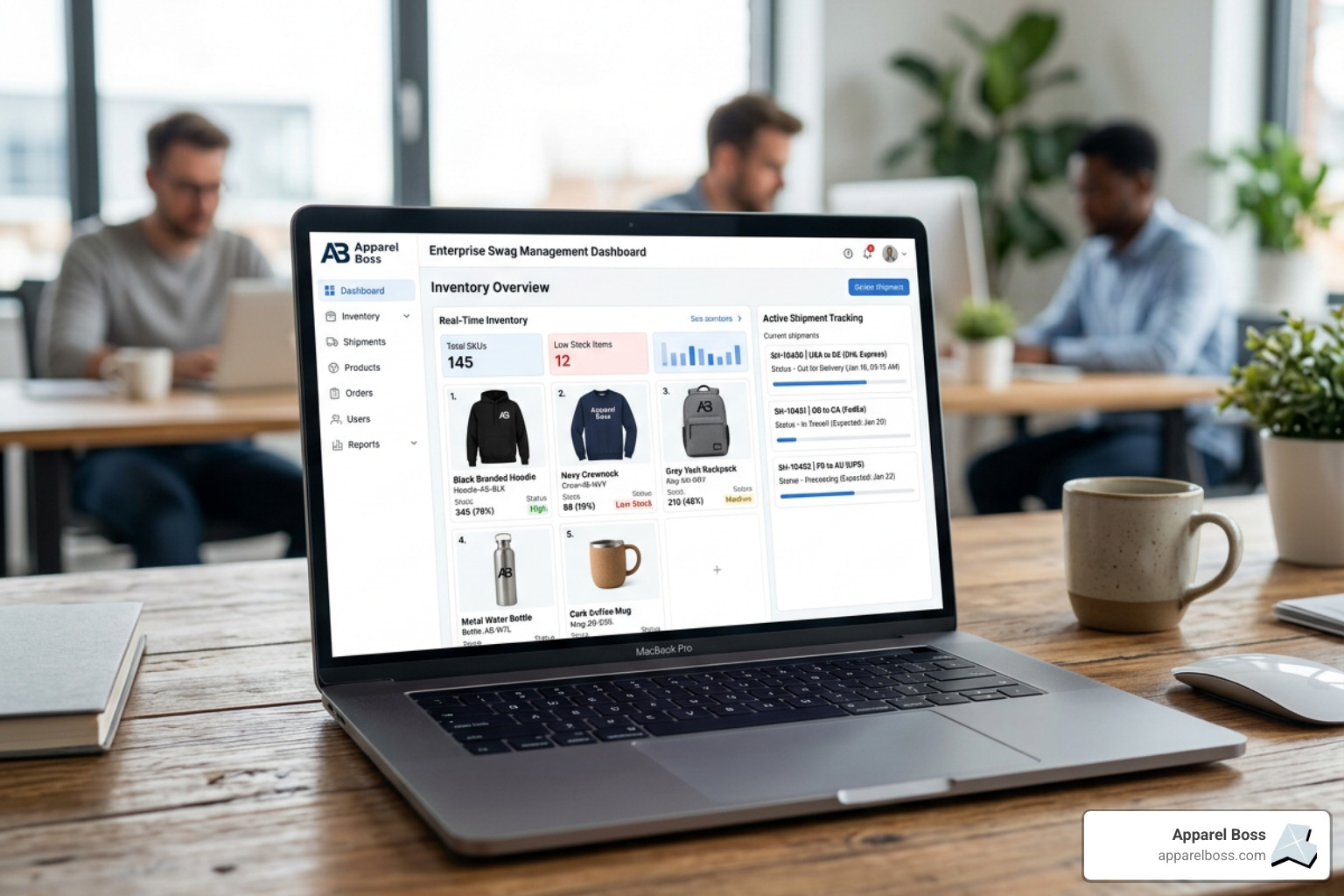
By integrating in-house production with cloud-based software, a modern swag management service provides real-time visibility into inventory levels, automated shipping, and on-demand local production capabilities. Whether you are distributing items to remote employees across New York or coordinating a major corporate conference, you can manage the entire program with a few clicks using Apparel Boss Swag Management Services.
Key Features of an Enterprise Promotional Swag Management Service
For enterprise teams managing merchandise across multiple departments and regions, a simple online shopping cart is not enough. You need robust, enterprise-grade features that integrate directly into your existing corporate tech stack:
- DAM (Digital Asset Management) Integration: Connects your verified brand guidelines, logos, and digital assets directly to the platform. This guarantees that only approved, high-resolution artwork is used for production.
- SSO (Single Sign-On) Access: Simplifies login security, allowing your employees, sales teams, or regional managers to access the swag portal securely using their existing corporate credentials.
- HRIS Automation: Integrates with systems like Workday, BambooHR, or Rippling. When a new hire is added to your HR system, it automatically triggers the swag platform to send a personalized onboarding kit to their home address.
- Budget and Approval Controls: Allows administrators to assign specific spending limits or points-based allowances to different departments, managers, or sales reps, with built-in manager approval workflows.
Traditional Ordering vs. Modern Promotional Swag Management Service
To see how these two models compare operationally, look at the differences in execution:
| Feature | Traditional Ordering | Modern Swag Management Platform |
|---|---|---|
| Ordering Process | Back-and-forth emails, manual quotes | Self-serve digital UI, instant mockups |
| Minimum Order Quantities (MOQs) | High MOQs required per item | Low or zero MOQs via on-demand production |
| Warehousing | Physical office closets or expensive generic 3PLs | Vertically integrated, real-time tracked storage |
| Shipping Accuracy | Low (manual label printing, address typos) | Over 99% accuracy via automated address verification |
| Brand Consistency | Low (multiple uncoordinated local vendors) | High (centralized brand controls and DAM sync) |
Step-by-Step Implementation of a Swag Management Platform
Transitioning from manual workflows to a streamlined platform is a straightforward process when you follow a structured onboarding framework.

Implementing a scalable system allows your team to focus on strategic initiatives rather than logistics, proving that Why Custom Branded Merch is the Secret to Success in 2025 and beyond lies in automation and quality control.
Step 1: Auditing Existing Inventory and Sizing Pain Points
Before launching your online portal, you must understand what you already have and what your team actually needs. Start by gathering all existing branded items from office closets and storage areas. Document the quantities, sizes, and quality of these items.
Next, analyze your historical sizing data. If you consistently run out of medium and large jackets while extra-larges gather dust, adjust your future inventory ratios accordingly. Utilizing a platform that offers automated address and sizing collection links eliminates this guesswork entirely.
Expert Insight: When sending swag to remote employees, never guess their sizes. Use email-based redemption links that allow the recipients to input their own shipping addresses and select their preferred sizes and colors before production begins. This reduces apparel waste by up to 40%.
Step 2: Setting Up an Online Company Store and DAM Integrations
Once your audit is complete, your swag management partner will help you build a custom, mobile-friendly online store. Here, you will upload your verified corporate logos and digital assets through a DAM integration.
You can restrict access so that only specific items are visible to certain users—for example, premium executive gifts might only be accessible to the sales leadership team, while standard polo shirts are available for general staff uniforms.
Pro-Tip: Utilize role-based user permissions within your online company store. Give your regional marketing managers in Nassau County or Suffolk County a set quarterly budget on the platform, allowing them to order event materials autonomously without needing corporate treasury approval for every single transaction.
Step 3: Automating Distribution and Global Fulfillment
With your store live, distribution becomes completely automated. When an order is placed—either manually by a team member or triggered automatically by an HRIS system—the platform's fulfillment engine takes over.
The items are picked, packed, and shipped directly from a vertically integrated facility. For international shipments, look for platforms that utilize DDP (Delivered Duty Paid) shipping, which ensures customs, duties, and tariffs are pre-calculated and paid upfront, eliminating delivery delays for your global recipients.
Evaluating Production Models: On-Demand Local vs. Bulk Warehousing
When choosing a promotional swag management service, you must decide which production model aligns best with your operational goals. Many organizations find that a hybrid approach—combining local on-demand production with strategic bulk storage—offers the best balance of cost and flexibility.
To find the right balance for your team's specific needs, you can explore Apparel Boss Custom Kitting Solutions to see how we manage both models under one roof.
The Case for On-Demand Local Production
On-demand local production means items are printed, embroidered, or customized only after an order is placed on your platform.
- No Minimum Order Quantities (MOQs): You can order a single custom jacket or notebook without paying bulk penalties.
- Zero Inventory Waste: You never pay to store items that might eventually become obsolete due to a corporate rebrand.
- Reduced Shipping Distances: Sourcing and producing items locally reduces shipping emissions and avoids long-distance transit times.
- Cost Savings: Platforms utilizing local, on-demand networks can deliver up to 60% in overall program cost savings by eliminating storage fees and reducing shipping distances by up to 80%.
When Centralized Bulk Warehousing Makes Sense
While on-demand is highly efficient, bulk ordering and centralized warehousing still play a critical role for certain types of branded merchandise.
- Evergreen Products: Items with high, predictable usage—such as standard employee uniforms, tradeshow pens, or custom notebooks—benefit from the lower unit costs of bulk manufacturing.
- Pre-Assembled Kits: If you regularly ship complex, multi-item welcome kits, pre-assembling them in bulk and storing them in a centralized warehouse allows for same-day shipping when a new hire joins.
Sustainability and ESG Compliance in Modern Swag Programs
Corporate sustainability is no longer a footnote in annual reports; it is a core operational requirement. Traditional promotional product sourcing is notorious for producing cheap, plastic items that quickly end up in landfills. A modern swag platform helps your company meet its Environmental, Social, and Governance (ESG) goals.
By shifting toward local, on-demand production, companies can reduce total shipping volumes by up to 70% and cut transport emissions significantly. Furthermore, a professional management service prioritizes eco-friendly, high-quality retail brands that recipients will actually keep and use, rather than generic items that represent a waste of environmental resources.
Frequently Asked Questions about Swag Management
How do swag management platforms handle international shipping and customs?
Leading platforms utilize DDP (Delivered Duty Paid) shipping protocols. This means all local tariffs, customs fees, and taxes are calculated and paid at checkout. The recipient never receives an unexpected customs bill, and packages pass smoothly through international border checks.
What integrations are most critical for enterprise teams?
Enterprise teams should prioritize SSO (for secure, centralized user access), HRIS (to automate onboarding and milestone gifting), and DAM integrations (to ensure absolute brand consistency by syncing live design assets directly to the production interface).
How does on-demand production eliminate minimum order quantities (MOQs)?
By leveraging advanced digital printing, direct-to-garment (DTG) technology, and computerized embroidery, modern production facilities can customize individual items quickly and cost-effectively, removing the setup constraints that historically forced vendors to require high minimum orders.
Conclusion
Managing corporate merchandise does not have to be an administrative headache of cluttered closets, manual spreadsheets, and unpredictable shipping fees. By outsourcing these tasks to a professional promotional swag management service, your business can eliminate operational overhead, control your budget, and ensure absolute brand consistency across every office and remote team.
At Apparel Boss, we combine a powerful, user-friendly online company store platform with our own in-house production and fulfillment capabilities right here in New York. We help you transition from chaotic, one-off orders to a scalable, automated system that your employees and clients will love.
If you are ready to stop managing logistics and start scaling your brand efficiently, let's build a system that works for you. Explore our Apparel Boss Company Stores solutions today to get started.
Step-by-Step Guide to Promotional Swag Management Service