Why ROI Corporate Gifting Retention Is the Metric Every Business Leader Needs to Track
Understanding ROI corporate gifting retention starts with one clear question: is your gifting program actually keeping clients and employees, or is it just spending money?
Here is a quick answer for decision-makers:
| What You Want to Know | The Short Answer |
|---|---|
| Does corporate gifting improve retention? | Yes — structured programs show up to 47% improvement in client retention |
| What is a realistic ROI? | Conservative programs return 4–6x; high-performing programs return 25–50x |
| How long until results show? | Early signals within 3 months; measurable retention impact within 6–12 months |
| What drives the highest ROI? | Personalized, milestone-timed gifts outperform generic gifts by 89% on ROI |
| What is the biggest mistake? | Not tracking gifts in a CRM — making attribution nearly impossible |
| How much should you spend? | 2–5% of your annual marketing budget is the industry standard |
Corporate gifting has moved well past holiday baskets and branded pens. Today, it is a measurable business lever — one that directly affects whether clients renew contracts, whether employees stay past year two, and whether referrals actually flow. A 5% increase in customer retention alone can increase profits by 25–95%, according to Harvard Business Review. Yet most companies still cannot answer a basic CFO question: "We spent money on gifts this year — what did we get?"
That gap between gifting spend and provable return is exactly what this guide closes.
I'm Salvatore Vento, Marketing Director at Apparel Boss, where I work with CEOs, HR leaders, and operations teams to build structured merchandise programs that turn branded gifts into measurable retention assets — not wasted line items. My work sits at the intersection of program design, quality control, and the kind of ROI corporate gifting retention data that actually holds up in a boardroom.
The Core Formula to Measure ROI Corporate Gifting Retention
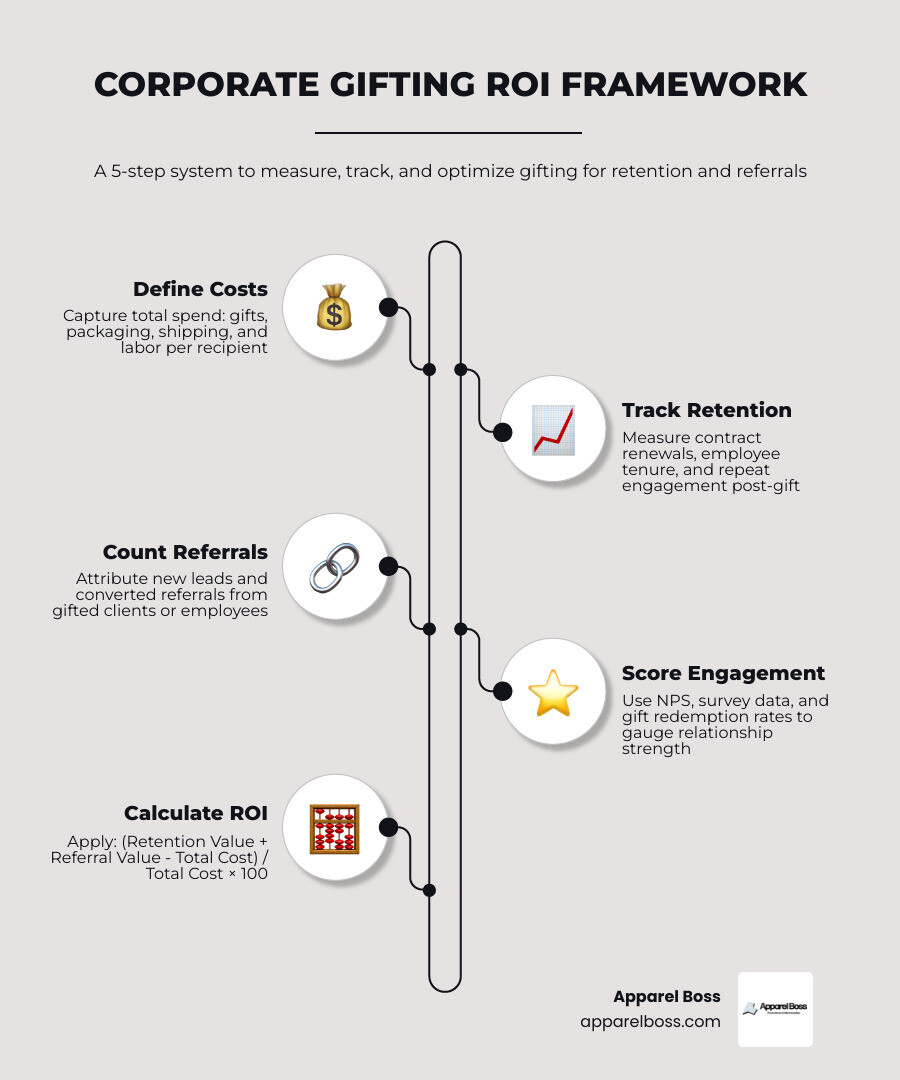
To defend your budget to a CFO, you must stop talking about "strengthening relationships" and start talking about numbers. The core financial formula for corporate gifting ROI is straightforward:
$$\text{ROI} = \frac{\text{Value Generated} - \text{Total Gifting Cost}}{\text{Total Gifting Cost}} \times 100$$
To build a defensible model, you must accurately calculate both sides of this equation.
First, Total Gifting Cost must include more than just the invoice price of the physical items. You must factor in:
- Direct item costs (the landed cost of the premium gifts)
- Shipping, fulfillment, and kitting fees
- Platform or software fees
- Administrative time (the hours your HR or marketing teams spend managing spreadsheets, collecting sizes, and chasing tracking numbers, multiplied by their hourly cost)
Second, Value Generated is the sum of your program's financial outcomes:
- Revenue Preserved (Retention Value): The value of client renewals directly influenced by your gifting touchpoints.
- New Revenue (Referral Volume & Deal Acceleration): Pipeline sourced from gifted client referrals or deals that closed faster due to a timely gift.
- Replacement Savings (Employee Loyalty): The recruitment and onboarding costs saved by reducing voluntary employee turnover.
By structuring your tracking around this framework, you can map both the hard financial returns and the softer, leading indicators. For a deeper dive into establishing these baselines, you can explore the Corporate Gifting ROI Calculator and Framework | Huggg | Huggg and examine how high-quality physical assets compound this value in our guide on The ROI of Branded Merchandise.
| Tangible ROI Metrics (Hard Financials) | Intangible Benefits (Leading Indicators) |
|---|---|
| Contract Renewal Rate Lift (%) | Net Promoter Score (NPS) Improvement |
| Inbound Referral Revenue ($) | Qualitative "Thank You" Response Quality |
| Voluntary Employee Turnover Reduction (%) | Employee Engagement Survey Scores |
| Sales Cycle Compression (Days) | Social Media Impressions & Brand Advocacy |
| Reduced Recruitment & Cost-Per-Hire ($) | Improved Brand Recall & Trust |
Quantifying Client Retention and Referral Volume
In B2B relationships, client retention is the ultimate driver of long-term profitability. To isolate the impact of your gifting program, track your Client Retention Rate (CRR) by comparing a gifted cohort of clients against a non-gifted control group over a 12-to-24-month period.
If your standard renewal rate is 80%, and your gifted cohort achieves an 85% renewal rate, that 5% lift directly translates to preserved Annual Contract Value (ACV). Additionally, 67% of gift recipients provide referrals within six months of receiving a high-quality gift. By tagging these inbound referrals in your CRM, you can easily attribute new closed-won revenue back to your initial gifting investment. This physical touchpoint acts as a persistent brand anchor, which is why strategic physical assets are so effective; learn more about this in our article on Why Custom Merchandise Drives Branding.
Measuring Employee Loyalty and Engagement Scores
Internal gifting is a high-yield hedge against the rising costs of recruitment. Replacing a single employee typically costs between 50% and 200% of their annual salary due to recruitment fees, lost productivity, and onboarding drag. In fact, the average B2B cost-per-hire has steadily climbed over the last several years.
When you implement a structured recognition program, you can measure success through employee Net Promoter Scores (eNPS) and voluntary turnover rates. Organizations with active recognition programs report a 12-15% reduction in voluntary turnover. By comparing the cost of your annual employee gifting program against the fully loaded replacement costs of the departures you prevented, the ROI quickly becomes clear. To ensure your team actually values and wears the items you distribute, check out our insights on The Psychology of Swag: How to Improve Employee Adoption of Company Merchandise.
Overcoming the 'Measurement Gap' and Operational Gifting Pitfalls
The "measurement gap" occurs when a company spends thousands on corporate gifts but fails to track the outcomes. If your gifting data lives on fragmented spreadsheets while your client data lives in a CRM, you cannot prove attribution. This operational disconnect leads to "false zeros" — where your gifting program is actively driving renewals and referrals, but because the data isn't linked, the program looks like a pure expense to your finance team.
To avoid this, businesses must transition away from manual, uncoordinated gifting and implement structured, scalable systems. You can read about how to build these frameworks in our guide on How to Build a Scalable Corporate Gifting System Without Wasting Budget.
Integrating Gifting Data with CRM and HRIS Systems
To achieve true attribution, your gifting platform must integrate directly with your CRM (such as HubSpot or Salesforce) and your HRIS (such as Workday or BambooHR).
When a client receives a gift, the event should automatically log as an activity on their CRM account page, complete with the gift tier, date sent, and delivery status. This allows your sales and customer success teams to run clean cohort analyses during quarterly business reviews. On the HR side, HRIS integrations allow you to automate milestone-triggered gifts — such as work anniversaries or onboarding kits — ensuring no employee is forgotten while removing the administrative burden from your internal teams.
Eliminating Hidden Costs: Inventory Waste and Sizing Errors
Traditional corporate gifting programs suffer from massive operational waste. When companies buy swag in bulk to get cheap unit pricing, they often run into the following hidden cost drains:
- Dead SKUs: Leftover inventory in extreme sizes (XS or 3XL) that sit in storage indefinitely.
- Storage and Warehousing Fees: Monthly costs paid to store boxes of undistributed merchandise.
- Sizing Guesswork: Sending an employee or client a jacket that doesn't fit, which results in a 100% waste of that item's budget and actively damages the brand's reputation.
- Inventory Write-offs: Up to 30% of bulk-ordered merchandise is eventually thrown away or written off due to damage, outdated branding, or sizing mismatches.
By utilizing managed online stores and print-on-demand kitting, you eliminate these overhead costs entirely. Recipients enter their own shipping addresses and select their preferred sizes upfront, ensuring a 100% utilization rate of your budget.
Strategic Practices to Maximize Gifting Program Returns

To maximize your ROI corporate gifting retention metrics, you must move away from the chaotic "Q4 holiday rush" and adopt a year-round, milestone-driven strategy. According to the Corporate Gifting Industry: 2026 Verified Stats, companies that run structured, personalized programs see up to a 5x higher return on investment compared to those relying on ad-hoc, transactional gifting.
Personalized Gifting vs. Generic Swag: The ROI Corporate Gifting Retention Impact
Cheap, generic promo items do more harm than good. When you send a client a low-quality, plastic item with a poorly printed logo, you are sending a subconscious signal that you value their relationship cheaply. In fact, 40% of corporate gift recipients admit to throwing away generic gifts.
High-quality, personalized gifts trigger the Endowment Effect — a psychological phenomenon where individuals place a significantly higher value on an object simply because they own it and it feels personal to them. By using premium decoration methods like permanent laser engraving or artisan-level custom embroidery, you create "buy-it-for-life" utility items that sit on a client's desk or are worn weekly.
To see how high-end outerwear can serve as a premium corporate touchpoint, read Why Premium Custom Fleece Jackets Are the Best Corporate Gift and discover more premium concepts in our guide on How to Impress Clients with High-End Swag Ideas.
Milestone-Driven Timelines: When to Expect Measurable ROI Corporate Gifting Retention Results
Gifting is most effective when it is tied to specific, contextual milestones rather than calendar holidays.
By mapping physical touchpoints to critical lifecycle events, you build a consistent cadence of appreciation:
- Onboarding (Day 1): Sending a premium welcome kit to a remote employee before their start date establishes an immediate physical connection to your team. Learn how to execute this flawlessly in The Ultimate Guide to Employee Onboarding and find inspiration in our breakdown of the Best Employee Welcome Kits for a Five-Star First Day.
- Work Anniversaries (Years 1, 3, 5): Tiered milestone gifts that increase in value based on tenure show employees that their loyalty is recognized.
- Contract Renewals (90 Days Pre-Renewal): Sending a premium gift to key client decision-makers three months before their renewal date rebuilds goodwill and opens the door for positive renewal conversations.
Frequently Asked Questions about Gifting ROI
How long does it take to see measurable ROI from a corporate gifting program?
While early engagement signals (such as thank-you emails, social media posts, and faster meeting bookings) appear within the first 30 to 90 days, true financial ROI typically takes 6 to 12 months to mature. This timeline allows you to track complete client renewal cycles and measure year-over-year changes in voluntary employee turnover.
What is a realistic improvement target for retention and referrals in the first year?
In the first 6 to 12 months of a structured corporate gifting program, realistic targets include:
- A 3% to 5% lift in client retention rates
- A 10% to 15% increase in inbound client referrals
- A 12% to 15% reduction in voluntary employee turnover Even a modest 3% improvement in client retention can completely cover your annual gifting budget while generating a substantial net-positive return for your bottom line.
Why do generic corporate gifts fail to deliver a positive financial return?
Generic corporate gifts yield a flat 1:1 ROI because they lack thoughtfulness and utility. When a recipient receives an item that is poorly made or overly branded, they do not feel appreciated; instead, they feel like a target for cheap marketing. Because these items are quickly discarded, they fail to generate daily brand impressions and do not influence renewal or retention decisions.
Conclusion
At the end of the day, corporate gifting is not an administrative chore or a discretionary marketing expense — it is relationship infrastructure. When executed with high-quality standards and managed through automated, scalable systems, it becomes one of the most reliable drivers of client retention and employee loyalty in your business playbook.
At Apparel Boss, led by industry expert Salvatore Vento, we help businesses in New York, Long Island, and Suffolk and Nassau Counties solve the "Quality-at-Scale" dilemma. We are the premium alternative to transactional, self-serve swag sites. Through our concierge-managed programs, we ensure that every piece of custom merchandise reflects the exact prestige of your brand.
If you are ready to stop wasting budget on uncoordinated, low-quality swag and start building a high-return corporate gifting program, explore our premium Apparel Boss services, discover our turn-key custom kitting solutions, or let us build your custom online company stores to streamline your distribution effortlessly. Let's build a gifting strategy that your CFO will love.
The Definitive Guide to Calculate ROI of Corporate Gifting & Retention