The Operational Shift from Manual Swag Chaos to Structured Fulfillment
An employee merchandise ordering system scales internal uniform and gear fulfillment by centralizing order intake, automating approval workflows, standardizing SKU catalogs, and connecting real-time inventory to automated pick-pack-and-ship logistics. Instead of managing orders through disjointed emails and spreadsheets, organizations provide team members with a role-based digital portal that enforces brand governance, controls departmental budgets, and routes gear directly to employees across multi-site facilities or remote workspaces.
Managing company gear manually often begins as a minor administrative chore, but it quickly spirals into an operational bottleneck as headcount grows. When organizations expand across regional facilities or distributed teams, HR, operations, and procurement teams find themselves buried under endless email threads, outdated size spreadsheets, and manual purchase approvals. Research shows that internal teams can spend between 5% and 10% of their working hours fielding one-off merchandise requests, leading to operational burnout and pulling core departments away from strategic initiatives.
The fundamental issue is that fragmented ordering lacks governance. When individual branch managers source items independently from commodity vendors, brand standards collapse. Thread colors shift, logos get distorted, and low-grade blanks replace premium workwear. By replacing ad-hoc workflows with a centralized employee merchandise ordering system, organizations can automate order intake, approvals, budgets, and reporting—slashing internal administrative time by up to 70% while safeguarding brand integrity across every touchpoint.
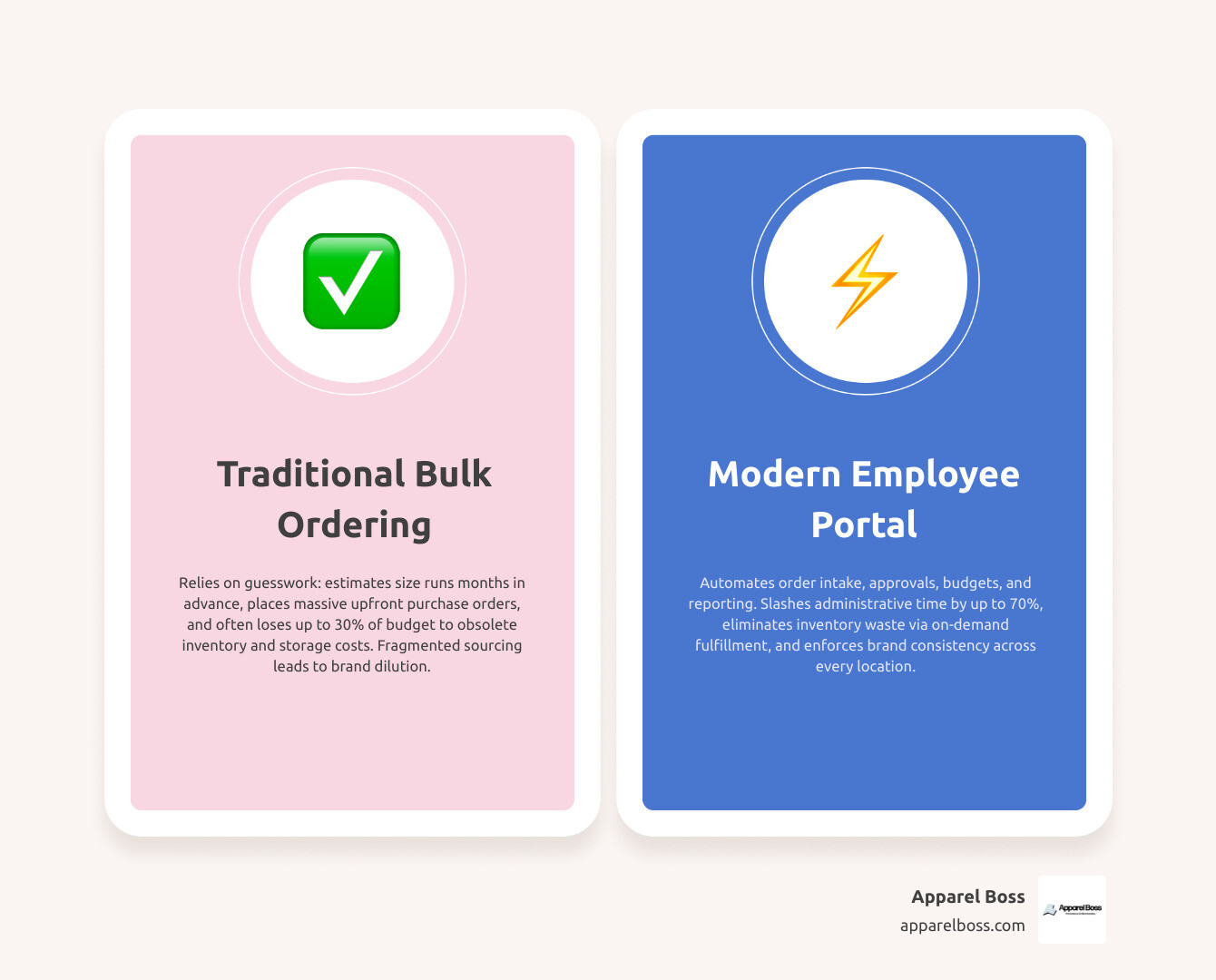
Traditional Bulk Ordering vs. Modern Employee Portals: The Hidden Costs of Swag Chaos
Traditional bulk ordering relies on guesswork. Procurement teams estimate size runs months in advance, placing massive upfront purchase orders to capture volume price breaks. The result is almost always the same: boxes of unusable extra-small and 3XL garments sitting in an office closet, while standard sizes run out immediately. Companies regularly lose up to 30% of their merchandise budget to obsolete inventory and holding costs.
| Operational Factor | Traditional Bulk Purchasing | Modern Online Employee Portals |
|---|---|---|
| Inventory Risk | High upfront capital, risk of dead stock | On-demand decoration or monitored min/max stock |
| Administrative Effort | Manual size collection, tracking spreadsheets | Direct employee self-service ordering |
| Brand Governance | Inconsistent regional purchasing, logo distortion | Centralized, pre-approved SKU catalogs |
| Spend Visibility | Fragmented receipts across cost centers | Real-time departmental reporting and budget caps |
| Fulfillment Model | Boxes shipped to one site, manually distributed | Automated direct-to-door or multi-site routing |
Evaluating the realities of modern fulfillment shows why companies are moving away from traditional inventory models. For a deeper breakdown of these cost dynamics, read The Ultimate Guide to Company Stores vs Traditional Programs to see how modern logistics eliminate legacy procurement liabilities.
How an Employee Merchandise Ordering System Eliminates Swag Chaos
A modern ordering platform replaces manual order intake with a streamlined digital experience. Rather than tracking down staff to collect sizing details, organizations give employees private access to a branded portal loaded with standardized SKUs.
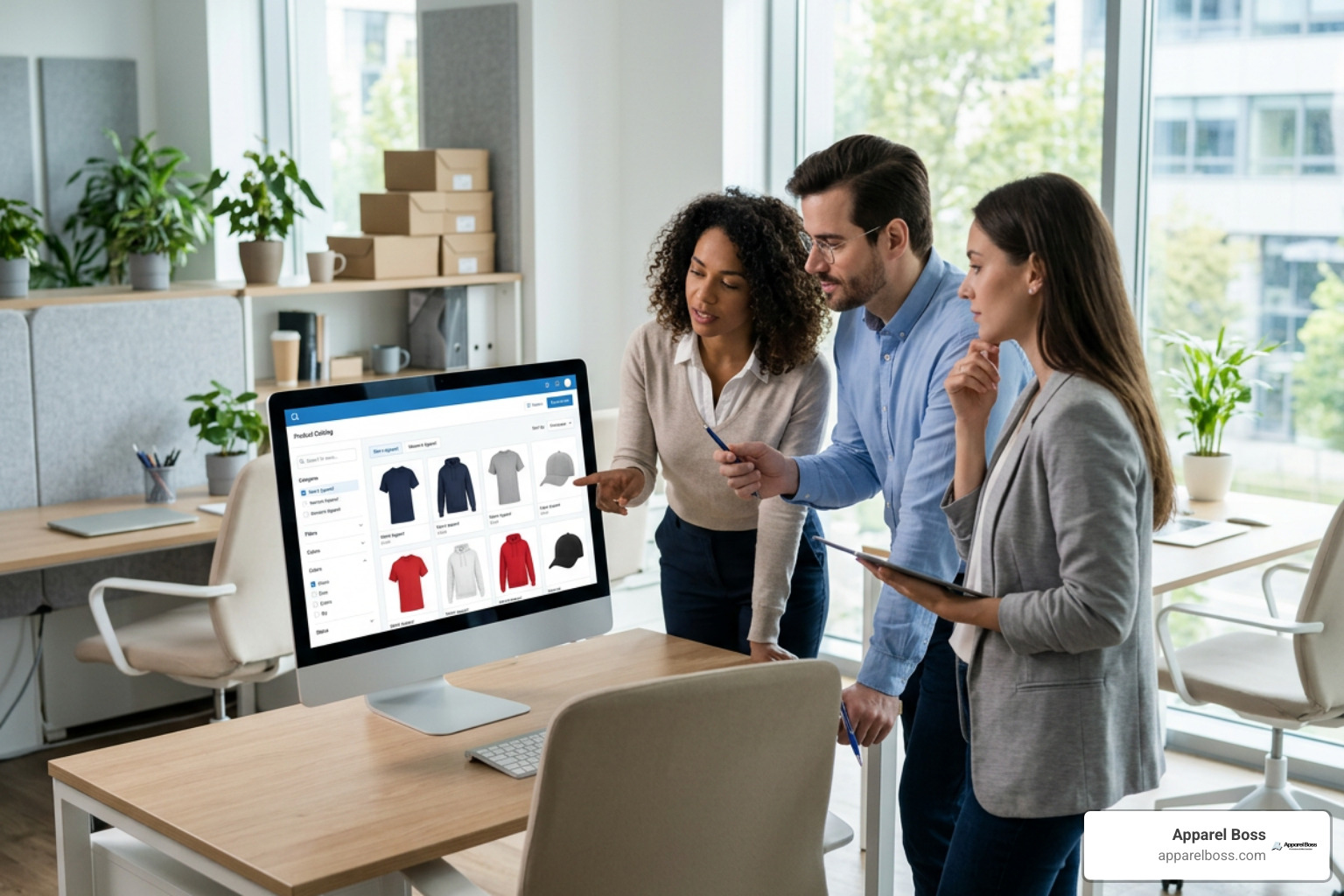
When an order is submitted, the platform routes it according to predefined business rules. Automated reordering triggers alert production teams before critical stock runs out, while end-to-end tracking eliminates the constant "Where is my gear?" inquiries hitting HR inboxes. To see how structured ordering transforms daily operations, you can explore how organizations stop the swag chaos with an online company store that centralizes fulfillment and asset control.
Controlling Multi-Location Brand Governance and Quality
When companies manage offices across different territories, decentralized purchasing causes severe brand dilution. A single brand mark might be printed in five different shades of blue across five different regional vendors.
A centralized ordering portal locks design templates, Pantone matching values, and embroidery digitizing files. Whether an order originates at an office in Deer Park, NY, a corporate hub in New York, NY, or a remote location, decoration standards remain identical. Organizations expanding across Long Island can also coordinate with local commercial programs like the Suffolk County Business Services to align business operations with regional compliance frameworks while standardizing their internal supply chain.
Architecture and Funding Models for an Employee Merchandise Ordering System
A scalable ordering infrastructure requires clear financial guardrails. Rather than routing invoices through manual accounting reconciliations, platforms allow finance teams to assign cost centers, track tax liabilities, and monitor purchasing behaviors in real time. Organizations setting up internal portals can reference An Essential Guide to Online Company Store for Employees to structure access permissions and departmental billing rules.
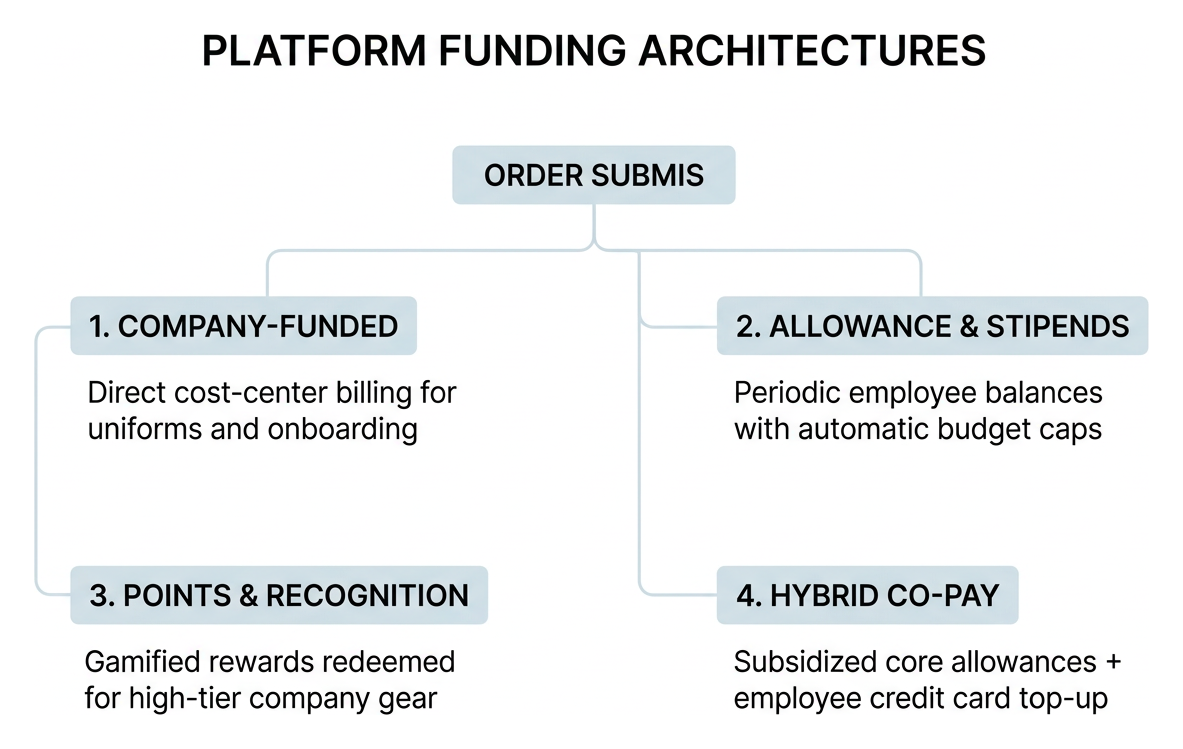
Managing Budgets, Points, Allowances, and Hybrid Payments
Organizations need flexible payment structures depending on the program's intent. The most effective systems support multiple funding mechanisms simultaneously:
- Departmental Stipends: Automatic budget allocations for managers to outfit teams for trade shows or regional initiatives without corporate credit card sprawl.
- Allowance and Allotment Rules: Periodic allotments (e.g., three uniform sets per year) that prevent over-ordering while ensuring compliance.
- Points-Based Recognition: Seamless redemption architectures where employees spend recognition balances on curated apparel.
- Hybrid Payment Gateways: The option for employees to use an allotted corporate credit while securely paying out-of-pocket for optional upgrades.
Organizations operating in regions like Nassau County can reference local consumer and merchant guidance such as the Item Pricing Waiver Program Information to understand pricing transparency regulations when setting up retail-facing or employee co-pay portals.
Key Integrations for Your Employee Merchandise Ordering System
To eliminate manual data entry, your merchandise platform should connect directly into your core business software stack:

- HRIS Automated Sync: Platforms connect to tools like Workday, BambooHR, or Rippling. When a new hire is added to payroll, an onboarding kit order triggers automatically.
- Single Sign-On (SSO): Secure enterprise authentication (Okta, Azure AD, Google Workspace) eliminates manual user provisioning and ensures immediate offboarding when employees depart.
- ERP & Accounting Mapping: Automatic syncing of cost-center spend directly into systems like NetSuite or SAP for seamless month-end reconciliation.
For teams building an integration roadmap, learning how to evaluate online company store platforms for your business ensures your chosen technology integrates cleanly with existing enterprise workflows.
Step-by-Step Implementation: Building a Zero-Waste Distribution Program
Deploying a modern program eliminates inventory waste through hybrid on-demand production and structured warehousing. Reviewing how to set up your company store quickly in 7 easy steps can help you establish clear operational timelines and avoid common rollout traps.
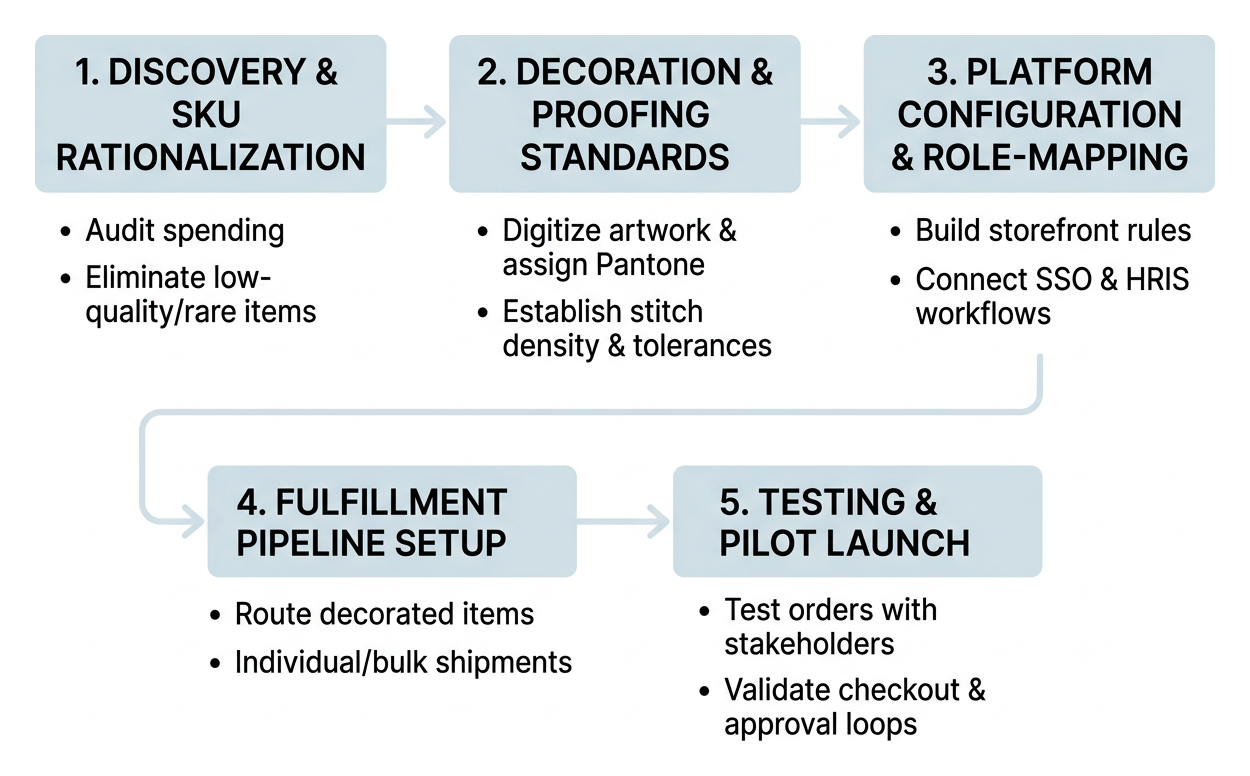
- Discovery and SKU Rationalization: Audit historical spending and eliminate low-quality, rarely ordered products. Focus on a refined, high-utility collection.
- Decoration and Proofing Standards: Digitize artwork, assign Pantone colors, and establish strict embroidery stitch densities and print tolerances.
- Platform Configuration & Role-Mapping: Build custom storefront rules, segment user permissions, and connect SSO and HRIS workflows.
- Fulfillment Pipeline Setup: Route decorated items through specialized services handling pick-pack-and-ship distribution, bulk shipments, and individual home deliveries.
- Testing and Pilot Launch: Run test orders with core stakeholders to validate checkout rules, approval loops, and tracking notifications before company-wide release.
Standardizing Workwear SKUs and Role-Based Catalog Views
Not every employee needs access to the same gear. Role-based catalog permissions ensure staff members only view apparel relevant to their position. A field technician sees safety-compliant, high-visibility outer layers, while corporate staff see branded business casual items.
Catalog segmentation prevents ordering errors and keeps spend focused on role-specific requirements. Discover how organizations simplify ordering corporate custom apparel stores by structuring catalogs by role, department, and facility.
Automating Onboarding Kits, Milestone Gifting, and Safety Apparel
Manual new-hire packaging consumes valuable HR resources. Instead of assembling boxes by hand, companies can automate welcome packages through specialized custom kitting solutions.
When an HRIS detects a new hire, the system automatically triggers a welcome box containing their selected apparel size, branded workplace essentials, and role-specific safety gear—delivered straight to their door before day one.
Frequently Asked Questions About Employee Merchandise Ordering Systems
How does an employee ordering platform handle inventory risk and storage?
Modern programs mitigate inventory risk by combining on-demand decoration with managed inventory buffers. Fast-moving base items can be stored blank at a dedicated fulfillment facility and decorated as orders are placed. This hybrid model avoids large upfront capital investments, prevents dead stock from rebranding, and ensures orders ship quickly.
Can different departments access different budgets and merchandise catalogs?
Yes. Enterprise platforms use a "store-within-a-store" architecture. Granular permission sets let administrators control product visibility, spending caps, and billing rules based on user roles, department codes, or regional branch locations.
How quickly can an enterprise merchandise ordering system launch?
A fully configured corporate store typically launches within four to eight weeks. This timeline includes catalog curation, embroidery digitization, user permission mapping, and end-to-end checkout testing.
Conclusion: Upgrading to Managed Fulfillment and White-Glove Brand Operations
At Apparel Boss, led by industry expert Salvatore Vento, we solve the Quality-at-Scale dilemma for organizations that refuse to settle for commodity swag. We bridge the gap between premium brand standards and reliable logistical execution. Our managed programs, custom kitting workflows, and dedicated online concierge company store solutions ensure every garment reflects your brand's true caliber with artisan decoration and seamless distribution. If your team is ready to eliminate spreadsheet chaos and modernize internal fulfillment, reach out to design a merchandise program built to scale with your business.
Scale Internal Uniform and Gear Fulfillment with an Employee Merchandise Ordering System