
What Is an Online Company Store for Employees — and Do You Need One?
An online company store for employees is a private, branded e-commerce platform where your team can order pre-approved merchandise, uniforms, and branded gear — without anyone in HR or marketing having to manage a spreadsheet, chase down sizes, or coordinate a bulk order.
Here is a quick breakdown of what these stores do and who they are for:
| Feature | What It Means for Your Business |
|---|---|
| Branded storefront | Employees shop from a curated, logo-approved catalog |
| Access controls | Roles, departments, and budgets determine who sees what |
| On-demand or pre-stocked | Items are produced when ordered or shipped from warehouse |
| Direct fulfillment | Orders ship straight to employee homes or office locations |
| Recognition programs | Gift codes, points, and allowances support rewards and onboarding |
If your company is spending hours managing merch requests, chasing down sizes, or dealing with off-brand gear showing up in team photos — you already have a problem an employee store is designed to solve.
According to industry data, 58% of employees say their company's commitment to recognition and rewards plays a significant role in their decision to stay. A well-run employee store is one of the most direct ways to act on that.
The operational reality is that most companies outgrow informal swag management long before they realize it. What starts as a shared folder of vendor contacts and a rack of leftover polos becomes a full-blown administrative burden — one that lands on whoever has the least capacity to handle it.
I'm Salvatore Vento, Marketing Director at Apparel Boss, and I've spent years helping marketing leaders, HR teams, and operations managers build structured merchandise programs — including online company stores — that reduce wasted spend and eliminate the operational chaos that comes with unmanaged branded apparel. In this guide, I'll walk you through everything you need to know to evaluate your options and build a store program that actually scales.
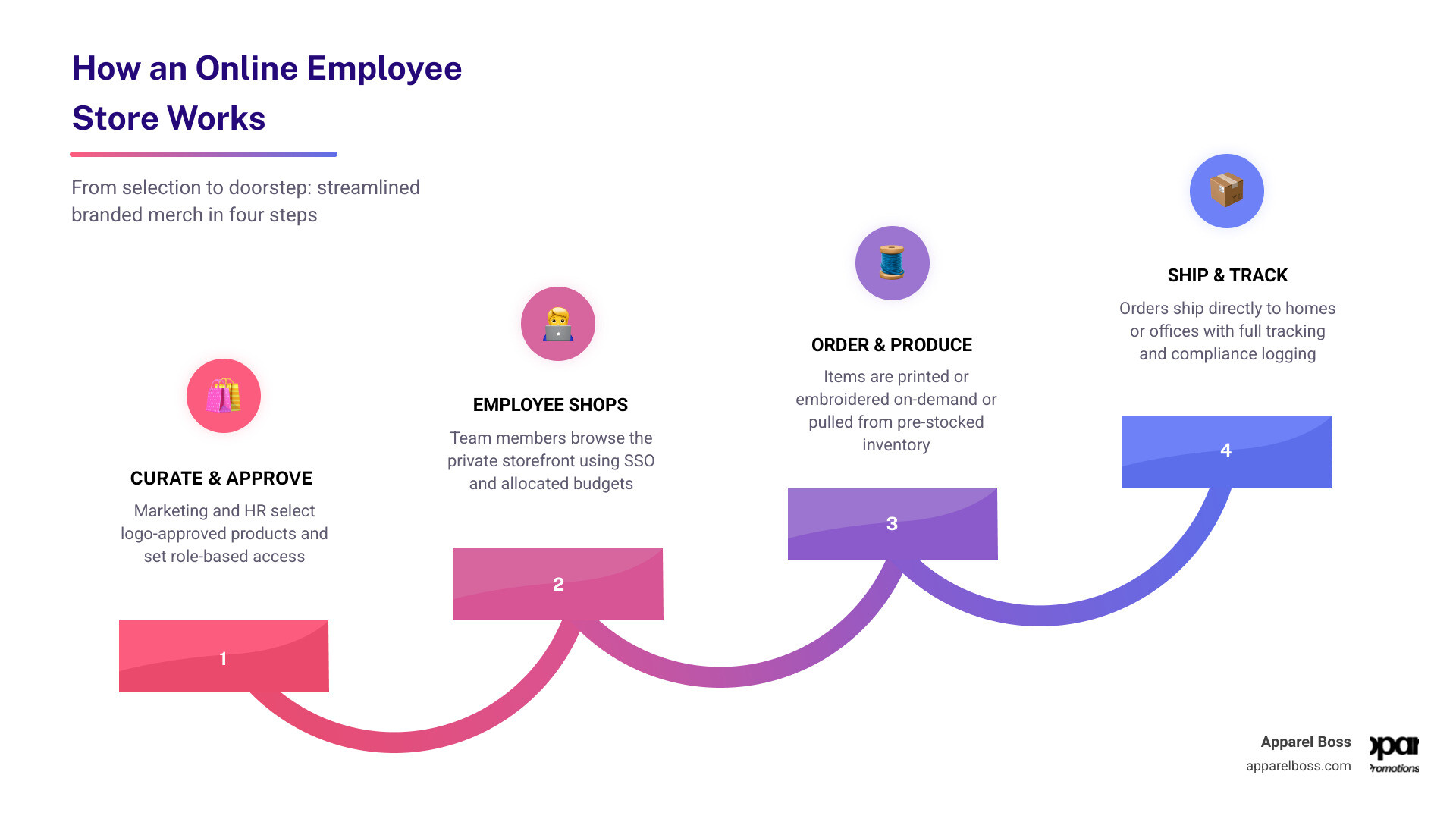
The Swag Chaos: Operational Pain Points of Manual Merchandise Management
When companies manage their custom apparel and merchandise manually, they inevitably hit a wall. I call this "swag chaos," and it is a massive drain on corporate resources.
The first major pain point is wasted inventory. Without a centralized system, companies tend to over-order random sizes based on guesswork. You end up with boxes of extra-small and triple-extra-large shirts collecting dust in a supply closet in Long Island, NY, while your medium and large sizes run out in the first week.
Then there is the issue of poor sizing and low employee adoption. When you force employees to take whatever is left in the closet, they rarely get a garment that fits well. If it does not fit or looks cheap, they simply will not wear it. This completely defeats the purpose of investing in branded apparel in the first place.
Inconsistent quality and delayed production are also highly common when multiple departments order from different transactional websites. One department orders embroidered jackets that look great, while another orders screen-printed shirts from a discount site where the logo peels off after two washes. This lack of centralized quality control actively damages your brand equity.
Finally, inefficient distribution turns your highly paid HR or administrative staff into makeshift warehouse workers. They spend hours packing boxes, labeling envelopes, and running to local shipping offices in Nassau County or Suffolk County just to send out a few new hire kits. You can easily stop the swag chaos with an online company store that automates these manual workflows entirely.
Why Your Business Needs an Online Company Store for Employees
An online company store for employees is not just a digital catalog; it is a strategic asset. By centralizing your purchasing, you solve multiple operational and branding challenges simultaneously.
First, it guarantees absolute brand consistency. When you control the store, you control the brand. You pre-approve the exact logo variations, color matching, and apparel styles that represent your company. No off-brand merchandise ever makes it to production.
Second, it dramatically improves employee recognition and onboarding programs. Instead of manually putting together welcome packages, your systems can automatically trigger a gift code or point allocation when a new hire signs their contract, allowing them to select their own gear.
Finally, the cost savings are substantial. By aggregating your purchasing power across different departments and office locations throughout the New York metro area, you eliminate rush shipping fees, minimize over-ordering, and reduce administrative labor costs. If you are still wondering why corporate apparel stores are important, the answer lies in the perfect alignment of brand control and operational efficiency.
For businesses looking to implement a highly professional standard, partnering with a local brand manager like Online Company Store for Employees - Pacific Color Graphics or utilizing a custom concierge platform can completely transform how your team interacts with your corporate brand.
Streamlining Onboarding and Employee Recognition
The onboarding experience sets the tone for an employee's entire tenure. A modern company store allows you to turn onboarding into a seamless, automated event.
Instead of pre-packing generic, one-size-fits-all kits, you can send new hires a digital welcome link containing store credits. They can log in, choose their preferred apparel style, input their exact size, and have their custom kit shipped directly to their home.
This level of personalization is incredibly impactful. When employees have a say in what they wear, they feel valued. This is why the employee store is your best workplace perk — it transitions branded merchandise from a mandatory uniform into a coveted reward.
Maintaining Brand Consistency Across Distributed Teams
For businesses with offices spread across Deer Park, Nassau County, and Manhattan, keeping your brand cohesive is incredibly difficult. Individual office managers often take matters into their own hands, using local print shops that cannot guarantee precise color matching or high-quality embroidery.
An employee store solves this by locking in your brand guidelines. Every item on the platform is configured with your exact Pantone colors and approved logo placements. Whether an employee is ordering a structured cap in Suffolk County or a premium polo in New York, NY, the decoration quality remains completely identical.
Comparing Inventory Models: On-Demand, Pre-Purchased, and Hybrid
One of the most critical decisions you will make when setting up your store is choosing how your inventory is managed. There is no one-size-fits-all model, and the right choice depends on your team size, budget, and distribution goals.
| Inventory Model | Capital Expenditure | Storage & Warehousing Fees | Production & Lead Times | Fulfillment Speed |
|---|---|---|---|---|
| On-Demand | Low (Pay as you go) | None | 5 to 15 business days | Slower (Produced per order) |
| Pre-Purchased | High (Upfront bulk buy) | Yes (Monthly warehousing) | Immediate (Pre-decorated) | Extremely Fast (Ships same-day) |
| Hybrid | Moderate | Minimal (Basics only) | Variable | Fast for stocked, slower for custom |
On-Demand Production and Zero-Inventory Models
The on-demand model is highly appealing for companies that want to eliminate upfront costs. Because items are only decorated when an employee places an order, you have zero inventory risk and no storage fees.
On-demand production is perfect for highly specialized apparel or seasonal items. However, the trade-off is speed. Because each item is embroidered or printed individually, lead times are longer — typically taking several business days to produce before they ship out.
Pre-Purchased Bulk Inventory and Warehousing
With the pre-purchased model, you buy your apparel and merchandise in bulk upfront, take advantage of volume discounts, and store the finished products in a fulfillment warehouse.
When an employee places an order, the item is picked, packed, and shipped immediately. This is the ideal model for high-demand items like standard office uniforms or safety gear that employees need right away. The primary downside is the upfront capital requirement and the ongoing cost of warehousing.
The Hybrid Approach: The Best of Both Worlds
For most mid-to-large-sized businesses, I highly recommend a hybrid inventory strategy. This model allows you to pre-purchase and warehouse your high-volume, standard items — like your core everyday polos and onboarding kits — while offering a wider selection of specialty outerwear, bags, and accessories on an on-demand basis.
This approach ensures that your most critical items ship out instantly, while still giving your employees a massive variety of choices without forcing you to tie up thousands of dollars in stagnant inventory. It is the ultimate way to transition from ideas to inventory when launching your merchandise store.
Platform Architecture: Budgets, Approvals, and Integrations
To keep your store from turning into an unmanaged shopping spree, your platform needs robust backend architecture. You must be able to control who can order, how much they can spend, and who approves the transactions.
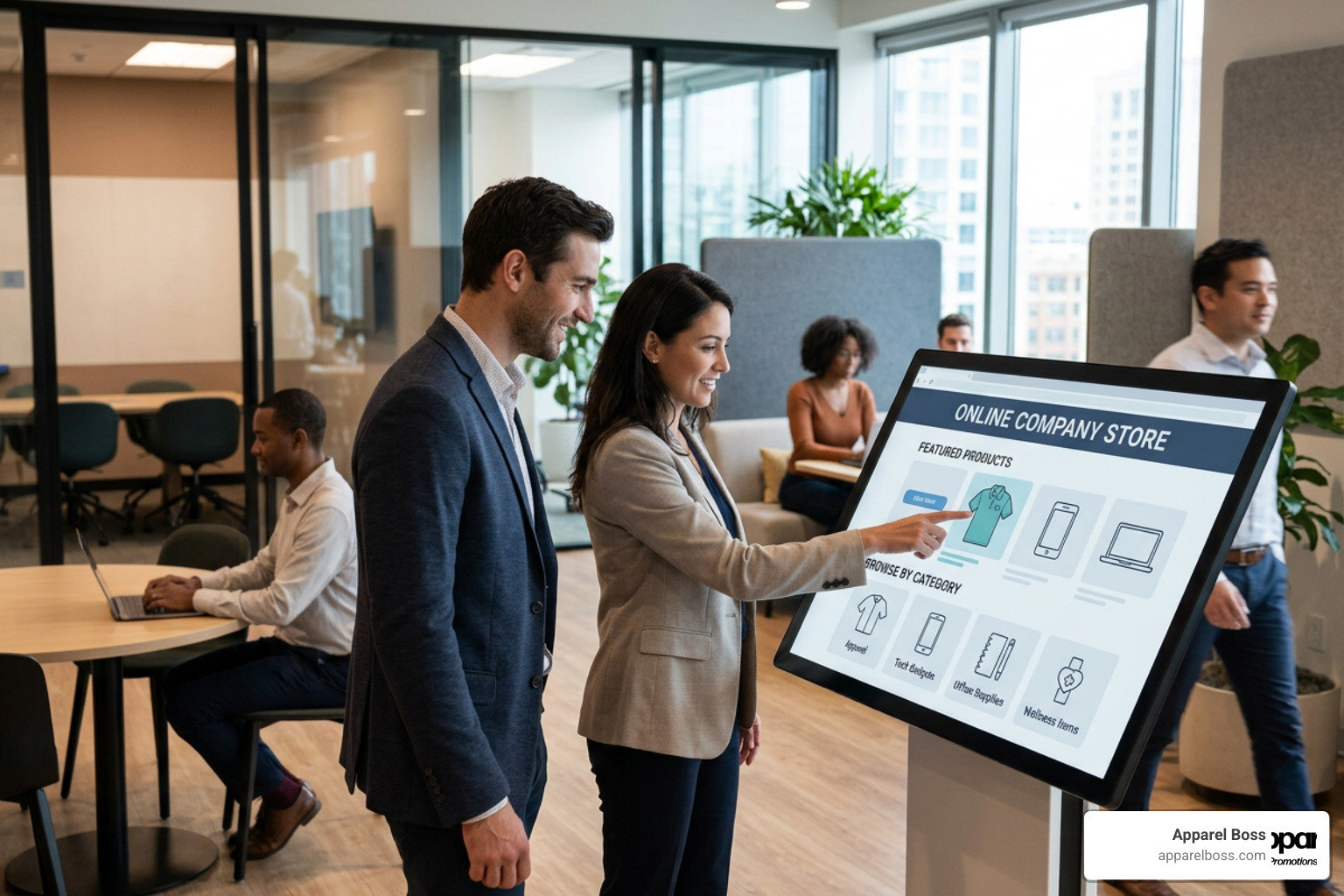
Key Features of a Modern Online Company Store for Employees
A professional-grade employee store must include several core administrative features:
- Role-Based Access Controls: Ensure field technicians only see safety apparel and PPE, while executive teams see premium corporate wear.
- Departmental Budgets: Allocate specific spending limits to different departments (e.g., HR, Sales, Operations) to prevent cost overruns.
- Approval Workflows: Require manager sign-off for orders that exceed a certain threshold or fall outside standard allocations.
- Security & Compliance: Ensure the platform utilizes PCI-compliant payment gateways and is fully GDPR compliant to protect employee data.
Integrating with HRIS, ERP, and Accounting Systems
The true power of an enterprise-level company store lies in its integrations. By connecting your store to your HRIS (like Workday or ADP) via secure API, you can automate user management. When an employee is hired, they are automatically added to the store with their designated allowance; when they leave the company, their access is instantly revoked.
Integrating with your ERP and accounting systems allows for seamless cost-center reconciliation. Instead of manually tracking credit card receipts, all store transactions can be automatically billed back to the correct department's general ledger code.
How to Launch and Manage a Premium Employee Store Program
Setting up a corporate store does not have to be a stressful, months-long ordeal. The process begins with a detailed scoping call to map out your program goals, followed by product curation, storefront branding, and rigorous checkout testing. To ensure a seamless deployment, it is best to follow the expert way to handle B2B company store setup without the stress.
Overcoming Operational Hurdles with an Online Company Store for Employees
The biggest hurdle companies face after launching a store is low employee adoption. If employees do not know the store exists, or if they find the interface confusing, they simply will not use it.
To overcome this, I recommend launching the store with an interactive campaign. Send every employee a custom gift code to celebrate the launch. This immediately drives traffic to the site, teaches them how to navigate the platform, and builds excitement around your brand. To make sure your rollout goes off without a hitch, take the time to learn how to launch an online company store without losing your mind.
Frequently Asked Questions about Employee Company Stores
How long does it take to set up and launch an online company store?
A standard, customized employee store typically takes anywhere from 3 to 4 weeks to design, configure, and launch once your product selection and branding assets are finalized. For highly complex enterprise programs requiring deep HRIS and ERP integrations, a full launch timeline can take up to 90 days to ensure extensive testing and data compliance.
What are the cost considerations and potential savings?
While there are initial setup and onboarding considerations, a centralized company store quickly pays for itself. By consolidating your purchasing, eliminating bulk inventory waste, and automating distribution, companies frequently report saving up to $10,000 per year on branded merchandise management alone.
How do online company stores handle global shipping and compliance?
A premium company store platform utilizes a network of strategic fulfillment centers to offer direct-to-recipient shipping, whether your employees work in Deer Park, Long Island, or are distributed across the country. For international shipping, the platform handles complex customs documentation, duties, and country-level service level agreements (SLAs) so your remote teams receive the exact same high-quality unboxing experience.
Conclusion
At Apparel Boss, we believe that your corporate apparel should reflect the prestige of your brand. Led by industry expert Salvatore Vento, we specialize in bridging the gap between premium brand standards and operational scalability. We do not offer cheap, throwaway promo items; we design and manage premium corporate apparel programs that your employees will actually want to wear.
If you are ready to eliminate the administrative headache of manual swag management and elevate your brand with artisan-level custom embroidery and a white-glove concierge store, we are here to help. Get started with a premium company store solution today, and let us build a managed program tailored to your business.