Why Inventory Management for Stores Costs More Than You Think
Inventory management for stores is the process of tracking, organizing, and replenishing stock across one or more locations — so the right products are available at the right time, without overstocking or running out.
Here is a quick breakdown of what effective store inventory management involves:
| Core Element | What It Means |
|---|---|
| Real-time tracking | Know exactly what stock you have, where it is, and when it moves |
| Automated reordering | Trigger replenishment based on set thresholds, not manual checks |
| Multi-location visibility | See inventory across all stores, warehouses, or offices in one place |
| Returns reconciliation | Update stock accurately every time a product is returned or exchanged |
| Demand forecasting | Use historical data to predict what you'll need before you run out |
Most organizations don't realize how much poor inventory management is costing them until the problem is already serious. Products run out at the worst times. Other products sit untouched, tying up budget that could go elsewhere. Staff spend hours on manual counts instead of doing meaningful work.
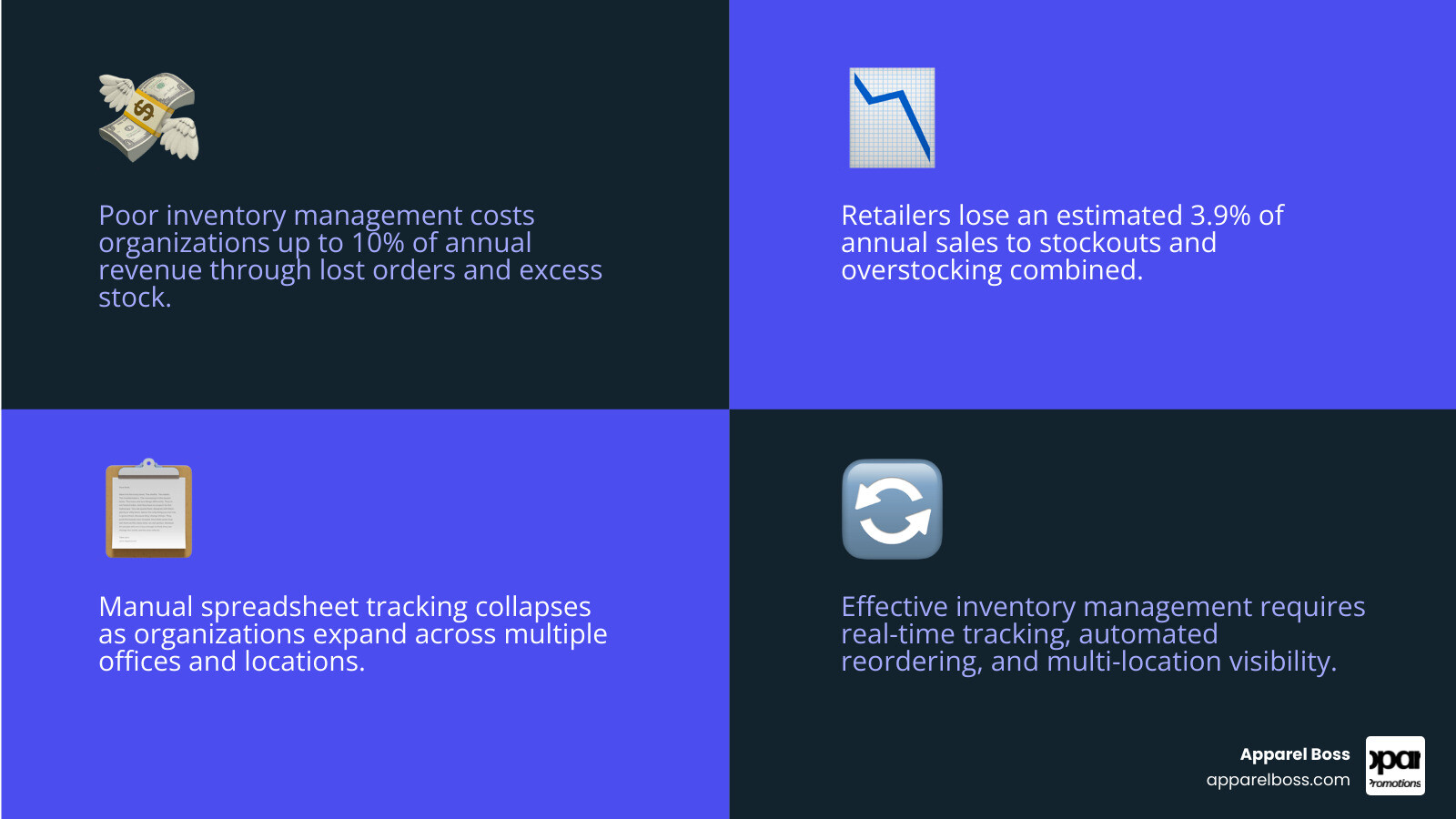
The numbers back this up. Retailers and corporate merchandise programs lose an estimated 3.9% of annual sales to stockouts and overstocking combined. Poor inventory management can cost organizations up to 10% of annual revenue through lost orders, excess stock, and forced markdowns.
For growing organizations managing branded merchandise programs — whether for employee onboarding, field teams, or marketing campaigns — these inefficiencies compound fast. A single spreadsheet holding your sizing data or stock counts is a liability, not a system.
I'm Salvatore Vento, Marketing Director at Apparel Boss, where I've helped scaling organizations fix the operational gaps in their corporate merchandise programs, including the inventory management for stores and distribution challenges that quietly drain budget and frustrate teams. In the guide below, I'll walk you through how modern inventory systems work, what to look for, and how to build a program that actually runs itself.
Why Manual Inventory Tracking Fails for Corporate Stores
Many operations managers start their corporate stores using basic spreadsheets. At first, tracking a handful of custom jackets or polo shirts seems simple. But as the business expands across multiple offices in New York, NY, and Long Island, NY, manual tracking quickly collapses under its own weight.
Spreadsheet errors are inevitable. A single incorrect keystroke can create "phantom inventory"—items that appear in your records but do not exist on your physical shelves. When an employee tries to order a jacket for an upcoming event, they are met with delays because the item is actually out of stock. This administrative burden distracts your team and leads to wasted capital.
If you are struggling with these issues, you are not alone. You can read more about how to stop losing money on your merchandise programs in our guide on how to Stop Throwing Money Away by Solving Your Inventory Waste Issues.
The Hidden Costs of Spreadsheet-Based Tracking
Manual data entry errors directly lead to a cycle of stockouts and overstocking. To avoid running out of stock, managers often over-order, which increases carrying costs. In fact, companies using advanced inventory management software report a 20% to 30% reduction in carrying costs and a 15% improvement in inventory turnover rates. When you rely on manual systems, you lose money to storage fees and obsolete stock that sits in boxes indefinitely.
Sizing Discrepancies and Employee Adoption Barriers
For corporate apparel programs, sizing inconsistencies are a major roadblock. If your inventory records do not account for different fits, or if employees keep ordering sizes that run too small, you will end up with a pile of unwearable garments.
This leads to low employee adoption and high dissatisfaction. If you want to understand why this happens, check out our analysis on The Real Reasons Your Apparel Sizing is So Inconsistent.
The Mechanics of Modern Inventory Management for Stores
To eliminate manual errors, modern organizations use automated workflows and real-time tracking. By connecting your online store directly to a live warehouse database, you ensure that what your employees see online matches exactly what is physically available.
When you partner with a vertically integrated provider like Apparel Boss, we handle everything from our facility in Deer Park, NY. With our in-house production, we can offer a 3-to-5 day turnaround on custom apparel, meaning you do not have to hold massive amounts of safety stock.
For organizations looking to scale their physical and digital storefronts, platforms like the Store Inventory Management & Real-Time Inventory Visibility | NewStore show how real-time visibility prevents fulfillment delays.
Pro-Tip: Integrate your Point of Sale (POS) and corporate store platforms with live warehouse databases to eliminate phantom inventory and ensure instant stock deduction at the moment of checkout.
Real-Time Visibility and RFID Technology in Inventory Management for Stores
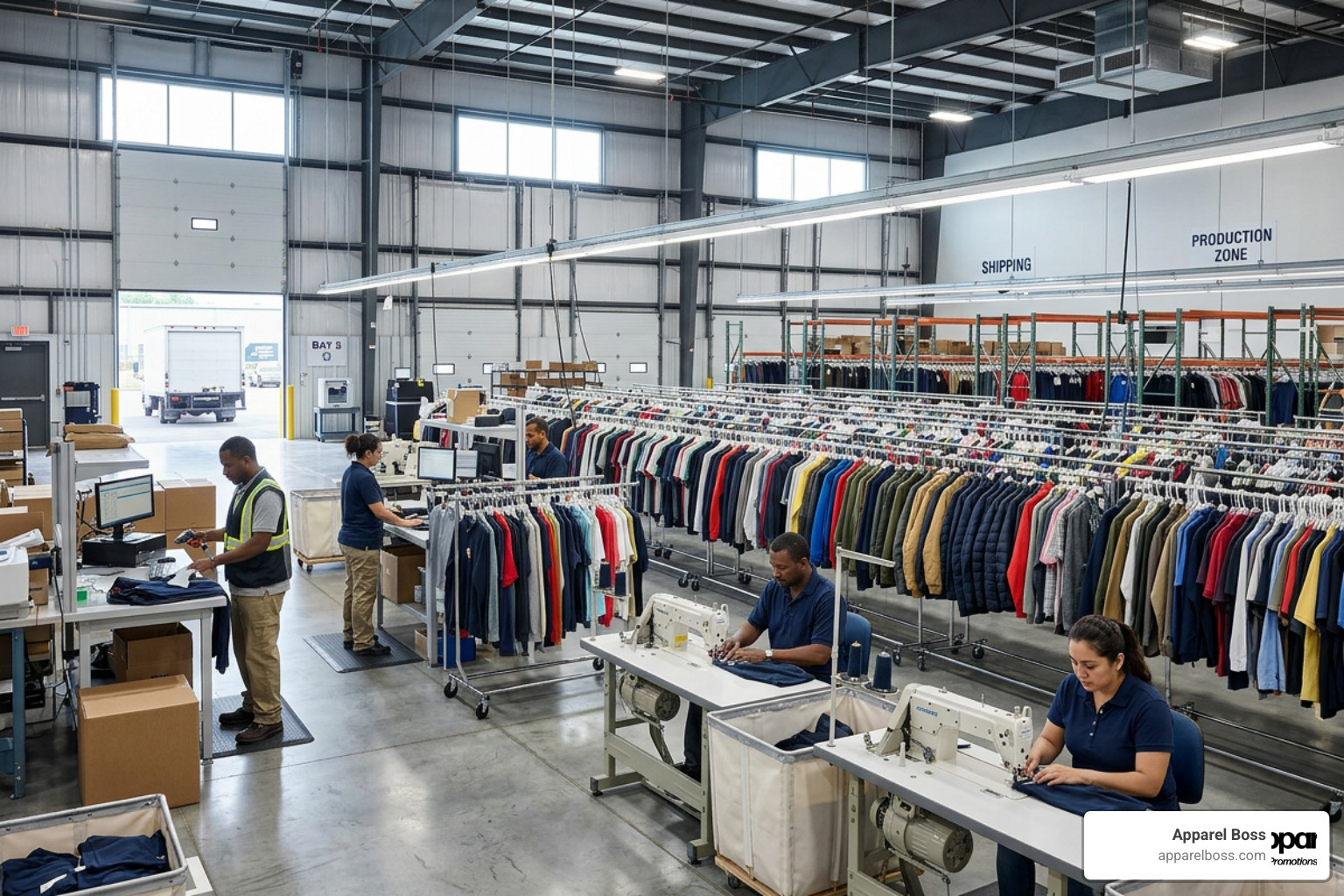
Modern inventory systems rely on barcode scanning and RFID technology. By assigning unique barcodes or RFID tags to each SKU, you eliminate manual counting. When items are received, moved, or shipped, a quick scan updates the system automatically. This level of automated data capture can improve your overall inventory accuracy by up to 25%.
Centralized Portals vs. Fragmented Systems
Fragmented systems require your team to log into one platform for shipping, another for stock levels, and a third for billing. A centralized corporate portal solves this by housing all data in a single database. This API-driven approach streamlines ordering, reduces administrative work, and gives your leadership team complete visibility over your program.
Key Features of Enterprise-Grade Inventory Software
If you are evaluating software to manage your corporate merchandise, you need an enterprise-grade platform. Look for cloud-based access, robust reporting analytics, and integrated supplier management. Systems like those detailed by Complete Retail Software: From Webshop to Warehouse | Novulo demonstrate the power of a single, composable platform that connects back-office logistics with the front-end user experience.
Expert Insight: Leverage automated purchase orders to maintain safety stock based on real-time sales velocity, eliminating the need for manual oversight and emergency print runs.
Multi-Store and Omnichannel Inventory Management for Stores
If your business operates across multiple locations in Suffolk County, NY, Nassau County, NY, and New York City, you need a system that supports multi-location tracking. Omnichannel inventory management allows you to balance stock across different offices, initiate transfer orders, and fulfill orders from the most logical location to save on shipping costs.
Automated Reordering and Demand Forecasting
Predictive forecasting uses your historical sales data to identify seasonal demand spikes. If you know you onboard the majority of your new hires in the fall, the system can automatically adjust your par levels and safety stock thresholds in late summer, ensuring you never run out of onboarding kits.
Overcoming Common Corporate Merchandise Challenges
Managing corporate apparel comes with unique operational hurdles. To keep your program running smoothly, you need to understand how to solve adoption and logistics issues. For a deeper look at these challenges, read our An Essential Guide to Inventory and Adoption Issues.
Using automation is the fastest way to resolve these bottlenecks. You can streamline your workflows by following our A-Z Guide to Solving Common Merchandise Problems with Automation.
Pro-Tip: Establish structured returns workflows within your corporate store portal to prevent returned items from causing inventory drift.
Managing Returns and Exchanges Without Inventory Drift
Returns and exchanges are the single largest source of inventory drift in corporate stores. In fact, 60% of retail and corporate operations that lack structured returns workflows experience significant inventory inaccuracies. When an employee returns a jacket for a different size, that item must be inspected, scanned, and systematically restocked to keep your inventory numbers accurate.
Classification and Forecasting Methods (ABC/XYZ Analysis)
To optimize your budget, categorize your inventory using ABC and XYZ analysis:
- ABC Classification: Group items by value. "A" items are high-value (e.g., premium custom jackets), while "C" items are low-cost (e.g., branded pens or notebooks).
- XYZ Analysis: Group items by demand predictability. "X" items have stable demand, while "Z" items are highly unpredictable.
By combining these methods, you can prioritize strict inventory control for your high-value, highly predictable items, ensuring your budget is spent where it matters most.
Measuring Success: Key Inventory KPIs to Track
To determine if your store inventory system is performing efficiently, you must track the right metrics.
| Metric | Traditional Manual Tracking | Modern Automated Tracking |
|---|---|---|
| Inventory Accuracy | 60% to 75% | 95% to 99% |
| Carrying Costs | High (due to over-ordering) | Optimized (20-30% reduction) |
| Turnover Rate | Slow (manual reorder delays) | Fast (automated replenishment) |
| Order Fulfillment Time | 7 to 14 days | 3 to 5 days (with in-house production) |
By monitoring your inventory turnover rate, carrying costs, sell-through rate, and stockout rate, you can make data-driven decisions that protect your bottom line and ensure your team always has the gear they need.
Frequently Asked Questions about Corporate Store Inventory
What is the difference between retail inventory software and corporate store tools?
Retail inventory software is designed for B2C consumer sales, focusing on transactions and cash registers. Corporate store tools are built for B2B operations, prioritizing budget enforcement, custom kitting, user access levels, and streamlined distribution for internal teams.
How do returns affect inventory accuracy in corporate stores?
Without automated workflows, returned items often sit in a warehouse without being scanned back into the system. This creates inventory drift, where your online portal shows an item as out of stock even though a returned item is sitting on a shelf.
Why is real-time inventory visibility critical for multi-location teams?
If you have offices spread across Long Island, NY, and Manhattan, real-time visibility allows you to fulfill orders from a centralized warehouse rather than shipping items back and forth between offices, saving time and reducing shipping costs.
Conclusion
Managing inventory management for stores does not have to be a source of constant administrative headache and wasted budget. By moving away from manual spreadsheets and adopting a centralized, automated system, you can protect your brand consistency, eliminate inventory waste, and give your employees a seamless ordering experience.
At Apparel Boss, we specialize in helping businesses solve these exact operational challenges. Through our Apparel Boss Company Stores program, custom kitting, and in-house production services, we streamline the entire process from design to doorstep.
If you are ready to eliminate the hassle of managing corporate merchandise, contact us today to learn how we can build a scalable, efficient system for your organization.
Inventory Management 101