
Why Inventory and Adoption Issues Derail Corporate Merchandise Programs
Inventory and adoption issues are two of the most common — and costly — operational problems facing growing organizations that manage corporate merchandise programs.
Here is a quick breakdown of what these issues typically involve:
- Inventory problems: Excess stock, stockouts, poor demand forecasting, high carrying costs, and inefficient fulfillment
- Adoption problems: Employees and teams failing to consistently use new systems, tools, or processes introduced to manage merchandise
- Where they overlap: When new technology or workflows are introduced without proper change management, both inventory accuracy and employee engagement suffer simultaneously
These issues affect operations, HR, and marketing leaders who are trying to scale merchandise programs — from onboarding kits to branded apparel — without wasting budget or creating administrative chaos.
The financial stakes are real. Inventory-carrying costs alone can represent 20% to 30% of total inventory value. When poor adoption compounds that with inaccurate data or unused systems, the losses multiply quickly.
The good news? Both problems are solvable — with the right systems, processes, and partners in place.
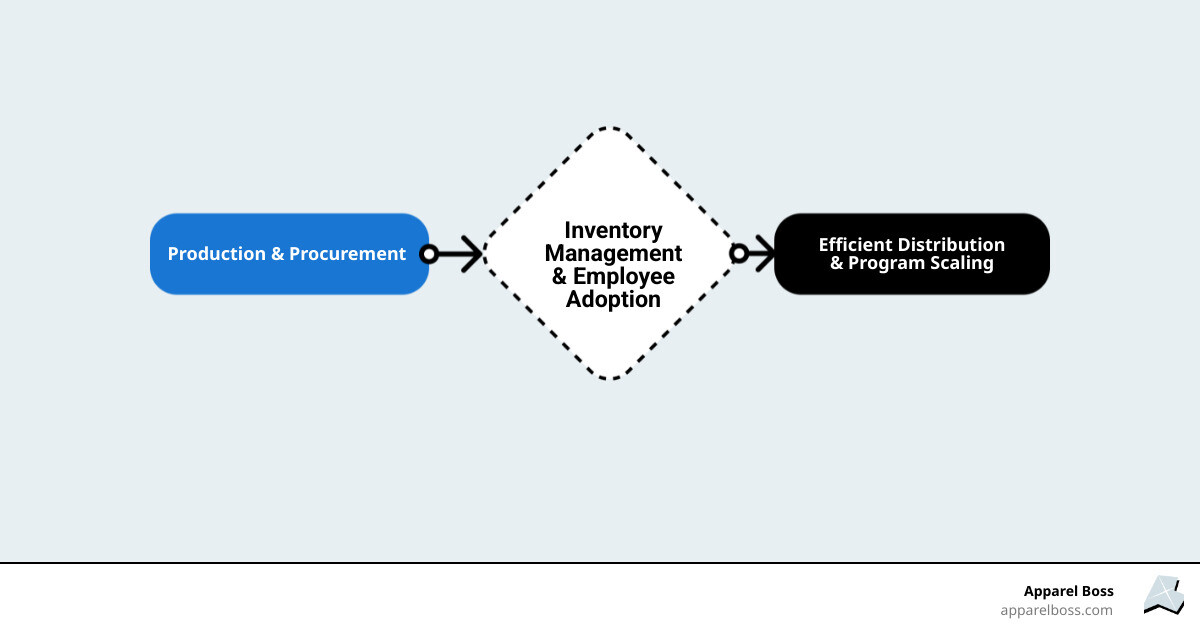
The Financial Impact of Inventory and Adoption Issues
When a business fails to address Inventory and Adoption Issues, the impact is felt most acutely on the balance sheet. In corporate logistics, cash tied up in warehouse operations typically accounts for 20% to 30% of total logistics costs. Simply holding onto physical goods makes up roughly 18% to 20% of that figure. For a company in New York or Long Island managing a large-scale apparel program, these percentages represent thousands of dollars in "dead" capital that could be better spent on growth initiatives.
Beyond the cost of the items themselves, there is the risk of "weaponized inventory" or inventory that becomes a liability due to shifts in demand or regulatory volatility. We see this in other industries, such as the automotive sector, where March 2026 vehicle inventory trends showed EV inventory hitting a three-year low. This demonstrates how quickly a surplus can turn into a shortage—or vice versa—when forecasting is off.
In corporate merchandise, this manifests as a closet full of XL shirts that nobody wants while the Mediums have been out of stock for six months. This is why building a scalable merchandise program requires a move away from "gut feeling" ordering and toward data-driven systems.

AI-Powered Forecasting and Cost Reduction
Artificial Intelligence (AI) is no longer a futuristic concept; it is a practical tool for reducing the financial sting of Inventory and Adoption Issues. By implementing AI-powered forecasting, organizations can decrease errors in their supply chain networks by 30% to 50%. This precision directly translates to a 65% reduction in lost sales caused by out-of-stock items.
Furthermore, the operational savings are substantial:
- Warehousing: Costs can decrease by 10% to 40% when AI optimizes storage and picking routes.
- Expert Systems: Specialized AI tools can improve overall inventory management accuracy by 8% to 18%, ensuring that the data in your system actually matches the boxes on your shelves.
Overcoming Technology Adoption Hurdles in Supply Chain Management
The best inventory software in the world is useless if your team refuses to use it. Currently, about 75% of companies are attempting to adopt AI and advanced analytics, yet only 35% of workers report receiving any training in the last year. This creates a massive "adoption gap" where expensive software becomes a "ghost town" just weeks after the launch energy fades.
Many businesses in Nassau and Suffolk County struggle with legacy systems and a heavy reliance on manual processes. When a manager is used to running a program via a complex Excel sheet, moving to a centralized platform can feel like a disruption rather than an improvement. This is The AI Adoption Problem Nobody Talks About—the gap between deployment and daily habit. To bridge this, companies must look for streamlined inventory ops platforms that prioritize the user experience.

Addressing Data Silos to Solve Inventory and Adoption Issues
Data silos are the enemy of efficiency. When your HR department has one list of employees, your marketing team has another list of "approved" swag, and the warehouse has a third list of what’s actually in stock, errors are inevitable. Solving Inventory and Adoption Issues requires a "single source of truth."
By integrating data across all departments, businesses can achieve:
- Automated Prioritization: Systems that tell you exactly what to reorder based on real-time consumption.
- Cloud-Based Collaboration: Eliminating the "v3finalFINAL.xlsx" spreadsheet confusion.
- Root Cause Analysis: Identifying why certain items aren't being ordered or why others are constantly disappearing.
Moving Beyond Manual Spreadsheet Management
Tool fatigue is real. The average sales or operations professional uses multiple tools daily, and adding "one more login" often leads to employee resistance. To combat this, organizations should adopt a 90-day framework for new technology:
- Weeks 1-4 (Audit): Map out how work actually flows today before changing anything.
- Weeks 5-8 (Coach): Provide in-workflow coaching rather than a single, boring classroom session.
- Weeks 9-12 (Scale): Remove the old tools (like those legacy spreadsheets) to ensure the new habit sticks.
Standardizing Processes: Lessons from the SAFE Model
Standardization is the bedrock of scalability. In the social services sector, the SAFE (Structured Analysis Family Evaluation) model was developed to provide a uniform way to conduct home studies across different states. Before this, disparities between state requirements created massive delays and confusion.
We see the exact same pattern in corporate merchandise. Without a standard "home study" for your inventory—meaning a rigorous, uniform way of classifying and tracking items—you end up with ServiceNow Inventory Management Implementation Issues 2026, such as "BLR Store" and "Bangalore Store" being created as two different locations for the same physical room.
Standardizing Workflows to Mitigate Inventory and Adoption Issues
The National Adoption and Foster Care Home Study Act of 2021 was proposed to solve the "interstate challenge" of varying standards. In the business world, your "interstate challenge" is often the difference between your Deer Park warehouse and your Manhattan satellite office.
If one location tracks items by the "pack" and another by the "individual unit," your data is compromised. This lack of uniformity is often the real reasons your apparel sizing is so inconsistent. Standardizing the "dimensions" of your inventory—from SKU naming to unit-of-measure—is the only way to ensure quality control.
Manual vs. Standardized Inventory Workflows
| Feature | Manual Workflow (Low Adoption) | Standardized Workflow (High Adoption) |
|---|---|---|
| Data Entry | Manual typing (high error rate) | Barcode/QR scanning (99% accuracy) |
| Naming | User-defined (e.g., "Blue Shirt", "Shirt-Blue") | Standardized Naming Convention |
| Tracking | "On paper" or informal | Serialized assets and bulk consumables |
| Auditing | Annual "Big Count" (reactive) | Automated Cycle Counting (proactive) |
| Visibility | Siloed in one person's head/PC | Real-time dashboard for all stakeholders |
Scaling AI and Automation Across Merchandise Operations
Scaling a merchandise program from 50 employees to 5,000 requires more than just a bigger closet. It requires automation that can handle the heavy lifting. However, 65% of executives still prefer human oversight in AI supply chain use, emphasizing the need for a "human-in-the-loop" approach. This is where a strategic partner can help, shifting implementation from a capital expense (buying the tech) to an operational expense (using a managed service).
When launching your merchandise store, you must account for the talent shortage. Most marketing teams don't have a dedicated data scientist to manage inventory levels. Leveraging a partner's expertise allows your team to focus on brand strategy while the system handles the logistics.
Phased Implementation and Change Management
The financial journey of adopting new systems happens in three distinct phases:
- Pre-Adoption: High costs for evaluation, needs assessment, and expert hiring.
- Adoption: Investment in hardware and intensive workforce training.
- Post-Adoption: This is where the ROI lives. Automation reduces repetitive tasks, lowers employee costs, and minimizes the "human error" tax.
To reach that 75% adoption rate, businesses must close the training gap. If employees feel the new system is a "black box" they don't understand, they will find workarounds that destroy your data integrity.
A Checklist for Successful AI Scaling
To ensure your investment in inventory tech actually pays off, follow this operational checklist:
- [ ] Audit Use Cases: Identify the 20% of tasks that drive 80% of your merchandise value (e.g., automated reordering of core uniform items).
- [ ] Coach Workflows: Provide immediate, in-app feedback when users interact with the system.
- [ ] Scale Governance: Establish clear rules for who can add new SKUs or adjust stock levels.
- [ ] Outcome Tracking: Measure Success Rates (SSR) and time saved per transaction.
- [ ] Feedback Loops: Regularly ask the "boots on the ground" where the system is causing friction.
Frequently Asked Questions about Inventory and Adoption Issues
What are the primary obstacles to adopting new supply chain technologies?
The biggest hurdles are data quality issues, high upfront costs, and employee resistance. Many teams are comfortable with their current "muscle memory" and fear that new technology will make their jobs harder or redundant. Overcoming this requires clear communication of the benefits and hands-on training.
How do data silos impact the financial performance of merchandise programs?
Data silos lead to duplicate ordering, stockouts of critical items, and wasted storage fees for obsolete goods. If the system of record doesn't match physical reality, you lose the ability to forecast, which can increase your carrying costs by up to 30%.
Why is standardization critical for multi-location inventory management?
Without standardization, each location becomes its own "island" with its own rules. This makes it impossible to move stock efficiently between sites (like from a Suffolk County hub to a New York City office) and leads to inconsistent branding and "broken" reporting for the CFO.
Conclusion
Navigating Inventory and Adoption Issues doesn't have to be a solo journey. The transition from "swag chaos" to operational excellence happens when businesses stop treating merchandise as a series of one-off purchases and start treating it as a strategic system.
Apparel Boss serves as a strategic partner for organizations looking to reclaim their time and budget. By implementing structured online company stores and custom kitting solutions, we help businesses in the New York area ensure brand consistency and operational efficiency. Whether you are solving for inconsistent sizing or trying to eliminate the administrative burden of manual distribution, the goal is the same: a scalable, professional program that your employees actually love to use.
Ready to move from ideas to a fully managed inventory system? Explore our company store services and see how we can help you scale.