When Your Stock Numbers Lie: The Inventory Mismatch Problem Solved
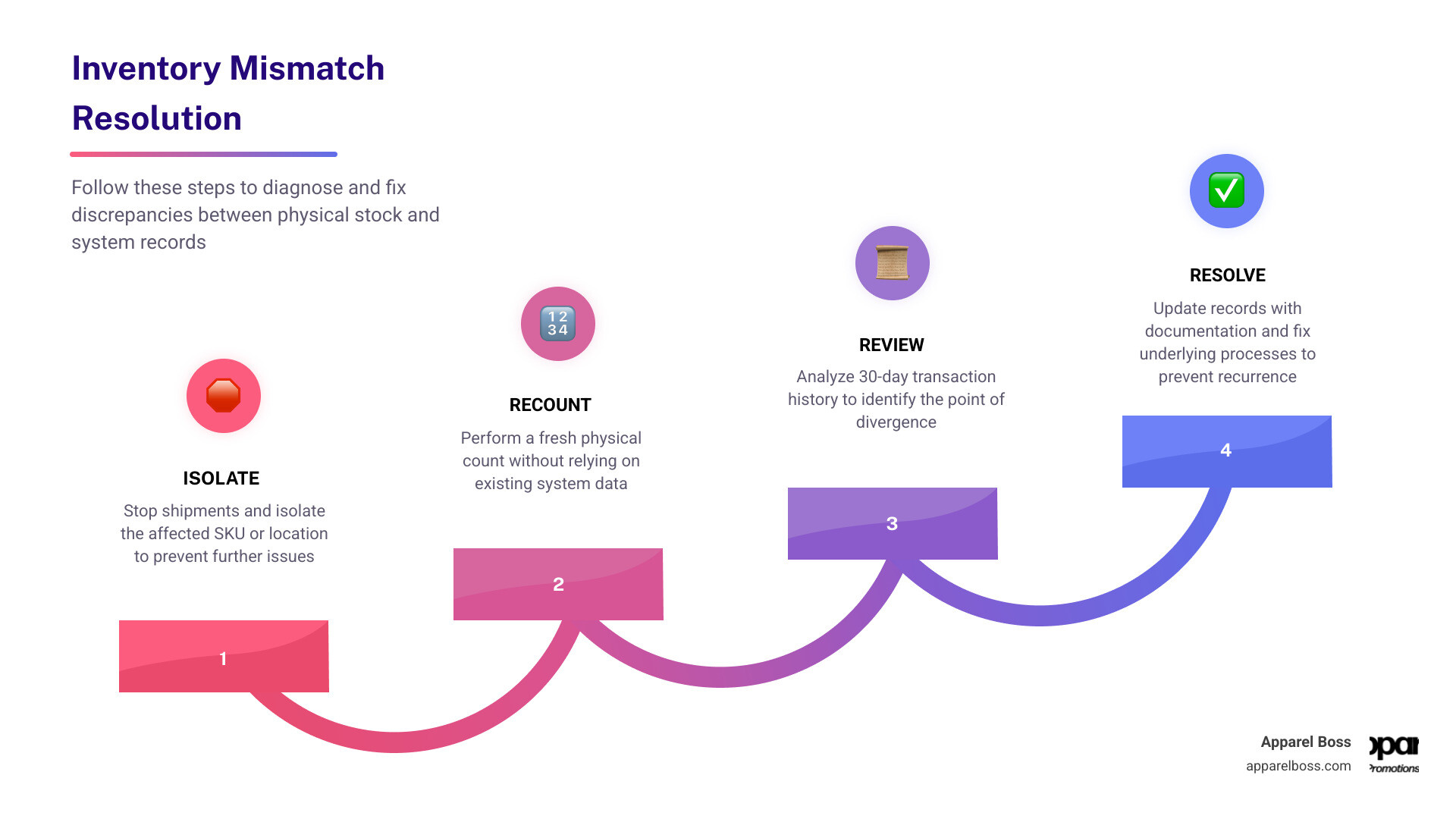
The fastest way to inventory mismatch problem solve is to follow this sequence:
- Stop and isolate the affected SKU or location immediately
- Recount physically with a fresh set of eyes — do not rely on the system
- Review transaction history for the last 30 days to find the first point of divergence
- Identify the root cause — human error, unposted receipt, system sync lag, or misplaced stock
- Adjust your records in your inventory management system with full documentation
- Fix the process — not just the number — so it does not happen again
Imagine your system shows 50 units of a product ready to ship. Your team goes to pull the order and finds 35. That gap — between what your records say and what is physically there — is an inventory mismatch. And it happens more than most operations teams want to admit.
According to industry data, the average inventory accuracy rate for businesses in 2024 was just 83%. That means roughly 1 in 6 items in a typical operation is miscounted, misplaced, or misrecorded at any given moment. For companies managing corporate merchandise programs — branded apparel, onboarding kits, and company stores — that gap does not just create operational headaches. It damages brand credibility with the very employees and clients you are trying to impress.
The problem rarely starts with one big mistake. It builds quietly — from a delivery that was never logged, a transfer that bypassed the system, or a return that was restocked without a record update. By the time the mismatch surfaces, it can take days to untangle.
I'm Salvatore Vento, Marketing Director at Apparel Boss, where I've spent years tightening the sourcing, fulfillment, and distribution workflows behind premium branded merchandise programs — which means the inventory mismatch problem solve process is something I work through with operations teams regularly. In the sections below, I'll walk you through exactly how these mismatches form, what they cost your business, and the clearest path to fixing them for good.
What is an Inventory Discrepancy and Why It Matters for Corporate Merchandising
An inventory discrepancy is the silent killer of corporate merchandise programs. It occurs when your physical stock levels do not align with what is recorded in your software. This goes beyond simple retail numbers; it affects high-end corporate assets.
If you are a CMO or Brand Director coordinating a major regional product launch across our service areas in Long Island, Suffolk County, Nassau County, or New York, NY, you cannot afford to "guess" your stock levels. When you look at your Inventory Record Accuracy (IRA), anything below 90% means your operations team is essentially flying blind. Best-in-class operations strive for an IRA of 95% or above, with 98% being the gold standard.
When your counts drift, carrying costs spike. For most businesses, holding inventory costs between 20% and 30% of its total value annually. If you are sitting on dead stock because of poor tracking, or worse, reordering premium custom-embroidered apparel that you actually already have hidden in a corner of your warehouse, you are bleeding capital. You can learn how to stop throwing money away on inventory waste to see just how quickly these unmanaged carrying costs accumulate.
To protect your budget and your brand, you must first understand the core causes of inventory discrepancy before you can build a sustainable workflow.
The Operational and Financial Impact of Unresolved Stock Mismatches
When inventory counts drift across systems, the consequences ripple through your entire organization. Financially, it results in lost sales, unexpected write-offs, and inflated carrying costs. Operationally, it creates pure chaos.

Imagine a manager trying to order 100 custom-kitted onboarding packages for a new cohort of executives in Manhattan. The storefront says the kits are available, but the physical components are missing in the warehouse. The order is delayed, the new hires arrive on day one with empty desks, and the brand's prestige takes an immediate hit. In fact, industry data shows that a single fulfillment failure raises the probability of customer churn by 30% to 40%.
Furthermore, trying to solve an inventory mismatch problem solve scenario after the fact creates massive operational drag. Warehouse workers waste hours searching for "phantom" stock, and finance heads end up staring at different valuation figures than the logistics coordinators. To stop this cycle, teams must learn how to diagnose and fix inventory counts drifting across systems before the errors compound.
For a deeper look into how these operational gaps affect employee adoption of your corporate programs, read our guide on inventory and adoption issues.
Common Causes of Corporate Merchandise Inventory Mismatches
In my experience working with corporate brands, inventory mismatches rarely stem from malicious intent. Instead, they are the product of minor, uncaptured daily process failures. Here are the primary culprits:
- Human Error in Data Entry: Manual entry remains the single largest source of warehouse errors. A simple typo can turn a batch of 50 premium jackets into 500 in the system.
- Unposted Goods Receipt Notes (GRNs): When new merchandise arrives at the loading dock, it must be posted immediately. If a GRN sits on a clipboard or in a "draft" folder for three days, the system thinks the stock doesn't exist, leading to unnecessary reorders. You can read a detailed breakdown of this in the anatomy of an untracked GRN.
- Silent Inter-Warehouse Transfers: Moving stock between a central hub in Deer Park, NY, and a temporary storage space in Nassau County without scanning the transfer creates instant "ghost" inventory.
- Returns Mishandling: When corporate items are returned or exchanged due to sizing issues, they often bypass standard receiving protocols, leading to unaccounted-for stock.
Multi-Location Challenges: An Inventory Mismatch Problem Solve Guide
Managing inventory across multiple locations introduces a unique layer of complexity. If your ERP, WMS, and online company store do not communicate in real time, you will inevitably experience "pool drift." This occurs when each system defines available inventory boundaries differently (for example, counting items that are in-transit or reserved for BOPIS as "available").
To prevent this, you must establish a single source of truth—typically your WMS, which is closest to the physical stock. You can diagnose multi-location inventory pool drift to identify whether your issues are integration-based or process-based.
How to Handle Shipping Delays and Store Issues
Shipping errors, damaged packages, and delayed transit are major contributors to system drift. If a shipment of custom apparel is damaged in transit but remains marked as "active" in your system, your digital records will show an overage that does not physically exist.
Learning how to handle shipping delays and store issues is critical to keeping your physical reality and digital records in perfect alignment.
How to Execute an Inventory Mismatch Problem Solve Protocol
When a discrepancy is flagged, you need a structured, repeatable playbook to resolve it. Do not just change the number in your system and move on; that only treats the symptom, not the cause.
I recommend a rigorous six-step investigation protocol:
- Stop and Isolate: Freeze all transactions for the affected SKU to prevent further data corruption.
- Recount with Fresh Eyes: Have an employee who was not involved in the original count perform a physical recount.
- Verify Units of Measure: Double-check if the mismatch is a simple conversion error (e.g., counting boxes instead of individual units).
- Review the Transaction History: Trace the last 30 to 90 days of transaction logs to find the exact moment the system and physical counts diverged.
- Check Adjacent Locations: Search nearby bins or racks. Misplaced stock is often just one shelf away.
- Document and Correct: Adjust the system count, log the cause code, and implement a process fix.
To keep these discrepancies from building up, replace traditional annual physical counts with a regular cycle counting program. Use ABC analysis to prioritize your counting: count high-value, fast-moving "A-class" items weekly or monthly, "B-class" items quarterly, and slow-moving "C-class" items annually. For more insights, review these industry-proven strategies on how to resolve inventory discrepancies.
Standardizing SOPs for an Inventory Mismatch Problem Solve Workflow
A process is only as strong as the people executing it. To maintain high inventory accuracy, B2B organizations must document clear Standard Operating Procedures (SOPs) for receiving, put-away, picking, and returns.
Every step must be standardized, and employees must be trained to understand the financial and brand impacts of their data entry. You can utilize this practical checklist for warehouse inventory discrepancy causes to audit your current physical workflows.
Leveraging Modern Technology and Automation to Eliminate Drift
If you are still managing your corporate merchandise on manual spreadsheets, you are fighting a losing battle. Manual data entry is the single largest source of inventory errors, and spreadsheets cannot provide the real-time syncing required for modern B2B operations.
By upgrading to an automated inventory management system integrated with barcode scanning or RFID technology, you can reduce data entry mistakes by up to 80%.
To help guide your technology transition, look at our A-Z guide to solving merchandise problems with automation. Here is a quick comparison of what you stand to gain:
| Feature | Manual Spreadsheets | Automated Inventory Systems |
|---|---|---|
| Data Entry | Manual, high risk of typos | Barcode/RFID scanning, 80% fewer errors |
| Sync Speed | Batch/Delayed (often weekly) | Real-time, event-driven triggers |
| Visibility | Siloed, prone to human error | Single source of truth across all channels |
| Fulfillment | Manual picking lists, slow | Automated routing, intelligent cycle counting |
| Accuracy (IRA) | Typically 50% - 80% | Consistently 95% - 98%+ |
Frequently Asked Questions about Inventory Mismatches
What is the most common cause of inventory mismatches in corporate merchandise?
The most common cause is a combination of manual data entry errors and delayed system syncing. When receiving, transfers, or returns are logged manually on a delay, the system and physical warehouse counts inevitably drift apart, leading to phantom stock.
How often should a B2B organization run cycle counts to prevent inventory drift?
We recommend an ABC cycle counting rhythm. High-velocity, premium "A-class" items should be counted weekly or monthly. Standard "B-class" items can be counted quarterly, while slower-moving "C-class" corporate assets can be counted on an annual basis.
Can inventory mismatches lead to overselling and brand damage?
Yes. If your online store shows items in stock that do not physically exist, you will experience fulfillment failures. For high-end corporate programs, delivering late or incorrect onboarding kits directly damages your brand's prestige and executive trust.
Conclusion
Solving the inventory mismatch problem solve challenge is not just about keeping clean books; it is about protecting your corporate reputation. When you partner with Apparel Boss, you do not have to worry about the logistics, warehouse drift, or fulfillment chaos that plagues traditional promotional programs.
Led by industry expert Salvatore Vento, Apparel Boss specializes in elevating corporate identity through luxury custom embroidery and high-end gifting systems. We solve the "Quality-at-Scale" dilemma for elite brands across Long Island and New York City. Our white-glove systems—including Online Concierge Stores and Custom Kitting—ensure that every piece of premium merchandise reflects the prestige of your brand, backed by artisan-level precision and flawless, automated distribution.
Ready to eliminate inventory headaches and scale your corporate merchandise program with absolute precision?
- Explore our custom kitting services to build bespoke executive gift boxes.
- Learn more about our online company stores to streamline your internal distribution.
- Discover our corporate merchandise services and let us handle your inventory management from end to end.
How to Solve Inventory Mismatch Fast