
Why an Apparel Order Backlog Fix Can't Wait
An apparel order backlog fix starts with understanding exactly where your fulfillment pipeline is breaking down — and acting on it fast. Here's a quick overview of the most effective steps:
- Audit your current backlog — calculate unfulfilled units divided by daily shipping capacity to know how many days behind you are
- Identify the root cause — production delay, 3PL sync gap, returns bottleneck, or demand spike
- Close the inventory visibility gap — switch from periodic syncs to real-time, event-based 3PL feeds
- Lock your production timeline — use freeze dates, weekly supplier updates, and built-in buffer time
- Speed up returns processing — target a 3-business-day return-to-stock SLA to recover sellable inventory faster
- Triage freight options — weigh air vs. sea freight to clear urgent orders without destroying margins
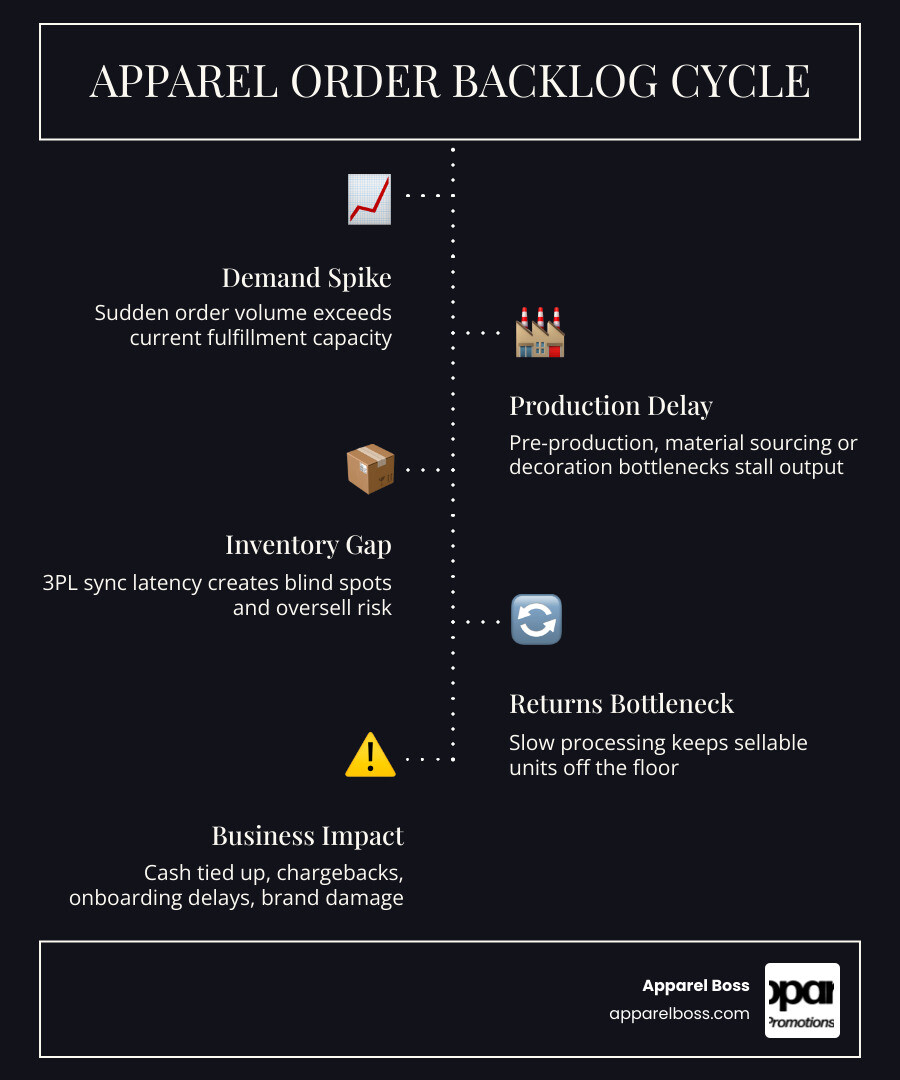
Order backlogs are one of the most disruptive problems a growing organization can face. When demand outpaces your ability to fulfill it, the consequences compound fast: cash gets tied up in unshipped orders, wholesale buyers issue chargebacks, employees wait weeks for onboarding kits, and your brand's reliability takes a hit.
The stakes are real. Out-of-stock situations alone cost retailers up to $634.1 billion in annual revenue. And for corporate merchandise programs specifically, a backlog doesn't just mean delayed shipments — it means delayed onboarding, inconsistent team branding, and frustrated operations teams spending hours chasing updates instead of running the business.
The problem is rarely just one thing. Backlogs usually reflect a system under stress — disconnected data, weak supplier timelines, slow returns processing, or a fulfillment setup that wasn't built to scale.
I'm Salvatore Vento, Marketing Director at Apparel Boss, and eliminating exactly these kinds of operational breakdowns — from unreliable production timelines to disconnected fulfillment systems — is central to the work I do helping organizations build merchandise programs that actually deliver. In this guide, I'll walk you through every layer of the apparel order backlog fix so your team can move from reactive firefighting to a predictable, scalable operation.
Understanding the Apparel Order Backlog: Definitions and Business Impact
In my experience working with operations leaders across the New York metro area—from Suffolk County to Nassau County and NYC—I have seen many teams confuse different types of inventory delays. To build a lasting apparel order backlog fix, we must first define what we are fighting.
- Backlog Inventory: This is a capacity issue. It represents the queue of sold but unshipped units currently sitting in your system because fulfillment throughput cannot keep up with order volume.
- Backorders: This is an availability policy. It allows customers to purchase items that are physically out of stock, with the promise of future delivery once new inventory arrives.
- Order Backlog: The total volume of customer orders that have been received but cannot be filled immediately due to production delays, material shortages, or warehouse bottlenecks.
To dive deeper into how these gaps form, you can read The Operator’s Guide to the Inventory Gap.
When your order backlog swells, the financial damage spreads quickly. Production delay announcements reduce shareholder value by an average of 12% and can cost a company between 15% and 35% of its Net Present Value (NPV). Furthermore, when inventory is inaccurate or misallocated across channels, you end up holding dead stock in one place while facing stockouts in another. This operational waste is detailed in our guide on how to Stop Throwing Money Away by Solving Your Inventory Waste Issues.
Expert Insight on Cash Flow Liabilities: Treat backorder revenue as a high-interest loan from your customers. Every day an order remains unfulfilled, the cancellation probability increases by roughly 2%. Never spend backorder cash on marketing or unrelated operations; reserve those funds strictly to secure the physical inventory required to fulfill those specific orders.
Key Bottlenecks in the Apparel Production Timeline
Most apparel backlogs do not start in the warehouse; they start upstream on the factory floor. When raw materials or pre-production approvals slip, the entire timeline collapses.
Raw material lead times represent 45% to 60% of the total order cycle for dyed fabrics and custom trims. A single missing element—like a delayed custom zipper pull or a late fabric dye approval—can stop an entire production line of jackets or polos.
The primary bottlenecks that lead to missed ship dates include:
- Pre-Production Loops: Endless rounds of sample approvals (fit samples, size sets, pre-production samples) that delay the start of bulk cutting.
- Material Sourcing Gaps: Late fabric booking or delays in receiving custom-branded trims.
- Decoration Constraints: Complex embroidery, multi-placement screen printing, or custom patch applications that slow down finishing.
- Rework: Quality control failures that force the factory to repair completed garments, adding days or weeks to the timeline.
To protect your delivery dates, you must track these milestones with disciplined Time & Action (T&A) calendars. For a step-by-step breakdown of managing supplier performance, see How to Track Supplier Lead Times and our internal guide, Inside the Factory: 5 Common Causes of Production Delays and How to Avoid Them.
Pro-Tip on Fabric Inspection: Implement a mandatory fabric inspection and shade-lot sorting step before any cutting begins. Identifying shading variances or fabric flaws early prevents the factory from sewing defective garments that will inevitably fail final inspection and trigger a backlog-inducing rework cycle.
Operational Strategies for an Apparel Order Backlog Fix

To permanently resolve backlogs, you must align your physical inventory with your digital systems. The traditional way of managing apparel inventory—relying on periodic, manual syncs between your ordering system and a third-party logistics (3PL) warehouse—inevitably creates a "data disconnect." Globally, this disconnect costs retailers billions of dollars annually.
The modern solution requires three architectural shifts:
- Single Inventory Ledger: Consolidate your inventory truth so that your ordering portal, ERP, and warehouse management system (WMS) share a single source of record.
- Event-Based 3PL Feeds: Move away from daily or hourly batch updates. Instead, use real-time webhooks that write physical events (receipts, picks, packs, and ships) directly to your system as they happen.
- Channel-Aware Available-to-Sell (ATS) Pools: Segment your inventory digitally. If you have 500 jackets committed to a corporate onboarding program, those units must be completely invisible to your direct-to-consumer (DTC) channels, preventing oversells before they happen.
To see how agile production systems can help you bypass these bottlenecks entirely, refer to our playbook on Fast Custom Apparel Production and Fulfillment for Brands in a Hurry.
Periodic Sync vs. Single Ledger Architecture
| Operational Metric | Periodic Sync Architecture (15-60 Min Batches) | Single Ledger Architecture (Real-Time Webhooks) |
|---|---|---|
| Oversell Rates (Peak) | 2% to 3% common | Under 0.5% |
| Inventory Reconciliation | 6 to 9 hours/week + multi-day month-end close | Under 1 day total per month (spot-checking) |
| Order Status Visibility | Opaque; requires manual 3PL portal lookups | Real-time tracking from receipt to dispatch |
| Wholesale Chargeback Risk | High (due to physical vs. digital allocation gaps) | Low (hard-allocated inventory is locked) |
Eliminating the 3PL Blind Spot as an Apparel Order Backlog Fix
The "3PL blind spot" is the latency window between when an order is placed and when your 3PL physically processes it. If your inventory system only syncs with your warehouse every 15 minutes, a sudden spike in order volume can lead to massive oversells.
For a $15M apparel brand, the hard direct costs of this blind spot—including customer service labor, manual reconciliation, and wholesale chargebacks—can easily reach $150,000 to $200,000 per year. To learn more about diagnosing this issue, read What Is the 3PL Blind Spot in Apparel Operations?.
Expert Insight on Sync Latency: If your brand processes 1,000 orders a day on a 15-minute batch sync, you constantly have 10 to 30 units "in motion" that your system cannot account for. Moving to real-time webhooks eliminates this blind spot by instantly updating your ATS pool the second a pick ticket is generated.
Implementing a Production Timeline Playbook for an Apparel Order Backlog Fix
A disciplined production timeline can dramatically reduce lead times and prevent backlogs. For example, a woven bottoms factory successfully reduced its average lead time from 72 to 50 days (a 30.6% reduction) and improved on-time delivery from 63% to 86% simply by implementing strict production timeline management.
To replicate these results, your operations team should adopt this four-step playbook:
- Establish Freeze Dates: Lock in your design, sizing specs, and trim selections. Under no circumstances should changes be allowed after the pre-production sample (PPS) is approved.
- Request Weekly Updates: Enforce a standardized weekly progress report from your manufacturers to catch delays before they compound.
- Build in Buffer Planning: Always add a 7- to 10-day buffer to your launch timelines to account for customs clearance or transit delays.
- Start with Trial Orders: When onboarding a new supplier, run a low-risk trial order using a single style and standard materials to verify their actual lead time before scaling.
For a deeper look at how factories systematically compress lead times, review How Clothing Manufacturers Cut Lead Times by 30%.
Pro-Tip on Trial Orders: When executing a trial order, keep packaging and decoration simple. Use in-stock fabrics and standard colorways. This isolates the factory's core sewing and assembly throughput from external material sourcing delays, giving you an honest baseline of their production capacity.
Key KPIs and Processes to Detect and Resolve Backlogs Early
To keep your fulfillment pipeline clear, your operations team must monitor the right metrics. I recommend tracking these three core KPIs:
- Backlog Days: Calculate this weekly. $$\text{Backlog Days} = \frac{\text{Total Unfulfilled Order Units}}{\text{Average Daily Shipping Capacity}}$$ If your backlog days exceed your standard shipping promise, you must immediately adjust your staffing or shift fulfillment waves.
- Return-to-Stock SLA: Measure how long it takes for a returned item to be inspected, repackaged, and added back to your sellable inventory. Your target should be 3 business days or fewer to prevent "ghost inventory" from clogging your system.
- Supplier Scorecards: Track your factory partners on their milestone variance. A supplier who consistently misses fabric readiness dates by more than 5 days represents a high risk for future order backlogs.
To keep your team aligned, run daily 20-minute "red-order standups" at the start of the morning. Focus exclusively on orders that have breached their shipping thresholds.
Expert Insight on Daily Standups: Do not use daily standups for general status updates. Instead, structure them around an exception-only dashboard. The team should only discuss "red" orders—those stuck in pre-production, missing a trim, or delayed at the 3PL—and assign a clear owner and resolution deadline for each blocker.
Frequently Asked Questions about Apparel Order Backlogs
What is the difference between backlog inventory and backorders?
Backlog inventory refers to sold units that are physically in your warehouse but have not yet been shipped due to fulfillment capacity constraints. Backorders, on the other hand, represent orders taken for items that are physically out of stock, relying on future production to fulfill them.
How does returns processing speed affect order backlogs?
Slow returns processing creates "ghost inventory"—units that are physically in your possession but digitally locked in returns purgatory. By establishing a strict 3-business-day return-to-stock SLA, you quickly return clean, sellable items to your active inventory pool, helping to clear backorders without waiting for a new production run.
How do you balance air vs. sea freight when clearing a backlog?
Air freight offers speed (3-5 days) but is highly expensive, whereas sea freight is cost-effective but slow (4-6 weeks). To protect your margins during a backlog, use split shipments: air-ship a small percentage (e.g., 10-20%) of the order to satisfy immediate corporate needs or backorders, and ship the remaining bulk volume via sea freight.
Conclusion
An apparel order backlog fix is not achieved through a single quick fix. It requires a systematic approach: aligning your digital systems to eliminate the 3PL blind spot, enforcing disciplined production timelines with your manufacturers, and tracking actionable operational KPIs.
At Apparel Boss, we help organizations across New York, Long Island, and the surrounding areas design and manage corporate merchandise programs that run smoothly. By leveraging our custom kitting, in-house production capabilities, and structured Apparel Boss Company Stores, we eliminate the administrative burden of fulfillment, ensure consistent branding, and keep your inventory moving without delay.
If you are ready to streamline your organization's custom apparel program and eliminate fulfillment bottlenecks for good, let's discuss how we can build a scalable system tailored to your team.