
Why the HR Onboarding Process of New Employees Defines Long-Term Retention
The HR onboarding process of new employees is one of the most consequential — and most underinvested — programs in any organization. Here is a fast answer for decision-makers who need the core steps immediately:
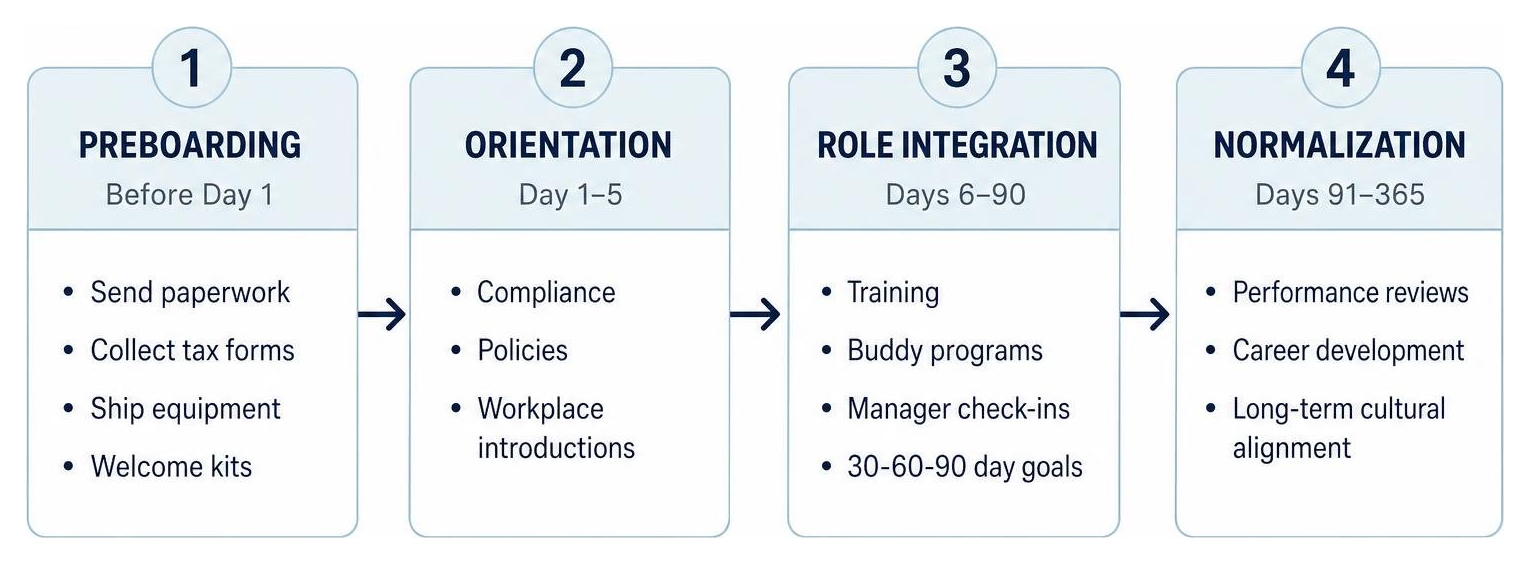
The HR onboarding process, phase by phase:
- Preboarding — Send paperwork, collect tax forms, ship equipment and welcome kits before day one
- Orientation (Day 1–5) — Cover compliance, policies, and workplace introductions
- Role Integration (Days 6–90) — Training, buddy programs, manager check-ins, 30-60-90 day goals
- Normalization (Days 91–365) — Performance reviews, career development, long-term cultural alignment
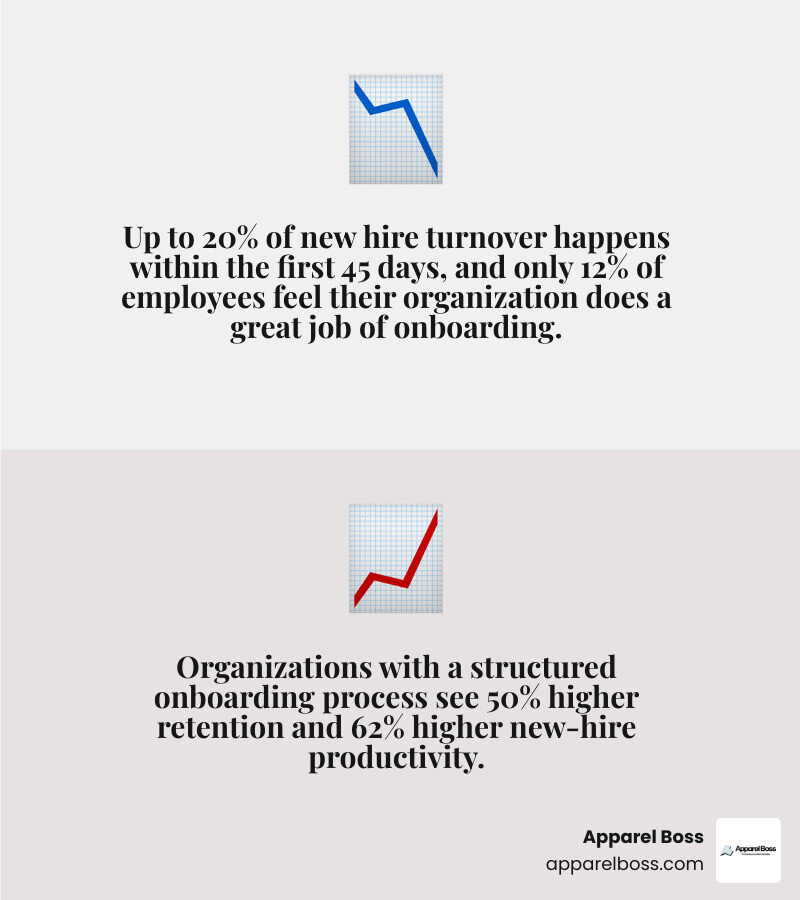
The stakes are high. Up to 20% of new hire turnover happens within the first 45 days, and only 12% of employees feel their organization does a great job of onboarding. Yet organizations with a structured onboarding process see 50% higher retention and 62% higher new-hire productivity.
Poor onboarding is not just an HR problem. It is an operational and financial one. A new hire who leaves in the first 90 days takes recruiting costs, training time, and team morale with them.
I'm Salvatore Vento, Marketing Director at Apparel Boss, where I work with HR, operations, and brand teams to eliminate the physical gaps in the HR onboarding process of new employees — particularly around welcome kits, branded apparel, and scalable distribution. I'll break down each phase of the onboarding journey and show where operational precision, not just good intentions, determines whether new hires stay or walk.
Key Phases of the HR Onboarding Process of New Employees
An exceptional onboarding program is not a single-day event. It is a long-term strategic journey that transitions a candidate from an outside recruit to a fully integrated, high-performing team member. To achieve this, organizations must separate short-term administrative tasks from long-term cultural alignment.
According to the framework outlined by the Employee Onboarding: Building a Structured Process | Human Resources Authority , a successful program is built on a phased architecture that spans an entire year. This structured approach ensures that compliance, role clarity, and cultural connection are introduced systematically, preventing cognitive overload.
To design your workflow effectively, you must first understand the fundamental differences between orientation and onboarding:
| Feature | Orientation | Onboarding |
|---|---|---|
| Duration | 1 to 5 days | 90 days to 12 months |
| Focus | Compliance, basic policies, and immediate administrative setup | Cultural integration, role competency, and long-term retention |
| Ownership | Primarily HR and IT | Shared between HR, hiring managers, and peer mentors |
| Outcome | Completion of required paperwork and basic systems access | Full productivity, role confidence, and brand advocacy |
By understanding this distinction, companies can transition from chaotic, manual checklists to a highly coordinated, automated workflow that addresses both administrative hygiene and human connection.
Optimizing Preboarding in the HR Onboarding Process of New Employees
The preboarding phase — the critical window between offer acceptance and the first day on the job — is where the employee experience is won or lost. If a new hire arrives on day one to find their laptop hasn't arrived, their credentials are stuck in an unmonitored IT queue, and their manager is scrambling, it sends an immediate signal that the organization is unprepared.
Operationally, preboarding should focus on two parallel tracks: digital compliance and physical readiness.
First, automate the administrative heavy lifting. Utilizing tools outlined in the New Hire Onboarding Packet Checklist 2026 - ZiaSign | ZiaSign allows HR teams to securely collect Form I-9, tax documents, and signed employee handbooks before the hire's start date. Under federal compliance guidelines, Form I-9 document verification must be completed within three business days of the employee's start date, and state-level new hire reporting must occur within 20 days.
Second, establish physical connection. This is where you bring your brand to life. Rather than forcing a remote or hybrid employee to wait weeks for their company apparel, the preboarding phase is the perfect moment to deliver a premium welcome kit. Providing high-quality, branded touchpoints during preboarding bridges the physical-digital divide and generates immediate excitement. For a complete blueprint on how to structure these early touchpoints, consult The Ultimate Guide to Employee Onboarding.
Executing the 30-60-90 Day Plan in the HR Onboarding Process of New Employees
Once the initial week of orientation is complete, the focus shifts to role integration. The most effective way to guide this transition is through a structured 30-60-90 day plan. Rather than overwhelming new hires with immediate performance pressure, this framework breaks their integration into progressive, manageable milestones:
- Days 1 to 30 (Foundation): The focus is entirely on learning the company's culture, core tools, and workflows. The new hire shadows team members and understands how their role fits into the broader organization.
- Days 31 to 60 (Development): The employee moves from passive learning to active contribution, taking ownership of small projects and collaborating directly with peers.
- Days 61 to 90 (Integration): The hire fully owns their role, hitting performance benchmarks and identifying areas for continuous improvement.
To support this timeline, high-performing organizations implement a structured "buddy system." Pairing a new hire with a peer mentor provides an informal channel for cultural and administrative questions. In fact, data shows that new hires with dedicated buddies are 23% more satisfied after their first week. For a deeper look at designing these milestone workflows, refer to the Ideal employee onboarding workflow: Complete 30-60-90 day guide for HR teams | Moxo .
Overcoming Operational Bottlenecks in New Hire Integration
While HR teams excel at designing the cultural and educational components of onboarding, the entire experience can break down due to physical and logistical bottlenecks.
Common issues include:
- Late Equipment Delivery: Remote hires sitting idle on day one because their laptop is stuck in transit.
- Poor Quality Swag: Distributing cheap, transactional promotional items that end up in the trash, which actively devalues the brand.
- Administrative Overload: HR and operations teams manually collecting shirt sizes, managing inventory, and shipping individual boxes.
When a company relies on disjointed spreadsheets to manage physical onboarding assets, failures are inevitable. To build a five-star first-day experience, organizations must treat physical welcome kits as a core operational workflow. You can read more about designing these physical touchpoints in our guide on Best Employee Welcome Kits for a Five-Star First Day.
Solving the Sizing and Inventory Dilemma
One of the most persistent headache-inducing tasks in the hr onboarding process of new employees is apparel sizing and inventory management. Historically, HR managers had to email new hires, ask for their apparel sizes, guess how many of each size to order in bulk, store boxes of garments in a cramped office closet, and manually mail them out. This process leads to wasted budget on unused sizes, delayed shipping, and a poor employee experience when garments fit poorly.
At Apparel Boss, we solve this "Quality-at-Scale" dilemma through our Online Company Stores system. Instead of guessing sizes, you can provide new hires with a digital voucher during the preboarding phase. The employee logs into your custom company store, selects their preferred, retail-grade branded apparel, inputs their exact size, and enters their shipping address.
This model eliminates inventory waste, ensures a perfect fit, and removes the administrative burden from your HR department. To understand how this system transforms company culture, explore Why the Employee Store Is Your Best Workplace Perk and our An Essential Guide to Online Company Store for Employees.
Automating Physical Touchpoints via Platform Integrations
To scale your onboarding program without burning out your operations team, you must connect your physical distribution with your digital HR ecosystem.
By integrating your Human Resources Information System (HRIS) — such as Workday, BambooHR, or Rippling — directly with a managed custom kitting platform, you can automate the dispatch of onboarding kits. The moment a new hire's contract is signed and their start date is confirmed in your HRIS, a trigger is sent to our fulfillment center in Long Island, NY.
We automatically assemble, pack, and ship a premium Custom Kitting package directly to the employee's home, ensuring it arrives exactly before day one. This automated handoff eliminates manual coordination and guarantees a consistent, high-end experience for every single hire. For a technical breakdown of how these systems connect, see our In-Depth Guide to Corporate Onboarding Kit Platform Integrations.
Best Practices for Measuring Onboarding Program Success
An onboarding program is only as good as the data supporting it. To ensure your process is functioning effectively and driving retention, you must track specific operational and sentiment-based metrics.
Key metrics to monitor include:
- New Hire Turnover (45-Day and 90-Day): High turnover in these early windows almost always points to a breakdown in onboarding or mismatched expectations during recruitment.
- Time-to-Productivity: Measure how long it takes a new hire in a specific role to contribute meaningful, independent work.
- Task Completion Rates: Track compliance and training milestones. Are hiring managers completing their integration deliverables on time?
- New Hire Satisfaction Scores: Gather direct feedback via structured surveys at the 30, 60, and 90-day marks.
To maintain compliance and avoid costly audit errors, HR teams should utilize a centralized dashboard that tracks both administrative checklists and compliance evidence. For a comprehensive look at managing these compliance checkpoints, consult the Employee onboarding checklist: from day-1 tasks to 90-day compliance checkpoints | Cadenio .
Frequently Asked Questions about Employee Onboarding
What is the difference between onboarding and orientation?
Orientation is a short-term, administrative event (typically lasting 1 to 5 days) focused on completing compliance paperwork, setting up basic systems access, and introducing company policies. Onboarding is a comprehensive, long-term strategic process (lasting 90 to 365 days) designed to integrate the employee into the company culture, align role expectations, build peer relationships, and drive long-term productivity.
How long should the employee onboarding process last?
An effective onboarding process should last at least 90 days, though high-performing organizations extend the normalization phase up to 12 months. Because it can take a new employee up to a full year to reach their complete performance potential, continuous engagement, check-ins, and professional development support should continue well past the initial 90-day mark.
How can technology improve the onboarding workflow?
Technology streamlines onboarding by automating repetitive administrative tasks. Utilizing e-signature platforms simplifies document collection, while HRIS integrations can automatically trigger IT provisioning and physical equipment shipping. Centralized workflow platforms ensure that handoffs between HR, IT, and hiring managers occur seamlessly without tasks falling through the cracks.
Conclusion
Building a world-class hr onboarding process of new employees requires a deliberate balance of structured compliance, clear milestone tracking, and premium physical touchpoints. When you eliminate administrative friction and welcome new hires with retail-grade, professionally decorated apparel and curated kits, you set a standard of excellence from day one.
At Apparel Boss, we help businesses across Long Island, NYC, and Nassau and Suffolk Counties eliminate the operational headaches of managing corporate merchandise. From automated platform integrations to white-glove fulfillment, we ensure your team receives a premium, concierge experience that reflects the true value of your brand.
To learn how we can streamline your physical onboarding touchpoints, Learn more about custom kitting services or explore our comprehensive Services today.