Why Most Organizations Are Flying Blind on Apparel Inventory
Choosing the right apparel inventory management tool is one of the most consequential decisions an operations or merchandise program leader can make. The wrong choice leads to wasted stock, overselling, inconsistent sizing across locations, and hours of manual reconciliation every week.
Here are the top apparel inventory management tools covered in this guide:
| Tool | Best For |
|---|---|
| AIMS360 | Wholesale and EDI-heavy fashion brands |
| ApparelMagic | Small to mid-size wholesale brands |
| Uphance | Mid-market multi-channel apparel operations |
| DOSS Operations Cloud | Growing and mid-market brands needing unified ops |
| NetSuite | Large-scale, multi-entity organizations |
| Cin7 Core | Multi-channel DTC and marketplace sellers |
| Shopify POS | Omnichannel retail with e-commerce integration |
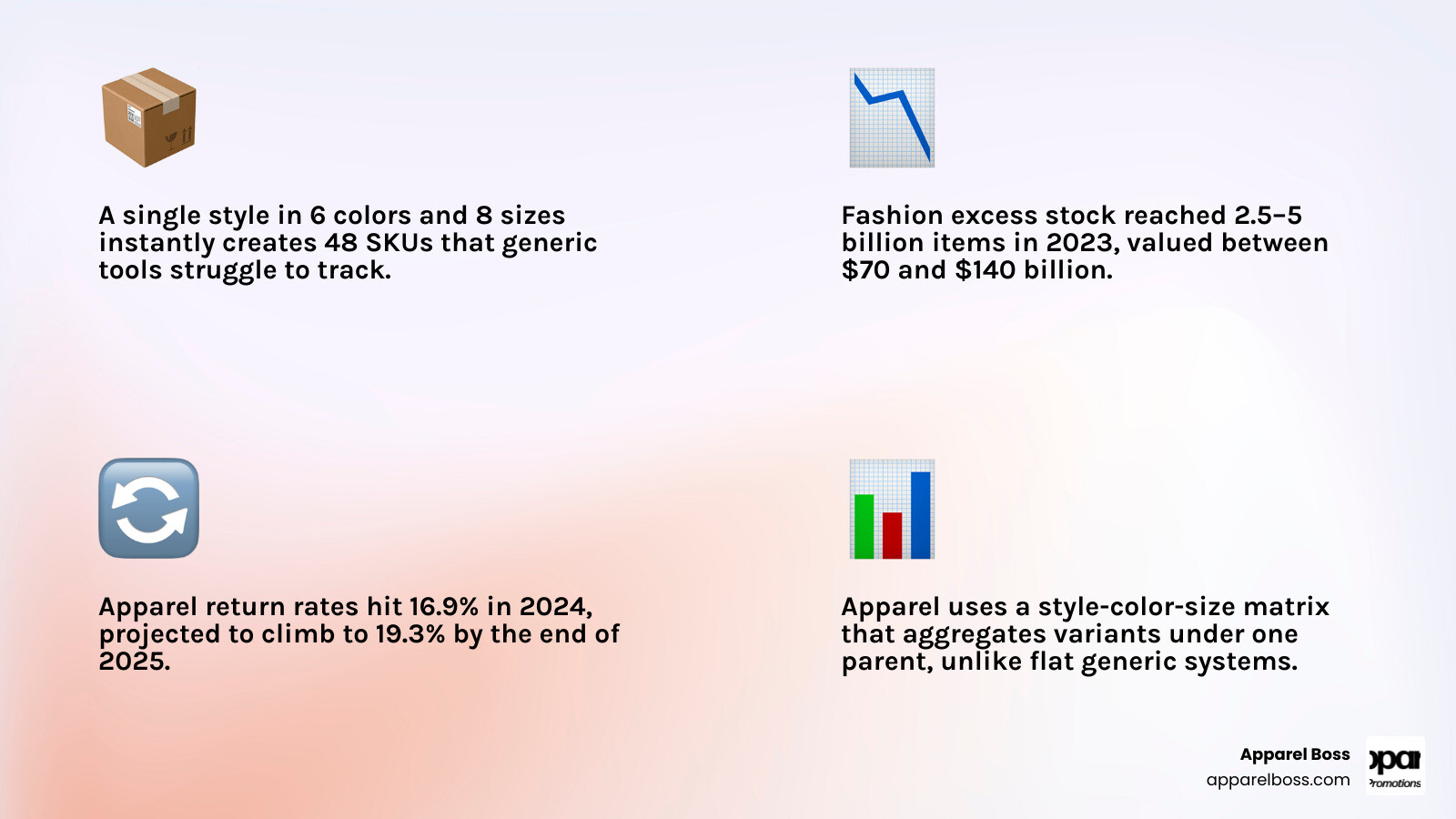
Apparel inventory is not like managing boxes of widgets. A single style offered in six colors and eight sizes creates 48 SKUs — instantly. Multiply that across dozens of styles, multiple warehouses, wholesale channels, and a DTC storefront, and the numbers become unmanageable without purpose-built software.
The stakes are real. The fashion industry produced an estimated 2.5 to 5 billion excess stock items in 2023, valued between $70 and $140 billion. At the same time, online return rates for apparel hit 16.9% of all 2024 sales, with projections pointing to 19.3% by end of 2025. Poor inventory visibility sits at the root of both problems.
I'm Salvatore Vento, Marketing Director at Apparel Boss, where I help scaling organizations build structured merchandise programs that eliminate waste and improve brand consistency — and getting the right apparel inventory management tool in place is always step one. In this guide, I'll walk you through what separates apparel-specific platforms from generic tools, how the leading options stack up, and what to look for before you commit.
Why Generic Systems Fail: The Unique Complexity of Apparel Inventory
When I consult with operations leaders across New York, NY and Long Island, NY, I often see them trying to manage their corporate apparel programs using standard ERPs or basic warehouse software. These generic systems treat garments like simple widgets, completely ignoring the multi-dimensional nature of apparel. This structural disconnect is why so many companies end up with boxes of dead stock, which is why I always advise teams to start by Stop Throwing Money Away by Solving Your Inventory Waste Issues.
To understand why generic systems fall short, we have to look closely at the data models required to run an efficient apparel program. A generic inventory tool tracks items in flat, linear rows. In contrast, specialized systems leverage a style-color-size matrix that aggregates variants into a single, logical parent item. For a deep dive into this architecture, refer to the Mastering Fashion Inventory Management Guide.
The Math Behind the Matrix: Style-Color-Size Complexity
Let's look at the math. If you want to distribute a single custom jacket design to your offices in Nassau County, NY and Suffolk County, NY, you aren't just tracking "one jacket." You are tracking:
- 1 Style (The Custom Softshell)
- 5 Colors (Black, Navy, Charcoal, Royal, Red)
- 6 Sizes (XS, S, M, L, XL, XXL)
This simple combination results in 30 distinct SKUs for just one garment. If you expand your corporate catalog to ten items, your team is suddenly managing 300 unique SKU variations.
Without an apparel-native matrix, your spreadsheets and generic databases will quickly break down. This variant explosion is also why teams struggle with sizing consistency across different manufacturers. I recommend reading about The Real Reasons Your Apparel Sizing Is So Inconsistent to understand how these SKU variations impact your physical fulfillment.
Tracking the 9 Distinct Inventory States
Generic software typically tracks two inventory states: "In Stock" and "Out of Stock." In the apparel world, this binary view is a recipe for operational chaos. To maintain a healthy supply chain, a professional apparel inventory management tool must track nine distinct inventory states:
- Stock Inventory: The physical units currently sitting on your warehouse shelves.
- Allocated Inventory: Units reserved for specific orders or departments.
- In-Pick Inventory: Items currently being gathered by warehouse staff.
- In-Transfer Inventory: Stock moving between warehouses or regional offices.
- Available Inventory: Physical stock minus allocated and in-pick units.
- OTS (Open to Sell): Total inventory available to promise to clients or teams.
- OTSi (Open to Sell Immediate): Stock that can be shipped out today.
- WIP (Work-in-Progress) Inventory: Garments currently in production or embroidery.
- WIP Allocated Inventory: Incoming production units already promised to specific teams.
Expert Insight: Managing WIP Allocated Inventory is crucial for corporate programs. By earmarking garments while they are still on our in-house production lines in Deer Park, NY, we ensure that new hire kits are pre-allocated before the truck even arrives at the warehouse, eliminating internal double-booking.
Key Features to Look for in an Apparel Inventory Management Tool
If you want to Stop the Grind with These Streamlined Inventory Ops Platforms, you need to know which features are non-negotiable. A robust platform must offer real-time, multi-location visibility. Whether your stock is sitting in a local depot in Long Island, NY or with a third-party logistics (3PL) provider, your team needs a single source of truth. You can learn more about establishing these baseline capabilities through Apparel Inventory Management Software.
How an Apparel Inventory Management Tool Prevents Overselling
Overselling is one of the most frustrating experiences for any employee or customer. Imagine an internal team member ordering a custom jacket for an upcoming trade show, only to receive an email three days later stating the item is backordered.
Specialized apparel tools solve this with an atomic decrement model. When an order is placed on an online company store, the software decrements the master ledger in under five seconds, instantly pushing the updated stock levels to all other integrated channels.
Pro-Tip: Always set channel-specific safety thresholds (buffer stock) within your inventory tool. By reserving a buffer of 3-5 units for highly popular sizes (like Medium and Large), you protect your program from stock drift during high-volume ordering windows.
Integrating Your Apparel Inventory Management Tool with ERP and WMS
Your inventory tool should never operate on an island. It must integrate seamlessly with your Enterprise Resource Planning (ERP) and Warehouse Management System (WMS) via open APIs. This ensures that when a purchase order is completed, the inventory levels, bill of materials (BOM), and shipping documents sync automatically.
Expert Insight: Look for platforms that support component-level landed cost tracking. This allows you to track the exact cost of the raw garment, the decoration (embroidery or print), and localized shipping to your NY offices, giving you a highly accurate cost-per-unit metric.
Comparing the Top Apparel Inventory Management Platforms in 2026
To help you evaluate your options, I have mapped out how the leading platforms compare across key operational categories:
| Platform | Target Business Size | Key Strengths | Integration Capabilities |
|---|---|---|---|
| AIMS360 | Mid-to-Enterprise | Deep fashion ERP workflows, EDI retail compliance | 350+ EDI retailers, Shopify, Magento |
| ApparelMagic | Small-to-Mid | Built-in PLM, B2B eCommerce, easy data import | Shopify, QuickBooks, ShipStation |
| Uphance | Mid-Market | Unified ERP/WMS, multi-warehouse coordination | Shopify, Amazon, various 3PLs |
| DOSS Operations Cloud | Mid-to-Enterprise | No-code adaptive workflows, rapid deployment | 100+ native integrations, custom APIs |
| NetSuite | Enterprise | Multi-entity accounting, global supply chain tracking | Robust native ecosystem, custom integrations |
| Cin7 Core | Small-to-Mid | Multi-channel DTC, budget-friendly setup | Shopify, WooCommerce, Amazon |
This landscape, detailed further in the Top 7 Apparel Inventory Platforms in 2026, highlights why choosing a tool that fits your specific operational scale is so critical.
Enterprise ERP and Specialized Fashion Software
For larger organizations running complex operations, enterprise-grade software is often required. AIMS360 is a powerhouse for brands that need deep wholesale and EDI compliance. It supports hundreds of SKUs per brand and manages complex retail distribution networks.
ApparelMagic is widely considered a gold standard for fashion brands that want integrated Product Lifecycle Management (PLM) alongside their inventory. It allows you to manage designs, materials, and production workflows in one place. You can explore their full feature set at Apparel Software ERP.
Meanwhile, NetSuite offers massive multi-entity capabilities for global corporations but often requires a lengthy, resource-intensive implementation process.
Mid-Market and Agile Operations Platforms
For fast-growing organizations that need agility without enterprise overhead, mid-market platforms are the sweet spot. Uphance provides a unified operations platform that bridges the gap between the front office and the warehouse floor. It replaces disconnected spreadsheets with a single, live stock picture. Discover how they unify operations at Uphance Unified Apparel ERP.
DOSS Operations Cloud uses an adaptive no-code architecture that allows companies to build custom tables and workflows without developer resources. This makes it highly flexible for businesses expanding their corporate merchandise programs.
Best Practices and FAQs for Implementing Apparel Inventory Software
Transitioning to a new inventory system requires careful planning. To avoid production stalls, I recommend a phased onboarding approach. You can find a step-by-step roadmap for automating these processes in our A-Z Guide to Solving Common Merchandise Problems with Automation.
Establishing a Single Source of Truth
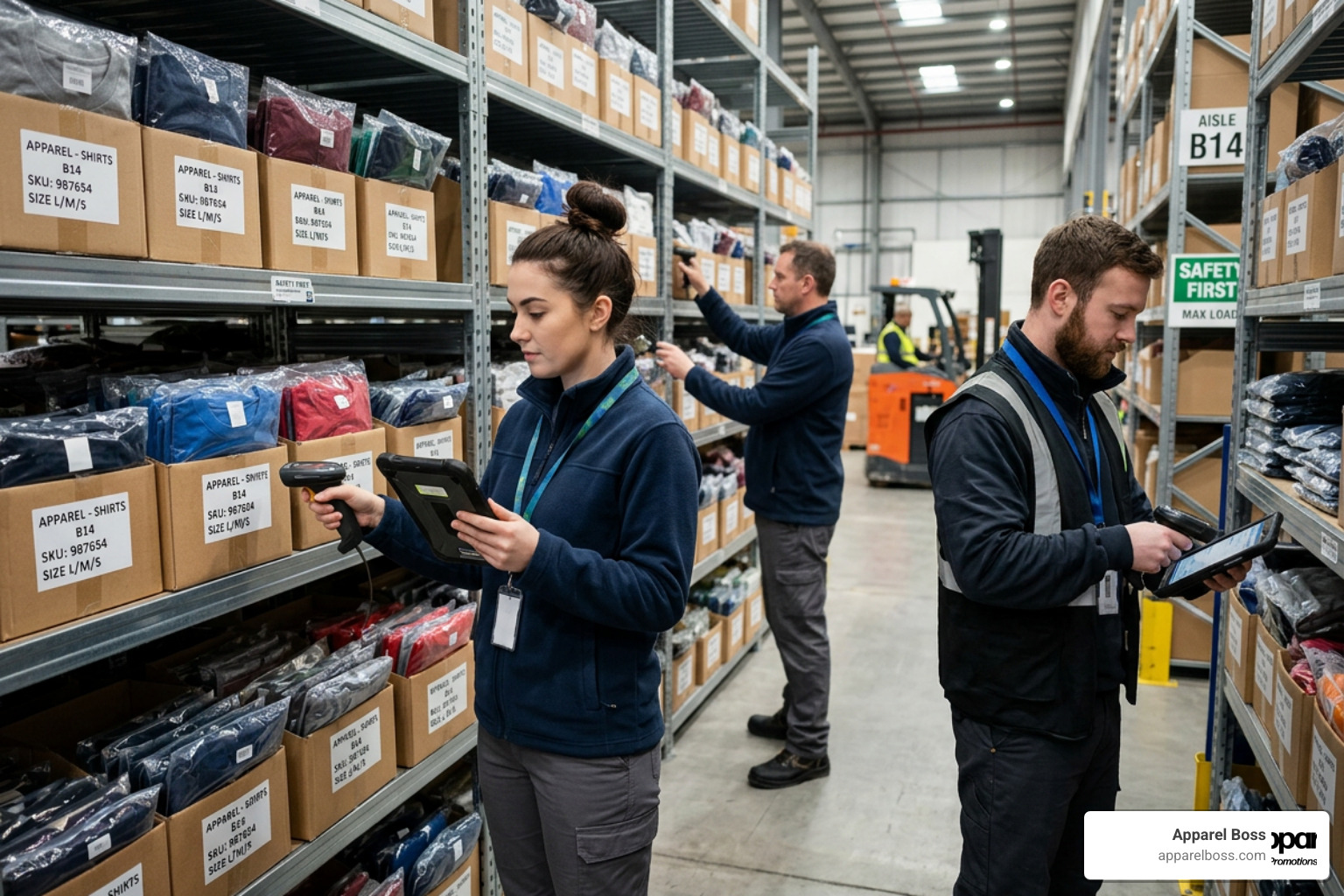
The foundation of any successful inventory program is a single source of truth. Your physical warehouse shelves must match your digital ledger perfectly. To achieve this, implement mobile barcode scanning and establish a strict cycle counting schedule rather than relying on annual physical audits. Learn more about optimizing your physical space with Apparel Warehouse Management Software.
Pro-Tip: Ditch paper pick sheets immediately. Paper pick sheets are often outdated within 45 minutes of being printed during peak periods. Transitioning to mobile-based execution ensures your picking team is always working with real-time order data.
Managing Returns and Restocking Workflows
With return rates for online apparel orders hovering near 20%, your software must handle reverse logistics efficiently. When a return arrives at your facility, it should be scanned, inspected, and restocked (or marked as damaged) within minutes to prevent inventory drift. If you are struggling with missing stock or transit issues, read our guide on Is Your Merch Missing? How to Handle Shipping Delays and Store Issues.
Why does generic inventory software fail for apparel?
Generic software cannot handle style-color-size matrices natively. It forces your team to enter every single size and color variation as a flat, disconnected SKU. This leads to massive data entry workloads, spreadsheet workarounds, and a complete lack of visibility into your overall style performance. For smaller shops looking to escape this cycle, specialized tools like those discussed in Apparel Inventory Software for Garment Shops offer a great starting point.
How quickly does inventory sync across channels?
Modern apparel inventory systems utilize real-time API integrations that sync stock levels across your online company stores, internal ERPs, and external 3PLs in under 30 seconds. This sub-30-second propagation is essential for preventing double-selling during high-volume ordering windows, a capability you can explore further at Fashion & Apparel Inventory Management Software.
Conclusion
Managing a corporate merchandise program shouldn't feel like a second job for your operations or HR teams. When you implement a dedicated apparel inventory management tool, you eliminate the administrative burden of tracking sizes, managing backorders, and dealing with wasted stock.
At Apparel Boss, we specialize in helping businesses across New York, NY, Suffolk County, and Nassau County build scalable, hands-off merchandise programs. By combining our in-house production capabilities in Deer Park, NY with custom kitting and state-of-the-art Apparel Boss Company Stores, we streamline your entire distribution process.
If you are ready to trade your fragmented spreadsheets for total supply chain control, let's talk. We can help you build a custom, automated system that keeps your brand consistent and your teams perfectly aligned.
Apparel Inventory Management Tool 101