
Why Companies Need to Automate Onboarding Kit Delivery Before Day One
To automate onboarding kit delivery, follow these five steps:
- Connect your HRIS or ATS (e.g., Workday, BambooHR) to your kitting platform to trigger orders when a hire is confirmed.
- Send a self-serve intake link so new hires submit their own address and sizing in under 60 seconds.
- Define pre-approved kit tiers by role, department, or seniority to remove manual decision-making.
- Route production to the nearest regional fulfillment center to hit day-one delivery windows without customs delays.
- Track every shipment from a central dashboard and feed delivery data back into your HR reporting.
Only 12% of employees strongly agree their company did a great job onboarding them. That number should concern every HR and operations leader who has invested in culture, training, and employer brand — because the physical welcome kit is often the very first tangible signal a new hire receives.
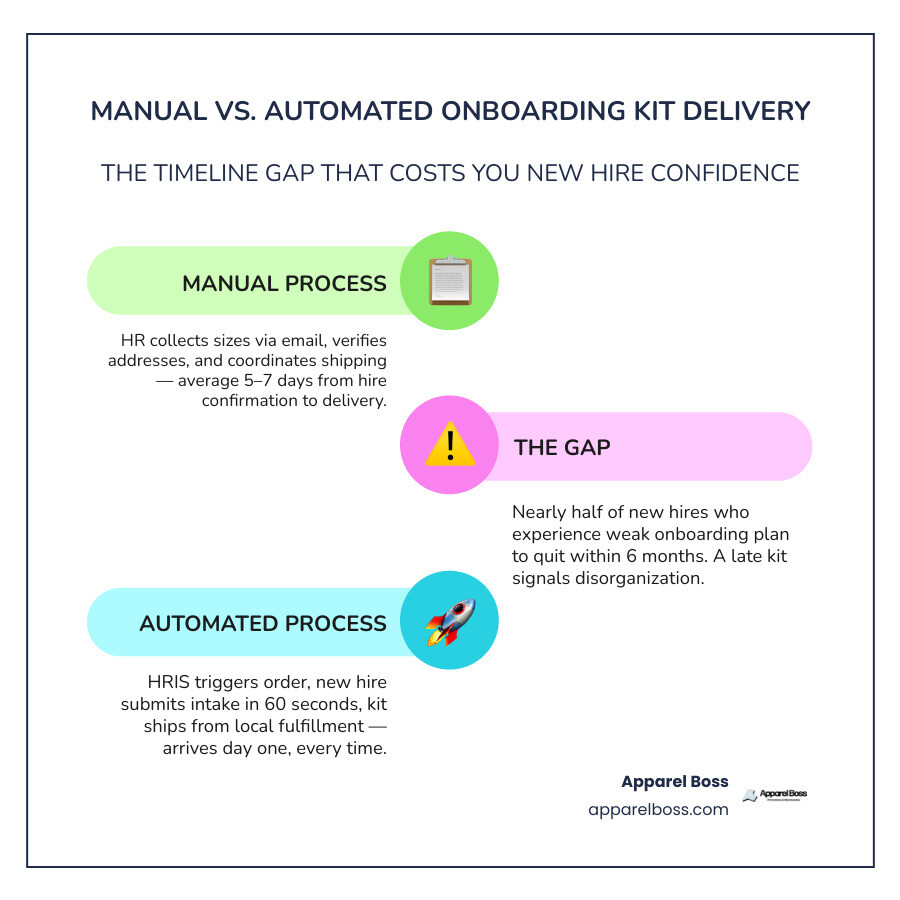
The problem is not that companies do not care. It is that the logistics behind kit delivery are still largely manual. Someone on the HR team is collecting t-shirt sizes over email. Someone else is chasing a tracking number. And far too often, the kit arrives after the employee does — or not at all.
Nearly half of new hires who experience a weak onboarding process plan to quit within six months. A late or missing welcome kit is a small operational failure that sends a loud message.
I'm Salvatore Vento, Marketing Director at Apparel Boss, where I've spent years helping scaling companies eliminate the manual chaos behind branded merchandise programs — including building the systems companies need to automate onboarding kit delivery reliably and at volume. In the sections below, I'll walk you through exactly how to set this up so your kits land on day one, every time.
The Hidden Costs of Manual Onboarding Kit Logistics
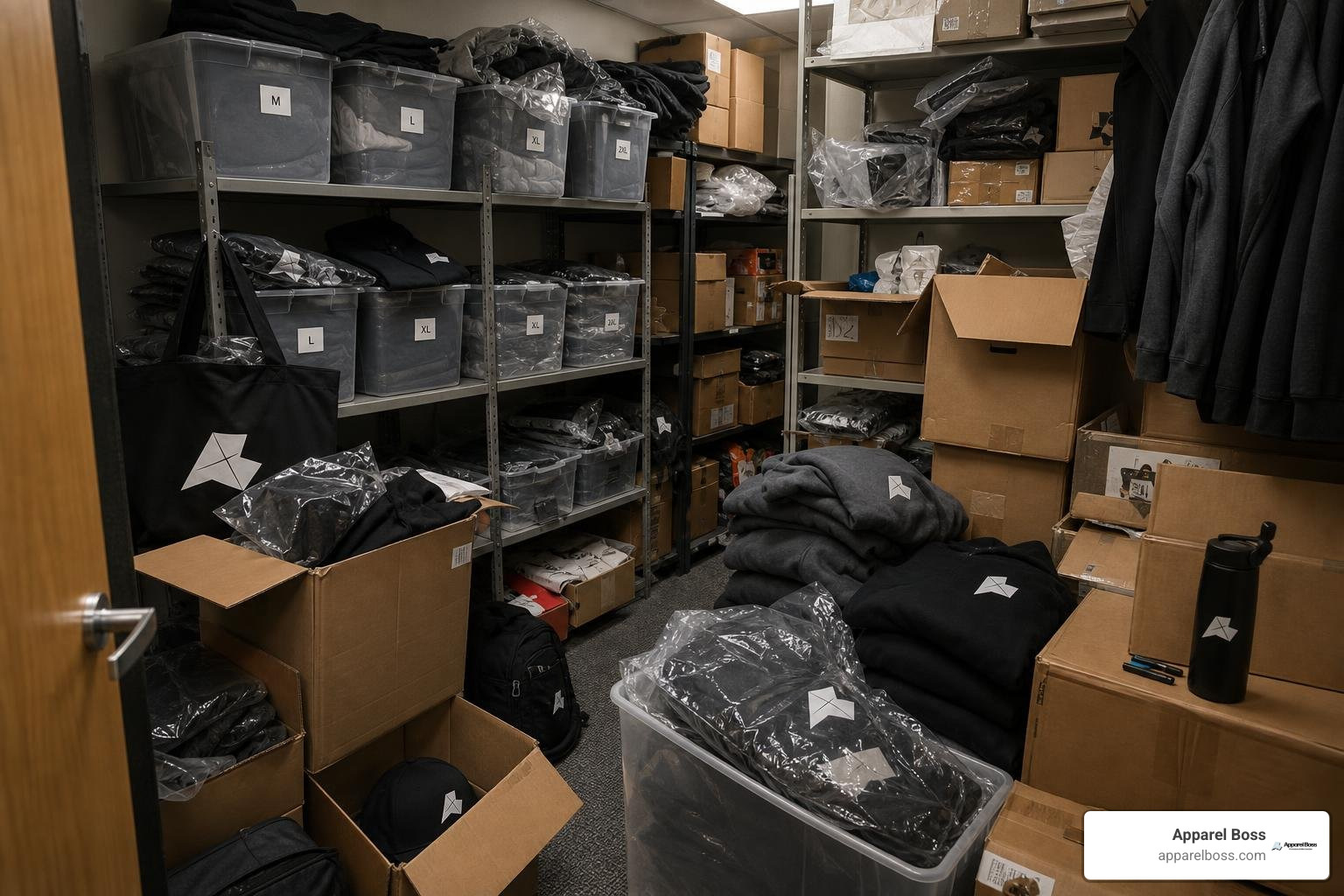
When organizations handle onboarding kits manually, the operational drag is rarely confined to a single department. Instead, it ripples across HR, recruiting, and office operations, quietly draining time and budget.
Highly paid talent acquisition specialists and HR managers should not spend their afternoons tape-gunning cardboard boxes, digging through dusty supply closets in Long Island, or hunting down a "medium" t-shirt from disorganized plastic bins. Yet, this is exactly what happens when logistics are managed in-house.
Beyond the lost administrative hours, manual kitting leads to significant financial leakage. Without centralized inventory tracking, companies suffer from "dead-stock waste"—buying hundreds of apparel items that sit in storage because they are the wrong sizes, or facing "pipeline stockouts" when a sudden hiring peak leaves them with nothing to send.
When regional managers try to bypass these slow internal supply chains, they often use decentralized corporate cards to buy low-quality, off-brand gifts from unvetted local vendors. This causes "brand drift," where the corporate identity is diluted by poor-quality prints and scratchy fabrics. To avoid this, companies must invest in Best Employee Welcome Kits for a Five-Star First Day that are managed through a professional system.
The Operational Nightmare of Sizing and Address Collection
The most common bottleneck in the manual workflow is collecting sizing and shipping data. HR teams often spend days chasing new hires over email or messaging apps to ask for t-shirt sizes and shipping addresses.
This manual data entry is highly prone to human error. A single mistyped apartment number or a guessed apparel size leads to delivery failures, returned packages, and administrative frustration. When a kit is returned because of a bad address, the shipping cost is wasted, and the employee's first-day experience is compromised.
If production delays occur or custom items are held up, it can completely derail your timeline. Knowing How to Delay Custom Kits Without Ruining Your Automation is a critical operational safeguard that ensures your digital pipeline remains intact even when physical supply chains face temporary friction.
Why You Must Automate Onboarding Kit Delivery for Remote Teams
In a hybrid or remote-first work environment, the physical welcome kit serves as a crucial emotional anchor. Psychologists refer to these small, welcoming gestures as "micro-affirmations"—tangible cues that signal to a remote employee that they are valued and belong to the team.
However, shipping individual kits to remote employees across different states or countries introduces complex logistical hurdles. International customs, varying transit times, and localized tax rules make centralized shipping from a single corporate office highly inefficient.
For example, shipping a single kit from a New York headquarters to a remote hire in Europe can incur massive international freight costs and weeks of customs delays. This prolonged shipping window often means the kit arrives long after the employee's first day.
Furthermore, cross-continental shipping carries a heavy carbon footprint that directly contradicts modern corporate sustainability commitments. To solve this, organizations must shift to decentralized, automated routing that leverages regional fulfillment networks.
How to Automate Onboarding Kit Delivery in 5 Steps
Transitioning from manual shipping to a touchless system requires a structured approach. By establishing a governed catalog and connecting your digital systems to a professional fulfillment network, you can learn How to Build a Scalable Corporate Gifting System Without Wasting Budget. Here is the five-step blueprint to achieve this.
Step 1: Connect Your HRIS and ATS Platforms
The foundation of a hands-off kitting program is integration. By connecting your Applicant Tracking System (ATS) or Human Resource Information System (HRIS)—such as Workday, BambooHR, or Rippling—directly to your kitting platform, you eliminate manual data entry.
When a candidate’s status changes to "Hired" or "Offer Accepted," an API call automatically triggers the onboarding kit workflow. This touchless trigger initiates the downstream logistics without a single click from your HR team. To see how these workflows behave on a broader scale, you can explore the mechanics of AI Onboarding Workflow Automation to understand how digital agents handle complex, multi-step triggers.
Step 2: Set Up Sizing and Address Intake Forms
To eliminate size-guessing and address typos, your automated workflow should immediately email a secure, white-labeled intake link to the new hire.
This mobile-friendly form allows the employee to input their current shipping address and select their preferred apparel sizes in under 60 seconds. The system validates the address in real time against global postal databases to prevent delivery failures. Automated, gentle reminders can be configured to nudge the new hire if they haven't completed the form, ensuring the data is locked in well before their start date.
Step 3: Define Your Kit Tiers and Brand Governance
Not every role or department requires the same welcome materials. An automated system allows you to pre-configure standardized kit templates tailored to different teams, roles, or seniority levels. By using role-based access control, you can ensure that managers only trigger kits within their approved budgets, preventing rogue spending.
| Kit Tier | Target Audience | Key Components | Governance Rule |
|---|---|---|---|
| Standard Tier | High-volume cohorts, interns, and general staff | Premium custom tee, functional notebook, branded drinkware | Automatically triggered upon HRIS hiring status change |
| Management Tier | Mid-level managers and department leads | Premium custom hoodie, insulated travel tumbler, tech organizer | Requires automated manager approval via the portal |
| Executive Tier | Directors, VPs, and C-suite hires | High-end custom fleece jacket, premium leather portfolio, luxury tech accessories | Triggers an automated financial approval workflow |
By standardizing these tiers, you lock in brand consistency and ensure that every item reflects premium quality, utilizing artisan-level decoration like custom embroidery rather than cheap, transactional printing.
Step 4: Route Production and Global Logistics
Once the new hire submits their sizing and address, the system routes the order to the closest regional fulfillment facility. For companies operating in the New York metro area, having a dedicated partner with local production facilities in Deer Park, NY, ensures rapid turnaround and lower domestic shipping fees across Suffolk County, Nassau County, and New York City.
For global hires, the system routes the order to regional facilities in Europe, Canada, or the UK to bypass international customs and reduce shipping times to a consistent 3-to-5 business days. This localized routing also ensures compliance with regional tax documentations (such as NF-e compliance in Brazil or local VAT rules in Europe) without requiring manual oversight from your finance team.
Step 5: Track Delivery and Measure Success
Once the kit is packed and shipped, the tracking number is automatically synced back to your HR portal. The system sends a live tracking link to the hiring manager, allowing them to coordinate day-one welcome activities with the physical arrival of the package.
To measure the ROI of your automated program, you should track key performance indicators such as:
- Administrative hours saved: The weekly hours reclaimed by HR and recruiting teams.
- Time-to-proficiency: How quickly new hires ramp up when equipped with their gear on day one.
- First 90-day retention: The correlation between a positive, kit-supported onboarding experience and early employee retention.
Bridging the Digital-Physical Gap in Modern HR Tech Stacks
A common mistake organizations make is treating physical merchandise as separate from their digital HR software. True operational efficiency happens when physical logistics are fully integrated into your modern HR tech stack. To understand how these connections function under the hood, read our In-Depth Guide to Corporate Onboarding Kit Platform Integrations.
Integrating Your HRIS to Automate Onboarding Kit Delivery
Integrating your HRIS with your kitting platform enables a completely touchless workflow. Rather than managing separate spreadsheets for digital onboarding software, learning management systems (LMS), and physical gear, everything flows from a single source of truth.
When a new user profile is created in your HRIS, the system coordinates account provisioning, LMS training path assignments, and the shipment of the physical welcome kit simultaneously. This unified orchestration ensures that remote and hybrid hires receive their digital credentials and physical tools on the exact same timeline, eliminating day-one confusion and maximizing early employee engagement.
Frequently Asked Questions about Onboarding Kit Automation
How long does it take to set up an automated onboarding kit program?
Setting up a standard automated onboarding kit program typically takes 2 to 3 weeks. This timeline includes designing your custom-branded packaging, selecting your apparel and gear, and configuring the API integrations with your HRIS. For highly customized enterprise programs with complex, multi-tiered approval workflows, setup can take 4 to 6 weeks to ensure complete brand governance and system testing.
Do we need to hold physical inventory to automate delivery?
No, you do not need to manage a physical warehouse yourself. A modern kitting program operates on a hybrid fulfillment model. High-turnover items can be produced in bulk and stored in our secure fulfillment facilities, ready for 1:1 on-demand dispatching. For high-end or specialized items, companies can utilize a "decorate-on-demand" model, where premium blank apparel is held in stock and custom-embroidered only when an onboarding order is triggered. This eliminates upfront capital ties and prevents inventory waste.
How do we handle international shipping and tax compliance?
When you automate onboarding kit delivery through a global kitting platform, international logistics are handled automatically. The system calculates local sales tax, manages customs documentation, and routes production to regional fulfillment facilities closest to the recipient. This local routing avoids international freight fees and ensures compliance with regional tax regulations without manual intervention from your accounting team.
Conclusion
Automating your onboarding kit delivery is more than just a logistical upgrade; it is a strategic investment in your employer brand and early talent retention. By replacing manual sizing spreadsheets and cluttered supply closets with a touchless, integrated system, you ensure that every new hire experiences a flawless, five-star first day.
At Apparel Boss, led by corporate merchandise expert Salvatore Vento, we specialize in solving the "Quality-at-Scale" dilemma. Our premium custom kitting services and managed online company stores provide a concierge alternative to transactional, commodity swag sites. Operating from our state-of-the-art production facility in Deer Park, NY, we deliver artisan-level custom embroidery and white-glove distribution across Long Island, New York City, and global remote teams.
If you are ready to eliminate operational chaos and elevate your onboarding experience, connect with an Apparel Boss branding expert today to design a scalable, automated kitting system tailored to your business.