
Why Businesses Struggle to Reduce Bulk Order Hassles in 2026
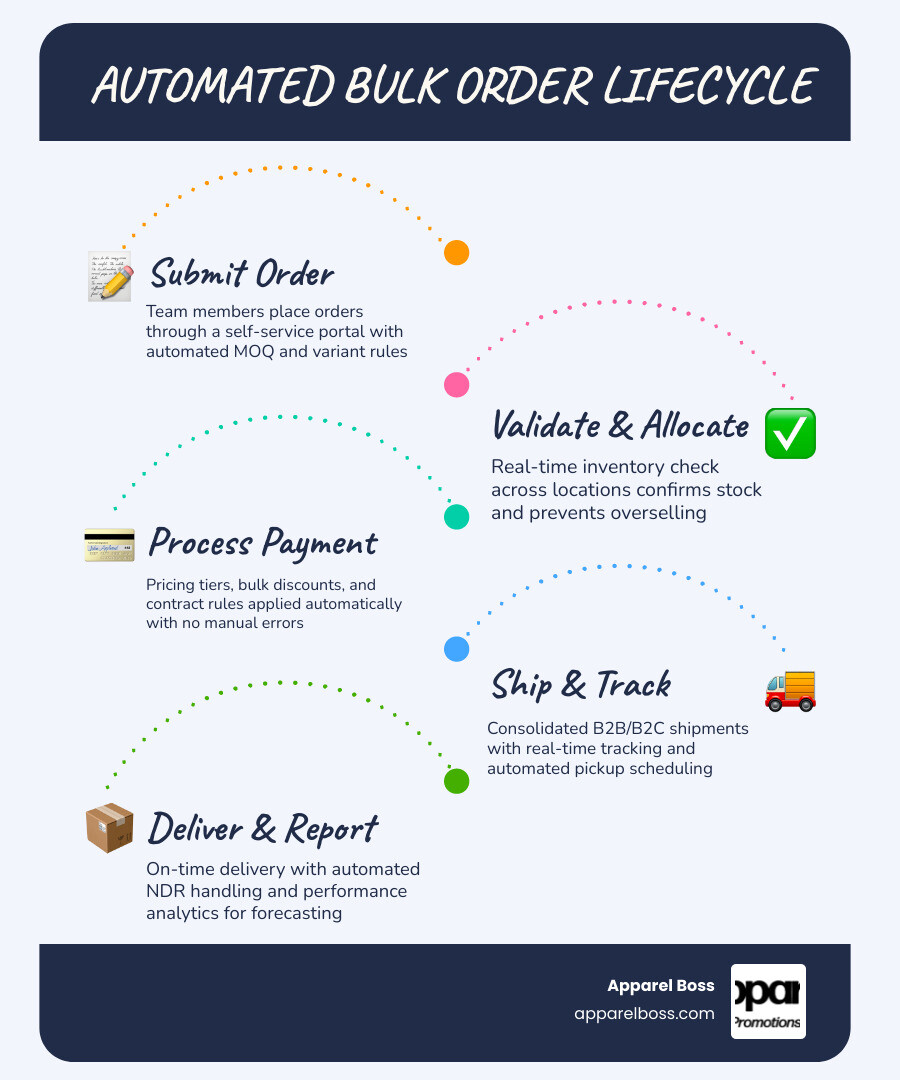
The fastest way to reduce bulk order hassles is to replace manual processes with structured, automated systems. Here is what that looks like in practice:
- Switch from spreadsheets to a self-service ordering portal — eliminates manual data entry and pricing errors
- Enforce minimum order quantities automatically — cart-level rules replace back-and-forth emails
- Use a unified inventory view — real-time stock visibility prevents fulfillment delays and overselling
- Consolidate shipping management — handle B2B and B2C orders from one dashboard to reduce failed deliveries
- Balance print-on-demand with bulk ordering — use bulk for predictable demand, on-demand for new or low-volume items
Managing bulk orders at scale is harder than it looks. What starts as a simple spreadsheet turns into a maze of manual entry, pricing inconsistencies, and fulfillment errors that compound as order volume grows.
The numbers reflect the pain. B2B sales teams can lose 2 to 5 hours per day to manual order entry and data rekeying alone. At the same time, traditional wholesale orders often arrive through four to six disconnected channels — emails, phone calls, PDFs, and portals — with no single source of truth to manage them.
For marketing, HR, and operations leaders responsible for branded merchandise programs, the stakes are higher than a missed shipment. A failed bulk order means delayed onboarding kits, inconsistent uniforms, and a team that loses confidence in the process you built.
The good news is that the fixes are not complicated. They require the right structure, not a complete overhaul.
I'm Salvatore Vento, Marketing Director at Apparel Boss, where I work directly with operations and brand teams to build merchandise programs that scale without scaling errors — and a core part of that work is helping companies reduce bulk order hassles before they turn into expensive operational problems. In this guide, I'll walk you through the specific changes that make the biggest difference, based on what we see working across real corporate apparel programs.
The Hidden Costs of Manual Bulk Order Management
When I talk to operations managers across Long Island, NY, the first thing they bring up is the hidden administrative drain of manual systems. What seems like a free, flexible solution—usually a shared Excel spreadsheet or a Google Doc—actually costs thousands of dollars in lost productivity, wasted stock, and shipping corrections.
The core issue is that manual workflows lack validation. When an employee or a department head types their apparel sizes into a shared sheet, there is nothing to prevent them from entering an invalid size, skipping a required field, or selecting a discontinued item. These small errors compound quickly, leading to what I call the "quality-at-scale" dilemma: trying to maintain premium brand standards while using tools that are fundamentally built for small-scale, transactional tasks. If you are currently struggling with these operational bottlenecks, you may want to read my guide on Managing High-Volume Merch Orders Without the Stress.
How Manual Workflows Drain Sales Team Productivity
In a traditional setup, your internal team or your sales representatives spend a shocking amount of time acting as human data routers. Instead of focusing on high-value strategy, they are busy rekeying orders from PDF purchase orders into an ERP, chasing down missing sizing details, and manually validating pricing tiers.
By implementing dedicated B2B Order Management Software for Wholesalers | WizCommerce, businesses can automate the entire ingestion process. Rather than reviewing every single transaction, your team shifts to an "exception-only" review process. The system automatically validates orders against live inventory and predefined contract rules, flagging only the rare discrepancies for human intervention. This single change can reclaim hours of productive time every single day.
The Financial Impact of Inaccurate Cost Tracking and Pricing Errors
Without automated cost tracking, calculating the true product cost of a bulk order is incredibly difficult. You have to account for the raw garment, the custom embroidery setups, the bulk volume discounts, and the individual shipping fees. When these variables are tracked manually, margin erosion is inevitable.
Inaccurate cost tracking also makes financial forecasting nearly impossible. If your system cannot automatically apply negotiated pricing tiers or enforce contract compliance across multiple regional offices, your accounting team will spend days reconciling invoices. To reduce bulk order hassles and protect your margins, you must have a system that calculates and locks in the exact, fully burdened cost of every item before the order is ever sent to production.
Strategic Changes to Reduce Bulk Order Hassles

To scale your merchandise programs without the accompanying headaches, you need to transition from reactive troubleshooting to proactive process optimization. This starts with how you view and allocate your inventory.
Transitioning to a Unified Inventory View to Prevent Stockouts
One of the quickest ways to stall a bulk order is to promise items that are not actually on the shelves. A unified inventory view gives you real-time visibility across all your storage locations, whether you are managing stock in Deer Park, NY, or coordinating with regional wholesalers in Long Island, NY.
When your ordering portal is directly tied to your physical inventory, the system can automatically allocate stock the moment an order is placed. This prevents the classic "double-selling" trap, where two departments place large orders for the same medium-sized jacket at the same time. To learn more about setting up these systems, check out our breakdown of Stop the Grind with These Streamlined Inventory Ops Platforms. By automating these checks, you can significantly improve both your fulfillment speed and your overall order accuracy. For a deeper dive into automation strategies, see our A-Z Guide to Solving Common Merchandise Problems with Automation.
Balancing Print-on-Demand vs. Bulk Ordering to Mitigate Risk
Many businesses assume they have to choose entirely between bulk ordering and print-on-demand (POD). In reality, the most efficient corporate programs use a hybrid model to balance upfront costs, inventory risk, and shipping speed.
- Bulk Ordering: Best for high-volume, highly predictable items (like standard field uniforms or onboarding t-shirts). This approach offers the lowest per-unit cost and allows for immediate, same-day shipping.
- Print-on-Demand: Ideal for testing new designs, offering a wider variety of colors, or handling low-volume specialty items without committing to upfront inventory.
By blending these two models, you keep your storage costs low while ensuring your core, high-demand items are always ready to ship.
Eliminating Spreadsheets with Modern Ordering Portals
If you are still collecting orders via email, you are inviting chaos. Replacing those manual touchpoints with a dedicated, self-service online portal is the single most impactful change you can make.
| Feature / Capability | Manual Spreadsheets | Automated Portals |
|---|---|---|
| Data Entry | Manual rekeying (high error risk) | Direct user input with validation |
| Inventory Verification | None (requires manual warehouse checks) | Real-time, automatic stock allocation |
| MOQ Enforcement | Manual review (requires back-and-forth emails) | Hard cart-level validation blocks |
| Sizing Details | Text fields (prone to typos and invalid sizes) | Dropdowns restricted to active variants |
| Brand Consistency | Low control over design and logo placement | Pre-approved, locked brand templates |
Transitioning to this model is easier than you think. You can read more about how to make the switch in our guide on how to Stop the Swag Chaos with Professional Online Company Stores.
Enforcing Minimum Order Quantities and Variant-Level Rules
A common headache in bulk apparel is managing the size matrix. A wholesale buyer might want to order 100 shirts, but they need them split across six different sizes and three colors. If they don't meet the minimum order quantities (MOQs) for specific high-end decoration runs, your production costs will skyrocket.
Modern portals solve this by enforcing variant-level rules directly in the cart. By using tools like the Bulk Variant Order by Vector - Simplify multi-variant bulk orders in minutes. | Shopify App Store, you can set strict rules that require a minimum number of items per variant before checkout is allowed. The system handles the validation instantly, meaning your team never has to send an awkward email explaining that an order cannot be processed because it didn't meet the minimum requirements.
How Online Portals Reduce Bulk Order Hassles for Team Stores and Events
Whether you are launching a new uniform program or preparing for a major corporate event, tight deadlines leave zero room for error. When you use a custom portal, you can build in automated approval workflows and custom fields to collect player rosters, employee names, or department codes at the point of purchase.
This structure ensures that you gather all necessary personalization details up front. To explore how to set these portals up for success, check out The Expert Way to Handle B2B Company Store Setup Without the Stress.
Optimizing Shipping and Logistics for High-Volume Shipments
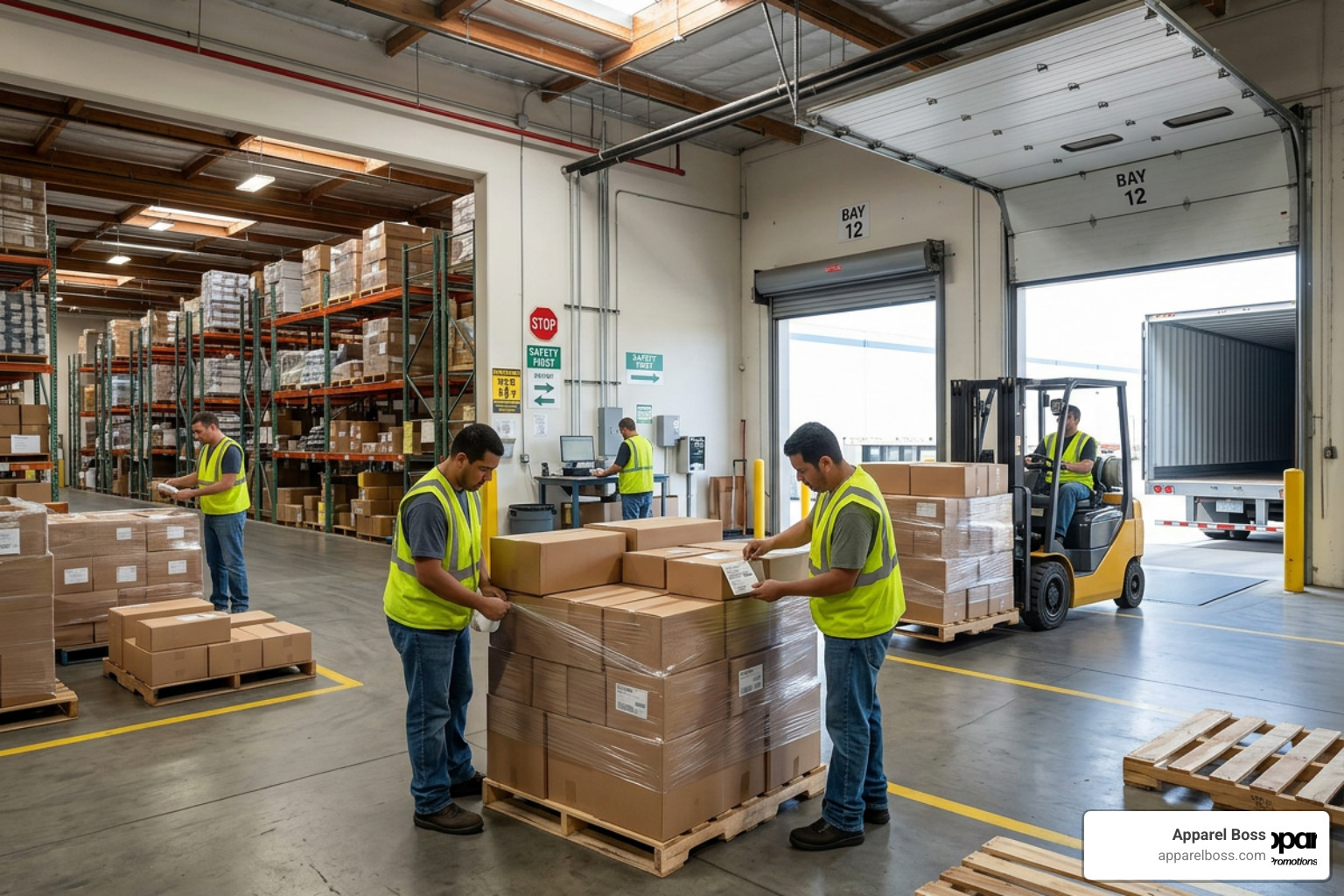
Getting the products decorated correctly is only half the battle; you still have to deliver them. High-volume shipments require specialized logistics to avoid astronomical shipping fees and delivery delays.
Whether you are arranging a local bulk delivery in Deer Park, NY, coordinating a freight shipment under the local regulations in Nassau County, NY, or setting up a bulky item pickup in Shirley, NY, having a centralized logistics plan is critical. To understand how to structure your shipping budgets effectively, read our guide on How to Budget for Corporate Merchandise Without Sacrificing Quality.
Leveraging Automated Courier Management to Reduce Bulk Order Hassles
Failed deliveries—often resulting in a Return to Origin (RTO)—are an expensive logistics nightmare. Automated courier management platforms help reduce bulk order hassles by providing real-time tracking and automated Non-Delivery Report (NDR) handling.
If a courier attempts a delivery to a corporate office and finds it closed, an automated NDR system immediately alerts the recipient to reschedule the delivery. This proactive communication dramatically reduces failed delivery rates, protecting your cash flow and ensuring your team gets their gear on time.
Consolidating B2B and B2C Shipping on a Single Platform
A major operational challenge for modern enterprises is handling split shipping. You might need 500 jackets shipped in bulk to your main office in Suffolk County, NY, while also needing 50 individual onboarding kits shipped directly to remote employees' homes.
Consolidating both B2B freight and B2C individual parcel shipping onto a single platform allows you to:
- Set smart shipping thresholds to incentivize larger orders.
- Access integrated carrier rates for USPS, UPS, and FedEx to ensure competitive pricing.
- Maintain complete, centralized tracking for every single package from a single dashboard.
Frequently Asked Questions About Bulk Order Management
What are the biggest pain points of manual bulk order management?
The primary pain points include human data-entry errors, lost or outdated spreadsheets, delayed order fulfillment, and communication gaps between departments. These manual steps create massive administrative overhead and often lead to inventory discrepancies that halt production.
How do automated portals enforce minimum order quantities (MOQs)?
Automated portals use cart-level validation and variant-level rules to prevent users from checking out unless their order meets your predefined criteria. This can include form-wide minimums, per-product minimums, or mix-and-match bundle rules that ensure production runs remain cost-effective.
How does a unified inventory view improve bulk fulfillment speed?
A unified inventory view connects all your warehouses and storage locations in real time. This allows the system to automatically route orders to the closest fulfillment center, trigger automatic reorder alerts before stockouts occur, and allocate inventory instantly so you never oversell a product.
Conclusion
Simplifying your bulk ordering workflow isn't just about saving time; it's about protecting your brand’s presentation and ensuring operational scalability. When you eliminate manual spreadsheets, centralize your inventory, and automate your shipping logistics, you free your internal teams to focus on growth rather than chasing down sizing errors and shipping updates.
At Apparel Boss, we specialize in bridging the gap between premium brand standards and operational ease. Through our custom online stores, expert custom kitting, and white-glove distribution, we help companies manage high-volume merchandise programs without the stress. If you are ready to transition from transactional, headache-inducing order forms to a fully managed, concierge experience, I invite you to explore our Apparel Boss Company Stores and let our team build a scalable solution tailored to your business.