Why High-Volume Merch Orders Become an Admin Nightmare (And How to Fix It)
To minimize merch admin workload, focus on these core strategies:
- Automate inventory tracking with real-time visibility tools to eliminate manual stock updates
- Centralize order management through an integrated platform to remove disconnected spreadsheets and data entry
- Use pre-order systems to produce only what's needed and reduce inventory guesswork
- Automate audience segmentation so the right products reach the right people without manual approvals
- Set up an online company store to handle ordering, fulfillment, and reporting without staff intervention
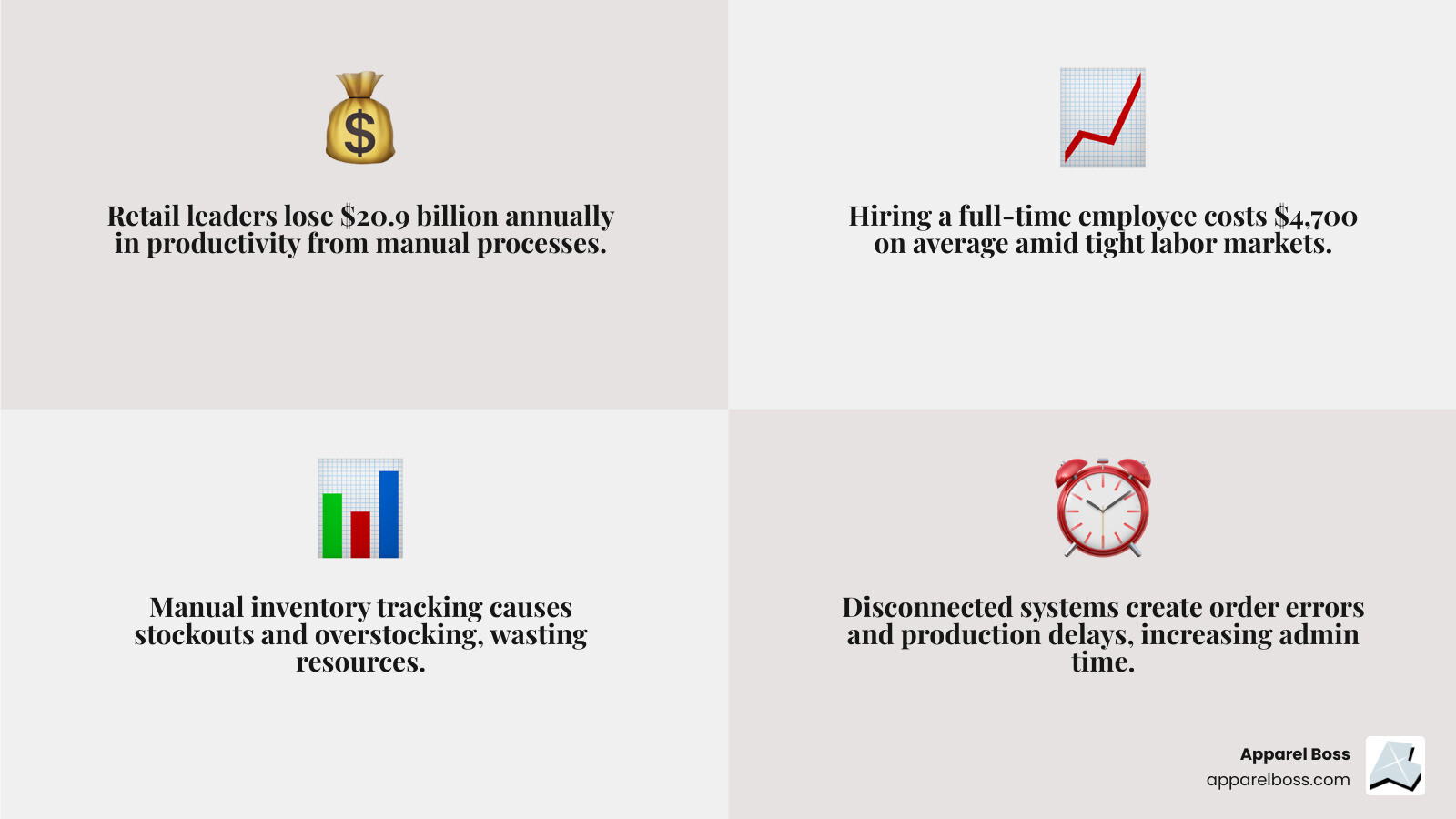
Retail and merchandise operations are losing enormous amounts of time to tasks that should not require human effort. According to industry data, retail leaders lose around $20.9 billion in productivity every year — largely from repetitive manual processes, unnecessary back-and-forth, and disconnected systems.
For growing organizations managing branded apparel, welcome kits, or uniform programs, this problem compounds fast.
One missed inventory update sends a sold-out item to the top of an order queue. One disconnected system means a custom order gets entered twice — or not at all. One person leaves the team, and suddenly nobody knows where the spreadsheet is.
The bigger your program grows, the worse the manual bottlenecks get.
This is not a people problem. It is a systems problem. Most merchandise admin overload comes from programs built on reactive, manual processes — spreadsheets, email chains, and one-off orders — that were never designed to scale.
The good news: the right infrastructure eliminates most of it.
5 Strategies to Minimize Merch Admin Workload and Scale Operations

In the current landscape of April 2026, the labor market remains tight, particularly in regions like Long Island and New York City. Hiring a new full-time employee now costs an average of $4,700, making it more critical than ever to optimize the team you already have. When staff members are buried in "merch math" and manual data entry, they aren't focusing on high-level strategy or culture building.
Research into labor productivity and workplace agreements suggests that structured, automated environments lead to higher retention and lower operational friction. By shifting from manual "firefighting" to a scalable system, businesses can see significant ROI. In fact, companies utilizing AI and automation in their retail and supply chain operations have reported profit growth over 130% higher than those sticking to traditional methods.
To truly minimize merch admin workload, you need to move beyond the spreadsheet. Here are five proven strategies to reclaim your time.
Automate Inventory Management and Real-Time Tracking to Minimize Administrative Burden
The Problem: Many companies still rely on "periodic" inventory checks. A manager counts boxes in a closet in Deer Park once a month and updates a master Excel sheet. By the time that sheet is shared with the HR team in Manhattan, three departments have already promised those same medium-sized hoodies to new hires.
Why it occurs: This happens because systems are siloed. The person ordering the gear isn't using the same software as the person distributing it. Without a live link between "stock on hand" and "orders placed," visibility is always a step behind reality.
The Impact: This leads to the "apology cycle." You have to email employees to tell them their gear is backordered. You end up with "dead stock" (extra-smalls that nobody wears) taking up expensive square footage in Suffolk County warehouses, while the popular sizes are perpetually out of stock.
The Solution: Implement a system that provides real-time visibility. When an order is placed through one of our online company stores, the inventory level updates instantly. Automation can even trigger "low stock" alerts or automatic reorders when a specific SKU hits a threshold. This ensures you never have to manually count a box of t-shirts again, significantly reducing the administrative burden and preventing costly stockouts.
Streamline Order Processing with Advanced Customization and Automation
The Problem: High-volume orders often involve "special requests." Someone wants their department name on the sleeve; another wants a specific logo variant for a regional event in Nassau County. Managing these variations via email is a recipe for disaster.
Why it occurs: When design approvals and order entries are handled manually, the "data hop" creates errors. A typo in an email gets copied into a production sheet, and suddenly you have 100 jackets with the wrong department name.
The Impact: The cost of an error isn't just the garment; it's the shipping, the re-production time, and the administrative hours spent investigating what went wrong. It creates a bottleneck that stops your program from scaling.
The Solution: Use an integrated platform that captures customization data at the point of sale. Whether it’s name and number personalization or specific logo placements, the data should flow directly from the user’s input to the production floor. This eliminates manual data entry and ensures that our custom apparel services deliver exactly what was requested every time. By automating the "verification" step, your admin team can focus on the big picture instead of proofreading order forms.
Implement Strategic Pre-Order Systems to Optimize Inventory and Cash Flow
The Problem: Estimating how many "Large" vs. "Extra Large" shirts you need for a 500-person company is usually just guesswork. This guesswork leads to wasted capital sitting on shelves.
Why it occurs: Traditionally, companies order "bulk" to get a better price. But if you buy 1,000 shirts and only 600 are ever claimed, that "bulk discount" is erased by the cost of the 400 unsold items.
The Impact: Excess inventory ties up cash flow and creates physical clutter. Conversely, under-ordering leads to frustrated employees who feel left out when the gear runs out in the first hour.
The Solution: Pre-order functionality is a game-changer for custom kitting solutions. By opening a store for a set window before production begins, you collect exact sizes and quantities. This "demand-driven" approach means you only pay for what people actually want. It improves cash flow by collecting funds (or budget allocations) upfront and eliminates the risk of ending the year with boxes of obsolete branded gear.
Automate Audience Segmentation for Targeted Merchandise Programs
The Problem: Not every employee should see every product. You might want your sales team to have access to high-end North Face jackets, while the warehouse team needs rugged safety gear. Manually policing who orders what is an administrative nightmare.
Why it occurs: Most basic e-commerce setups are "all or nothing." There is no way to restrict access based on a person's role, location, or seniority without manual oversight.
The Impact: Without segmentation, you deal with "order envy" or, worse, budget bloat. Admins end up spending hours every week manually approving or declining orders that don't meet company policy.
The Solution: Modern online company stores allow for automated audience segmentation. By integrating with your HR system or using secure login tiers, the store automatically shows the right catalog to the right person. A new hire in Long Island sees an onboarding kit; a manager in New York City sees a different selection. This ensures brand consistency and budget control without a single "approval" email ever being sent.
Implementing a Stress-Free Merchandise Program for Long-Term Efficiency
Managing a high-volume merchandise program shouldn't feel like a second full-time job for your HR or Operations team. The goal is to move from a "manual push" model — where you are constantly chasing vendors and counting boxes — to an "automated pull" model where the system handles the heavy lifting.
To minimize merch admin workload, you need a partner who understands the intersection of technology and physical production. At Apparel Boss, we don't just print shirts; we build the systems that make your program run on autopilot. From our 60,000 sq. ft. fulfillment capabilities to our seamless online company stores, we focus on solving the operational "fire drills" that drain your team's energy.
By centralizing your custom apparel services and automating the "boring" parts of inventory and ordering, you can finally scale your brand without scaling your stress levels.
Ready to see how a structured system can transform your operations? Request a store today and let us show you how to put your merchandise program on autopilot.
Managing High-Volume Merch Orders Without the Stress