Why Real-Time Inventory Updates Are the Backbone of Scalable Merchandise Programs
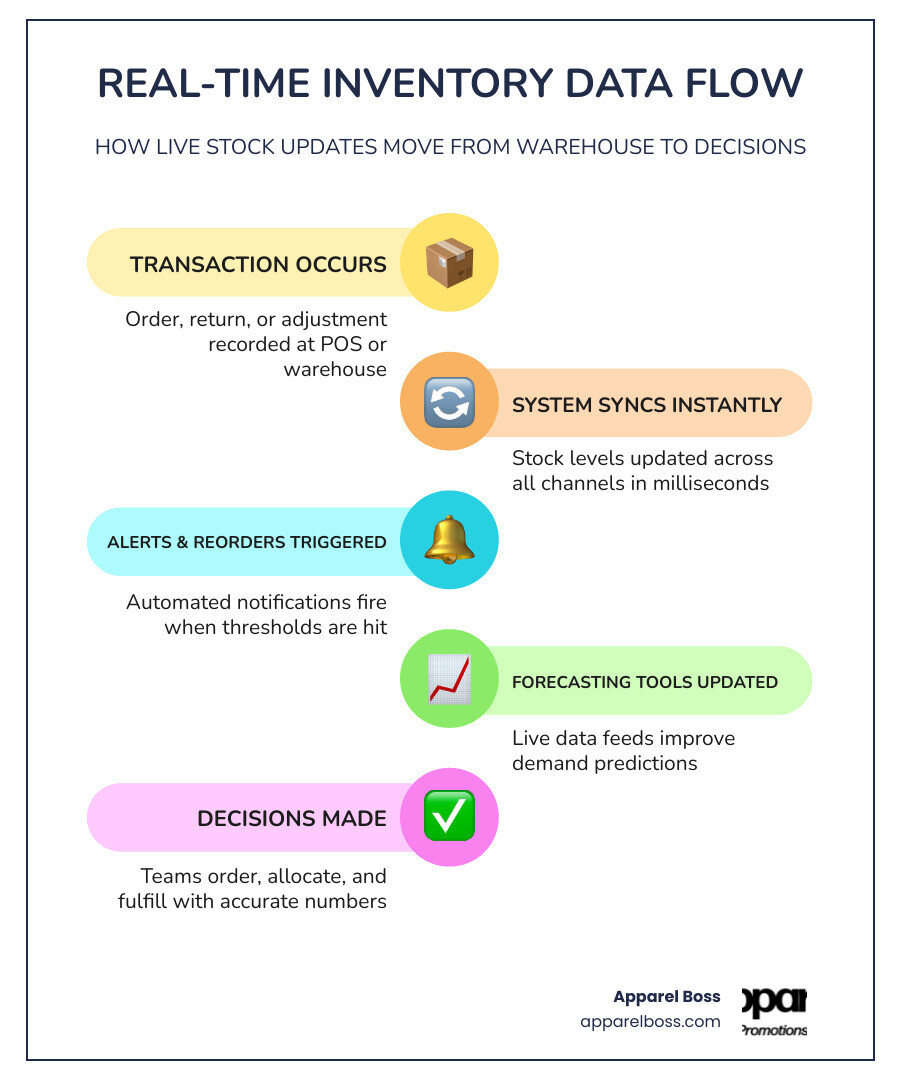
Real-time inventory updates give businesses an accurate, live view of exactly what stock they have — across every location, channel, and warehouse — the moment any transaction occurs.
Here's what that means in practice:
| What Real-Time Inventory Updates Do | Business Impact |
|---|---|
| Sync stock levels instantly after every order | Eliminates overselling and phantom stock |
| Trigger automated reorder alerts | Prevents stockouts before they happen |
| Track inventory across multiple locations | Gives ops teams one source of truth |
| Update allocation as items enter carts | Stops double-selling during peak demand |
| Feed live data to forecasting tools | Improves purchasing decisions and reduces waste |
Running a corporate merchandise program on stale data is expensive. When HR orders onboarding kits, marketing launches a branded campaign, or operations restocks a field team — and the numbers they're working from are hours or days old — the result is wasted budget, delayed fulfillment, and frustrated employees.
In 2024, retailers alone faced $818 billion in losses — 52% from stockouts and 44% from overstocking. For corporate merchandise programs, the stakes are just as real: excess inventory ties up capital, while stockouts stall onboarding and damage brand consistency.
The core problem isn't just having inventory data. It's having inventory data you can actually trust right now.
I'm Salvatore Vento, Marketing Director at Apparel Boss, where I help scaling organizations eliminate the operational waste that comes from running merchandise programs without reliable, live inventory visibility. My work on streamlining ordering workflows and distribution systems connects directly to why real-time inventory updates matter far beyond traditional retail.
The Operational Cost of Stale Data in Corporate Merchandise Programs
When you run a corporate merchandise program across multiple departments—such as HR, marketing, and sales—relying on outdated inventory figures is a recipe for operational chaos. Stale data creates a domino effect of phantom stock, budget leakage, and physical merchandise waste.
I often see companies accumulate piles of unused, outdated apparel because they lacked clear visibility into what was actually moving. If you do not have a live feedback loop, you are essentially flying blind, resulting in massive write-offs. You can read more about how to Stop Throwing Money Away by Solving Your Inventory Waste Issues to understand the direct financial impact of this visibility gap.

Why Traditional Periodic Audits Fail Corporate Teams
Traditional inventory management relies on periodic physical counts—often done monthly or quarterly. In a fast-moving corporate environment, this batch-processing approach creates a dangerous lag.
By the time someone manually counts the polo shirts in your Deer Park, NY storage room and updates a spreadsheet, three other departments have already promised those same shirts to incoming hires or event attendees. This lag creates heavy administrative burdens, as team leaders must spend hours cross-referencing files and sending emails just to verify if a box of custom jackets actually exists.
The Business Impact of Stockouts and Overstocking
When inventory data is wrong, two things happen:
- Stockouts: An employee logs into your online store to claim their work anniversary gift, only to find their size is backordered. This kills employee adoption and ruins the excitement.
- Overstocking: To prevent stockouts, managers panic-buy excess stock. This ties up capital in "dead stock" that sits in boxes, incurring high carrying costs.
According to research, companies using live tracking can reduce stockouts by 37% and overstocks by 29%. To dive deeper into why this paradigm shift is necessary, check out Why Real-Time Inventory Tracking is a Game-Changer for Businesses.
How Real-Time Inventory Updates Prevent Stockouts and Overstocking
Moving to real-time inventory updates allows corporate teams to pivot from a reactive, firefighting posture to proactive, automated control. By continuously tracking stock changes, you maintain a balanced inventory flow without manual intervention.
To illustrate the stark differences, let’s look at how traditional batch tracking compares to real-time systems:
| Feature | Traditional Batch Tracking | Real-Time Inventory Updates |
|---|---|---|
| Data Freshness | 15 to 60 minutes (or days) stale | Millisecond latency (under 5 seconds) |
| Stock Visibility | Periodic snapshots | Continuous, live ledger |
| Reordering | Manual checks & gut-feel guesses | Automated alerts based on actual velocity |
| Oversell Risk | Extremely high during flash events | Near 0% due to live cart allocation |
| Multi-Location Sync | Manual reconciliation spreadsheets | Bi-directional, centralized sync |
Eliminating Phantom Stock with Real-Time Inventory Updates
Phantom stock occurs when your system shows items are available, but the physical shelf is completely empty. This happens because of delayed sales recording or unrecorded damaged goods.
By integrating your Point of Sale (POS) and online store databases directly with your warehouse management systems, every single transaction updates your ledger instantly. Platforms like Real-Time Inventory Sync for Multichannel Brands | Nventory US achieve sub-5-second synchronization, ensuring that when an item is ordered, it is immediately deducted from the available pool across all platforms.
Pro-Tip: Implement "cart-allocation locking." When a user adds a low-stock item to their cart, temporarily reserve that stock for 10–15 minutes. This prevents two users from checking out with the same physical item simultaneously.
Optimizing Reorder Points with Real-Time Inventory Updates
With live updates, you no longer need to guess when to reorder. You can set automated low-stock thresholds for every SKU based on lead times and production speeds.
For example, if your custom kitting process in Nassau County, NY takes 5 days, your software can calculate the precise moment stock dips below a 7-day safety buffer and automatically ping your account manager or trigger a purchase order. Utilizing advanced tools like Inventory Management Software — Katana allows you to track materials from raw fabrics to final products seamlessly.
Key Technologies Enabling Live Stock Tracking
To build a reliable real-time system, you must replace manual data entry with automated data capture.

Barcode Scanning and RFID Infrastructure
While barcode scanning is highly accurate and cost-effective, Radio Frequency Identification (RFID) technology takes efficiency to the next level. RFID does not require a direct line of sight; a warehouse worker can scan an entire pallet of custom jackets in seconds.
Adopting RFID can improve inventory accuracy from 63% to a staggering 95%, while cutting manual counting times by up to 50%.
Pro-Tip: For high-volume corporate stores, use RFID gates at your warehouse exit points. As fulfillment teams move custom kits onto delivery trucks, the system automatically marks them as "shipped" without requiring individual barcode scans.
Database Architecture: CDC and Streaming SQL
Behind the scenes, real-time tracking requires modern database architecture. Traditional systems use "polling," where the store periodically asks the database for updates. This is inefficient and slow.
Modern systems use Change Data Capture (CDC) and streaming SQL. CDC monitors the database's write-ahead logs (like PostgreSQL WAL) and instantly streams any changes—such as a stock deduction—to your online store in milliseconds. To understand how this works technically, you can read about Warehouse Inventory Tracking with CDC and Streaming SQL | RisingWave.
Overcoming Implementation Challenges in Multi-Location Operations
Scaling your merchandise program across multiple offices in Long Island, Suffolk County, and New York, NY introduces logistical complexity. Managing this growth requires addressing integration, training, and production challenges. You can prepare your team for these hurdles by reviewing An Essential Guide to Inventory and Adoption Issues.
Managing Multi-Channel Sales and Multi-Location Warehouses
If you have inventory split between a fulfillment center in Deer Park, NY and an office closet in Manhattan, you need a system that is "warehouse-aware." Your online store must route orders to the closest warehouse with available stock.
To streamline these operations and avoid manual spreadsheet reconciliation, businesses rely on dedicated tools. Learn how to simplify your workflows with these Stop the Grind with These Streamlined Inventory Ops Platforms.
Pro-Tip: Establish "safety stock buffers" for your highly sought-after items. If you have 10 units left of a popular jacket, set your public-facing store inventory to show "0" or "Low Stock - Contact Admin" to protect against sudden, overlapping bulk orders.
Handling Custom Kitting and In-House Production Workflows
Corporate gift boxes and onboarding kits are rarely pre-assembled; they are often built-to-order (kitted) using individual components (e.g., a box, a custom water bottle, a notebook, and a hoodie).
Your inventory system must track stock at the component level. If you run out of custom boxes, your system must immediately mark the entire kit as "unavailable," even if you have thousands of hoodies in stock. This prevent stalls in fulfillment. For a deep dive into production logistics, read Slow Bag Fulfillment and Shirt Production Stalls Explained.
Frequently Asked Questions about Real-Time Inventory
How does real-time inventory tracking improve online company store adoption?
When employees log into a company store and order a shirt, they expect it to arrive quickly. If their order is delayed or cancelled due to inaccurate stock levels, they lose trust in the system and stop using it. Real-time updates guarantee that what they see is what they get, boosting adoption and satisfaction.
What is the difference between product-level and variant-level stock tracking?
Product-level tracking only tells you that you have "Hoodies" in stock. Variant-level tracking tells you exactly how many Red, Size Medium hoodies are available. For corporate apparel, variant-level accuracy is critical to prevent employees from ordering sizes that are out of stock. For advanced insights on how this affects automated systems, check out Variant Stock Refresh: Live Inventory for AI Agents.
How do real-time updates reduce corporate merchandise waste?
By monitoring stock levels and item velocity in real time, you can spot slow-moving items early. This allows you to run targeted internal promotions or swap out unpopular styles before the garments become obsolete, saving your budget from being wasted on dead stock.
Streamline Your Merchandise Program with Apparel Boss
Managing a corporate merchandise program shouldn't feel like a constant battle against spreadsheets, missing boxes, and backordered sizes. At Apparel Boss, we help businesses across Long Island, Suffolk County, Nassau County, and New York, NY transition from chaotic, manual processes to streamlined, automated systems.
Through our custom online company stores, we integrate real-time inventory updates directly into your ordering workflow. Whether you are distributing onboarding kits via custom kitting or managing bulk apparel runs through our in-house production merchandise services, we ensure consistent branding, zero-oversell peace of mind, and complete budget control.
Ready to eliminate the guesswork and scale your corporate swag program? Let's discuss how we can build a tailored, hassle-free merchandise system for your organization.
How to Get Live Stock Levels with Real-Time Inventory Updates