
Why Inventory Waste Is Silently Draining Your Merchandise Budget
The most practical fix inventory waste requires comes down to five core actions: enforce physical stock rotation, shift to on-demand ordering, set data-driven par levels, run regular audits, and centralize fulfillment through a structured system.
Quick Answer: How to Fix Inventory Waste
- Implement FIFO - Rotate stock so older items are used before newer ones
- Use an online company store - Eliminate bulk guessing with on-demand production
- Set data-driven par levels - Base reorder points on actual usage, not estimates
- Audit and track variance - Compare expected vs. actual stock weekly
- Centralize fulfillment - Consolidate distribution to reduce overstock and waste
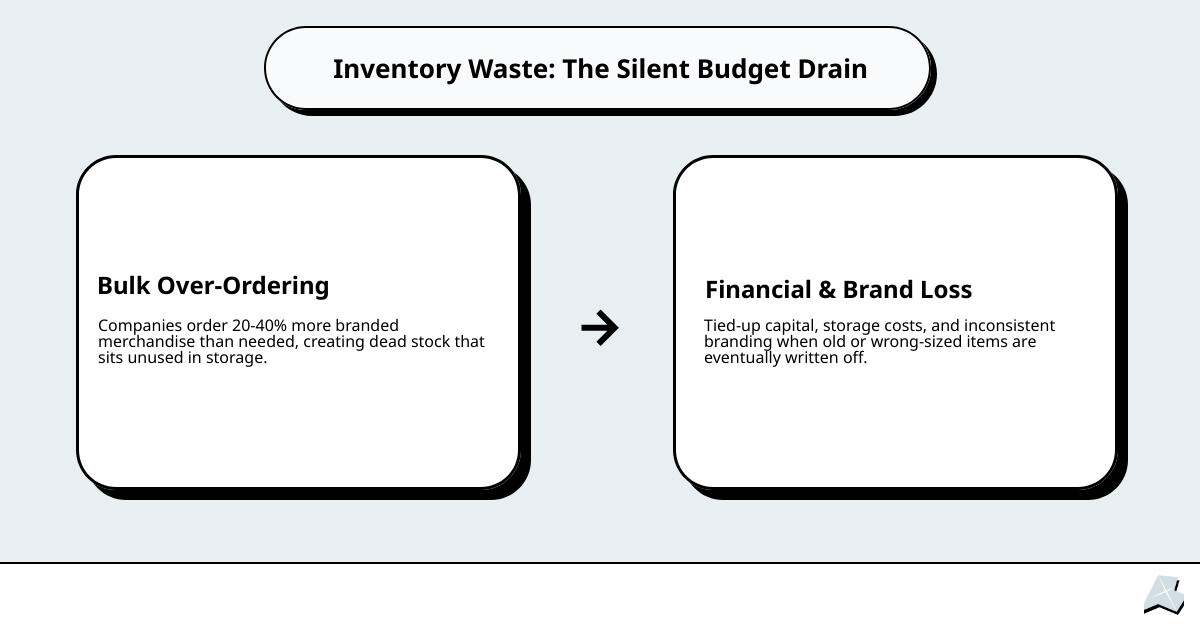
If your organization orders branded merchandise in bulk, there is a high chance a significant portion of it never gets used. Research shows that between 20% and 40% of inventory in retail and general business operations is classified as dead stock — items that sit, age, and eventually get written off.
For merchandise programs, this is not just a storage problem. It is a budget problem, a brand consistency problem, and an operational drag on HR, marketing, and operations teams alike.
The waste is easy to overlook because it builds slowly. A box of last year's onboarding kits in the back of a storage room. Hundreds of units ordered for a hiring push that never materialized. Sizes that nobody wanted. These are not edge cases — they are the norm in programs that lack a structured system.
I'm Salvatore Vento, Marketing Director at Apparel Boss, where I specialize in building structured merchandise programs that eliminate the ordering inefficiencies and practical fix inventory waste challenges that growing organizations face every day. In the sections below, I'll walk you through the five methods that consistently deliver measurable results across teams of every size.
The Real Cost of Corporate Merchandise Stagnation
When I speak with operations and HR leaders across Long Island and New York City, I often find they are unaware of how much capital is tied up in unused boxes of apparel. The reality is that inventory stagnation leads to a continuous financial drain.

According to a study on Reducing Waste in Retail, dead stock represents a massive unrecovered product cost (UPC). When items sit in your office closet or warehouse, you are not only losing the initial capital spent to produce them, but you are also paying silent carrying costs. Storage space, manual counting labor, and organizational clutter all eat into your bottom line.
Worse yet, letting merchandise stagnate leads to brand dilution. Logo designs change, corporate messaging shifts, and older garments begin to look dated. If your team is still handing out old merchandise simply to "get rid of it," you are actively weakening your brand presentation. You can read more about this in our guide on how to Stop Throwing Money Away by Solving Your Inventory Waste Issues.
To understand why so many companies suffer from these hidden costs, let's look at the difference between traditional manual tracking and automated merchandise systems:
| Operational Metric | Traditional Manual Tracking (Spreadsheets/Closets) | Modern Automated Systems (Online Company Stores) |
|---|---|---|
| Dead Stock Percentage | Typically 20% to 40% of total stock | Under 5% due to on-demand models |
| Inventory Accuracy | Low (prone to human counting errors) | Real-time tracking (98% material reconciliation) |
| Admin Time Spent | Up to 25% of personnel time wasted on data entry | Minimal (automated ordering & fulfillment) |
| Turnaround Speed | Weeks or months for bulk replenishment | Fast 3-5 day turnaround with in-house production |
| Waste Risk | High (over-ordering, size mismatches, outdated logos) | Low (employee self-selection & pre-approved quantities) |
Expert Insight: Many decision-makers forget that storage space is a premium asset. Whether you are storing merchandise in your high-rent Manhattan office or a local facility in Nassau County, every square foot occupied by obsolete apparel is space that could be used for revenue-generating activities.
Method 1: Implement a Physical FIFO System for Merchandise Storage
If you must hold physical inventory, you must treat your storage area with the same operational discipline as a commercial warehouse. This starts with a physical First-In, First-Out (FIFO) system.

FIFO is not just an accounting policy; it is a physical layout strategy. When new batches of apparel arrive, busy team members naturally place them at the front of the shelf because it is the path of least resistance. Consequently, older stock gets pushed to the back, where it sits, gathers dust, and eventually becomes obsolete.
To implement a physical FIFO system, organize your shelving so that products load from the back and pull from the front. This physical rotation ensures that your oldest stock is always distributed first. Additionally, integrating simple barcode labeling can reduce data entry errors by over 90% while accelerating routine transactions. This approach aligns with the principles of Sustainable Inventory Management, which highlights how structured physical rotation prevents product degradation and waste.
Pro-Tip: Use color-coded labels or tape to represent the quarter in which the merchandise arrived (e.g., Red for Q1, Blue for Q2). This visual system makes it immediately obvious to any staff member which items must be distributed first, removing all guesswork.
Method 2: Deploying a Practical Fix Inventory Waste Strategy via Online Company Stores
The single most effective way to eliminate merchandise waste is to stop guessing what your employees want. Traditional bulk ordering forces you to guess size distributions, color preferences, and style choices months in advance. The result? You run out of medium shirts in three days, while boxes of extra-large and small shirts sit untouched for years.
By moving to an online company store model, you can transition to on-demand production and a zero-inventory framework. Instead of ordering 500 shirts in bulk, you set up a centralized online company store where employees select their preferred size, style, and color.
This employee self-selection model guarantees that every single item produced is actually wanted and worn. You completely bypass the bulk-ordering guesswork, retain absolute budget control through points-based allocations, and eliminate the physical clutter of storage closets. To understand how this transition can streamline your operations, check out our guide on how to Stop the Swag Chaos with Professional Online Company Stores.
Pro-Tip: Implement a points-based allocation system within your online store. Give new hires a set number of points on day one, allowing them to redeem the exact items and sizes they need. This automates the onboarding process while ensuring zero wasted budget.
Method 3: Establish Data-Driven Par Levels and Demand Forecasting
If your business requires keeping a baseline level of inventory on hand—such as uniform shirts for service staff or seasonal gifts for clients—you must establish data-driven par levels rather than relying on gut feelings.
A par level is the minimum amount of stock required to meet your operational needs before reordering. Most companies set their par levels once and never update them, leading to massive over-ordering when hiring slows down. To avoid this, analyze your historical usage data from previous quarters to build a predictive ordering model.
When you track actual adoption rates, you can adjust your purchases to match seasonal trends and actual department growth. For a deeper look into aligning your inventory with actual team needs, read through An Essential Guide to Inventory and Adoption Issues.
Expert Insight: I highly recommend adjusting your par levels quarterly based on actual department hiring plans. If your Suffolk County office plans to slow down hiring in Q3, your onboarding kit par levels should automatically scale down in Q2 to prevent excess stock accumulation.
Method 4: Conduct Regular Audits and Variance Analysis
You cannot manage what you do not measure. If you are not running regular physical audits and comparing them against your theoretical inventory records, waste will remain invisible.
A physical audit involves counting every item on your shelves and comparing it directly to your digital records or purchase logs. The difference between what should be there (theoretical stock) and what is actually there (actual physical stock) is your variance.
Variance is usually caused by unrecorded distribution, lost items, or administrative counting errors. By running weekly spot checks on your highest-cost items and monthly full audits, you can catch these discrepancies early. As demonstrated in this Warehouse Dead Stock Elimination Project, systematic tracking and targeted audits can achieve a massive reduction in dead pallets, freeing up physical space and unlocking immediate cost savings.
Pro-Tip: Do not try to audit your entire inventory at once. Perform weekly spot checks on your top 10 highest-value items. This keeps the task manageable for your team while maintaining tight control over 80% of your merchandise budget.
Method 5: Streamline Distribution with Custom Kitting and Centralized Fulfillment
For companies with multiple offices across New York, Nassau County, or remote teams nationwide, decentralized distribution is a primary driver of inventory waste. When every local office manages its own closet of branded items, over-ordering and duplication are inevitable.
The solution is to centralize your fulfillment and utilize custom kitting options. Instead of shipping bulk boxes of loose apparel to individual offices, you can store your inventory in a centralized warehouse where items are professionally kitted and distributed on demand.
Centralized fulfillment allows you to consolidate shipping, control brand consistency, and ensure that kits are only assembled and sent when a real event—like a new hire onboarding or a client milestone—triggers the order. This approach is highly detailed in our strategic guide on How to Build a Scalable Corporate Gifting System Without Wasting Budget.
Expert Insight: Pre-assembling custom kits based on real-time triggers, rather than pre-packing hundreds of boxes in advance, prevents the accumulation of obsolete, pre-packaged kits if your corporate branding or kit contents change mid-year.
Frequently Asked Questions about Inventory Waste
What is the most practical fix inventory waste strategy for growing companies?
The most practical fix inventory waste strategy is transitioning from bulk-ordering models to on-demand fulfillment. By utilizing centralized online stores and inventory tracking software, companies can produce apparel only when a verified need arises, completely eliminating upfront storage costs and the risk of obsolescence.
How does an online company store act as a practical fix inventory waste?
An online company store acts as a practical fix inventory waste by shifting the selection process to the end-user. Instead of managers guessing size distributions, employees log in and select their own sizes and styles. This ensures 100% adoption and utilization of every item produced, resulting in zero pre-printed waste.
How much money do businesses lose to obsolete merchandise inventory?
On average, businesses lose 20% to 40% of their total merchandise budget to dead stock and obsolete inventory. This includes the initial unrecovered product cost, the carrying costs of storing unused items, and the administrative labor spent managing disorganized closets.
Conclusion
Managing a successful corporate merchandise program does not have to mean dealing with chaotic storage closets, wasted budgets, and boxes of outdated apparel. By implementing physical FIFO systems, setting data-driven par levels, and transitioning to online company store models, you can establish a highly efficient, sustainable system that protects your brand and your bottom line.
At Apparel Boss, we specialize in helping businesses in Deer Park, Long Island, and the greater New York area solve these operational headaches. Through our custom company store services, custom kitting, and in-house production capabilities, we provide scalable systems that streamline your ordering, fulfillment, and distribution processes. Let's work together to turn your merchandise program into a lean, high-performing asset.