Why Branded Promotional Tote Bags Deliver Real Marketing ROI
Branded promotional tote bags are one of the highest-performing marketing tools available to businesses today — and for good reason.
Quick answer: the best branded promotional tote bags for events in 2026:
| Priority | Best Choice |
|---|---|
| Budget giveaways | Non-woven polypropylene totes |
| Premium brand impression | Cotton canvas totes |
| Eco-conscious branding | Recycled cotton or jute totes |
| Trade show utility | 600D polycanvas with pockets |
| Fast turnaround | Non-woven totes with rush production |
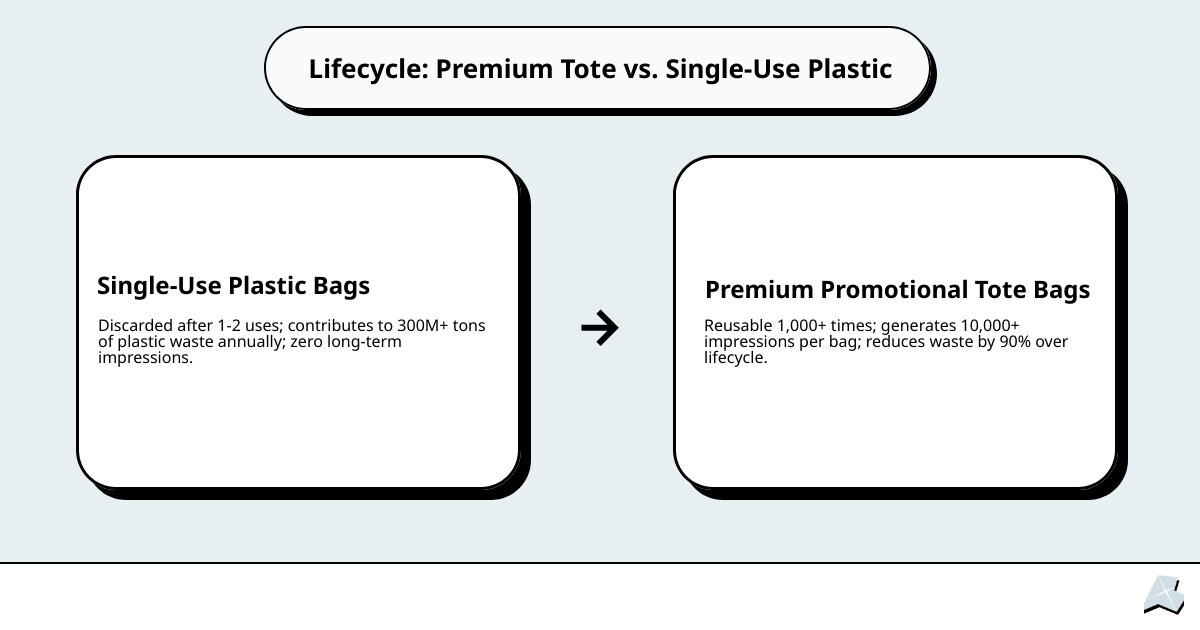
Unlike a flyer or a digital ad, a well-made tote bag sticks around. People use them for grocery runs, office commutes, weekend outings, and everything in between. Every time someone carries your branded tote, your logo gets seen — by them and by everyone around them.
That's the core appeal: a single tote bag can generate thousands of impressions over months or even years, at a fraction of the cost of traditional advertising.
But for organizations managing events, employee programs, or client gifting at scale, the challenge isn't just picking a bag. It's choosing the right material, print method, and supplier — then getting the right bags to the right people, on time, without wasting budget on excess inventory or inconsistent branding.
This guide breaks down the best options available in April 2026, so your team can make a confident, informed decision.
Scaling Event Logistics with Branded Promotional Tote Bags
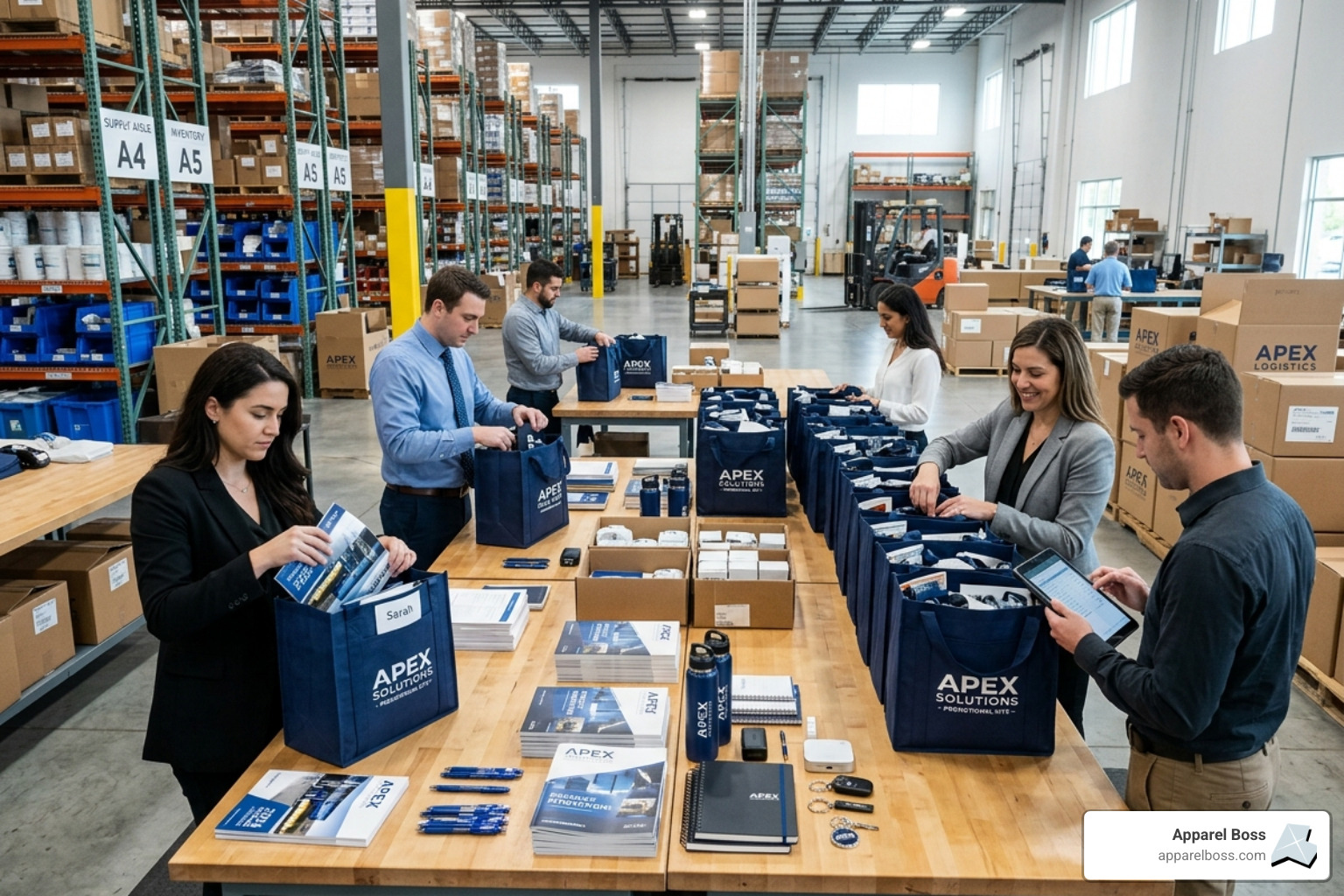
When planning a large-scale event in the New York area, whether it is a trade show at the Javits Center or a corporate retreat on Long Island, logistics often become the hidden source of budget overruns. In practice, the challenge is not simply selecting branded promotional tote bags. It is building a merchandise process that supports brand consistency, avoids storage waste, and gets the right items to the right people on time.
For 2026, durability still matters, but the larger operational issue is program design. If bags arrive late, vary in quality, or sit unused in storage after an event, total program costs rise quickly. That is why decision-makers are shifting from one-off ordering toward structured merchandise systems supported by custom apparel services and repeatable fulfillment workflows.
Material Deep Dive: Choosing the Right Foundation
- Cotton Canvas: A strong option when teams need a longer-lasting bag for onboarding, executive programs, or internal distribution. Heavyweight canvas supports a more premium presentation and extended use.
- Non-Woven Polypropylene: Often used for high-volume event distribution because it is lightweight and cost-effective. It can support short-term event needs, but quality control and intended use should be evaluated carefully.
- 600D Polycanvas: A more structured synthetic option that can work well for seminar kits, field teams, and professional internal use where appearance and utility both matter.
Operational Efficiency and Bulk Strategies
The bigger challenge for most organizations is not choosing a fabric. It is controlling ordering volume, forecasting demand, and avoiding excess inventory. Many teams still over-order to lower unit cost, then absorb hidden expenses in storage, write-offs, and rushed reorders when event plans change.
| Material Type | Estimated Lifespan | Weight Capacity | Best Use Case |
|---|---|---|---|
| Non-Woven Poly | 6-12 Months | 15-20 lbs | High-volume event distribution |
| Cotton Canvas | 3-5 Years | 30+ lbs | Employee onboarding programs |
| 600D Polyester | 2-4 Years | 25 lbs | Corporate seminars and internal kits |
| Recycled Jute | 1-2 Years | 20 lbs | Sustainability-focused campaigns |
A better approach is to connect product selection with fulfillment planning. For example, teams can hold approved inventory in a controlled program, trigger replenishment based on usage, and distribute through a central system rather than relying on manual spreadsheets. This is especially important for organizations managing multiple offices across Suffolk County, Nassau County, and New York City.
Optimizing Brand Consistency Across Branded Promotional Tote Bags
A common pain point for marketing and operations leaders is brand drift. A logo may look correct in a digital style guide but print inconsistently across materials, colors, or production runs. That problem usually happens when ordering is fragmented across multiple vendors, artwork is not standardized, or proofing is rushed.
To maintain consistency, it helps to work with providers that understand how imprint methods affect outcome on different surfaces. For example, screen printing behaves differently on textured canvas than on smoother synthetic materials. Teams evaluating production standards can also reference general background on screen printing when comparing decoration methods and durability.
Key branding techniques for 2026 include:
- Screen Printing: Best for bold, one-to-three color logos with strong durability.
- PMS Color Matching: Important for organizations with strict brand standards.
- Embroidery: Useful when a more elevated, tactile finish is needed.
- Heat Transfer: Suitable for complex artwork, gradients, or highly detailed graphics.
Maintaining branding beyond clothing requires a process that includes approved artwork, proof review, and consistent production controls. Without those safeguards, even a simple event order can create avoidable brand and budget issues.
Solving Inventory Waste with On-Demand Branded Promotional Tote Bags
For many New York businesses, storage space is limited and expensive. Boxes of unused event merchandise tie up capital, create clutter, and make it harder to track what is actually available. This is one reason more companies are rethinking ad hoc merchandise buying and moving toward leaner ordering models.
By combining lower minimum order planning with centralized fulfillment and online company store infrastructure, businesses can reduce overbuying and improve visibility into demand. If an event grows, inventory can be replenished through a structured process. If demand drops, teams are not left holding obsolete stock.
This is where the untapped potential of promotional products becomes operational rather than purely promotional. The real value comes from reducing manual work, improving control, and aligning production with actual usage.
USA-based production can also support this model in 2026 by helping teams reduce lead times, improve quality oversight, and respond faster to changing event requirements.
Streamlining Distribution Through Online Company Stores
The real "secret sauce" for modern merchandise management isn't the bag itself—it's the system used to distribute it. Apparel Boss focuses on helping businesses solve the administrative nightmare of manual ordering. Instead of an HR manager spending three days collecting addresses and sizes for an employee kit, an online company store automates the entire process.
Centralized Fulfillment and Custom Kitting
Imagine a scenario where a new hire starts at your Deer Park office. Instead of hunting down a spare tote bag in a closet, the system automatically triggers a "New Hire Kit." A branded promotional tote bag is pulled from a centralized warehouse, packed with a custom notebook and a branded water bottle, and shipped directly to the employee’s home.
This level of centralized fulfillment, supported by a dedicated online company store, reduces administrative workload by up to 80%.
Integrating Branded Promotional Tote Bags into Custom Kitting
Tote bags are the "anchor" of any successful kit. They are the vessel that holds everything else together. In 2026, we are seeing a massive shift toward eco-friendly utility totes. These aren't just bags; they are statements of corporate values.
Many premium totes now feature partnerships with organizations like 1% for the Planet, where a portion of the sale goes to environmental nonprofits. Using recycled cotton canvas or jute not only provides a durable product but also aligns your brand with the sustainability goals of your clients and employees.
Popular Kitting Combinations for 2026:
- The Onboarding Kit: Canvas tote, company hoodie, notebook, and custom pens.
- The Wellness Kit: Recycled cotton tote, yoga mat, and insulated water bottle.
- The Trade Show Kit: Non-woven tote, portable charger, and branded lanyard.
Reducing Administrative Burden with Automated Fulfillment
For companies with a global footprint—or even just multiple offices across New York City and Long Island—distribution is a major hurdle. Managing promotional products across 170+ countries requires a sophisticated backend.
A company store service provides:
- Real-Time Inventory Tracking: Know exactly how many branded promotional tote bags you have left across all warehouses.
- Multi-Location Distribution: Ship 100 bags to a London office and 50 to a Manhattan boutique with three clicks.
- Cost Reduction: By consolidating all spend into one platform, businesses can leverage better bulk pricing and reduced shipping rates.
- Brand Control: Ensure that every department, from Sales to HR, is using the same approved bag designs.
Choosing the Right Tote Features for Functionality
When browsing promotional products, it’s easy to get lost in the aesthetics. However, for a business leader, functionality is what drives long-term use. If a bag is uncomfortable or impractical, it ends up in the trash.
The Impact of Gussets and Inserts
A "gusset" is the extra fabric that allows a bag to expand.
- Bottom Gusset: Allows the bag to sit flat when filled—perfect for groceries or heavy books.
- All-Around Gusset: Provides the most space, turning a simple tote into a serious haul-all.
- Bottom Inserts: Often made of plastic or reinforced cardboard, these provide structure and prevent the bag from sagging under weight.
Handle Length and Comfort
For a bag to be used daily, the handles must be ergonomic.
- Standard Handles: Usually 20–22 inches. Good for hand-carrying.
- Shoulder-Length Handles: 28–30 inches. These are the most popular because they allow for hands-free carrying, which is essential for busy commuters in New York.
- Rope Handles: Provide a "nautical" or high-end fashion look, often found on premium cruising totes.
The Path to a Scalable Merchandise Program
Selecting the right branded promotional tote bags is just the first step. The real goal for any growing business is to move away from the "chaos" of ad-hoc ordering and toward a structured, scalable system.
When you treat your branded merchandise as a strategic asset rather than an afterthought, you improve employee adoption, ensure brand consistency, and significantly reduce the "hidden costs" of administrative time and wasted inventory.
Whether you are looking to launch a wellness gift box for your team or need a reliable way to distribute swag to international offices, the solution lies in automation and partnership. By integrating high-quality products into a centralized fulfillment system, you ensure that your brand is represented with integrity, every single time.
Are you ready to stop managing boxes and start managing your brand?
At Apparel Boss, we help businesses transition from messy, manual merchandise processes to streamlined, automated systems. Our expertise in online company stores and custom kitting ensures that your branded promotional tote bags—and all your corporate gear—get to where they need to go without the headache.
Learn how our company store solutions can simplify your merchandise program today.
The Best Branded Promotional Tote Bags for Your Next Event