Why Custom Apparel Orders Get Delayed — And What It Costs Your Business
Why custom apparel orders get delayed is one of the most common operational frustrations for growing organizations. Before diving into the full breakdown, here are the most frequent causes:
Top reasons custom apparel orders get delayed:
- Artwork not ready — missing vector files, wrong formats, or slow internal approvals
- Blank garment shortages — popular styles, sizes, or colors out of stock at distributors
- Supply chain disruptions — port congestion, shipping backlogs, customs documentation errors
- Seasonal demand surges — Q4 holidays, back-to-school, and trade show seasons overload production capacity
- Order changes mid-process — quantity updates or design revisions after production has started
- Payment or PO delays — production doesn't start until payment terms are met
- Quality control rework — failed inspections requiring reprints or re-cuts
Most teams don't realize how many of these delays are compounding. One small issue — a low-resolution logo file, a missing size confirmation, a supplier running low on stock — can push a delivery back by days or even weeks.
For business leaders managing branded apparel programs, this isn't just an inconvenience. Delayed uniforms mean new hires show up without gear. Late event shirts mean your brand isn't represented. Missed deadlines erode trust with the people you're trying to impress.
As one industry operator put it plainly: large orders can "dribble in over four or five weeks" when supply chain issues hit — long past the date your team needed them.
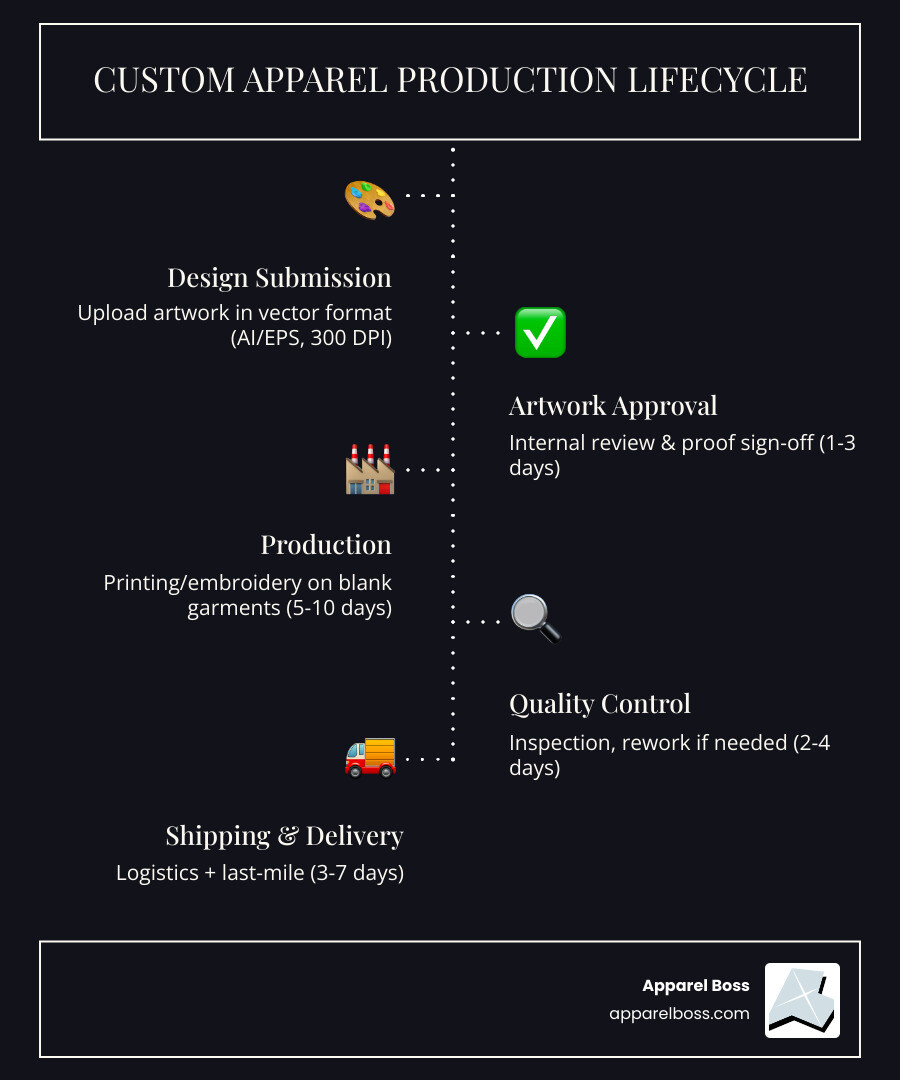
The standard production window for custom apparel runs 8 to 16 business days after artwork approval. Add shipping, revisions, and peak season pressure, and that window stretches fast. For organizations running merch programs across multiple departments or locations, the margin for error is razor-thin.
Understanding exactly where delays happen — and how to prevent them — is the difference between a smooth merch program and a recurring operational headache.
Critical Factors Why Custom Apparel Orders Get Delayed
When a shipment of branded hoodies or corporate polos fails to arrive for a scheduled launch, the root cause is rarely a single catastrophic event. Instead, it is usually a "compound risk"—a series of small, overlapping friction points that aggregate into a major production stall. In the New York metro area, from Long Island to Manhattan, logistics are already complex; adding production volatility into the mix can decimate a marketing timeline.
Supply Chain Volatility and Blank Garment Availability
One of the most significant reasons why custom apparel orders get delayed is the availability of the "blank" garment itself. Before a single drop of ink touches fabric, the printer must source the base product from a distributor.
While the apparel industry was once considered insulated from global supply shocks, the "shipping crisis" of recent years has proven otherwise. It is common for a 350-piece order to be pieced together from three different suppliers across seven different warehouses just to fulfill a single request. If a specific shade of "Navy Blue" is out of stock in a size Large at the Pennsylvania hub, your printer may have to wait for a shipment from a West Coast warehouse, adding 3 to 5 days to the timeline before decoration even begins.
Production Capacity and Quality Control
Every shop has a finite number of "impressions" they can pull per day. When a facility hits overcapacity—often due to taking on too many "rush" jobs simultaneously—standard orders get pushed. Furthermore, quality control (QC) is a mandatory bottleneck. If a batch of embroidered jackets shows thread tension issues or a screen-print run has slight color bleeding, the shop must stop and restart. While frustrating, this "rework cycle" is necessary to protect your brand consistency.
Standard vs. Rush Timelines
To manage expectations, decision-makers should understand the industry-standard tiers of production.
| Service Level | Production Time | Typical Surcharge |
|---|---|---|
| Standard | 8–16 Business Days | Base Pricing |
| Priority | 5–7 Business Days | +15-20% |
| Rush | 3–4 Business Days | +25-35% |
| Emergency | 1–3 Business Days | +40-75% |
Note: Timelines begin only after artwork approval and payment confirmation.
Artwork Readiness and the Approval Bottleneck
In the experience of most production managers, artwork issues are the primary reason for initial delays. A common misconception among marketing teams is that a high-resolution JPG or a logo pulled from a website is "print-ready."
To avoid stalls, files must be submitted in vector formats (AI, EPS, or SVG). Vector files allow for infinite scaling without losing clarity. If a team submits a low-resolution PNG, the printer’s art department must spend hours—or days—recreating the file. This process, known as Common Mistakes to Avoid When Ordering Custom Merchandise, is a silent killer of deadlines.
The Problem with "Design by Committee"
Internal proofing delays are equally damaging. If an approval email sits in an inbox for 48 hours because three different stakeholders need to weigh in, the production slot is lost. Experienced printers recommend nominating a single decision-maker for all proof approvals. Once a digital proof is approved, the design is "locked." Any changes requested after this point—even a minor color tweak—will reset the production clock and likely incur additional setup fees.
Complexity and Decoration Methods
The method of decoration also dictates the timeline.
- Screen Printing: Requires physical screens to be burned for each color.
- Embroidery: Requires a "digitizing" process where the artwork is converted into a stitch map.
- Direct-to-Film (DTF): Often faster for complex, multi-color designs as it bypasses traditional screen setup.
Global Supply Chain and Logistics Disruptions
Even after the garments leave the dryer or the embroidery hoop, they face the gauntlet of modern logistics. For companies in Suffolk County or Nassau County, local delivery might seem simple, but the components of that garment likely traveled thousands of miles.
Port Congestion and Customs
If your order involves custom-manufactured items (like specific cut-and-sew uniforms or woven labels), they may be subject to international shipping delays. A Package Stuck in Customs? How to Fix & Prevent - ShipBob scenario can happen due to minor paperwork errors—such as labeling a shipment "cotton tee" instead of "100% cotton jersey tee." These semantic errors can hold up a container for days.
The "Missing Button" Effect
Production can also stall due to Overcoming Supply Chain Challenges for Custom Merch in 2025. If a specific trim, zipper, or thread color is unavailable due to raw material shortages, the entire bulk order sits idle. In 2026, many brands are mitigating this by "nearshoring" production or keeping larger safety stocks of essential items.
Seasonal Demand and Peak Production Periods
Timing your order is just as important as the design itself. The custom apparel industry follows a highly predictable—yet volatile—seasonal calendar.
The Q4 "Bloodbath"
From October through December, production facilities face a "bloodbath" of demand. Between holiday gift kits, end-of-year corporate rebranding, and winter spirit wear, lead times that were once 10 days can easily stretch to 25 days. During this period, "ports turn into parking lots," and courier services like UPS and FedEx face significant backlogs.
Planning Around Factory Closures
For organizations sourcing specialized materials, seasonal factory closures—such as Chinese New Year (which can shut down production for 2 to 4 weeks)—must be factored into the 12-month merch calendar. To stay ahead, leaders should Order Early: Winter Merch Tips for Businesses and build in a minimum of 3 to 4 weeks of "buffer time" for any critical event.
Strategic Solutions to Prevent Production Stalls
The most effective way to address why custom apparel orders get delayed is to move away from reactive, "one-off" ordering and toward a structured, system-based approach.
Inventory Pre-Positioning and Bulk Production
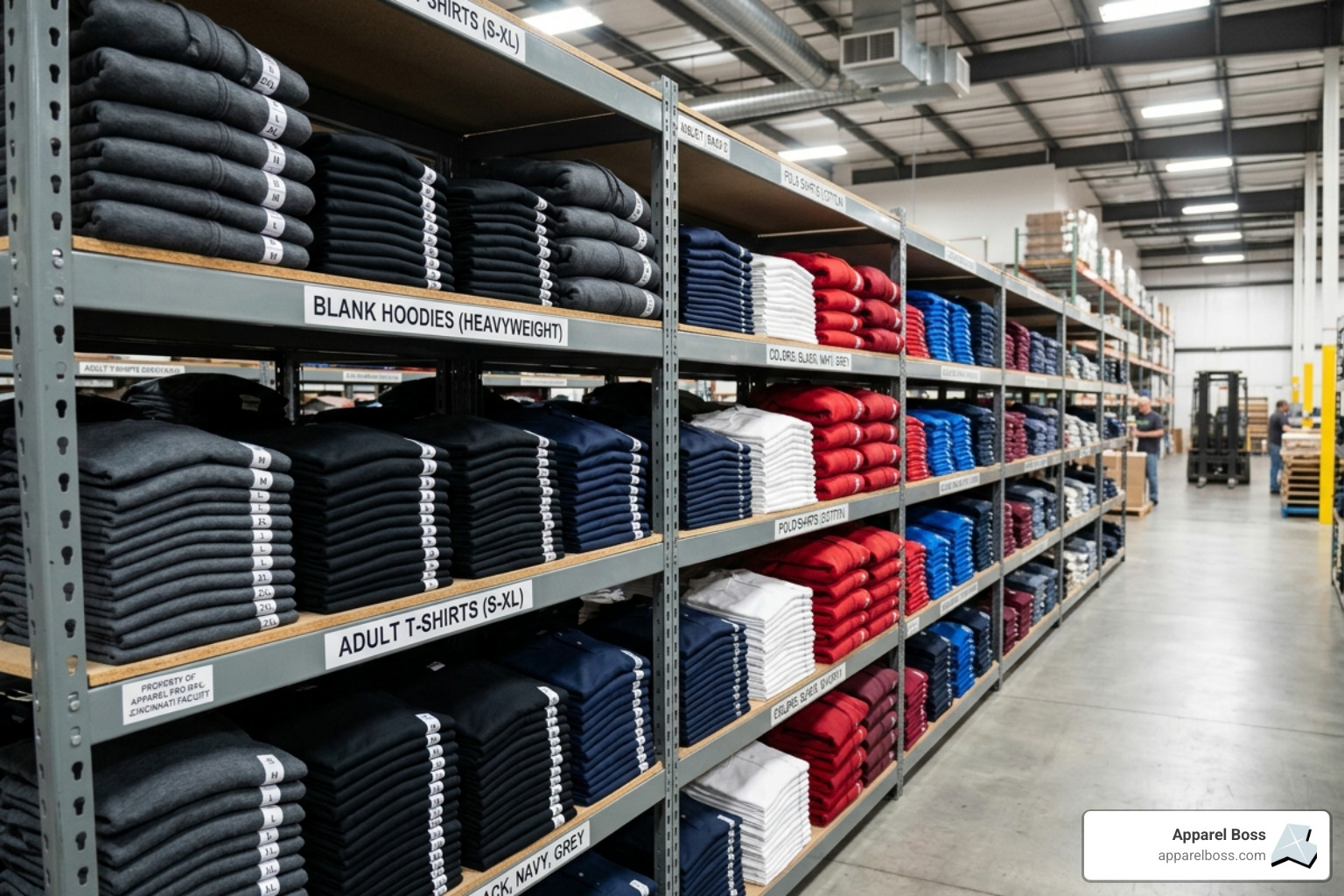
Instead of ordering 50 shirts every time a new hiring class starts, savvy operations teams use bulk production to create "safety stock." By producing 500 units upfront and storing them in a centralized fulfillment center, the production delay is eliminated entirely for the end-user. When a shirt is needed, it is pulled from a shelf and shipped the same day, rather than entering a 14-day production queue.
Rush-Feasible Printing Methods
If an emergency arises, certain methods are easier to expedite:
- Easy to Rush: 1-2 color screen printing on in-stock blanks.
- Hard to Rush: Complex embroidery (due to fixed machine run times).
- Impossible to Rush: Custom woven labels or specialized hardware that must be manufactured overseas.
Learning How to Launch a Company Store for Safety Gear Without the Stress involves selecting the right decoration method for the right timeline.
Why Custom Apparel Orders Get Delayed Due to Inefficient Ordering
For many businesses, the bottleneck isn't at the factory—it's in the office. Manual spreadsheets, fragmented email chains, and decentralized procurement are the primary drivers of administrative delays.
When multiple departments (Marketing, HR, Operations) use different vendors, branding becomes inconsistent, and the company loses its "bulk" bargaining power. This fragmentation leads to:
- Administrative Overload: Hours spent chasing quotes and tracking tracking numbers.
- Wasted Inventory: Buying too much of what doesn't sell and not enough of what does.
- Slow Fulfillment: Orders sitting on a desk for days before being sent to the printer.
By choosing to Simplify Ordering: Corporate Custom Apparel Stores, businesses can centralize their procurement. An online store acts as a single source of truth, ensuring that every order uses the correct logo, the correct garment, and the correct shipping data.
Mitigating Why Custom Apparel Orders Get Delayed with Real-Time Inventory
At Apparel Boss, we recognize that the "old way" of ordering custom gear—sending an email and hoping for the best—is no longer viable for modern enterprises. We help companies in New York and beyond streamline their programs through a combination of technology and in-house production.
Stock Transparency and Custom Kitting
By integrating real-time inventory tracking into a custom company store, we eliminate the "out of stock" surprise. If a garment isn't available at the warehouse, it doesn't show up in the store, preventing the order from ever being placed and subsequently delayed.
For companies managing remote teams, our custom kitting services solve the logistics nightmare of onboarding. We can curate employee onboarding kits, store them in our Long Island facility, and ship them the moment a new hire is added to your system. This proactive approach transforms apparel from a "to-do" list item into a seamless, automated workflow.
Structured Systems for Scaling
Whether you are based in Deer Park or Manhattan, your merchandise program should be an asset, not a liability. By leveraging our custom apparel services, businesses can reduce their administrative workload, ensure brand consistency, and—most importantly—eliminate the production stalls that keep leadership up at night.
If your organization is struggling with inconsistent quality or "dribbling" deliveries, it may be time to move beyond the local print shop and toward a strategic merchandise partner. Apparel Boss provides the infrastructure you need to scale your brand without the stress of constant delays.
Ready to eliminate the headache of custom apparel delays? Apparel Boss helps businesses streamline their merchandise programs through custom online stores and professional fulfillment.
Explore our Company Store solutions or Learn more about Custom Kitting to see how we can protect your brand's timeline.
Slow Bag Fulfillment and Shirt Production Stalls Explained