Why Most Merchandise Programs Break Down Before They Scale
How to scale company merchandise programs is one of the most urgent operational questions facing growing organizations today — and the answer starts with recognizing that most programs aren't built to scale in the first place.
Here's a quick framework for how to do it:
- Audit your current state — map all departments ordering merch, identify fragmentation, and quantify wasted spend
- Centralize brand guidelines — create a single source of truth for logos, colors, and quality standards across every product
- Launch an online company store — give teams a controlled, self-service ordering system with role-based access and budget controls
- Standardize fulfillment — move from ad-hoc vendor relationships to a structured 3PL or managed fulfillment partner
- Implement demand forecasting — use historical data and size curves to reduce dead stock and rush orders
- Track the right metrics — monitor sell-through rates, cost per item, fulfillment accuracy, and employee adoption
- Evolve your team structure — assign clear program ownership across HR, marketing, and procurement
The branded merchandise market in the United States alone reached $24.7 billion in 2025. Yet most organizations treat merch as an afterthought — a reactive, department-by-department scramble that produces inconsistent branding, ballooning costs, and frustrated employees.
The real problem isn't a lack of products. It's a lack of system.
When organizations grow, what started as a simple "we need team shirts" request quietly becomes a full operational burden. Engineering orders from one vendor. HR orders from another. Marketing goes rogue entirely. The result is what some operations leaders call the "fragmentation tax" — the hidden cost of decentralized purchasing, measured in wasted inventory, brand dilution, and hours of administrative overhead every week.
Research backs this up: companies with no formal merchandise program typically waste 20 to 30 percent of their merchandise spend on rush orders, overstock, and inconsistent branding.
The good news? This is a solvable problem — with the right structure.
This guide walks you through exactly how to build that structure, from your first centralized policy to a fully scaled global distribution operation.
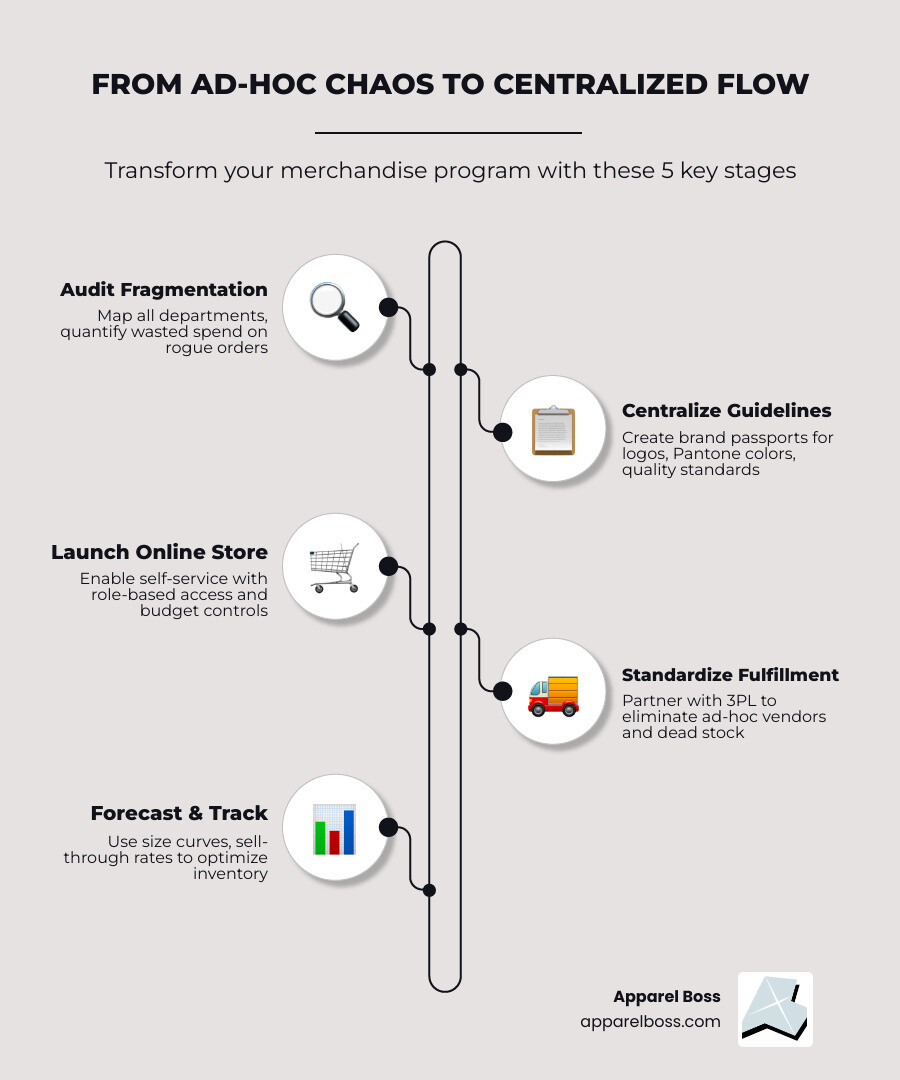
How to Scale Company Merchandise Programs: From Fragmentation to Flow
Scaling a merchandise program is less about finding "cooler" products and more about evolving your internal "operating system." As companies expand from single-office startups to multi-location enterprises, the cracks in manual processes become canyons.
The primary challenge is moving from a reactive model—where a manager realizes they need shirts three days before a trade show—to a proactive, centralized flow. This transition eliminates "rogue merch," where departments bypass brand standards to order from local, unvetted vendors. This fragmentation doesn't just hurt the wallet; it dilutes the brand. When the logo on a New York team’s hoodie is a different shade of navy than the one in the London office, the professional image of the company suffers.
To achieve "flow," organizations must adopt SKU rationalization. Instead of offering 50 different items with low turnover, successful programs focus on a core "anchor" collection of high-quality, high-utility items. By limiting the number of unique products, companies can negotiate better bulk pricing and simplify inventory management. Modern scaling also leverages technology like 3D prototyping to visualize products before a single stitch is sewn, reducing the need for costly physical samples. For enterprise-level brands, this digital-first approach is the secret to scaling branded merchandise programs without the headaches.
Overcoming Operational Hurdles: How to Scale Company Merchandise Programs
The most dangerous phase of growth isn't the beginning; it's the middle. A study by Inc. Magazine and the Kauffman Foundation found that two-thirds of the fastest-growing private companies failed or stagnated after five to eight years, often due to premature and uncontrolled growth. In merchandise, this manifest as "inventory chaos."
Without data-driven forecasting, companies fall into two traps: stockouts that kill momentum or overproduction that traps cash in "dead stock." To solve this, operations teams must use size curves. Apparel does not sell evenly across sizes; a standard curve might see 30% of demand for Medium and Large, but only 5% for XXL. Ignoring these curves leads to shelves full of sizes no one wears while the popular ones remain on backorder.
Before committing to a massive expansion, leaders must ask: is a merch store a right fit for your company? If you have over 50 employees or multiple departments ordering independently, the answer is likely yes. By utilizing local resources like SCORE Long Island, businesses in the New York area can find mentorship to navigate these scaling risks safely.
Centralizing Brand Consistency Across Global Locations
As you scale, "brand consistency" becomes a technical challenge rather than a creative one. Maintaining a unified look across New York, Tokyo, and Berlin requires more than a PDF style guide. It requires a "Brand Passport"—a technical document that specifies Pantone matching for dyes, thread counts for embroidery, and exact logo placements for every approved SKU.
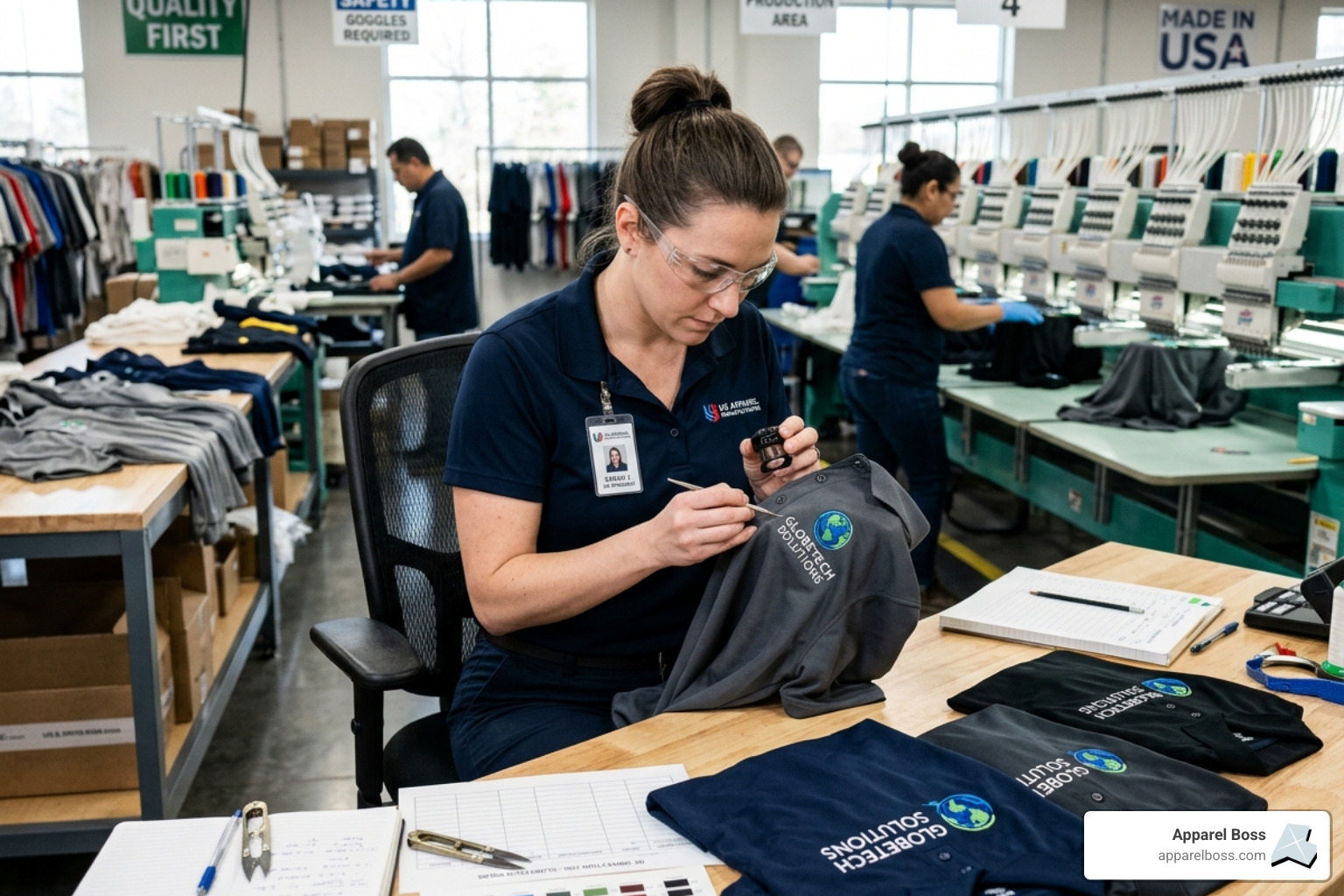
Centralizing production with a partner that offers in-house capabilities is the most effective way to ensure this consistency. When production is fragmented across dozens of local printers, quality control becomes impossible. By mastering your brand with in-house apparel production, you gain direct oversight of the manufacturing process. This ensures that a shirt printed in Suffolk County meets the same rigorous standards as one shipped to a satellite office in Manhattan.
Implementing Online Company Stores for Automated Fulfillment
The "manual era" of merchandise management—spreadsheets, email threads, and boxes stored in the breakroom—ends with the launch of an online company store. These platforms act as a centralized portal where employees and managers can order what they need, when they need it, within pre-set boundaries.
Key requirements for a successful corporate store include:
- Role-Based Access: Ensuring only authorized managers can place high-volume orders while employees might have a "points" balance for personal gear.
- SSO Integration: Connecting the store to your company’s Single Sign-On system (like Okta or Microsoft Azure) for security and ease of use.
- Budget Controls: Setting hard caps on departmental spending to prevent end-of-quarter budget surprises.
- Approval Workflows: Automatically routing large orders to the appropriate finance or marketing lead for sign-off.
Understanding why corporate apparel stores are important is the first step toward reclaiming dozens of hours of administrative time every month. For some enterprise brands, centralizing these operations has reduced admin overhead by as much as 97%.
Strategic Execution: A Phased Action Plan for Global Distribution
Scaling doesn't happen overnight. It requires a phased approach that balances immediate needs with long-term infrastructure. In April 2026, the standard for excellence is a "lean" model that prioritizes sustainability and speed. By adopting modular production, companies can scale capacity up or down without major disruptions.
The roadmap for how to scale company merchandise programs typically follows a 90-day stabilization plan:
- Month 1-2: Audit core SKUs, implement size curves, and launch the online portal.
- Month 3-4: Focus on fulfillment logistics, international shipping rules, and kitting workflows.
- Month 5-6: Refine onboarding processes, integrate with HRIS systems, and optimize pricing through direct import or bulk production.
For detailed operational planning, leaders often look to resources on how to scale a merch business in 2026, which emphasize the shift from "project-based" ordering to "supply-chain" management.
Leveraging Custom Kitting to Streamline High-Volume Operations
One of the highest-leverage tools in a scaled program is custom kitting. Instead of shipping individual items, companies create repeatable "bundles" designed for specific use cases. The most common is the New Hire Onboarding Kit.
When an HR manager in New York hires a remote employee in Nassau County, they shouldn't have to pack a box themselves. A scaled system triggers a kitting workflow: a branded box is pulled, filled with a pre-selected hoodie, notebook, and tech accessory, and shipped via a 3PL (Third-Party Logistics) partner. This ensures every employee has the same "day one" experience, regardless of their location.
Launching your merchandise store with kitting capabilities from the start prevents the "logistics bottleneck" that often occurs when companies grow past 500 employees.
Data-Driven Decision Making for How to Scale Company Merchandise Programs
In a scaled program, data is the antidote to waste. Operations leaders should track specific metrics to measure the health of their merchandise ecosystem:
- Sell-Through Rate: How quickly is inventory moving? High sell-through on certain items suggests they should become "anchor" products.
- Inventory Turnover: How many times per year do you cycle through your stock?
- Employee Adoption: What percentage of your team is actually using the store?
- Cost per Impression: Instead of looking at unit cost, look at value. A premium jacket might cost more upfront, but if it generates 6,000 impressions over its life, the ROI is far higher than a cheap pen that ends up in a drawer.
| Feature | On-Demand (POD) | Stocked Inventory |
|---|---|---|
| Upfront Cost | Low | High |
| Unit Margin | Lower | Higher |
| Shipping Speed | 2–10 Days | Same-Day / 24hr |
| Customization | High (Individual) | Limited (Bulk Only) |
| Risk | Zero Waste | Potential Dead Stock |
Evolving Organizational Structure and Supplier Partnerships
As you grow, your internal team must evolve. Scaling a program usually requires a shift in ownership. What was once handled by an office manager now requires a dedicated program owner—often sitting between Procurement and Marketing. This person manages the relationship with strategic partners like Apparel Boss to ensure the system remains efficient.
Partnerships are the backbone of scale. A true partner doesn't just take orders; they consult on why custom branded merch is the secret to success in 2026. They help you navigate programs like the nyc scale ready studio accelerator or local business development centers to ensure your infrastructure can handle global demand.
The goal is to move away from "swag" and toward a professional retail strategy. By exploring our scalable company store solutions, businesses can transform their merchandise from a line-item expense into a powerful engine for culture and brand equity.
Scaling your merchandise program doesn't have to be a source of operational friction. By centralizing your brand, automating your fulfillment through an online store, and leveraging custom kitting, you can turn your corporate gear into a global icon. Ready to solve your merchandise headaches? Apparel Boss provides the structured systems and in-house production needed to take your program from a startup scramble to an enterprise-grade operation.
Scaling Your Merch Program from Startup to Global Icon