
Why Slow Kit Assembly Is Costing Your Business More Than You Think
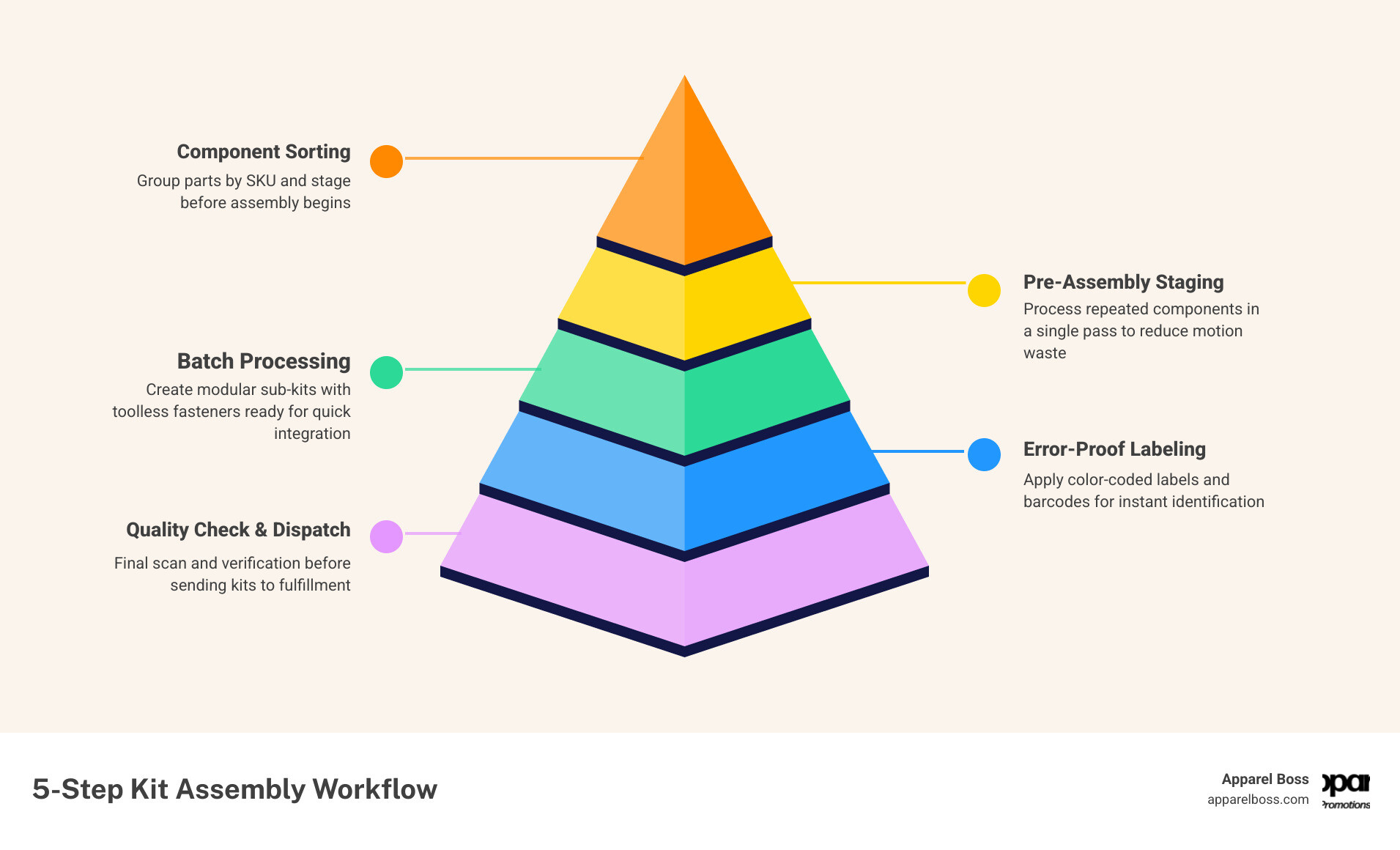
If you're trying to speed up kit assembly, here are the most effective ways to do it:
- Use pre-assembled, modular sub-kits - Group components by assembly stage before the line starts
- Eliminate tools where possible - Toolless fasteners and knurled hand knobs cut setup time significantly
- Standardize packaging and labeling - Color-coded kits and barcodes reduce picking errors and search time
- Batch similar components together - Process repeated parts in one pass, like a factory workflow
- Automate sorting with cobots or vision systems - Especially effective when kits are diverse and component quantities per SKU are low
In most growing organizations, the pressure to speed up kit assembly quietly builds until it becomes a real operational problem. What starts as a manageable process — someone packing a few onboarding kits or product bundles — turns into a bottleneck the moment volume increases.
Manual kitting is slow by nature. It depends on individual attention, physical organization, and consistent execution across every person involved. When any of those variables shifts — new team member, higher order volume, more SKUs — errors climb and timelines slip.
The research backs this up. In manufacturing environments, fastener areas alone are often described as the "quiet saboteur" of lean initiatives, where operators waste valuable minutes hunting for the right parts instead of building the product. The same principle applies directly to corporate merchandise programs: disorganized kit assembly doesn't just slow fulfillment — it creates inconsistent brand experiences and erodes confidence in your program.
The good news is that the fixes are well understood, proven across industries, and scalable to almost any operation.
I'm Salvatore Vento, Marketing Director at Apparel Boss, where I work with operations, HR, and marketing teams to build merchandise programs that are structured, consistent, and built to scale — including the kitting workflows that make or break a program's success. Streamlining how companies speed up kit assembly is central to everything we help our clients execute.
Understanding Speed-Up Kits and Their Strategic Value
To build a faster workflow, we first need to understand what a speed-up kit actually is and how it fundamentally shifts operational dynamics.
Defining the Speed-Up Kit vs. Standard Assembly Methods
In standard assembly, workers pull individual, loose components from various bins at the moment of assembly. This requires high cognitive load, constant reaching, and manual verification of each part.
A speed-up kit, by contrast, consolidates all required components, pre-sorted and packaged, into a single SKU delivered directly to the point of use. By shifting the picking and sorting activities away from the main assembly line, we reduce touchpoints, eliminate motion waste, and dramatically lower the risk of missing parts during final staging.
Key Applications to Speed Up Kit Assembly Across Industries
The concept of a "speed-up kit" or "speed assembly kit" is utilized across diverse sectors to solve unique bottlenecks:
- Security Equipment: Walkthrough metal detectors often utilize specialized speed assembly kits featuring quick screws and knurled hand knobs. This allows rapid, toolless setup and teardown for temporary events or security checkpoints.
- Commercial Appliances: High-end commercial juicers use integrated, one-step removal groups. Instead of dismantling multiple individual gears and blades for daily cleaning, operators remove the entire juicing group in a single step, cutting assembly and sanitation time down to seconds.
- Lawnmower Decks: Heavy-duty mower decks use specialized speed-up pulley kits (reducing center pulley diameters from 7-1/4" to 6-1/2") to increase blade RPM, optimizing cutting performance without requiring entirely redesigned belt layouts.
- Scale Modeling: Hobbyists and industrial prototypers use fast-setting adhesives (reducing bond times from hours to seconds) and pre-organized sub-assemblies to complete complex builds efficiently.
- Manufacturing Kitting: Industrial operations group custom fasteners, brackets, and connectors into sealed, pre-labeled poly bags. This ensures assembly technicians have exactly what they need for a specific work order without searching through central inventory.
Core Components and Design Features to Speed Up Kit Assembly
To successfully implement these time-saving workflows, certain design features must be engineered into the kits and the assembly stations themselves.

Toolless Assembly and Modular Sub-Assemblies
The fastest tool is no tool at all. By designing components that connect via hand-tightened fasteners, businesses remove the physical and mental drag of locating, calibrating, and using manual tools.
- Knurled Hand Knobs & Quick Screws: Replacing standard hex bolts with knurled knobs allows operators to secure components firmly using only hand pressure.
- Modular Sub-Assemblies: Breaking a complex final product into smaller, self-contained sub-units allows multiple operators (or automated machines) to work in parallel.
Expert Insight: Designing for Toolless Integration
When developing product packaging or corporate welcome kits, design the unboxing experience so that no scissors, box cutters, or specialized tools are required. Easy-tear tabs, magnetic closures, and custom-molded pulp trays keep components securely in place while accelerating the final assembly and unboxing speeds.
Automation, Cobots, and Vision Systems in Modern Kitting
For high-volume operations, bringing automation into the kitting zone yields massive efficiency gains. Robotic kitting systems, guided by advanced vision software, can automate high-speed sorting and placement. You can learn more about these integrations through resources on Revolutionizing Efficiency with Robotic Assembly Kitting Systems.
- Collaborative Robots (Cobots): Unlike traditional industrial robots that must be caged, cobots work safely alongside human operators. They can handle repetitive tasks — such as picking small fasteners or placing items into boxes — while the human operator focuses on high-dexterity tasks.
- Vision Systems (2D & 3D): Integrating cameras allows the system to identify part orientation, check for defects, and verify that the correct item is being placed. This ensures high placement accuracy (typically ranging from ±0.01 mm to ±0.05 mm) without requiring precise manual staging.
- Industry 5.0 Human-Robot Collaboration: Modern assembly cells combine high-payload cobots with augmented reality (AR) overlays to guide workers through complex assembly steps in real-time, as detailed in the pilot study on Human-Centric Robotic Solution for Motor and Gearbox Assembly: An Industry 5.0 Pilot Study.
Supporting Lean Manufacturing, 5S, and Visual Management
A well-designed kit is a physical manifestation of lean principles. It directly targets the eight wastes of lean — specifically motion, waiting, and defects.
How Pre-Assembled Kits Reinforce the 5S System
Using pre-assembled kits, such as those discussed in the guide on Using Kitted Fasteners to Support Lean Manufacturing and 5S, directly supports each pillar of the 5S methodology:
- Sort (Seiri): Eliminate unnecessary items from the workspace. Technicians only have the exact parts required for the job at hand.
- Set in Order (Seiton): Every part in the kit has a designated, engineered location, making it obvious if something is missing.
- Shine (Seiso): Sealed kit packaging keeps hardware clean, dry, and free of oil or dust.
- Standardize (Seikitso): Kit configurations are standardized across all shifts, ensuring consistent assembly methods regardless of operator experience.
- Sustain (Shitsuke): Outsourcing or automating the kitting process removes the human discipline variable, making the clean workflow easily repeatable over time.
Expert Insight: Standardizing Kit Packaging
Always use transparent, clearly labeled poly bags or custom-divided boxes. When an operator can instantly see the contents of a kit without opening it, they save valuable verification seconds and avoid breaking the seal on incorrect kits.
Visual Management and Error Reduction
Visual controls turn the physical workspace into an active instruction manual. By using color-coded bins, custom labels, and barcode scanning, you create an environment where errors are almost impossible to make.
- Color-Coded Locations: Matching the color of the kit bag to a specific assembly station or product line prevents operators from pulling the wrong hardware.
- Barcodes and Data Matrix Codes: Printing tracking codes directly on the kit packaging allows operators to scan the kit at the workstation, automatically updating inventory and verifying that the correct kit is paired with the active work order.
Evaluating Performance, ROI, and Cost Considerations
Before implementing a speed-up kit workflow, it is critical to model the time savings and understand how different system variables affect performance.
Quantifying Time Efficiency and Labor Reduction
Academic research offers clear, data-driven insights into how human-cobot collaboration impacts kitting efficiency. According to the research paper Modelling time efficiency of cobot-supported kit preparation, the performance of automated vs. manual kitting depends heavily on kit diversity and component volume:
- High Diversity / Low Volume per SKU: Cobot-supported kitting is highly time-efficient when kits are diverse and fewer components are picked per SKU. The cobot reduces the operator's mental sorting load, allowing them to focus entirely on picking (shifting operator focus to 34% picking time compared to 29% in manual setups).
- Identical Kits / High Volume per SKU: Manual preparation actually outperforms cobots when kit contents are identical and multiple components of the same SKU are grouped together. This is because humans can grab multiple items in a single motion, whereas robots typically pick items sequentially.
- Collaborative Zones: Utilizing four compartments in a shared human-cobot zone reduces the average time spent per kitted component to 4.83 seconds, compared to 5.25 seconds when using only one compartment.
| Performance Metric | Manual Kitting Staging | Cobot-Supported Kitting |
|---|---|---|
| Average Cycle Time | Faster for high-volume, identical kits | Comparable overall; faster for highly diverse kits |
| Cycle Time Variability | High (dependent on operator fatigue/experience) | Extremely low (highly predictable outcomes) |
| Error Rate | Higher risk of miscounts or missing parts | Near zero due to integrated vision verification |
| Operator Time Focus | 29% spent on active picking | 34% spent on active picking (sorting automated) |
Cost-Benefit Analysis and ROI Factors
While implementing automated systems or outsourcing kit assembly requires upfront capital, the return on investment comes quickly through:
- Reduced Labor Costs: Shifting tedious sorting tasks away from high-value technicians.
- Defect Reduction: Eliminating downstream assembly errors caused by missing or incorrect parts.
- Scalable Systems: Allowing your business to handle sudden spikes in order volume without a linear increase in headcount.
Transitioning to Scalable Corporate Merchandise Kitting
At Apparel Boss, we see these exact manufacturing bottlenecks play out in corporate merchandise and onboarding programs. When companies try to manage inventory, print custom apparel, and assemble employee kits in-house, they run into massive operational friction.
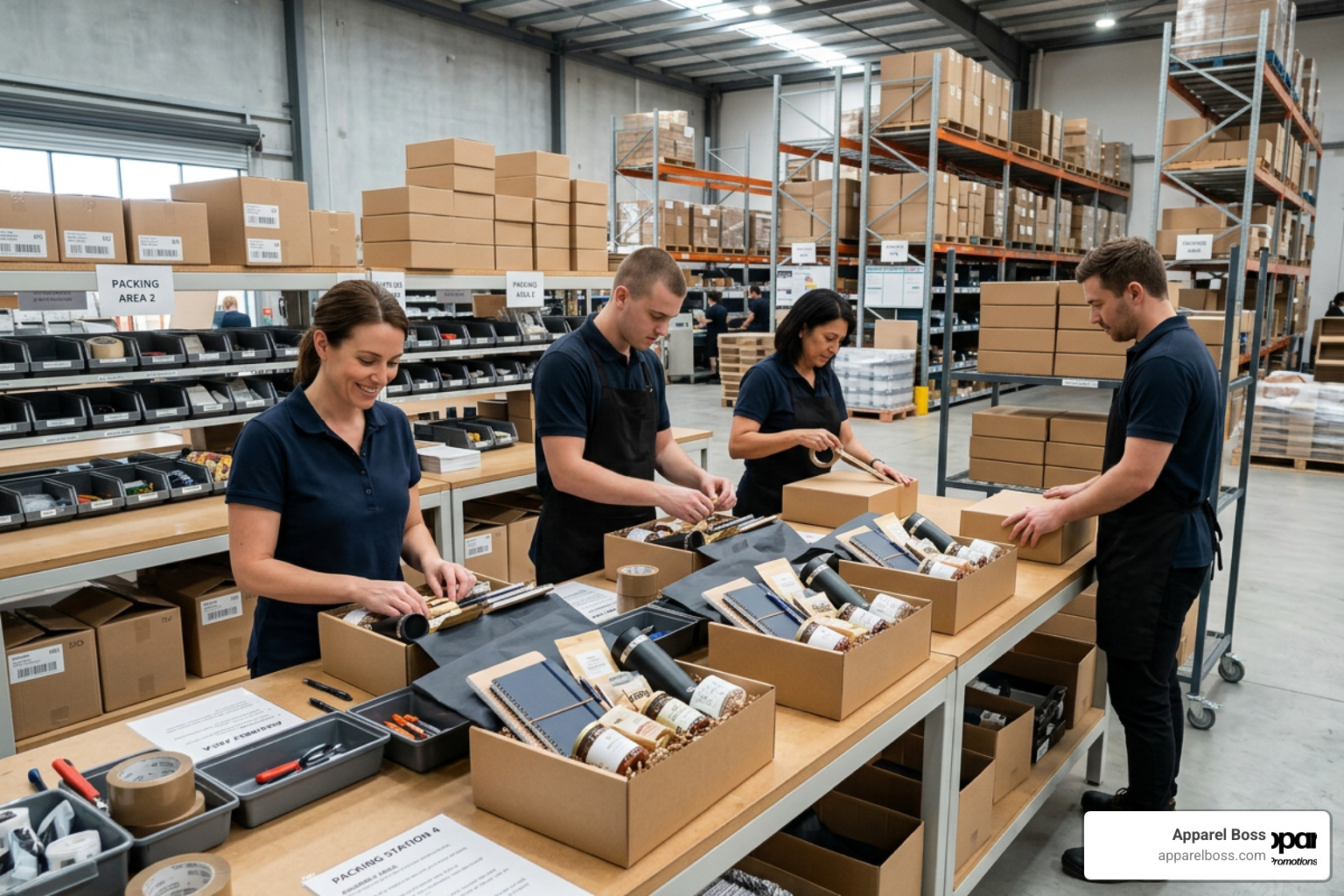
Best Practices to Speed Up Kit Assembly in Corporate Merchandise Programs
If you are managing custom gear, employee onboarding, or milestone programs, you can drastically speed up kit assembly by adopting these proven operational strategies:
- In-House Production & Fast Turnaround: Partner with a provider that manages decoration and assembly under one roof. At Apparel Boss, we leverage in-house production to offer rapid, reliable turnaround times, taking the lag out of kit preparation.
- Pre-Staging and Standardized Kits: Instead of picking items on demand, pre-assemble your standard kits — such as your curated welcome boxes — and store them as a single SKU. Check out our guide on the Best Employee Welcome Kits for a Five-Star First Day to see how pre-staged kits elevate the onboarding experience.
Expert Insight: Outsourcing Variable Kitting Tasks
If your kit requirements change frequently, outsource the variable assembly tasks to a professional fulfillment partner. This moves the most error-prone, labor-intensive steps out of your office and into a highly controlled warehouse environment.
Leveraging Online Company Stores for Automated Fulfillment
The ultimate way to speed up kit assembly is to automate the entire ordering and fulfillment workflow. By integrating an online company store with your internal HR systems (HRIS), you can trigger kit assembly and shipping automatically based on real-time business events.
To streamline this process, you can transition away from manual tracking by using modern logistics tools, as detailed in our guide on how to Stop the Grind with These Streamlined Inventory Ops Platforms. Once your platforms are integrated, you can completely eliminate manual ordering bottlenecks using the strategies outlined in our A-Z Guide to Solving Common Merchandise Problems with Automation.
Frequently Asked Questions about Speeding Up Kit Assembly
What is the single biggest time-saver in kit assembly?
The single biggest time-saver is pre-assembly of modular sub-kits. By grouping components into stage-specific, toolless sub-assemblies before the main line begins, you eliminate search time and minimize manual handling on the final line.
How do cobots compare to manual labor in kit preparation?
Cobots provide highly stable, predictable cycle times with minimal variability and near-zero error rates. While manual labor can be faster for repetitive, identical kits with high component counts, cobots are significantly more efficient when assembling highly diverse kits with low quantities per SKU.
How does kitting support 5S and lean manufacturing?
Kitting supports 5S by eliminating unnecessary items from the workspace (Sort), keeping required parts in designated, engineered locations (Set in Order), protecting hardware in sealed packaging (Shine), standardizing the assembly process (Standardize), and making the clean workflow easily repeatable (Sustain).
Conclusion
Whether you are assembling complex industrial machinery on a factory floor or preparing premium welcome kits for a remote team across New York, Long Island, and beyond, the path to efficiency is the same. By eliminating tool requirements, standardizing packaging, leveraging smart automation, and pre-staging modular components, you can drastically speed up kit assembly and eliminate operational bottlenecks.
At Apparel Boss, we help businesses solve these exact operational challenges. We specialize in taking the stress out of corporate merchandise programs through structured, scalable systems — including our custom online company stores, in-house production capabilities, and high-efficiency custom kitting.
Ready to stop the administrative grind and streamline your organization's kitting and distribution? Let's design a scalable solution tailored to your team. Learn more about how we can help by visiting our Apparel Boss Custom Kitting Services page today.