
Why Every Scaling Business Needs a Bulk Apparel Ordering System
A bulk apparel ordering system is the operational backbone that separates companies running smooth, scalable merchandise programs from those drowning in spreadsheets, re-keying errors, and inventory chaos.
Here is what a bulk apparel ordering system does, at a glance:
| Feature | What It Solves |
|---|---|
| Centralized order management | Eliminates manual entry and scattered email orders |
| Real-time inventory visibility | Prevents overselling across channels |
| Customer-specific pricing and catalogs | Ensures correct pricing for every account or department |
| Pre-book and at-once ordering | Supports seasonal programs and replenishment cycles |
| ERP and 3PL integration | Keeps fulfillment, finance, and logistics in sync |
| Self-service buyer portal | Reduces administrative workload for internal teams |
The operational cost of not having one adds up fast. A $15M apparel brand running wholesale, direct-to-consumer, and 3PL relationships typically spends 6 to 9 hours per week just reconciling inventory across systems — and still faces a 2 to 3 percent oversell rate during peak drops. For enterprise teams, that kind of friction does not just waste time. It erodes brand credibility and creates the exact kind of unpredictability that makes leadership nervous.
The problem is not effort. It is architecture. Most companies outgrow their ordering setup long before they realize it.
I'm Salvatore Vento, Marketing Director at Apparel Boss, where I've spent my career helping scaling teams replace reactive, error-prone apparel workflows with structured bulk apparel ordering systems that deliver consistency and control at every stage. If you're responsible for how your company sources, manages, and distributes branded merchandise, this guide is built for you.
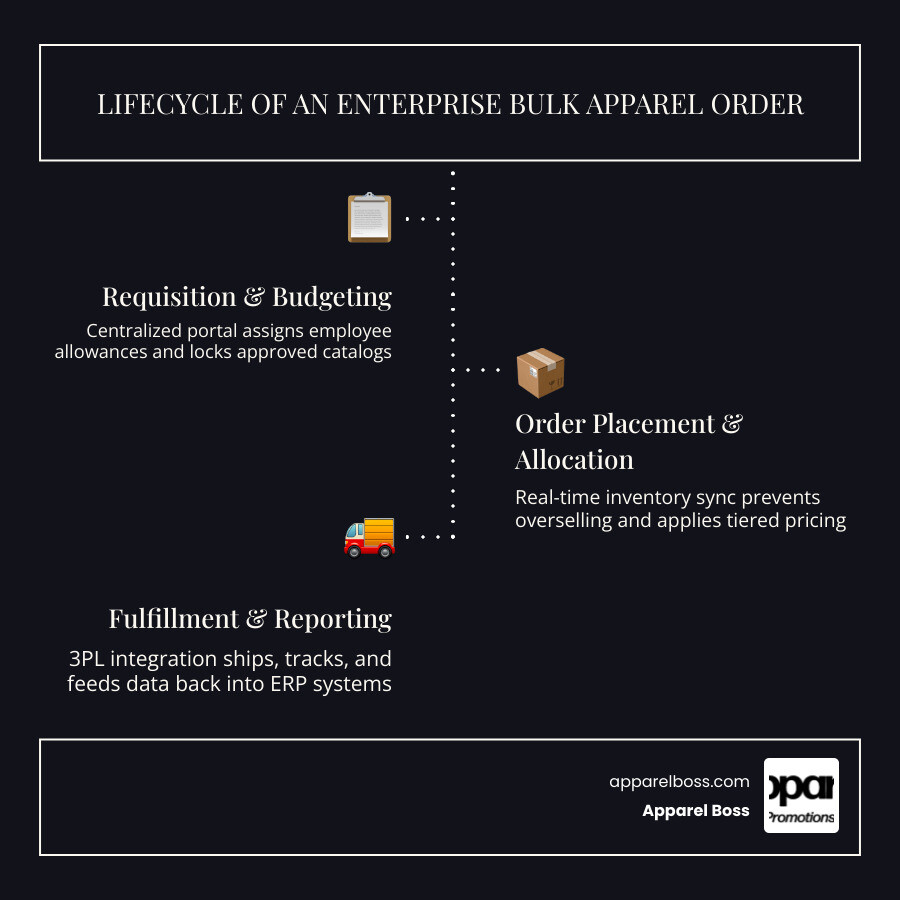
Streamlining Enterprise Operations with a Bulk Apparel Ordering System

When enterprise organizations manage corporate apparel, they often fall into a trap: treating apparel like an ad-hoc office supply purchase rather than a critical logistics workflow. Without a dedicated system, you find yourself chasing sizes over email, guessing inventory levels, and dealing with boxes of unused shirts taking up valuable office space.
To run a professional program, you must Stop the Swag Chaos with Professional Online Company Stores. Transitioning to a unified platform allows organizations to centralize inventory, reduce per-unit costs through strategic volume planning, and guarantee absolute order accuracy.
Traditional Wholesale vs. a Modern Bulk Apparel Ordering System
The traditional wholesale model is notoriously manual. Sales representatives carry physical or PDF linesheets, write down orders on paper or disjointed forms, and manually key them into an order entry system days later. This delay leads to immediate pricing drift, partial cancellations, and frustrated stakeholders.
A modern bulk apparel ordering system replaces this friction with digital, self-service portals. Instead of static PDFs, buyers and internal departments log into a customized storefront to view live inventory levels, place orders 24/7, and receive instant confirmations. Modern digital ordering platforms have proven that digitizing these workflows eliminates the operational lag of traditional wholesale.
By utilizing a modern online company store, businesses can streamline procurement, ensuring that regional offices or departments can order their pre-approved apparel independently without creating administrative bottlenecks at headquarters.
Overcoming the Operational Breakpoints of Manual Ordering
For businesses growing past a certain threshold, manual systems eventually buckle. When you are managing custom embroidery, screen printing, and complex shipping requirements across multiple offices, spreadsheets simply cannot keep pace.
Consider the real-world operational impact of upgrading from fragmented systems to a unified approach. Multi-entity wholesale operators have improved their inventory accuracy from a stressful 90–95% range to a near-perfect 99%. By consolidating their order management, these operators have reduced excess stock by up to 20% and successfully scaled their accounts without adding operations headcount.
At Apparel Boss, we specialize in helping brands navigate these exact transitions. By implementing The Expert Way to Handle B2B Company Store Setup Without the Stress, we eliminate the manual re-keying errors and inventory reconciliation headaches that quietly drain your team's time and budget.
Key Capabilities of an Enterprise-Grade Ordering Platform

An enterprise-grade bulk apparel ordering system must offer more than just a digital checkout cart. It must support complex corporate hierarchies, manage strict brand guidelines, and provide a seamless user experience for both administrators and end users.
| Ad-Hoc Decentralized Ordering | Centralized Bulk Ordering Workflows |
|---|---|
| Scattered emails, spreadsheets, and manual invoices | Single, unified digital portal for all departments |
| Frequent overselling and stockouts | Real-time inventory allocation and buffer stock |
| Inconsistent branding and decoration quality | Pre-approved catalogs with locked design specifications |
| Uncontrolled spending and manual expense reports | Budget caps, employee allowances, and automated tracking |
Real-Time Inventory Visibility and Allocation Rules
There is nothing more frustrating than approving a large apparel order, waiting weeks for production, and then discovering that a critical size is backordered. A robust platform prevents this by using real-time inventory visibility and strict allocation rules.
Rather than treating your inventory as one giant, unstructured pool, a modern system establishes clear allocation tiers. For example, pre-booked corporate programs or key retail accounts are prioritized first, followed by seasonal replenishment, and finally immediate-ship needs. By leveraging managed apparel services, we ensure that your committed stock is ring-fenced and protected from accidental overselling, keeping your programs running on schedule.
Customer-Specific Pricing, Budgets, and Assortments
Enterprise operations require control. If you are managing uniform distribution across different departments, you cannot have a one-size-fits-all catalog.
A professional platform allows administrators to set customer-specific pricing, define unique product assortments, and manage employee allowances. You can establish budget caps directly within the portal, allowing employees to self-select their size and style within their pre-approved allowance. This is the easiest way to Simplify Ordering Corporate Custom Apparel Stores without requiring a human to manually review and approve every single transaction.
Supporting Pre-Book, At-Once, and Seasonal Programs
Corporate merchandise needs change throughout the year. Your summer internship program requires lightweight polos, while your winter holiday packages demand premium custom jackets.
Your platform must support multiple ordering cadences:
- Pre-book ordering: Securing inventory months in advance for major corporate events or seasonal launches.
- At-once ordering: Quick-turn replenishment for new hires or immediate uniform replacements.
- Seasonal collections: Rotating product catalogs that keep your brand looking fresh and relevant.
%Managing these cycles requires deep integration with custom kitting and fulfillment partners. Advanced B2B wholesale ordering systems highlight how crucial it is to synchronize seasonal planning with backend production to avoid delays.
Integrating Bulk Ordering with ERP, Inventory, and Fulfillment
A bulk ordering portal is only as strong as its connection to your physical supply chain. If your ordering software does not talk to your ERP (Enterprise Resource Planning) or your warehouse, you have simply moved your manual data-entry problem from one screen to another.
The Role of EDI Compliance and 3PL Workflows
For companies distributing apparel to major retail networks or large-scale corporate partners, compliance is non-negotiable. Major retailers like Target and Nordstrom enforce strict Vendor Compliance rules. Non-compliance, such as a misplaced barcode or a late shipment notification, can result in hefty chargebacks ranging from $50 per box to a percentage of the entire invoice.
An enterprise bulk apparel ordering system automates compliance by integrating directly with EDI (Electronic Data Interchange) systems and 3PL (Third-Party Logistics) workflows. The system automatically handles critical documents, including:
- EDI 850 (Purchase Order): Seamlessly receiving incoming orders.
- EDI 855 (PO Acknowledgment): Confirming stock availability.
- EDI 856 (Advance Ship Notice): Sending precise carton-level details and tracking before the shipment arrives.
- EDI 810 (Invoice): Automating the billing process.
By generating GS1-128 shipping labels and routing guides automatically, and aligning with established GS1 standards, the platform ensures that every carton leaving the warehouse meets exact partner standards, protecting your margins from avoidable penalties.
How to Choose the Right Bulk Apparel Ordering System for Your Brand
When evaluating platforms, look beyond basic features. Consider how well the system scales with your business, its native integration capabilities, and the level of customization it offers.
If your organization prioritizes brand prestige and high-end presentation, look for a platform that supports artisan-level decoration details, custom packaging, and white-glove distribution. The technology should make your life easier, but the physical product must still reflect the high standards of your brand.
Frequently Asked Questions About Bulk Apparel Ordering
What is the difference between decentralized ad-hoc purchasing and a centralized bulk ordering system?
Decentralized purchasing occurs when individual departments buy their own apparel from various local vendors. This leads to inconsistent logo embroidery, varying garment quality, and zero cost control. A centralized bulk apparel ordering system consolidates all purchasing into a single, pre-approved portal. This guarantees brand consistency, unlocks bulk-pricing discounts, and provides leadership with complete visibility over total corporate apparel spend.
How do bulk ordering systems prevent inventory overselling?
They establish strict allocation rules and synchronize inventory levels in real-time across all channels. If a block of inventory is committed to a seasonal corporate program, the system automatically locks those units, making them unavailable for other immediate-ship orders. This multi-channel governance ensures you never have to send a painful "out of stock" email after an order has already been approved.
What are the typical setup times for an enterprise bulk apparel portal?
A standard enterprise deployment typically moves through four structured phases: discovery, data migration (importing user directories, budget rules, and product catalogs), system configuration, and go-live support. Depending on the complexity of your ERP integrations and the level of custom kitting required, a professional portal can be fully launched and operational within 30 to 60 days.
Conclusion
Managing a high-end corporate apparel program should not feel like a second full-time job.
At Apparel Boss, led by industry expert Salvatore Vento, we specialize in bridging the gap between premium brand standards and operational scalability. From our state-of-the-art facility in Deer Park, NY, we provide luxury custom embroidery, custom kitting, and white-glove distribution services to elite brands across Long Island, New York City, and beyond.
We don't just build online stores; we build cohesive brand experiences. If you are ready to eliminate inventory waste, secure absolute brand consistency, and elevate your corporate gifting programs, let's build a solution tailored to your team.
Explore Apparel Boss Company Stores today and find out how we can streamline your merchandise operations from design to doorstep.