Why Brand Consistency Is a Business-Critical Operational Problem
To improve team branding consistency, start with these core actions:
- Audit your current brand assets across all channels and touchpoints
- Centralize approved assets in a single, accessible system with role-based access
- Document clear brand standards covering logos, colors, typography, voice, and messaging
- Train and align all teams — not just marketing — through onboarding and ongoing education
- Implement lockable templates so distributed teams can customize within approved guardrails
- Assign brand champions in each department to enforce standards locally
- Measure and iterate using audits, engagement data, and team feedback
Think about the last time someone on your team used an old logo. Or a vendor printed your company apparel in the wrong shade of blue. Or a new hire created a sales deck that looked nothing like your brand.
These aren't small mistakes. They're symptoms of a broken system.
Brand consistency means your organization looks, sounds, and feels the same everywhere — from your website to your employee uniforms to the kits you ship to new hires on day one. When it breaks down, it erodes customer trust quietly and steadily, often before anyone notices the damage.
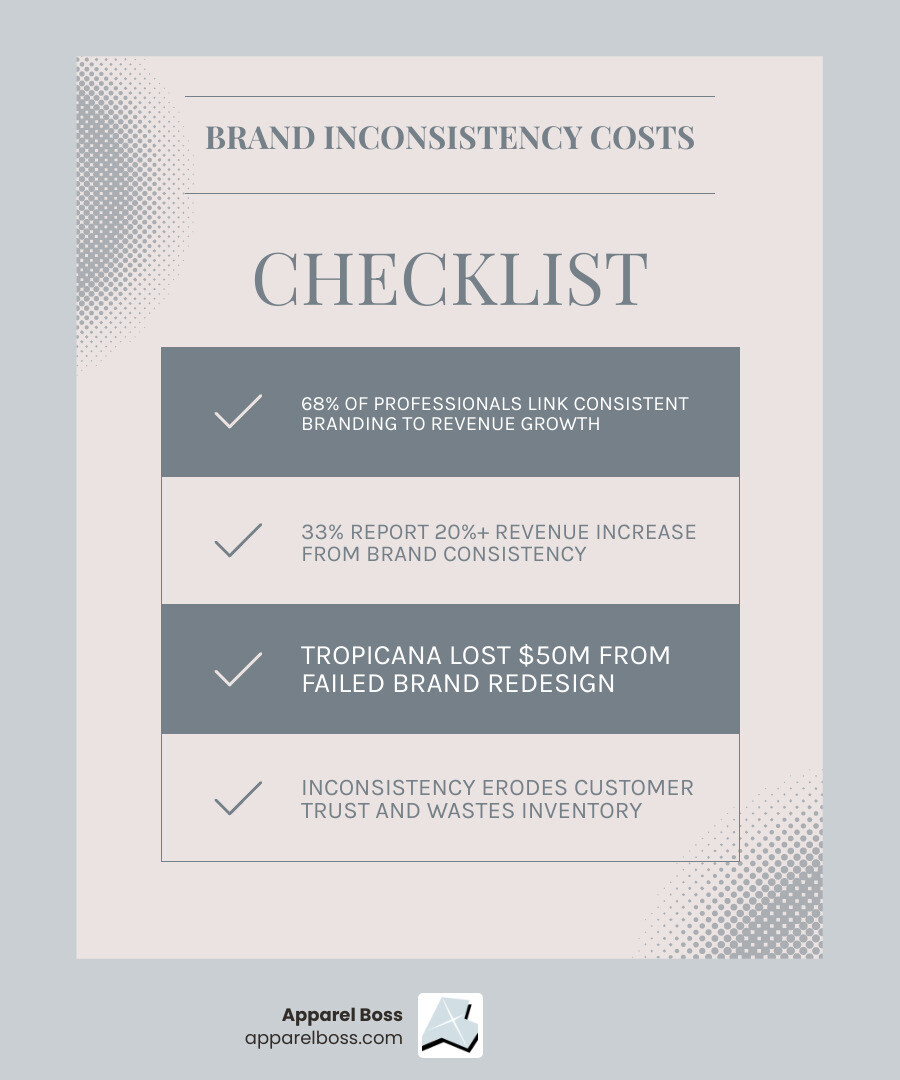
The numbers make the stakes clear. Research shows that 68% of professionals link brand consistency directly to revenue growth, and over a third say it increased revenue by 20% or more. On the flip side, Tropicana's failed brand redesign cost the company over $50 million and wiped out 20% of its sales — a real-world lesson in what inconsistency can cost at scale.
For growing organizations managing distributed teams, multiple vendors, and increasing content volume, this challenge compounds fast. What starts as a minor visual mismatch becomes an operational problem — wasted inventory, inconsistent apparel quality, slow approvals, and a brand that feels fractured rather than unified.
The good news: this is a solvable problem. But it requires more than a PDF brand guide buried in a shared drive.
Strategies to Improve Team Branding Consistency Across Your Organization
Achieving a unified brand isn't just a "marketing thing"—it is an operational imperative. When teams in New York or Long Island operate in silos, the brand experience begins to fracture. Marketing might be using the latest HEX codes, while the operations team is ordering custom apparel from a local vendor who hasn't updated their files since 2022.

This friction creates "brand debt." Every time a team member has to hunt for a logo or guess which font to use, productivity drops. Even worse, fragmented technology—where assets live across Google Drive, Slack, and personal desktops—makes it nearly impossible to achieve consistency in branding across teams for unified messaging. To fix this, leadership must view brand consistency as a logistical challenge that requires a structured, systemic solution.
Identifying Common Challenges to Improve Team Branding Consistency
Before you can fix the system, you have to identify where the pipes are leaking. In our experience working with mid-to-large organizations in Suffolk and Nassau County, the most common "brand killers" include:
- Rogue Vendors: Different departments hiring different printers leads to "color creep." Your "Navy Blue" becomes "Royal Blue" depending on who is running the press.
- Outdated Logos: The "LogoFinalv3USETHIS.png" file is rarely the final one. Without a central hub, old versions circulate indefinitely.
- Manual Review Bottlenecks: If every single t-shirt or business card requires a manual sign-off from the Creative Director, teams will eventually bypass the process just to get their work done.
- Wasted Inventory: Ordering 500 shirts because "it’s cheaper in bulk" often leads to boxes of outdated merchandise sitting in a closet when the logo changes six months later.
- Poor Sizing Standards: Inconsistency in garment brands means a "Large" from one vendor fits like a "Small" from another, leading to low employee adoption and frustration.
The Role of Centralized Systems in Maintaining Standards
The solution to "rogue branding" is a single source of truth. For physical assets, this is where an online company store becomes a game-changer. By centralizing your branded gear, you eliminate the possibility of a satellite office using the wrong logo.
Centralized systems allow for "lockable templates." For example, a branch manager in Manhattan might need to order custom company gear for a local event. With a centralized system, the logo and brand colors are locked; the manager can only change the text for the specific event date.
| Feature | Manual Governance | Automated (Company Store) |
|---|---|---|
| Logo Control | High risk of outdated versions | Enforced "Single Source of Truth" |
| Approval Speed | Slow; manual emails/Slack | Instant; pre-approved templates |
| Inventory | Guesswork; high waste | On-demand or tracked levels |
| Quality | Varies by vendor | Consistent; single-source production |
Conducting a Brand Consistency Audit to Find and Fix Gaps
If you suspect your branding is drifting, it’s time for an audit. This isn't just about looking at your website; it’s about looking at the physical touchpoints your employees and customers interact with daily. According to the Brand Consistency Audit Guide: How to Find and Fix Inconsistencies, you should evaluate four key areas:
- Visual Identity: Are the logos, colors, and fonts identical on your building signage, sales decks, and quality branded apparel?
- Voice and Tone: Does your internal newsletter sound like the same company that writes your LinkedIn posts?
- Terminology: Are you using consistent names for your products and services across all departments?
- Scoring Method: Assign a score (0 for inconsistent, 3 for perfect) to each touchpoint. If your overall score is below 75%, you need a remediation plan.
Once the audit is complete, prioritize the "high-visibility" fails—usually the apparel worn by front-line staff and the custom kits sent to high-value clients.
Building a Scalable System for Long-Term Brand Alignment
A brand is not a static document; it is a living entity. As your team grows from 50 to 500, the "word of mouth" method of maintaining standards will fail. You need a governance framework that empowers people to be brand ambassadors without needing a design degree.
Cross-functional alignment is the secret sauce. This means your HR lead, your Operations manager, and your Marketing head are all reading from the same playbook. When everyone understands that custom branded merch is the secret to success, they become more protective of how that merch is produced and distributed.
Defining Comprehensive Brand Standards for Distributed Teams
For teams spread across New York City and Long Island, clarity is kindness. Your brand standards guide should be more than just a list of "don’ts." It should be a library of "dos."
- Logo Usage: Provide clear space requirements and minimum sizes. Show examples of the logo on different fabric textures (e.g., how it looks embroidered on a jacket vs. screen-printed on a tote).
- Color Palettes: Include HEX, RGB, and CMYK codes, but also specify "thread colors" for embroidery to ensure your corporate branded hoodies match your digital assets.
- Typography: Limit your brand to 2-3 font families. Specify which fonts are for internal documents (like invoices) and which are for marketing.
- Messaging Library: Give teams pre-approved blurbs they can copy and paste for "About Us" sections or email signatures.
Leveraging Technology to Improve Team Branding Consistency at Scale
In April 2026, manual fulfillment is a relic of the past. If your office manager is still spending Friday afternoons packing boxes and printing shipping labels, your brand consistency is at risk. Human error in packing often leads to the wrong items—or worse, the wrong branded items—reaching your team.
By leveraging an online company store, you automate the entire lifecycle of your brand's physical presence. When a new hire is added to your HR system in Nassau County, an automated trigger can order a professional style onboarding kit that includes a branded polo, a notebook, and a tech kit—all perfectly aligned with your current brand standards.
This technology also solves the "inventory graveyard" problem. With on-demand production (like direct-to-film printing or in-house embroidery), you can produce items as they are ordered. This ensures that every piece of apparel is fresh, relevant, and consistent with your latest branding.
Measuring Success and Maintaining Operational Efficiency
How do you know if your efforts to improve team branding consistency are working? You have to move beyond "it looks better" and look at the data.
- Administrative Workload Reduction: Track how many hours your team saves by using an automated store versus manual ordering. Companies often save hundreds of hours a year by eliminating "order spreadsheets."
- CSAT (Customer/Employee Satisfaction) Surveys: Ask your team if they feel proud to wear the company gear. High adoption rates are a direct indicator of brand resonance.
- ROI Analysis: Compare the cost of "wasted inventory" from previous years to the lean, on-demand model of a centralized system.
- Engagement Metrics: For custom merchandise, track how often items are requested. If no one is ordering the branded pens but everyone wants the hoodies, you know where to focus your brand energy.
At Apparel Boss, we specialize in turning these branding headaches into streamlined, automated systems. Whether you are looking to master professional style across a distributed sales team or need a robust online company store to manage your global presence from Long Island, we provide the infrastructure that makes consistency the path of least resistance.
Stop fighting with rogue logos and wasted boxes of shirts. Let’s build a system that protects your brand while you focus on growing your business.
Ready to see how a structured merchandise program can transform your team's alignment? Explore our custom apparel services and discover how we simplify branding for organizations like yours.
Why Brand Consistency Matters: How Your Team Can Achieve It