What Is Corporate Merchandise Strategy & Management (And Why It Matters)
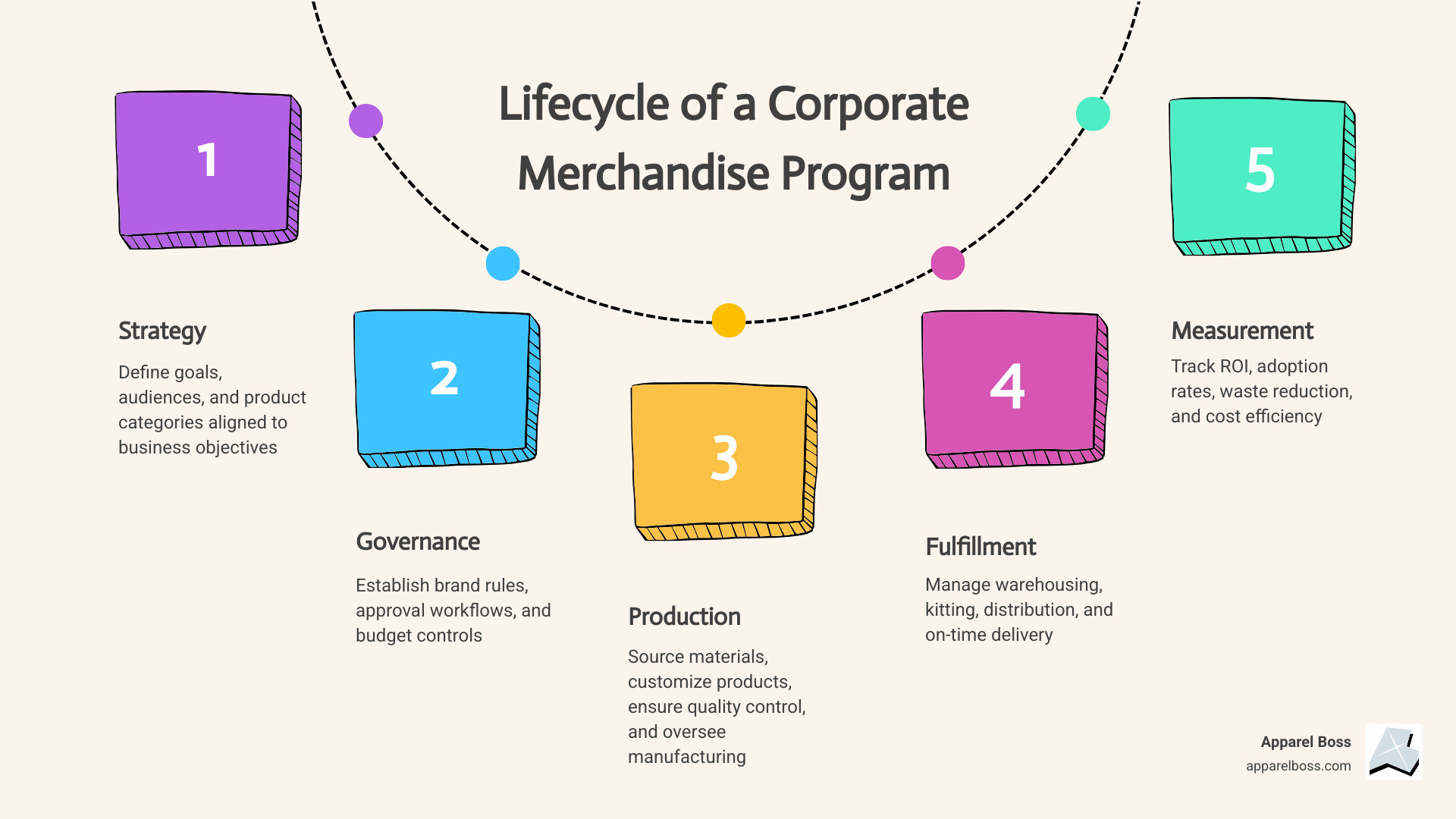
Corporate Merchandise Strategy & Management is the structured system an organization uses to plan, source, produce, distribute, and measure branded products across teams, locations, and business objectives.
Here is a quick overview of what it covers:
| Component | What It Means |
|---|---|
| Strategy | Defining goals, audiences, and product categories aligned to business needs |
| Governance | Establishing brand rules, approval workflows, and budget controls |
| Production | Sourcing, customization, quality control, and manufacturing oversight |
| Fulfillment | Warehousing, kitting, distribution, and on-time delivery |
| Measurement | Tracking ROI, employee adoption, waste reduction, and cost efficiency |
In most growing organizations, branded merchandise is not one tidy program. It is three, four, or five programs running at the same time — often without any of them knowing the others exist.
HR orders onboarding kits. Marketing orders event swag. Sales sends client gifts. Each team uses a different vendor, a different approval process, and a different quality standard. The result? Inconsistent branding, wasted inventory, duplicated spend, and a operational headache that scales with your headcount.
This is what practitioners call the fragmentation tax — the hidden cost of managing merchandise without a system.
The good news is that this problem is structural, not personal. And structural problems have structural solutions.
This guide walks operations, HR, and marketing leaders through everything needed to build a merchandise program that is consistent, scalable, and built to run without constant manual intervention.
Building a Scalable Corporate Merchandise Strategy & Management Framework
For enterprise organizations in New York City or Long Island, managing physical brand assets often feels like a constant battle against chaos. To scale effectively, a business must move away from "one-off" transactional ordering toward a comprehensive framework. This framework relies on a federated execution model: a central hub provides the infrastructure (the tech, the vendors, and the brand rules), while individual teams (HR, Sales, Marketing) execute their specific programs within those guardrails.
A scalable framework is built on shared infrastructure. Instead of five teams managing five different vendor relationships, the organization consolidates volume to unlock better pricing and ensures every item meets a single quality standard. This transition is critical because, as many leaders discover, is a merch store a right fit for your company? is often answered by the need for better control over brand equity.
Comparing Fragmented vs. Centralized Management
| Feature | Fragmented Management | Centralized (Apparel Boss) Management |
|---|---|---|
| Vendor Count | 3–5 active relationships per team | 1 strategic partner with in-house production |
| Brand Consistency | High risk; varying colors and quality | Guaranteed; single source of truth |
| Inventory | "Closet" storage; high waste | Digital tracking; 99% accuracy |
| Ordering | Manual emails and spreadsheets | Automated online company stores |
| Fulfillment | Team leads packing boxes in the office | Professional kitting and multi-location delivery |
When organizations like The Company - GNP Branded Gear focus on the long-term lifecycle of products, they recognize that a structured program supports growth without reinventing the wheel for every event.
Solving Operational Challenges in Corporate Merchandise Strategy & Management
The most common pain points in merchandise management are rarely about the "swag" itself; they are about the operational friction that surrounds it. Research shows that informal programs often suffer from 20% to 30% waste due to over-ordering, obsolete branding, and rush shipping fees.
Common operational failures include:
- Inventory Waste: Boxes of "leftover" event shirts sitting in a storage unit in Suffolk County because there was no system to redistribute them to HR for new hire kits.
- Sizing Inaccuracies: Without a centralized data system, teams often guess size breakdowns, leading to a surplus of Small and 3XL items that never get used.
- Quality Flaking: Using disparate vendors leads to "logo drift," where your brand colors look different on a polo than they do on a jacket.
- Production Delays: Fragmented ordering means you lose the leverage needed to prioritize production during peak seasons.
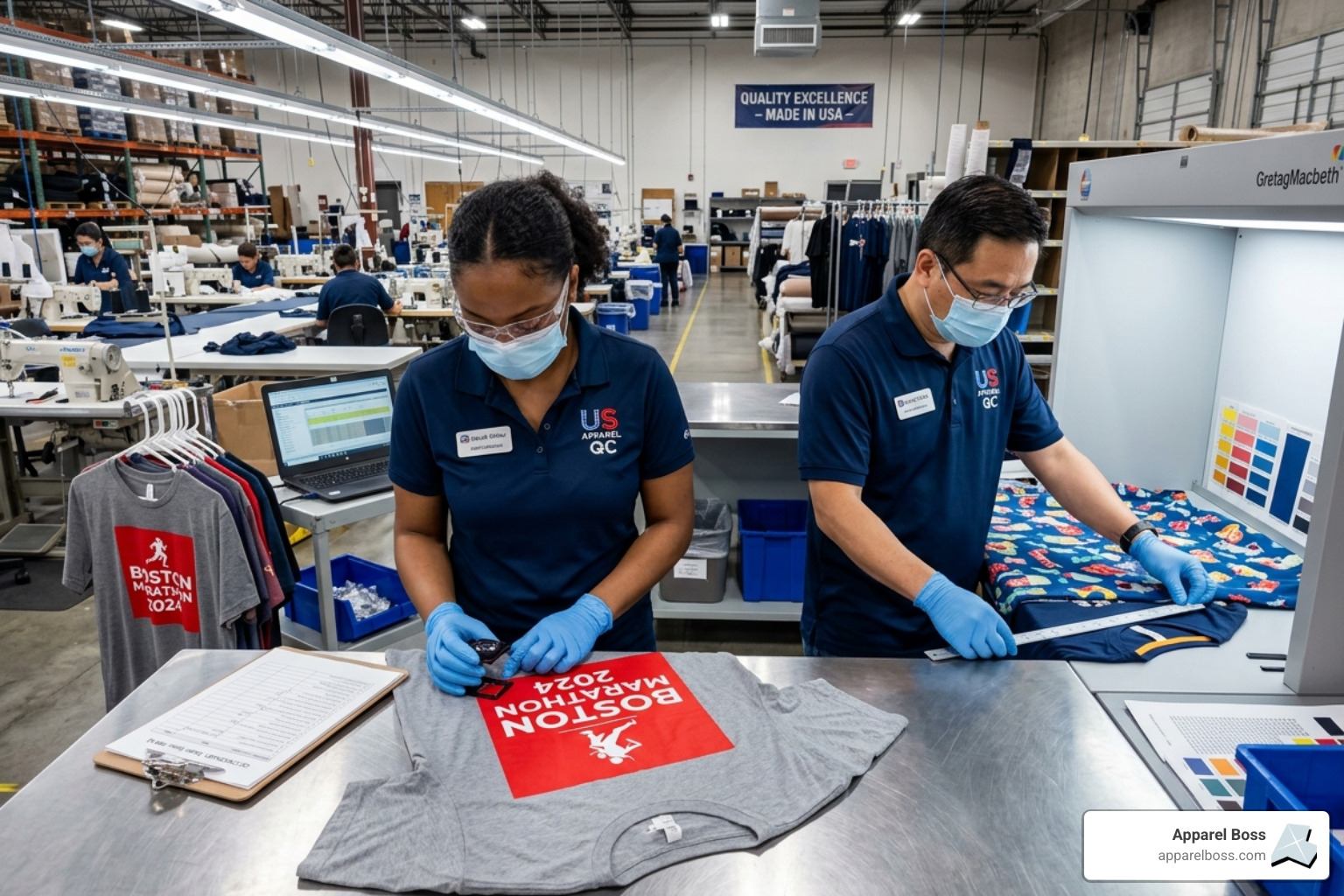
To stop the swag chaos with professional online company stores, businesses must implement rigorous quality control. At Apparel Boss, this means multi-point inspections—from raw material checks to print adhesion testing—ensuring that the physical product matches the brand's premium reputation.
Leveraging Technology for Global Fulfillment and Inventory Control
In April 2026, technology is the backbone of Corporate Merchandise Strategy & Management. Modern systems no longer just "track" inventory; they use AI analytics to balance stock levels across multiple locations. If a sales team in Nassau County is running low on client gifts while the New York City office has a surplus, a smart system can trigger a redistribution rather than a new production run.
Fulfillment technology also enables "Buy Online, Pick Up In Store" (BOPIS) style workflows for corporate environments. For example, an employee can select their uniform size on a company store and have it ready at their specific office location within 48 hours. Partners like TVP NYC: Great Swag - Made Managed Delivered highlight the importance of "managed" and "delivered" as much as "made." By integrating e-commerce with real-time warehousing, organizations can achieve a 99% on-time delivery rate, even when fulfilling tens of thousands of units per month.
Integrating Sustainability and Personalization into Modern Programs
Decision-makers are increasingly under pressure to ensure their physical brand footprint is ethical. Sustainability is no longer a "nice-to-have" in 2026; it is a critical differentiator. This involves moving away from "throwaway" items toward high-utility, durable goods made from recycled or organic materials.
Personalization further elevates this impact. A generic notebook might be kept for a month, but a high-quality, personalized item creates an emotional connection that fosters loyalty. The key is to use data-driven personalization—leveraging HRIS or CRM integrations—to trigger the right gift at the right moment (e.g., a five-year work anniversary).
However, sustainability and personalization require careful planning. Organizations must learn how to budget for corporate merchandise by calculating the "cost-per-impression" rather than just the "cost-per-unit." A durable, eco-friendly jacket that is worn for three years provides a significantly higher ROI than a cheap t-shirt that ends up as a rag after two washes.
Optimizing Operations: From Fragmented Ordering to Centralized Systems
The transition from a fragmented "order-as-needed" model to a centralized system is where true cost savings are found. By consolidating purchasing volume, enterprise organizations can access bulk-pricing tiers that were previously out of reach for individual departments.
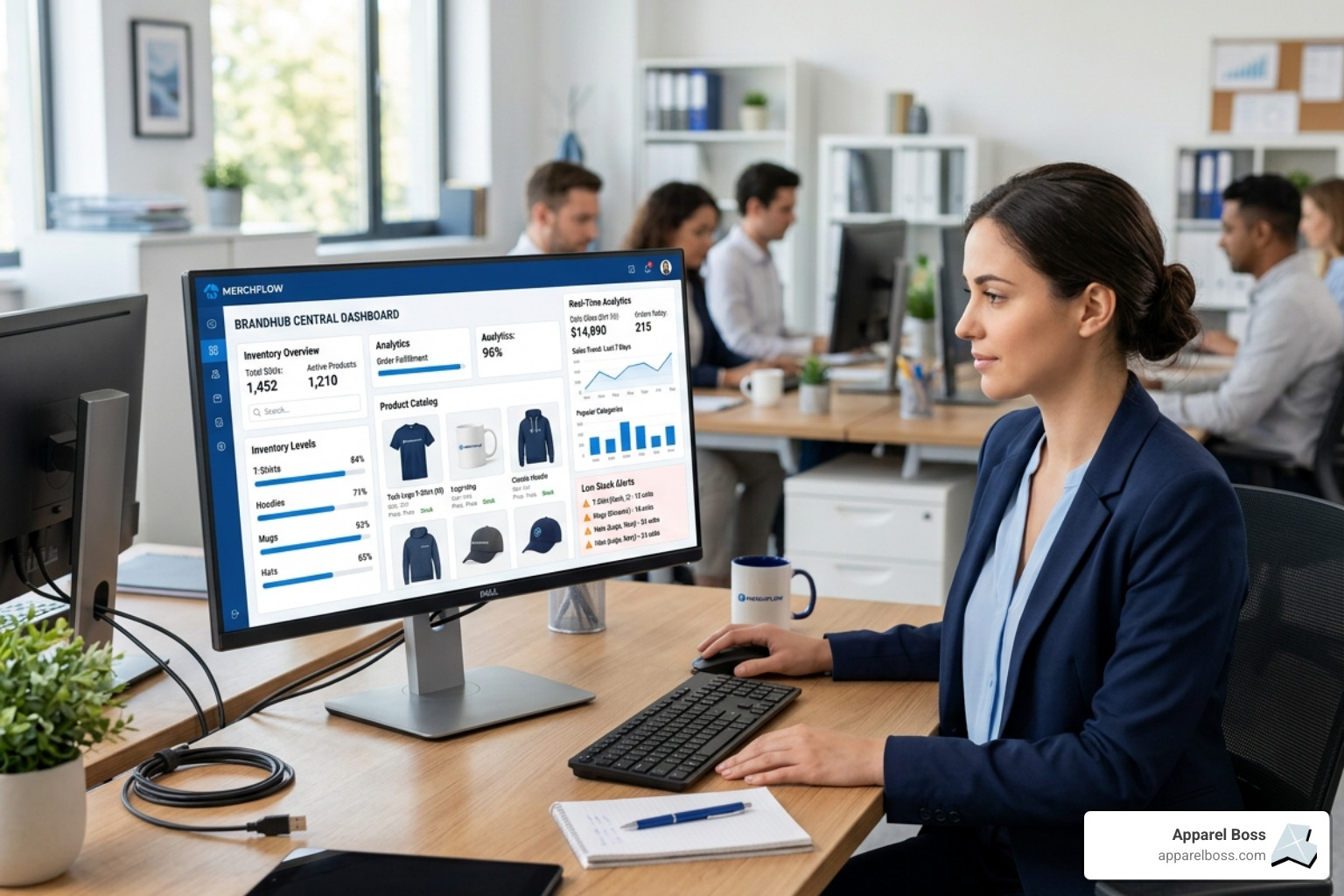
Centralization also provides spend visibility. Finance teams can finally see exactly where the budget is going—which teams are ordering the most, which products have the highest reorder rates, and where fulfillment delays are concentrated. This data allows for the creation of a scalable corporate gifting system without wasting budget.
The Role of Online Company Stores in Corporate Merchandise Strategy & Management
The most effective way to centralize is through a branded e-commerce interface. An online company store acts as the "digital front door" for your merchandise program.
Key benefits of this technology include:
- Automated Ordering: Eliminates the need for HR or Marketing to manually collect sizes via spreadsheets.
- Budget Allocation: Set specific allowances for different departments or individual employees.
- Approval Workflows: Orders that exceed a certain threshold can be automatically flagged for manager review, while routine orders flow through instantly.
- Real-Time Reporting: Instantly see stock levels and shipping statuses across the entire organization.
For businesses looking to see this in action, the ability to request a store or a demo is the first step toward reclaiming hundreds of hours of administrative time.
Measuring Success: KPIs for Enterprise Merchandise Programs
To prove the value of Corporate Merchandise Strategy & Management, leaders must track specific Key Performance Indicators (KPIs). Moving beyond "it looks nice," enterprise programs should measure:
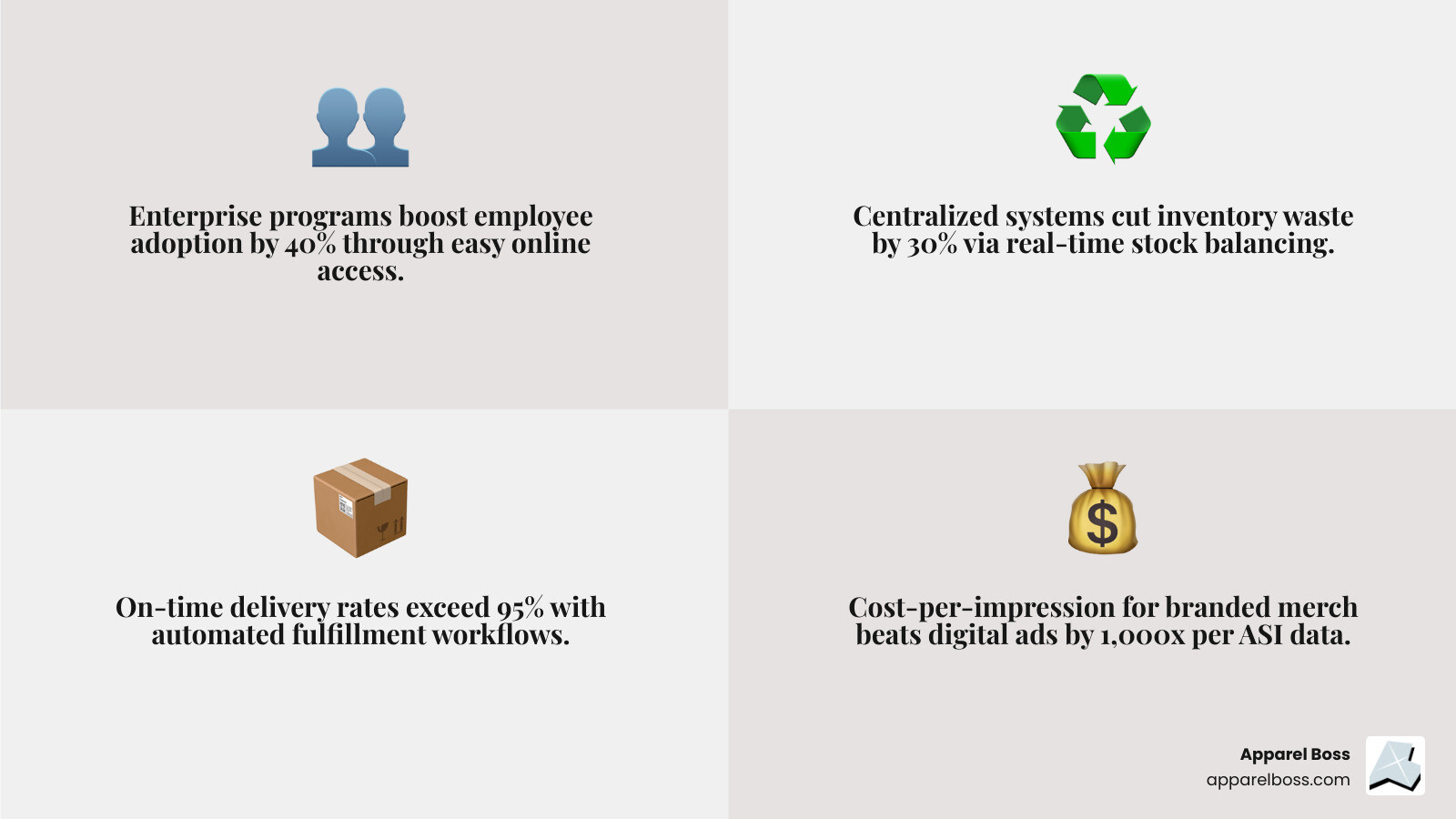
- Employee Adoption: What percentage of the team is actually using their allocated credits?
- Waste Reduction: How much have you decreased "dead stock" or obsolete inventory year-over-year?
- On-Time Delivery Rate: Are onboarding kits arriving before the new hire's first day?
- Cost-per-Impression: ASI data suggests promotional products generate more impressions per dollar than digital ads; tracking usage helps quantify this.
By understanding the ROI of branded merchandise, operations leaders can transform merchandise from a "marketing expense" into a strategic growth channel.
Transitioning Your Organization to a Structured Merchandise Partner
Shifting a large organization to a new system doesn't happen overnight. At Apparel Boss, we recommend a phased implementation approach to ensure stakeholder alignment and minimize disruption.
- Month 1–2: Problem Identification & Pilot. Identify the team with the most "operational pain" (usually HR or a high-volume Sales team) and launch a pilot company store.
- Month 3–4: Strategy & Fulfillment Expansion. Integrate custom kitting for onboarding and events, moving inventory from office closets to a professional fulfillment center.
- Month 5–6: Full Onboarding & Optimization. Roll out the system to all departments, establish final decision-making frameworks, and refine pricing through consolidated volume.
This phased approach allows you to build internal "quick wins" and prove the system's efficiency before a full-scale rollout. By partnering with a strategic manufacturer rather than a simple middleman, your organization gains control over the entire supply chain—from the first stitch in the factory to the final delivery at a satellite office in Suffolk County.
Ready to eliminate the fragmentation tax and reclaim your team's time?
Managing a brand’s physical presence shouldn't be a logistical nightmare. Whether you are outfitting a national team or simplifying your onboarding process, a structured system is the only way to scale without losing quality.
Explore how Apparel Boss company stores can centralize your operations, or reach out to our team in New York to design a governance model that fits your organization’s unique needs.
The Ultimate Guide to Corporate Merchandise Strategy & Management