
Why Inconsistent Branding Is Quietly Costing Your Organization More Than You Think
What causes inconsistent branding is one of the most important operational questions a growing organization can ask — and the answer usually isn't one big mistake. It's dozens of small ones, compounding over time.
Here are the most common root causes:
- Hyper-growth without brand foundations — teams scale faster than standards can follow
- Disconnected teams and siloed workflows — marketing, product, and operations each do their own thing
- No centralized asset management — people use outdated logos, wrong colors, or unapproved files
- Rogue local teams or franchisees — locations create their own materials when approved ones aren't accessible
- Multiple vendors and agencies — each interprets brand guidelines differently
- Incomplete rebrands — legacy assets linger long after a rebrand is "done"
- Trend-chasing — adopting styles that don't match the brand's voice or audience
- Weak or missing brand guidelines — no clear rules means no consistent output
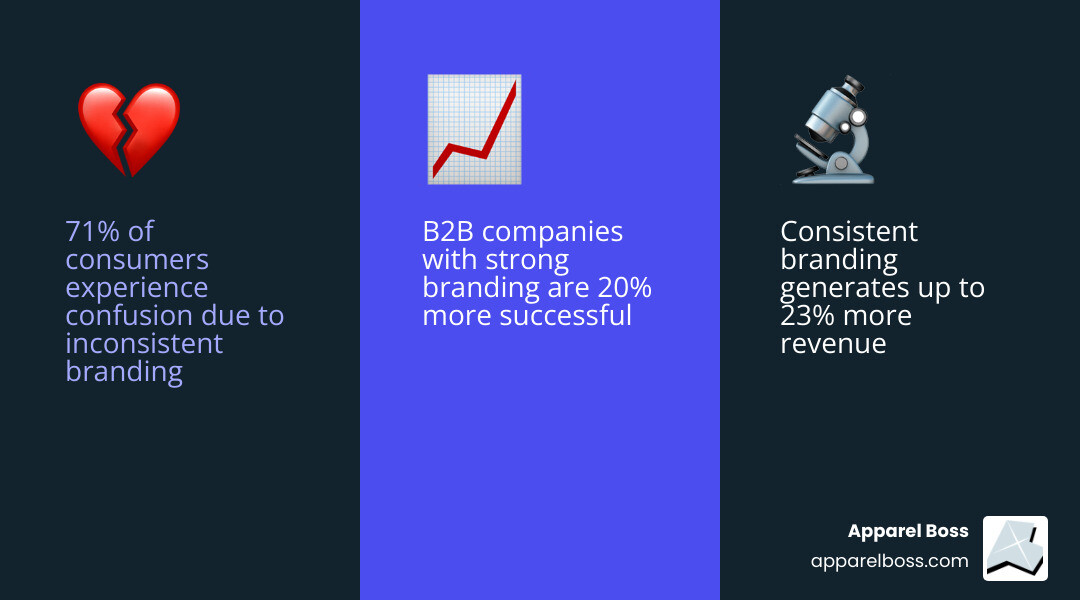
The stakes are real. Research shows that 71% of consumers say inconsistent branding causes confusion in the market. And companies with consistent branding across all channels generate up to 23% more revenue on average.
For growing organizations managing branded apparel, company merchandise, and employee kits across multiple teams or locations, this problem is especially acute. When every department — or every location — is pulling from different sources, ordering from different vendors, or making their own design calls, the brand fractures. Quietly. Gradually. Expensively.
The good news? Inconsistent branding is a solvable operational problem — not just a creative one.
What Causes Inconsistent Branding in Modern Organizations?
In the business environment of 2026, branding is no longer just about having a nice logo. It is the "cement" that binds customer associations together, turning individual interactions into a coherent mental construct. When that cement cracks, the entire structure of trust begins to lean.
For B2B organizations, the impact is even more pronounced. Research on brand inconsistency risks indicates that B2B companies with strong, consistent branding are 20% more successful than those with weak or fragmented identities. This isn't just a marketing theory; it's a measurable performance gap.
What causes inconsistent branding often boils down to a loss of "mental availability." Branding creates shortcuts in the human brain. When a customer sees your signature color or specific typography, they should immediately feel the "brand promise." If your website feels premium but the employee uniforms arriving at a client site look cheap or use an outdated logo, you’ve created a "memory leak." The customer has to work harder to recognize you, increasing their cognitive load and eventually leading them to choose a competitor who feels more reliable.
How Hyper-Growth and Disconnected Teams Cause Inconsistent Branding
Scaling a business is an exciting phase, but it is also the most common time for brand drift to occur. As organizations move through "hyper-growth," the speed of execution often outpaces the development of foundational systems.
When a company adds dozens of new employees or opens new offices in Long Island or New York City, communication silos naturally form. The product squad in one department might be using a new design system, while the operations team is still ordering apparel based on a style guide from three years ago. Without a unified approach, these isolated squads begin to create "messaging mismatches."
This is why custom apparel is key to the future of corporate branding. It serves as a physical design system that aligns everyone, regardless of their department. When teams are disconnected, they lose sight of the shared visual language. A shared design system isn't just for your website; it must extend to your physical touchpoints—the shirts your team wears, the kits you send to new hires, and the merchandise you distribute at trade shows.

Operational Gaps: Why Missing Centralized Asset Management Causes Inconsistent Branding
One of the most frustrating causes of brand drift is simply a lack of organization. In many companies, the "official" logo lives in a random Google Drive folder, a Slack thread, or—worst of all—on a single employee’s desktop.
Without a "single source of truth," employees are forced to become hunters. When a manager needs to order a new batch of polo shirts for a client meeting in Suffolk County, they might grab the first logo they find on the company website. If that file is a low-resolution PNG or an old version, the resulting merchandise will look unprofessional.
Operational gaps like these are why custom branded merch is the secret to success in 2025 and beyond. Success doesn't come from the merch itself, but from the system used to manage it. Digital asset management (DAM) and centralized ordering platforms prevent "version control" issues. When the right assets are locked into a centralized system, you eliminate the approval bottlenecks that tempt employees to go "rogue" just to get their jobs done on time.
The Role of Rogue Local Teams and Legacy Components
In organizations with multiple locations—whether across Nassau County or the broader New York area—local marketing chaos is a frequent culprit. When corporate headquarters makes it difficult or slow to access approved materials, local teams take matters into their own hands.
This "rogue" behavior is rarely malicious. Usually, it's a well-meaning manager trying to solve a problem quickly. They might go to a local print shop to get a banner made, only to have the colors come out three shades off because they didn't have the correct Pantone specifications.
Legacy components also play a "sneaky" role. An organization might announce a beautiful rebrand, but if the old logo is still on the warehouse signage, the lobby floor mats, and the employee jackets, the rebrand is effectively incomplete. These contradictions between what you say (your new brand) and what you show (your legacy assets) erode credibility. Local marketing chaos happens when there is no accountability or easy-to-use governance structure in place to help local teams stay compliant.
External Vendor Chaos and Trend-Chasing Pitfalls
Even with the best internal intentions, external factors can sabotage your brand. Using multiple vendors for different products—one for screen printing, another for embroidery, and a third for promotional items—often leads to "production variance." Each vendor has different equipment, different ink types, and different quality standards.
Furthermore, "trend-chasing" can lead to a disjointed identity. In an attempt to stay relevant on platforms like TikTok, some brands adopt a voice or visual style that is completely disconnected from their core values. If a professional B2B firm suddenly starts using "gen-alpha" slang or mismatched social media aesthetics, it creates a perception gap.
The hidden costs of inconsistent branding include the literal cost of re-printing materials that were done incorrectly by an unvetted vendor. This is why branding smarter with custom products requires vendor consolidation. By working with a single strategic partner who understands your brand's DNA, you ensure that your logo looks exactly the same whether it’s embroidered on a jacket or screen-printed on a tote bag.
Real-World Failures and the High Cost of Brand Drift
We don't have to look far to see the damage caused by brand inconsistency. Consider the famous Tropicana packaging redesign of 2009. By removing iconic visual cues—the orange with the straw—and changing the typography, they made the product unrecognizable to their loyal customers. The result? A 20% drop in sales in just two months. They had accidentally broken the "memory structure" their customers relied on.
In the B2B world, the failure is often more subtle but equally damaging. It manifests as a "professionalism gap." A prospect might have a fantastic sales call, but when they visit the company’s LinkedIn page and see pixelated graphics, or receive an onboarding kit with a crooked logo, their trust wavers. They begin to wonder: If they are this careless with their own brand, how will they treat my business?
| Feature | Consistent Branding | Fragmented Branding |
|---|---|---|
| Customer Trust | High (Predictable experience) | Low (Confusing signals) |
| Revenue Growth | Up to 23% Increase | Stagnant or Declining |
| Team Efficiency | High (Shared assets) | Low (Searching for files) |
| Market Recognition | Instant (Distinctive assets) | Weak (Easily forgotten) |
| Operational Cost | Lower (Streamlined ordering) | Higher (Redundant work/reprints) |
Strategic Solutions for Eliminating Brand Inconsistency
The solution to what causes inconsistent branding is not "more policing"—it's better systems. You cannot expect employees to be brand experts if you don't give them the tools to succeed. To achieve brand cohesion, you must move from a reactive posture (fixing mistakes) to a proactive one (preventing them).
Modern organizations are moving away from static PDF style guides that no one reads and toward dynamic, scalable systems. This involves creating a unified brand management environment where the right choice is also the easiest choice for every employee.
Auditing and Solving Brand Inconsistency with Scalable Systems
To fix the drift, you must first find it. A visual audit is the necessary starting point. This involves looking at every touchpoint—from your website and email signatures to the apparel your team wears in the field. Ask yourself:
- Are the logos current and high-resolution?
- Are the colors consistent across different materials (fabric vs. digital)?
- Is the messaging unified across all departments?
Once the gaps are identified, the most effective way to maintain long-term alignment is through an online company store. By centralizing your branded apparel and merchandise in one portal, you eliminate the "rogue" vendor problem. Every item in the store is pre-approved for quality, color accuracy, and logo placement.
Apparel Boss specializes in this type of automated governance. We help companies in New York and beyond streamline their programs with an online company store that handles everything from production to fulfillment. This removes the administrative burden from your HR or marketing teams and ensures that whether an employee is in Deer Park or Manhattan, they are receiving the exact same high-quality gear.
Furthermore, implementing custom kitting for employee onboarding ensures that every new hire starts their journey with a consistent brand experience. Instead of a hodgepodge of leftover "swag," they receive a professionally curated kit that reinforces your company values from day one.
Partner with Apparel Boss to Solidify Your Brand
Inconsistent branding isn't just a "marketing problem"—it's an operational leak that drains revenue, kills productivity, and erodes the trust you've worked hard to build. Whether it's caused by hyper-growth, disconnected teams, or a lack of centralized systems, the cost of doing nothing is simply too high.
At Apparel Boss, we act as your strategic partner to eliminate these friction points. We provide the infrastructure—through custom company stores and in-house production—that makes brand consistency the default setting for your organization. By centralizing your fulfillment and distribution, we ensure that your brand remains powerful, professional, and unified across every single touchpoint.
Ready to stop the drift and scale your brand with confidence?
Contact Apparel Boss today to learn how our custom apparel services and online store solutions can bring professional consistency to your organization. Let’s build a system that works as hard as your brand does.