
Why Delayed Bag Printing Happens (And What It Costs Your Business)
Delayed bag printing why this keeps happening is a question more operations and marketing leaders are asking in 2026 — and the answer is rarely just one thing.
The most common reasons custom bag printing gets delayed:
- Artwork not print-ready — low-resolution files, missing bleeds, or unapproved proofs stall production before it starts
- Material sourcing gaps — fabric or substrate shortages push back production windows
- Production capacity limits — high-volume seasons create backlogs at print facilities
- Equipment downtime — screen misalignment, ink curing issues, or DTF printer maintenance stops runs mid-batch
- Approval bottlenecks — multiple stakeholder sign-offs slow the proofing cycle significantly
- Late or incomplete order specs — quantity, colorway, or finish changes after intake reset the entire queue
If your branded tote bags are arriving late, damaged, or inconsistent — it's almost always one of these six things. And when you're managing merchandise at scale across onboarding kits, events, or company stores, even a small delay compounds fast.
Most organizations don't realize the delay started days or weeks before production even began.
The sections below break down each cause in detail — and more importantly, what you can do to prevent it.
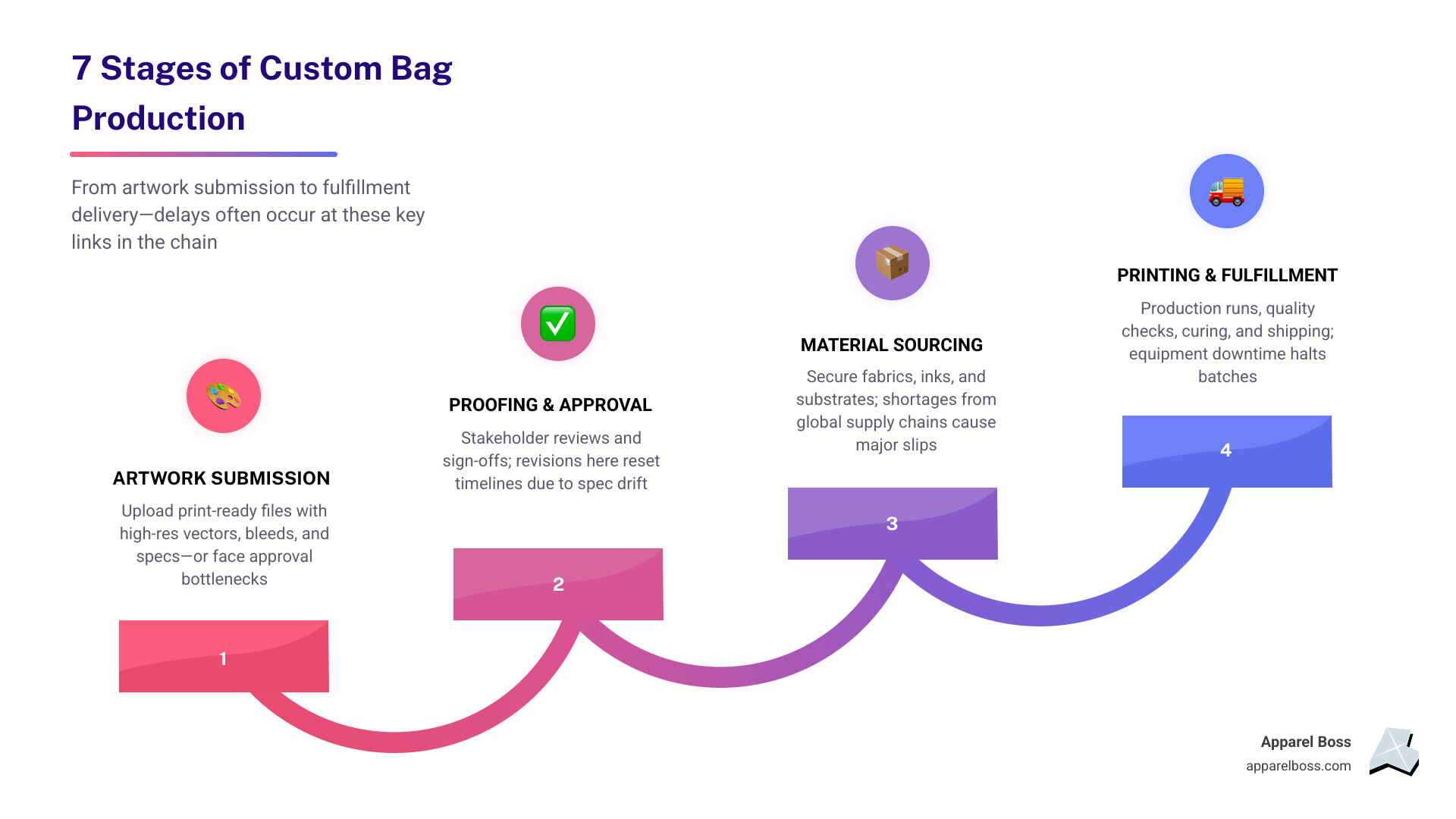
Critical Factors Behind Delayed Bag Printing Why Your Merch Timeline Slips
In high-volume B2B merchandise, a "fast" print job is often a misnomer. Research into what causes high-volume print delays shows that timelines rarely slip due to a single random event. Instead, delays are systemic, often compounding across different stages of the production workflow.
When a marketing director in New York City or an HR lead in Suffolk County orders a thousand custom tote bags for an upcoming conference, they are entering a complex manufacturing chain. If one link in that chain breaks—whether it's a delay in artwork approval or a mechanical failure on the floor—the entire delivery date shifts. For businesses, this isn't just an inconvenience; it’s a wasted investment. If the bags arrive the day after the event, their value drops to near zero while storage costs begin to climb.
Common Production Bottlenecks in 2026:
- The "Waiting Room" Effect: Time spent between steps (waiting for an email reply) often exceeds the actual time spent printing.
- Spec Drift: Changing a bag’s handle length or fabric weight mid-project resets the quoting and sourcing process.
- Capacity Crunch: During peak seasons, even if your files are perfect, the physical machines may be booked three weeks out.
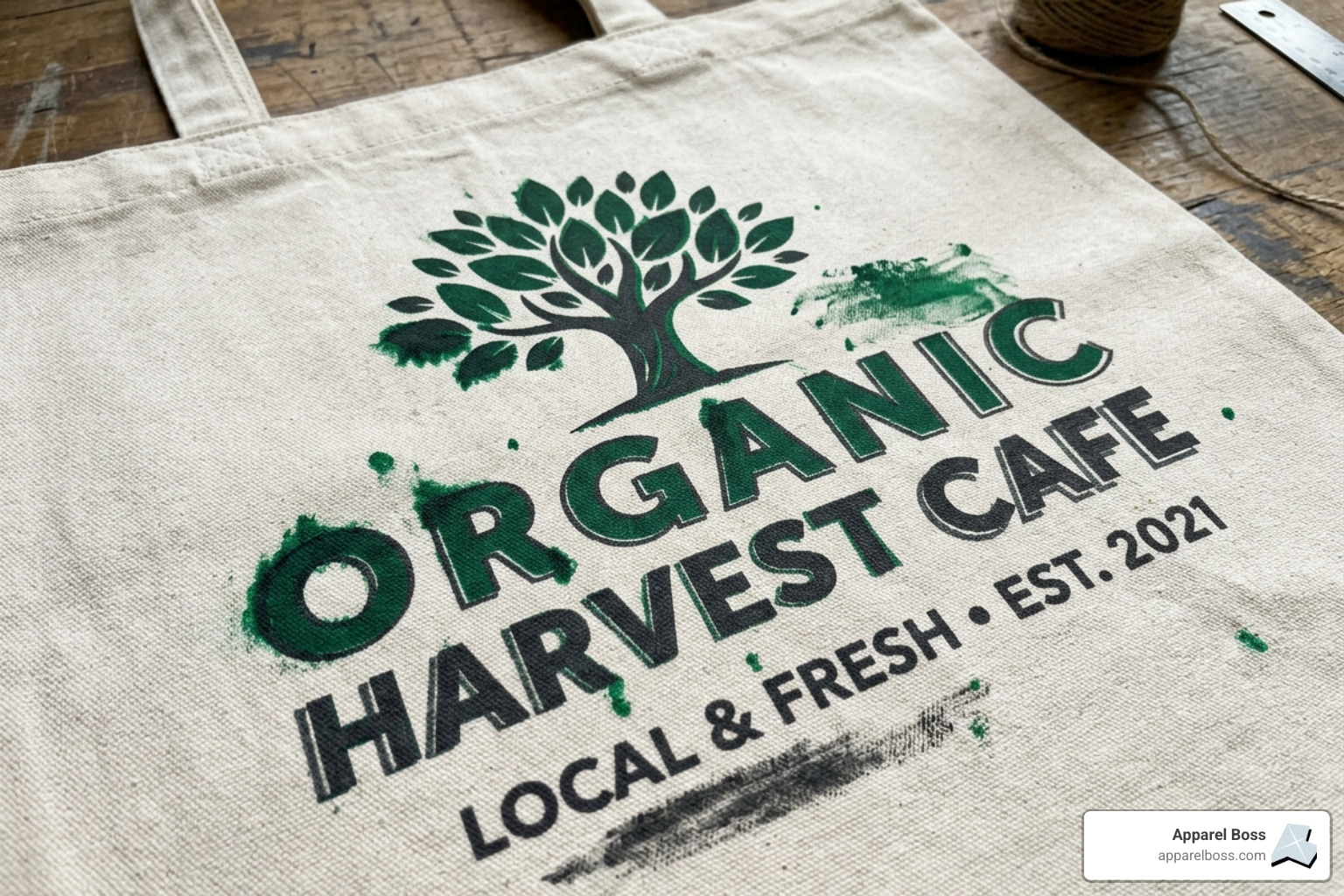
Data Readiness and Artwork Approval Bottlenecks
The most frequent culprit for delayed bag printing why projects stall early is "data unreadiness." In a professional printing environment, a "logo.jpg" pulled from a website footer is not a production file. High-quality results require vector graphics (AI, EPS, or high-res PDF) that can be scaled without losing clarity.
When files arrive with low resolution or missing bleeds, the production team must stop to request new assets. This triggers a proofing cycle that can take days. If the branding consistency isn't caught early, you risk "spec drift," where the final product doesn't match the digital mockup.
To solve this, many firms utilize custom apparel services that provide professional pre-flight checks. A pre-flight check ensures that fonts are outlined, colors are matched to Pantone standards, and the resolution is sufficient for the specific substrate, such as heavy canvas or non-woven polypropylene. Without this technical oversight, the "approval bottleneck" becomes the longest phase of the project.
Supply Chain Disruptions and Material Shortages in 2026
As we navigate the landscape of April 2026, the textile industry continues to face unique hurdles. While we have made strides in overcoming supply chain challenges for custom merch in 2025, global logistics remain sensitive to fuel costs and trade shifts.
For a business in Long Island or Nassau County, "material availability" is the silent timeline killer. You may have the perfect design, but if the specific organic cotton canvas you selected is stuck in a port or backordered at the mill, production cannot begin.
Inventory Management Realities:
- Textile Imports: Many high-quality bag substrates are imported. Any disruption in global shipping lanes directly impacts local print queues in Deer Park or Manhattan.
- Sustainable Sourcing: As more companies pivot to eco-friendly bags, the demand for recycled PET and organic fibers often outstrips the immediate supply, leading to longer lead times.
Technical Failures and Delayed Bag Printing Why Equipment Matters
Even when the fabric is on the table and the art is approved, mechanical reality can intervene. To prevent delays in fast print jobs, equipment must be meticulously maintained.
Custom tote bags often require specialized handling compared to flat t-shirts. The seams, handles, and gussets of a bag create uneven surfaces that can cause screen tension issues or ink curing failures. If a Direct-to-Film (DTF) printer isn't calibrated correctly for the specific texture of a tote, the ink may not bond, leading to a batch that fails quality control.
Mechanical downtime is a major factor in delayed bag printing why orders miss their windows. A single broken head on a multi-head embroidery machine or a clogged print head on a digital press can cut production capacity by 50% instantly. Leading facilities mitigate this through "redundant capacity"—having multiple machines capable of the same job—but smaller shops often lack this safety net, leading to cascading delays when a part breaks.
Operational Solutions to Mitigate Delayed Bag Printing Why Efficiency Wins
The impact of delayed merchandise on a business is significant: it erodes team trust, complicates event logistics, and results in "rush" shipping fees that eat into the marketing budget. The solution lies in moving away from fragmented, manual processes and toward integrated systems.
For companies in the New York metro area, transitioning to a model that emphasizes in-house production and structured fulfillment is the most effective way to reclaim control over the timeline.
| Feature | Manual Fulfillment | Automated Company Stores |
|---|---|---|
| Ordering | Spreadsheets & Emails | Centralized Digital Portal |
| Inventory | Guessed (High Waste) | On-Demand or Tracked |
| Branding | Inconsistent across vendors | Locked Brand Standards |
| Fulfillment | Hand-packed by HR/Admin | Professional Logistics Team |
| Lead Times | Unpredictable | Standardized & Transparent |
Streamlining Through Online Company Stores
One of the most effective ways to solve the "why" behind delays is to remove the administrative burden of individual orders. By implementing online company stores, businesses can move to an on-demand or pre-stocked model.
Instead of an HR manager in Nassau County manually collecting sizes and quantities for a "one-off" bag order, employees or department heads can order directly from a curated selection. This eliminates the "Late or Incomplete Specs" bottleneck mentioned earlier. Because the branding is pre-approved and the files are already in the system, the time from "click" to "print" is slashed. This also prevents wasted inventory; you only print what is actually needed, protecting both your budget and your brand equity.
Leveraging Custom Kitting for Faster Distribution
When tote bags are part of a larger initiative—like a new hire welcome package or a corporate gift—the delay often happens at the assembly stage. Utilizing custom kitting services ensures that as soon as the bags are printed, they are immediately moved into assembly with other items like branded apparel or tech gadgets.
Custom kitting solves the "assembly logistics" nightmare. Instead of receiving 500 bags in one box and 500 hoodies in another, and then forcing your office manager to spend Friday night stuffing bags, the kits arrive at their destination fully assembled and ready for distribution. This "bulk-to-individual" shipping model is essential for scaling distribution across multiple New York office locations without increasing administrative workload.
Proactive Planning to Avoid Delayed Bag Printing Why Early Ordering is Key
While technology and systems help, the laws of physics and manufacturing still apply. Proactive planning remains the best defense against a missed deadline. Understanding seasonal demand—such as the "holiday rush" or the "conference season" peak—allows businesses to secure production windows before they fill up.
Apparel Boss recommends that decision-makers order early winter merch and event supplies at least 6 to 8 weeks in advance. This buffer accounts for potential material shortages or shipping delays that are common in the high-traffic corridors of Long Island and New York City.
2026 Strategic Ordering Deadlines:
- Spring Events (April/May): Order by February 15th.
- Summer Intern Programs: Order by April 1st.
- Fall Conferences (Sept/Oct): Order by July 15th.
- Year-End Holiday Kits: Order by October 1st.
By treating your merchandise provider as a strategic partner rather than a simple vendor, you gain visibility into the production queue. This transparency allows you to adjust your plans before a delay becomes a crisis.
Solving the Merch Bottleneck with Apparel Boss
Managing a custom merchandise program shouldn't feel like a second full-time job for your operations or marketing team. When you're constantly fighting delayed bag printing why issues, it’s a sign that your current process lacks the structure needed to scale.
At Apparel Boss, we specialize in removing these operational friction points. By combining in-house production in our New York facilities with sophisticated online company stores and custom kitting, we help businesses maintain absolute brand consistency while reducing the administrative hours spent on ordering and fulfillment.
Whether you are looking to streamline your employee onboarding kits or need a reliable system for distributing branded apparel across multiple regional offices, we provide the infrastructure to make it happen. Our focus is on solving the "hold ups" before they start, ensuring your team has the high-quality gear they need, exactly when they need it.
Ready to stop chasing late orders and start scaling your merchandise program?
Explore our Custom Services and see how we can streamline your production today.