
Why Your Custom Promotional Product Store Is a Strategic Business Decision
The best custom promotional product stores for growing organizations in 2026:
| Store Solution | Best For | Key Advantage |
|---|---|---|
| Apparel Boss Company Stores | Scalable corporate programs | Centralized ordering, fulfillment, and branding |
| Online company stores | Distributed teams | On-demand access, no inventory waste |
| Custom kitting platforms | Onboarding and events | Pre-packed, branded kits shipped direct |
| Bulk promo vendors | One-off campaigns | Low cost per unit at volume |
Most organizations start their merchandise program the same way: someone orders a box of branded t-shirts, it lands in a storage closet, and three months later half of it is still there.
That's not a product problem. It's a system problem.
A custom promotional product store sounds simple on the surface — pick a product, add a logo, ship it out. But for growing organizations managing merchandise across teams, offices, and geographies, the operational reality is far messier.
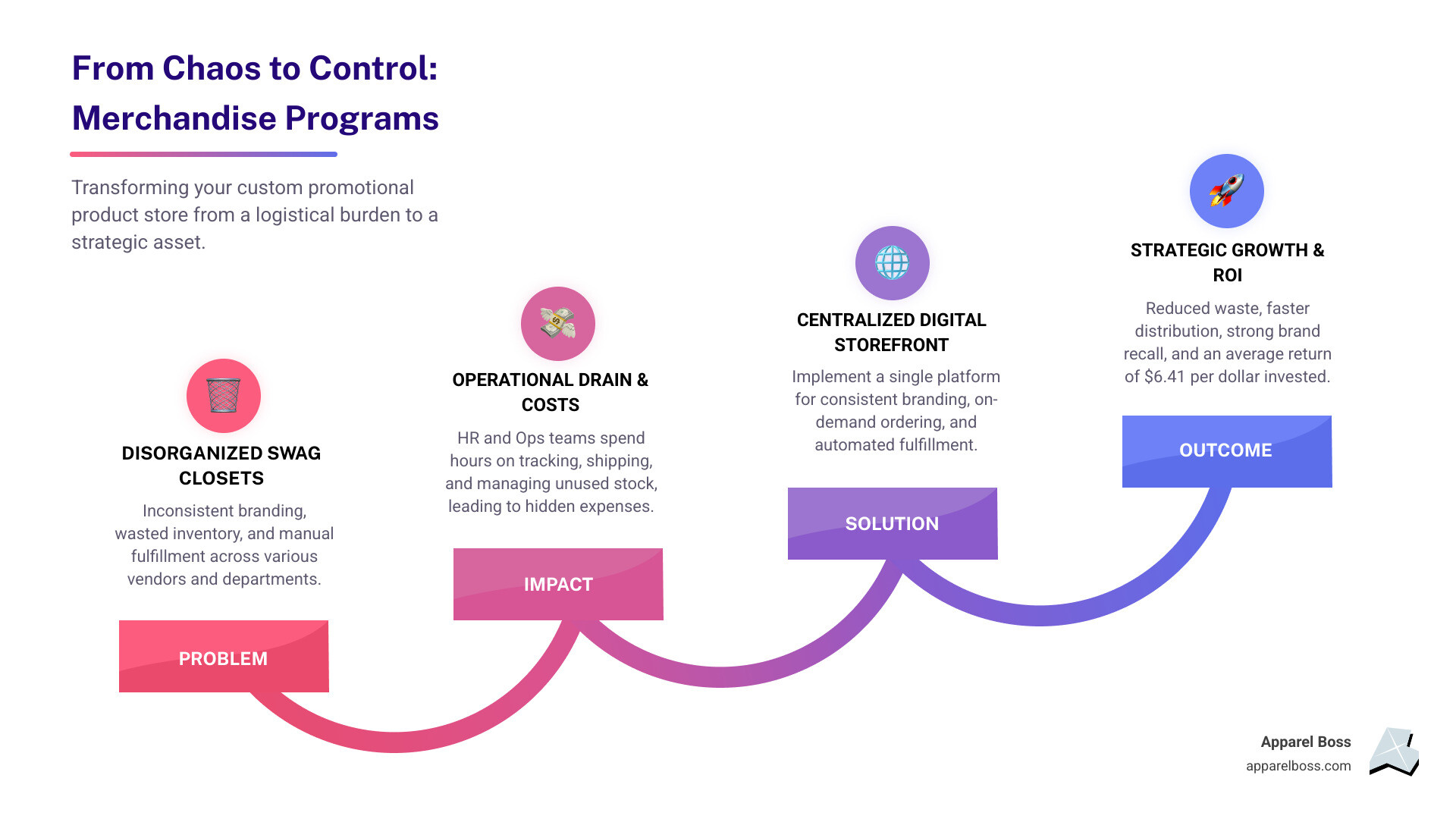
Inconsistent branding. Wasted inventory. Slow fulfillment. HR and operations teams spending hours tracking down sizes and shipping addresses. These aren't edge cases — they're the default for companies that haven't built a proper merchandise infrastructure.
The stakes are real. Research shows that 9 out of 10 people remember the brand on a promotional item, and branded products stay in use for an average of 12 to 24 months. Every dollar invested in promotional products returns an average of $6.41. That's significant ROI — but only if your program actually runs efficiently.
This article breaks down the leading store models and platforms available in 2026, so you can stop patching together one-off orders and start building a merchandise program that scales.
Solving the Operational Chaos of the Traditional Custom Promotional Product Store
In the business hubs of New York, from the corporate towers of Manhattan to the expanding offices in Nassau and Suffolk County, the "swag closet" has become a relic of inefficiency. When a company relies on a traditional custom promotional product store model—one that simply takes an order and drops a pallet of goods at the front desk—it inadvertently creates a logistical nightmare for its operations team.
The chaos usually stems from three areas: inventory waste, manual fulfillment, and brand fragmentation. Without a centralized digital storefront, different departments often order from various vendors. The marketing team in Deer Park might use a different logo version than the HR team in Long Island. This decentralized purchasing leads to quality variance that dilutes the professional image of the brand.
Furthermore, manual fulfillment is a silent killer of productivity. When an HR manager has to spend Friday afternoon digging through boxes to find a Medium-sized polo for a new hire, the company is losing high-value labor to low-value tasks.
| Feature | Manual "Swag Closet" | Automated Online Store |
|---|---|---|
| Inventory Tracking | Spreadsheet or "best guess" | Real-time digital dashboard |
| Brand Control | High risk of logo/color errors | Locked-in, approved brand assets |
| Storage | Occupies expensive office space | Third-party warehouse/fulfillment |
| Employee Access | Must ask a manager | Self-service portal |
| Fulfillment | Manual packing and shipping | Automated pick-and-pack |
The financial impact is measurable. Statistics indicate that 80% of consumers keep promotional products, and 73% are more likely to purchase from a brand that gives them a useful item. However, if those items are sitting in a box in a storage room because the distribution process is too difficult, that ROI drops to zero. Transitioning to a structured company store model ensures that every dollar spent on merchandise is actually working to build brand equity.
Why Your Current Custom Promotional Product Store Is Costing You Efficiency
If your current process involves high administrative overhead, you are likely overpaying for your merchandise. Hidden costs include the time spent managing shipping delays, the price of climate-controlled storage for apparel, and the "obsolescence tax"—the cost of branded items that become unusable because of a rebrand or a change in office location.
Many businesses in the New York City area face unique space constraints. Using 100 square feet of premium office space to store boxes of mugs and pens is a poor use of capital. Modern company stores solve this by moving inventory off-site, allowing teams to reclaim their workspace while maintaining instant access to their branded goods.
Transitioning to a Scalable Custom Promotional Product Store Model
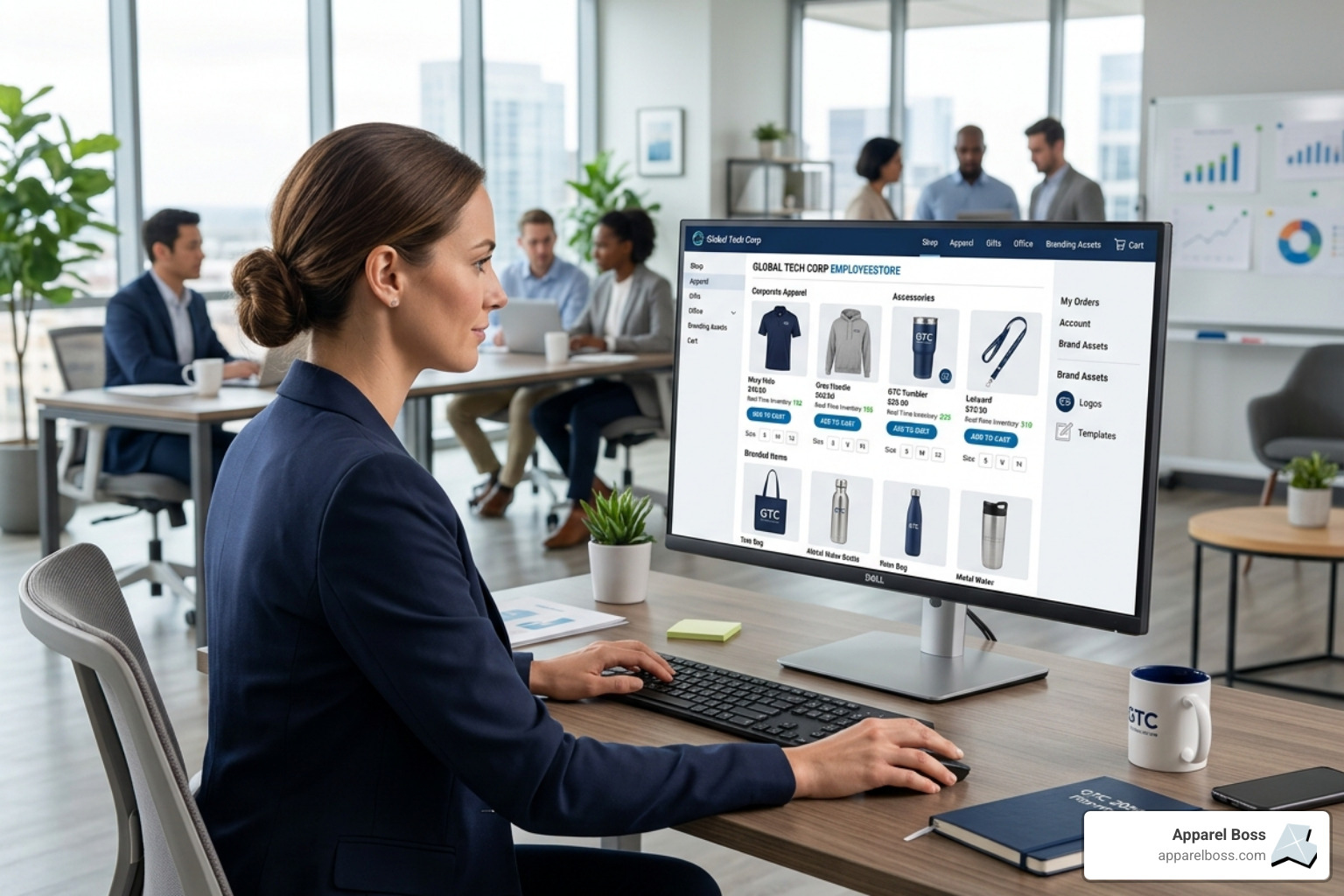
Scaling a merchandise program requires moving away from the "order and dump" mentality. A scalable model focuses on on-demand production and centralized branding. By implementing a system that allows for simplified ordering, companies can empower department heads to order what they need, when they need it, while the system automatically enforces brand guidelines and budget caps.
This transition allows a business to move from reactive ordering (buying 500 shirts because a trade show is next week) to proactive management (having a steady flow of inventory managed by a fulfillment partner). This ensures that whether you are shipping to a client in Manhattan or a remote employee in Suffolk County, the experience and the product quality remain identical.
The ROI of Integrated Custom Kitting and Fulfillment
One of the most effective ways to boost employee engagement and brand loyalty is through custom kitting. Instead of handing a new hire a loose pile of items, imagine them receiving a professionally curated welcome box on their first day.
The data supports this approach: 83% of consumers feel a stronger loyalty to a brand that provides them with a promotional product. In a B2B context, this translates to higher employee retention and stronger client relationships. Because promotional products have a 90% recall rate and stick around for up to two years, a well-executed kit serves as a long-term advertisement that lives on a client's desk or in an employee's daily routine. For businesses operating in competitive markets like New York City, this tangible touchpoint is often more effective than digital advertising.
Implementing a Strategic Merchandise Program for 2026 and Beyond
As we look toward the mid-2020s, the most successful companies are treating their merchandise as a strategic asset rather than an afterthought. This requires a phased execution approach. In the first few months, the focus should be on identifying common friction points—like sizing errors or shipping bottlenecks—and introducing a structured online company store system.
By months three and four, the strategy should expand into refining fulfillment and operational processes. This is where Apparel Boss acts as a strategic partner, helping businesses move from simple ordering to sophisticated, scalable distribution systems.
Streamlining Global Distribution and Brand Consistency
For organizations with a global footprint, the challenge is maintaining consistency across borders. A custom promotional product store must be able to handle the logistics of shipping to diverse locations while ensuring the "Navy Blue" polo in London matches the "Navy Blue" polo in Deer Park.
By utilizing high-quality curated stores, businesses can centralize their production. This eliminates the need to vet dozens of local vendors and ensures that the brand's visual identity is never compromised. Professional fulfillment logistics take the burden off your internal teams, managing everything from customs documentation for international shipments to last-mile delivery in local New York neighborhoods.
Launching Your Corporate Merchandise Store with Confidence
The fear of "getting it wrong" often prevents companies from launching a store. However, modern platforms offer tools to mitigate risk. Virtual proofs allow you to see exactly how a logo will look before a single stitch is made. Low minimums allow you to test new items without committing to thousands of units.
When you move from ideas to inventory, the right system will provide real-time data on what is actually being used. This prevents the "dead stock" problem and allows for better budgeting. Decision-makers can see exactly which items are popular among employees and which ones are gathering dust, allowing for a more data-driven approach to future purchases.
Future-Proofing Your Brand with Sustainable and High-Quality Systems
In 2026, sustainability is no longer optional; it is a brand requirement. A sophisticated custom promotional product store should offer eco-friendly materials and "Better Choices" that align with corporate social responsibility goals.
Sustainability also means quality. A high-quality item that stays in use for two years is inherently more sustainable than a cheap giveaway that ends up in a landfill after one use. By focusing on high employee adoption—selecting items that people actually want to use—you ensure that your brand remains visible and respected.
If your organization is ready to stop the "swag chaos" and start building a professional, scalable merchandise program, the first step is seeing the system in action. You can request a store demo to understand how a centralized company store can transform your operations.
Apparel Boss specializes in helping businesses in Deer Park, Long Island, and throughout the New York metro area solve the operational headaches of merchandise management. By integrating in-house production with structured digital systems, we help you reduce costs and improve brand consistency across your entire organization. Stop searching for individual products and start building a system that works as hard as you do.