Strategic Framework: How to Manage Company Store Operations
Knowing how to manage company store operations is one of those problems that sounds simple until you're actually doing it. Suddenly you're juggling inventory across departments, chasing down reorder approvals, fielding complaints about wrong sizes, and wondering why branded polos from last quarter are still sitting in a storage room.
Here is a quick breakdown of how to manage a company store effectively:
- Centralize your inventory - Use a single platform to track all branded merchandise, avoid duplicate orders, and eliminate dead stock
- Define clear roles - Assign who approves orders, manages replenishment, and handles fulfillment logistics
- Choose the right fulfillment model - Decide between pre-stocked inventory, print-on-demand, or a hybrid approach based on your order volume and budget
- Enforce brand standards - Control logo usage, decoration methods, and product quality from one centralized system
- Automate where possible - Set reorder triggers, use real-time inventory tracking, and integrate with HR or finance systems
- Promote internal adoption - Train employees, communicate regularly, and use stipends or reward points to drive engagement
- Monitor performance - Track order frequency, popular products, and fulfillment speed to continuously improve
For growing organizations, a poorly managed online company store creates real operational drag. Inconsistent branding, slow fulfillment, and wasted inventory are not minor inconveniences - they are measurable costs that compound over time.
This guide walks through a practical framework for building and managing a corporate merchandise program that actually scales.
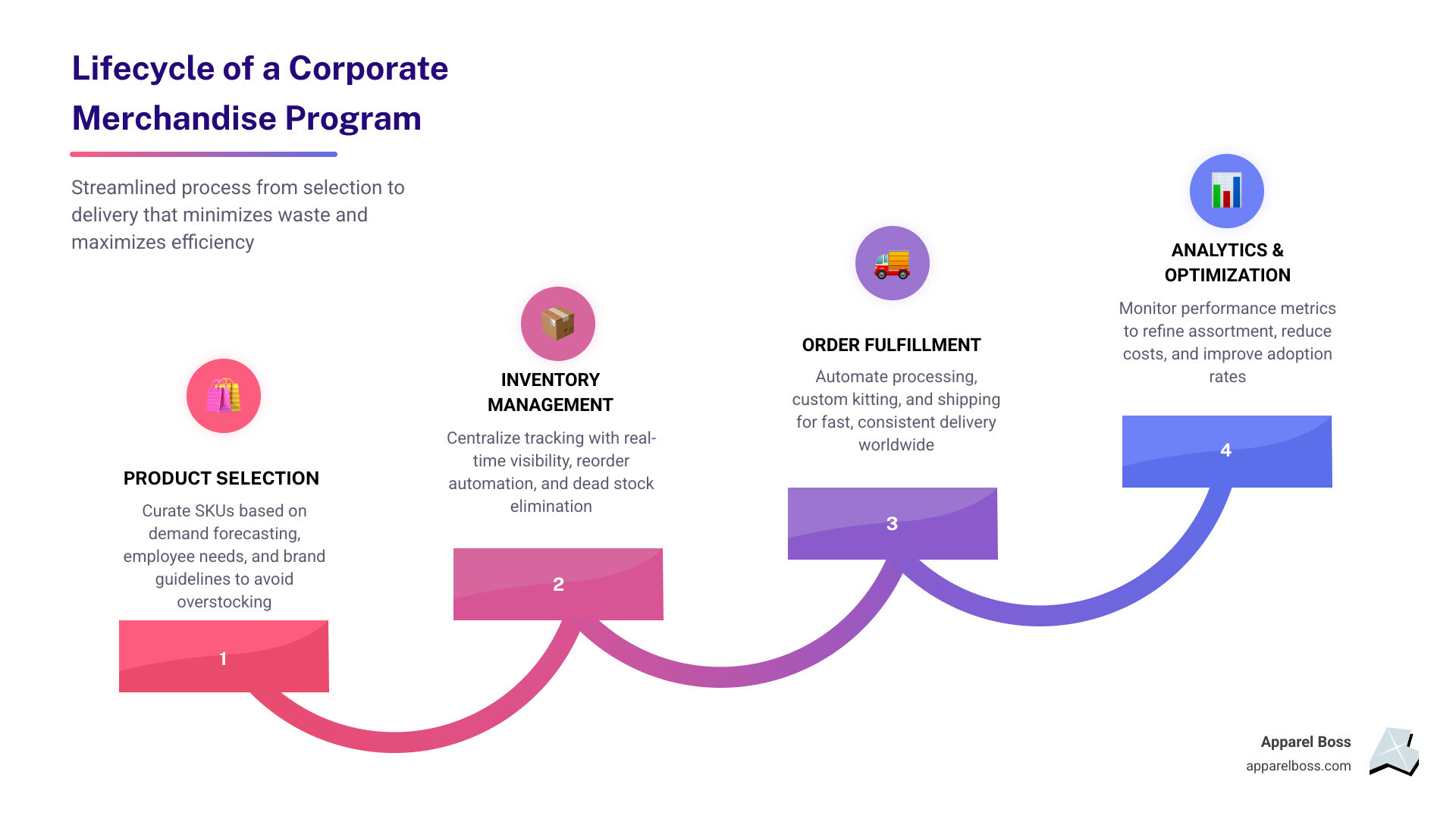
Effective management isn't just about having a website where people can click "buy." It is a discipline that requires a structured operating system. In April 2026, the complexity of managing a large-scale apparel program multiplies faster than revenue. Most businesses fail to scale because they try to run a $1M program using the same manual spreadsheets they used when they were a $50k startup.
To succeed, organizations must move from reactive firefighting—ordering more shirts because someone "thinks" they are low—to data-driven inventory management. This involves SKU rationalization, which is the process of identifying which items actually provide value and which are just taking up shelf space.
A critical decision in your strategy is choosing a fulfillment model. Below is a comparison of the two primary paths:
| Feature | Pre-Stocking Model | Print-on-Demand (POD) |
|---|---|---|
| Speed | Same-day or next-day shipping | 7-14 day production lead time |
| Cost | Lower per-unit cost (bulk pricing) | Higher per-unit cost |
| Risk | Potential for wasted/dead stock | Zero inventory risk |
| Consistency | High (all items decorated at once) | Variable (different batches) |
| Best For | High-volume staples (uniforms) | Seasonal items or niche sizes |
Many modern enterprises now utilize a hybrid approach: pre-stocking high-turnover uniforms and using on-demand production for specialized event gear.
Centralizing Inventory to Eliminate Wasted Stock
One of the biggest silent killers of a corporate budget is "dead stock." These are the boxes of 2024 "Summer Picnic" t-shirts in size Small that are still sitting in a closet in Suffolk County in 2026. This represents tied-up capital that could be better used elsewhere.
When asking is a merch store a right fit for your company?, the answer often depends on your ability to centralize. Centralization allows for accurate demand forecasting. Instead of every department in Nassau County placing their own independent orders, a centralized store aggregates data. You can see that you go through 500 Large polos every six months across the whole company, allowing you to buy in bulk and save significantly on unit costs while reducing storage overhead.
Streamlining Fulfillment and Distribution Logistics
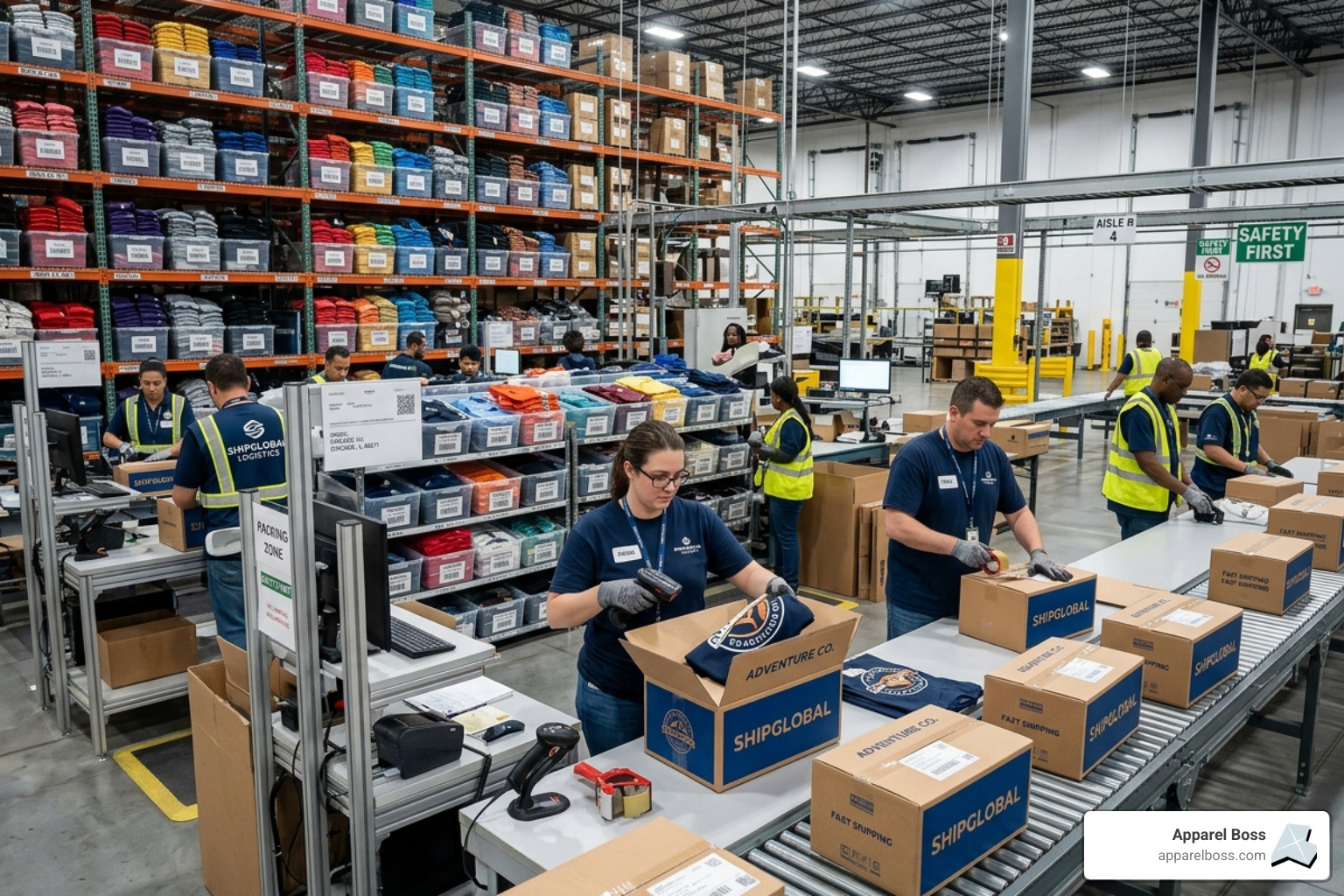
Slow fulfillment is a major point of friction for employees. If a new hire in Long Island has to wait three weeks for their onboarding kit, the "welcome" feels a bit hollow. Managing a large retail store or a corporate apparel program requires the same logistical rigor: shipping automation and real-time tracking.
To simplify ordering, businesses should look toward custom kitting. Kitting involves pre-assembling items—like a polo, a notebook, and a hat—into a single package. This reduces the "pick and pack" time during fulfillment and ensures that every employee receives a consistent experience, regardless of their location.
Maintaining Brand Integrity Across Custom Apparel
Inconsistent branding happens when different vendors are used for different projects. One vendor’s "Navy Blue" might be another’s "Royal Blue," and logo placements can migrate an inch in any direction. This dilutes the professional image of the organization.
Maintaining brand integrity requires centralized control over decoration methods. Whether it is high-stitch-count embroidery for executive polos, durable screen printing for warehouse teams, or vibrant direct-to-film (DTF) printing for complex multi-color logos, the quality must be uniform. By using curated stores for high-quality apparel, you ensure that every garment meets the company's rigorous standards before it ever reaches an employee's hands.
Implementing Scalable Systems for Long-Term Success
Scalability is the difference between a program that survives and one that thrives. In 2026, technology is the backbone of this success. An effective how to manage company store strategy isn't just about the clothes; it's about the software that moves them. Launching your merchandise store is just the beginning; the real work lies in the systems that handle the day-to-day operations.
Essential Features for Your How to Manage Company Store Strategy
A professional B2B store needs features that a standard consumer site doesn't. You aren't just selling to "customers"; you are managing "users" with different levels of authority.
- User Permissions & Roles: Not everyone should be able to order 500 jackets on the company dime. Your store should allow for tiered access, where managers can approve subordinate orders.
- SSO (Single Sign-On) Integration: Security is paramount for NY-based enterprises. Integrating with your existing HR systems via SSO ensures that only active employees can access the store and that their data remains secure.
- Reporting & Analytics: You need to know your "burn rate" on inventory. Reporting tools should show you which items are popular, which are stalling, and what your total spend is per department.
- Departmental Billing & Budget Controls: Modern company stores allow for "points" or "stipends." You can allocate $100 to every employee in the New York office, and the system automatically tracks and enforces those limits.
Internal Marketing: How to Manage Company Store Adoption
A store is only successful if people use it. Corporate apparel stores are important because they foster a sense of belonging, but they require internal promotion.
Effective adoption strategies include:
- Onboarding Kits: Automatically trigger a "Welcome Kit" order the moment a new hire is added to your HRIS.
- Stipend Management: Give employees "company dollars" on their work anniversaries or birthdays to encourage them to refresh their gear.
- Seasonal Refreshes: Don't let the catalog get stale. Introduce a "Winter Collection" or limited-edition items for company milestones to keep engagement high.
When employees see that the gear is high-quality and the ordering process is frictionless, adoption happens naturally. They become walking brand ambassadors, projecting a unified and professional image across Suffolk and Nassau Counties.
Conclusion: Partnering for Operational Excellence
Managing a company store shouldn't be a full-time job for your HR or Marketing team. When done correctly, the system should run in the background, allowing your leadership to focus on high-level strategy rather than debating thread colors or tracking down missing packages in Deer Park.
Apparel Boss specializes in taking the administrative "noise" out of the equation. By solving the core problems of inconsistent branding, wasted inventory, and slow fulfillment, they help businesses scale their culture as fast as their operations. Whether you are looking to request a store for the first time or optimize an existing program that has grown too complex to handle in-house, the goal remains the same: professional consistency with zero wasted effort.
By combining high-quality in-house production with custom kitting and advanced apparel services, organizations can finally master the art of team apparel ordering.
Ready to streamline your merchandise program? Let's build a system that works for your team, not the other way around.
Mastering the Art of Team Apparel Ordering Online