Why Brand Consistency in Apparel Is Harder to Maintain Than It Looks
How ensure consistent branded apparel is one of the most common operational challenges growing organizations face — and the stakes are higher than most teams realize.
Here is a quick answer:
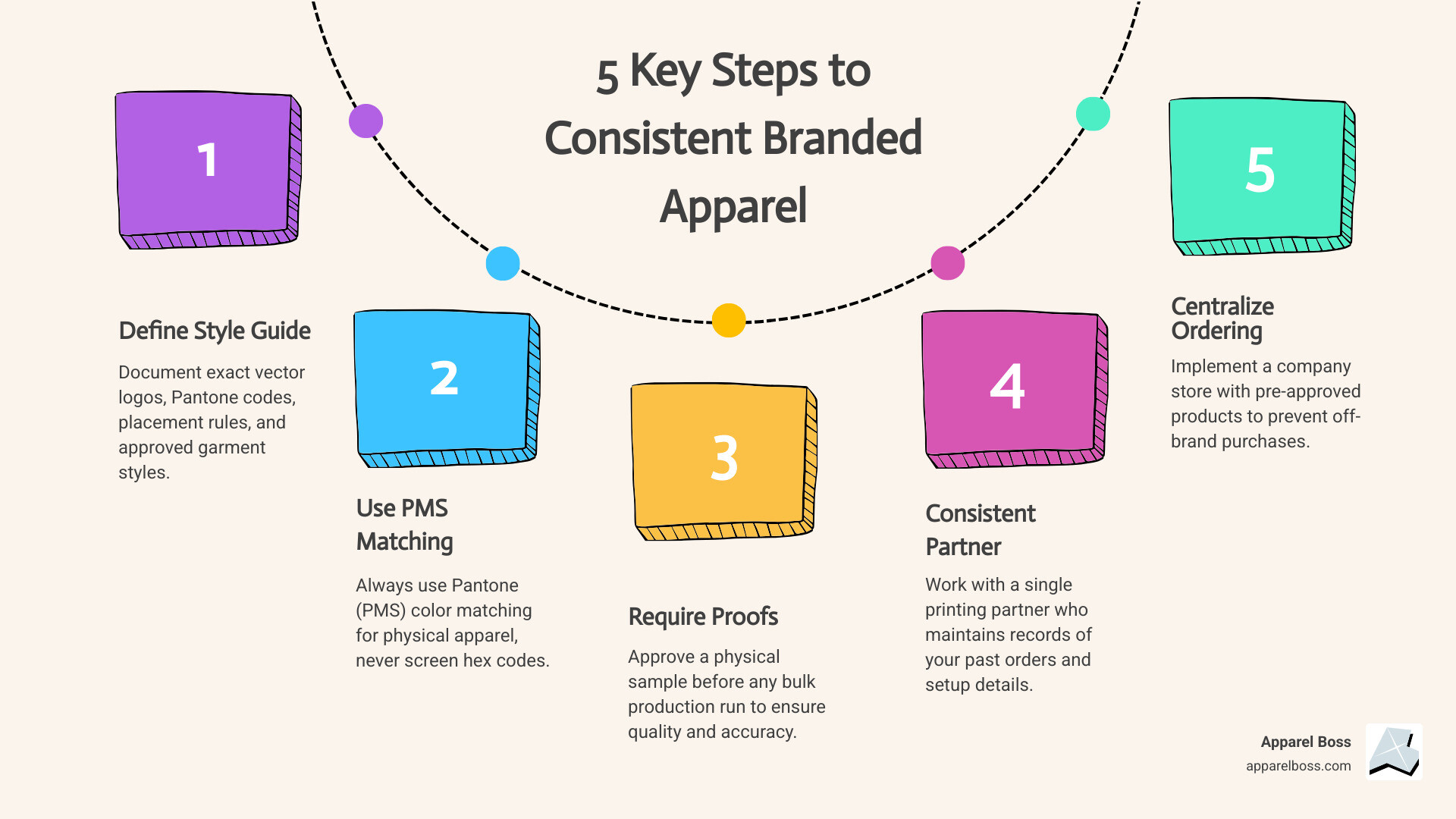
- Build a brand style guide — document exact logo files (vector format), Pantone color codes, placement rules, and approved garment styles
- Standardize your garment selection — stick to the same brand, style, and fabric across all orders and reorders
- Use Pantone (PMS) color matching — never rely on screen hex codes for physical apparel production
- Require physical proofs — approve a sample before any bulk production run
- Work with a consistent printing partner — one who keeps records of your past orders and setup details
- Centralize ordering through a company store — pre-approved products prevent off-brand purchases across departments
- Audit regularly — check that live apparel across your teams still matches your documented standards
Research shows that 90% of potential buyers expect a consistent brand experience across every platform and touchpoint they encounter. And in physical settings, the numbers are just as clear — 73% of hospitality guests say staff uniforms directly reflect the quality and professionalism of the business they are visiting.
The problem is not that organizations do not care about brand consistency. They do. The problem is that without a system behind it, consistency breaks down quietly over time. A reorder goes through a different vendor. A new department head picks a slightly different navy. Someone uploads a JPEG instead of a vector file. Suddenly, the sales team's polos and the ops team's jackets look like they belong to two different companies.
That kind of fragmentation is not just an aesthetic issue. It signals disorganization to clients, dilutes brand recognition, and creates real administrative headaches for operations and HR teams managing apparel at scale.
This guide walks through the technical standards, system-level strategies, and operational tools that growing organizations need to get branded apparel right — and keep it right across every order, location, and team.
Strategic Frameworks: How Ensure Consistent Branded Apparel
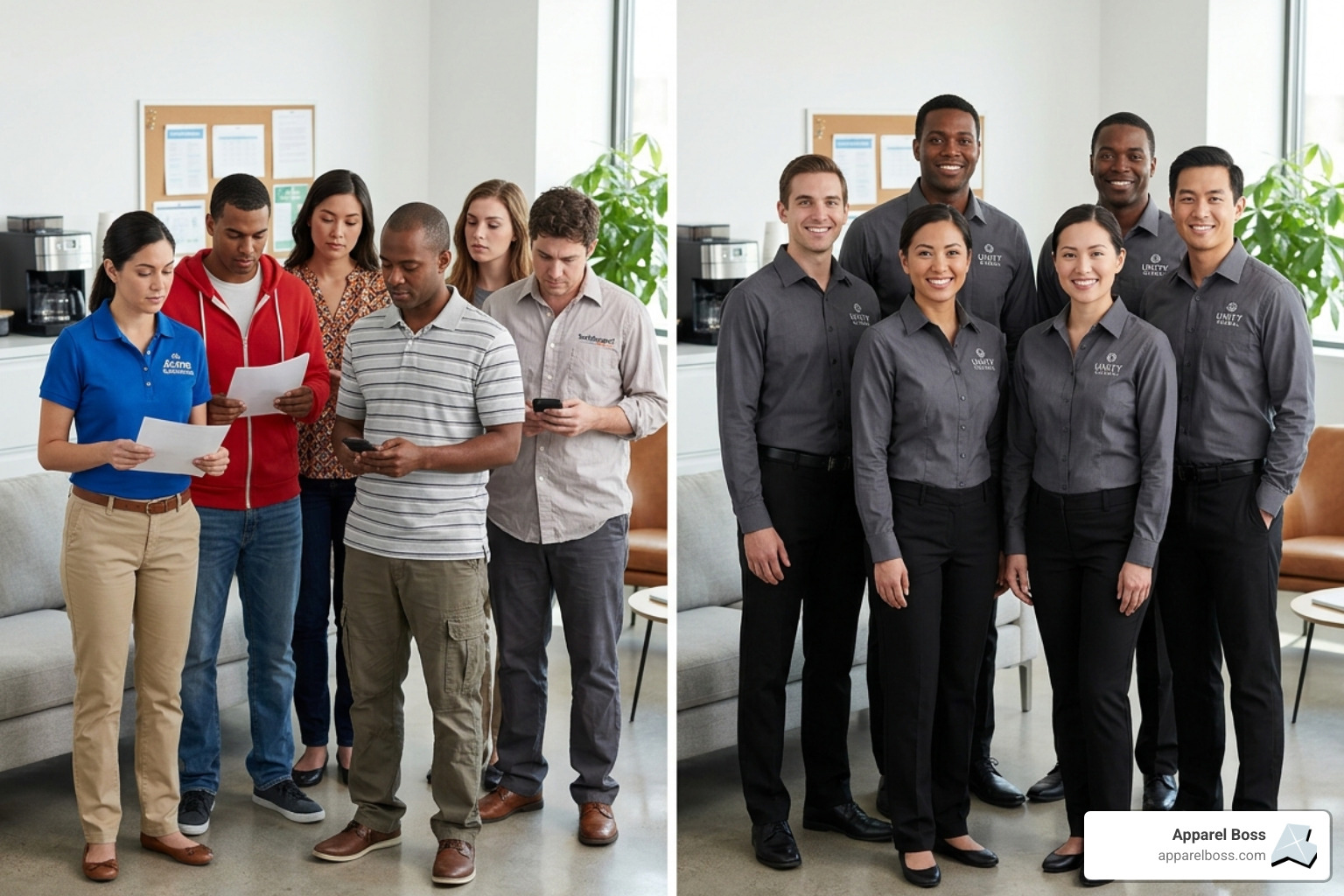
In the architecture of a successful business, consistency is the bedrock upon which trust is built. When a technician arrives at a client’s home in a crisp, professionally branded uniform, it does more than just identify them; it legitimizes their presence and establishes authority. Conversely, fragmented attire — where one employee wears a faded screen-printed tee and another wears a high-end embroidered polo with a slightly different logo — dilutes your market presence.
Inconsistency makes a business look disorganized or, worse, unreliable. For businesses operating in competitive hubs like New York City or Long Island, where first impressions happen in seconds, visual unity is a non-negotiable asset. How Custom Apparel Strengthens your Brand Identity is about more than just aesthetics; it is about creating a "mobile billboard" that tells the same story every time it’s seen.
Investing in The Importance of Quality Branded Apparel ensures that your team looks as professional in month twelve as they did on day one. High-quality garments retain their shape and color, preventing the "shabby" look that often plagues budget-tier programs.
Standardizing Technical Specs for How Ensure Consistent Branded Apparel
The most common source of brand inconsistency isn't actually the printer — it’s the files and specifications provided to them. To How ensure consistent branded apparel, you must treat your apparel specs with the same rigor as your digital brand book.
- Vector Files Only: Never use JPEGs or PNGs for apparel production. These are pixel-based and will blur when scaled. Always provide .AI, .EPS, or high-resolution PDF vector files. This ensures your logo remains sharp whether it’s on a hat or the back of a jacket.
- Pantone (PMS) Matching: Computer screens use HEX or RGB, but physical ink and thread use different systems. To avoid "color creep" (where your red slowly turns orange over several reorders), specify exact Pantone Matching System (PMS) codes. This is the only way to ensure the navy blue on your Long Island team’s hoodies matches the navy on your Suffolk County sales team’s polos.
- Logo Placement and Clear Space: Don't leave placement to the vendor’s "best judgment." Define exact coordinates (e.g., "3 inches down from the collar seam") and specify the "clear space" — the mandatory buffer zone around the logo that must remain free of seams, zippers, or other graphics.
- The Brand Style Guide: A dedicated apparel section in your branding style guide should document these rules so that any team member or vendor has a "source of truth."
Selecting Decoration Methods to Maintain Integrity
Not every decoration method works for every fabric. Choosing the wrong one can lead to peeling logos, puckered fabric, or colors that fade after three washes. Mastering Corporate Apparel 101: Mastering Professional Style requires matching the method to the garment’s purpose:
- Embroidery: Ideal for polos, outerwear, and headwear. It provides a premium, three-dimensional look. However, ensure you request a "sew-out" (a physical sample of the embroidery on scrap fabric) to verify that fine text doesn't "close up."
- Screen Printing: Best for high-volume t-shirt runs. It offers vibrant colors but can struggle with complex gradients.
- DTF (Direct to Film) Transfers: A modern solution for complex, multi-color logos. DTF transfers are incredibly durable and maintain their integrity even after dozens of industrial washes, making them a favorite for high-use workwear.
Scalable Systems for Long-Term Brand Uniformity
For many operations leaders in Nassau County or Manhattan, the real problem isn't the first order; it's the fiftieth. As a company grows, ordering becomes decentralized. The HR manager in one office orders "New Hire Kits," while a project manager in another orders "Safety Vests." Without a centralized system, the brand inevitably fractures.
| Feature | Ad-Hoc Ordering | Centralized Company Stores |
|---|---|---|
| Brand Control | Low (Varies by person/vendor) | High (Pre-approved designs only) |
| Inventory Risk | High (Wasted bulk stock) | Low (On-demand or managed levels) |
| Admin Effort | High (Chasing invoices/approvals) | Low (Automated workflows) |
| Quality | Inconsistent | Guaranteed Standards |
Implementing Online Company Stores for How Ensure Consistent Branded Apparel
The most effective way to scale a merchandise program is to remove the "human error" element from the ordering process. Simplify Ordering: Corporate Custom Apparel Stores act as a digital extension of your brand guidelines.
When you use a company store, every product is pre-approved. The logo placement is locked, the thread colors are set, and the garment styles are fixed. This means a manager in Deer Park can order a dozen jackets knowing they will look identical to the ones ordered by the New York City headquarters six months ago. These systems also allow for real-time reporting, helping you track spending and avoid the "closet full of wasted swag" syndrome.
Avoiding Common Production Pitfalls
Even with a great system, apparel production has inherent variables. Knowing how to navigate them is key to How ensure consistent branded apparel:
- Dye Lot Variations: Fabric is dyed in batches. If you order 500 shirts today and 10 next month, they might come from different dye lots, resulting in a slight shade difference. To mitigate this, stick to major apparel brands with high-consistency manufacturing standards.
- Sizing Inconsistencies: A "Large" in one brand is a "Medium" in another. Standardizing on 2-3 core brands across your entire program helps employees know exactly what size to order every time.
- Vendor Fragmentation: Using multiple local printers might seem like a way to save on shipping, but it’s a recipe for brand disaster. Each printer uses different inks, machines, and setups. Centralizing with one strategic partner who understands your standards is the only way to maintain long-term uniformity. Review Common Mistakes to Avoid When Ordering Custom Merchandise to stay ahead of these issues.
Streamlining Distribution Through Custom Kitting
Brand consistency shouldn't stop when the shirt is printed; it should extend to how the employee receives it. Why Custom Apparel is Key to the Future of Corporate Branding highlights the shift toward "experience-based" branding.
Custom kitting allows you to bundle branded apparel with other essential items — such as a hat, a notebook, and a welcome letter — into a single, cohesive package. For a new hire starting at a firm in Suffolk County, receiving a professionally kitted box on day one builds instant pride and belonging. It transforms a "uniform" into a "perk." From an operational standpoint, kitting simplifies fulfillment, ensuring that every team member, regardless of location, receives the exact same brand experience.
Conclusion: Partnering for Brand Excellence
Maintaining brand consistency across a growing organization is an operational challenge that requires more than just a good logo; it requires a structured system. By standardizing technical specifications, selecting the right decoration methods, and moving away from ad-hoc ordering toward centralized systems, businesses can protect their most valuable asset: their reputation.
At Apparel Boss, we specialize in helping businesses across the New York metropolitan area — from Deer Park to Manhattan — solve these exact challenges. We don't just print shirts; we build the infrastructure that ensures your brand looks perfect every time a team member zips up their jacket or puts on their hat.
Whether you are looking to eliminate wasted inventory through an online company store or want to elevate your onboarding through custom kitting, we are here to help you scale with confidence.
Ready to take the headache out of your merchandise program? Explore our company store services and see how we can help you build a legacy of quality and consistency.
Mastering Color Matching and Logo Placement for Brand Consistency