Launch a Branded Company Store Without Creating More Work
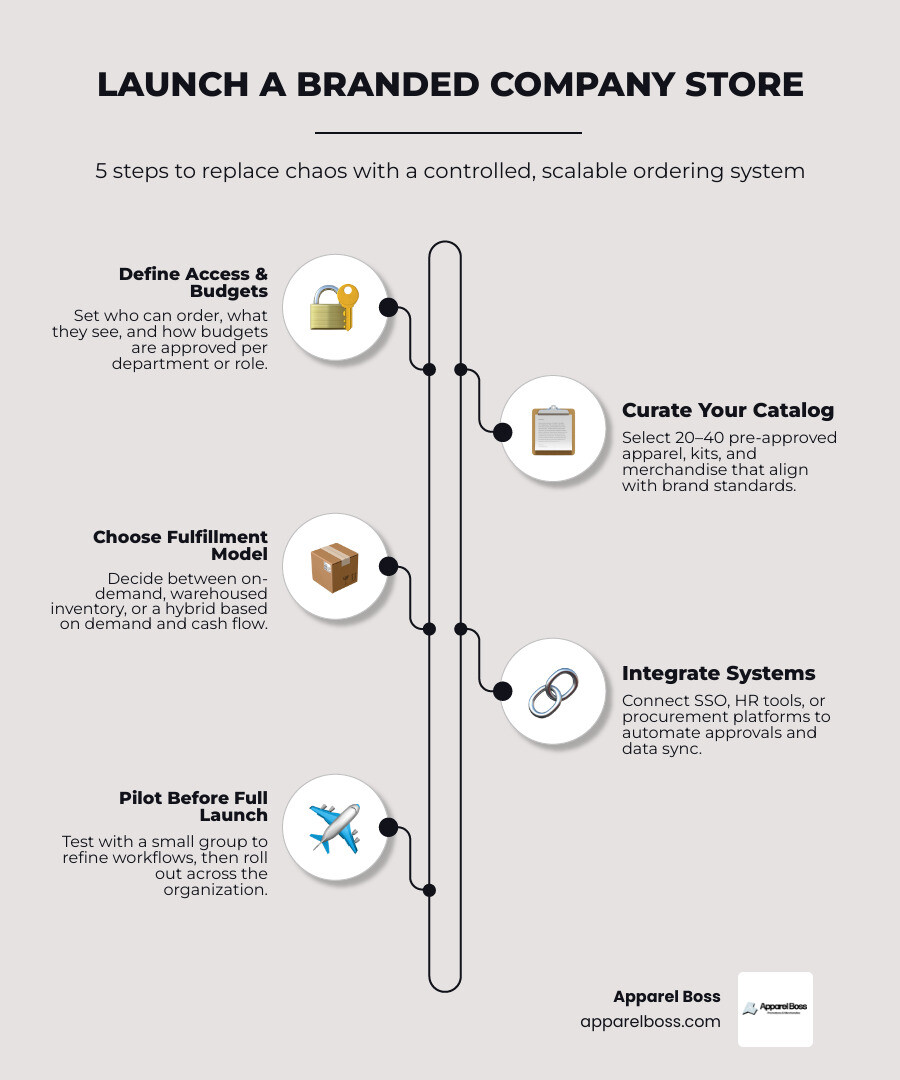
To launch branded company store systems that employees and departments will actually use, start with a clear operating plan:
- Define who can order, what they can access, and how budgets are approved.
- Build a focused catalog of pre-approved apparel, kits, and merchandise.
- Choose the right fulfillment model: on-demand, stocked inventory, or a hybrid.
- Connect the store to the systems your team already uses, such as SSO, HR, or procurement tools.
- Pilot the experience with a small group before a wider rollout.
An online company store turns scattered logo requests, last-minute reorders, and overflowing swag closets into one controlled ordering system. It gives HR a cleaner way to send onboarding kits, helps marketing protect brand standards, and gives operations better visibility into merchandise demand and distribution.
The goal is not to put every possible item online. It is to create a dependable store with quality products people want, clear purchasing rules, and fulfillment that works at scale. A curated launch catalog also makes it easier to learn what teams actually use before expanding the assortment.
I am Salvatore Vento, Marketing Director at Apparel Boss, where I help scaling teams launch branded company store programs that make custom apparel, kits, and reorders more consistent and easier to manage. My work focuses on dependable sourcing, decoration quality, and distribution systems that support brand standards as organizations grow.
The Hidden Costs of Decentralized Merchandise Management
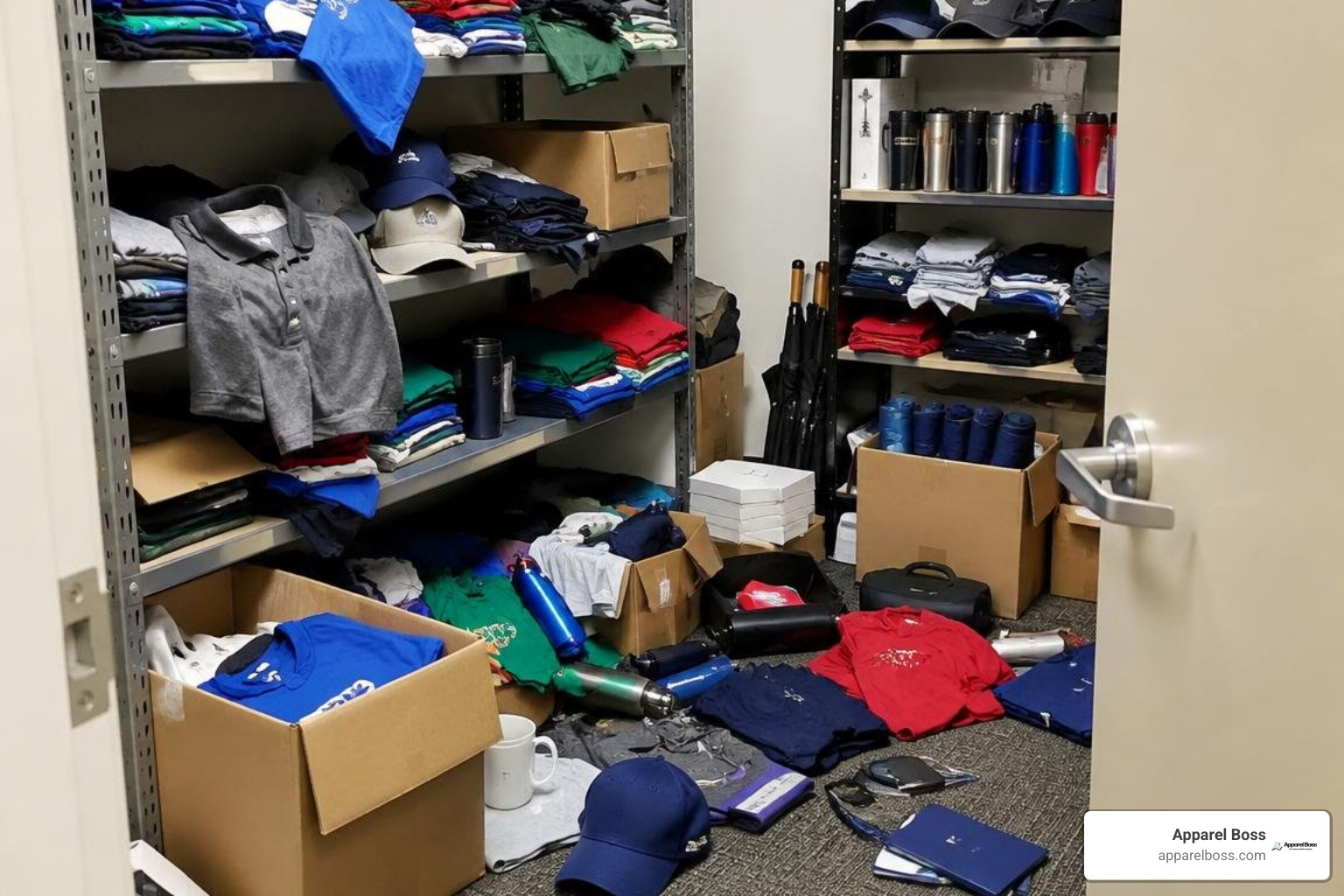
When an enterprise lacks a centralized merchandise distribution system, ordering responsibility fractures across HR, marketing, regional offices, and departmental heads. This ad-hoc approach creates severe operational drag. Individual managers routinely turn to consumer-facing commodity platforms to meet short-term needs, resulting in rogue branding, inconsistent logo usage, and zero quality control.
The administrative burden of managing disjointed purchasing is immense. Finance teams are left sorting through scattered corporate credit card receipts, managing dozens of disparate vendor accounts, and reconciling mismatched general ledger codes. When we examine traditional merch ordering vs online stores, the operational inefficiency of legacy procurement becomes glaringly obvious. Office closets fill with boxes of odd sizes and dated items, tying up capital in products that ultimately get discarded.
The True Financial Impact on Growing Enterprises
Decentralized procurement directly drains company budgets through uncoordinated purchasing. Without consolidated ordering, organizations miss volume efficiencies entirely and regularly incur 20% to 40% rush surcharges to meet tight event timelines.
When evaluating platforms, decision-makers must look beyond transactional e-commerce carts. Understanding the operational criteria for evaluating online company store platforms allows leaders to eliminate approval bottlenecks, aggregate purchasing data, and enforce clear spending limits across every division.
Core Store Inventory Models: On-Demand, Warehoused, and Hybrid
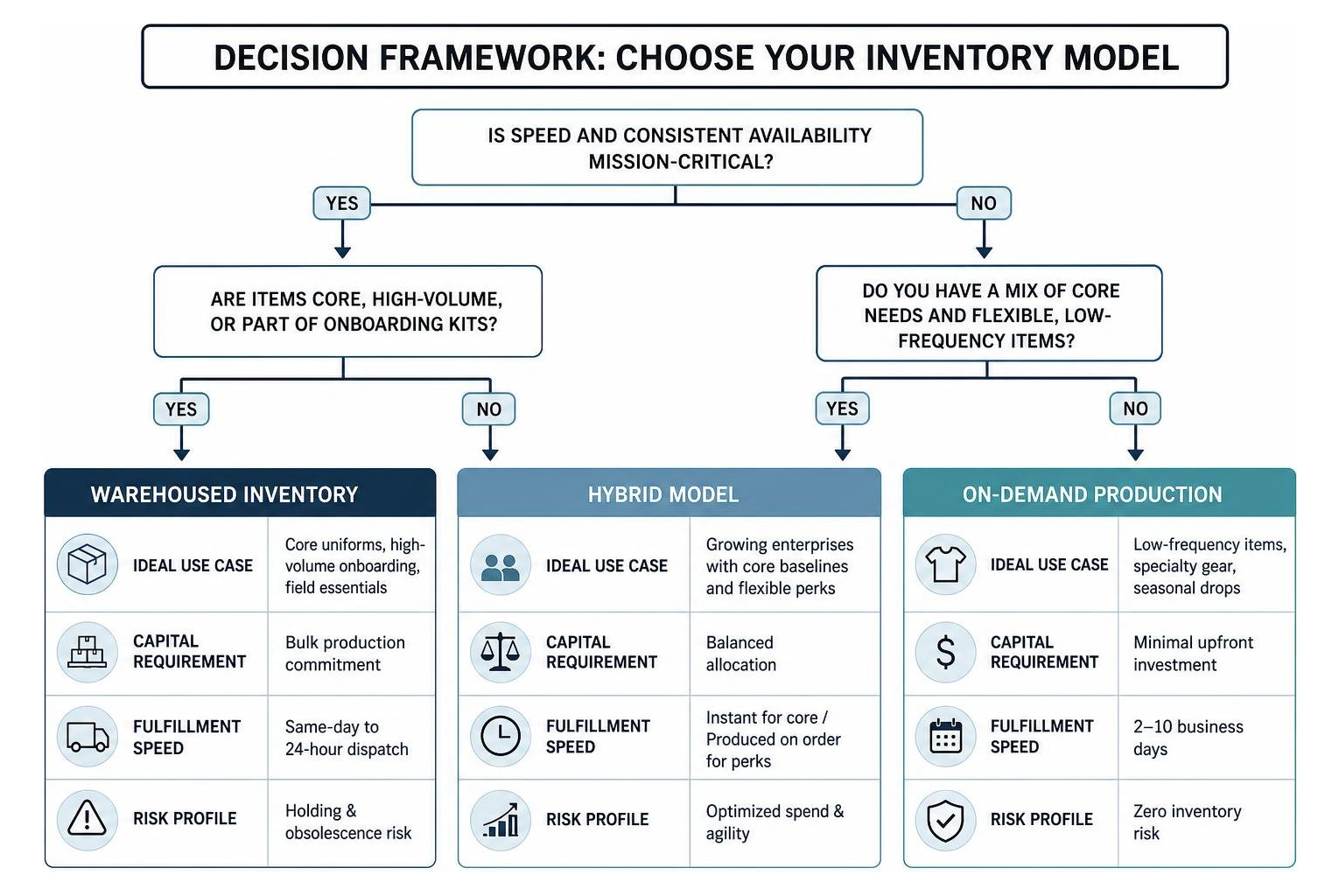
Selecting the right fulfillment model is the most important structural decision when designing an internal merchandise portal. Every organization balances distinct demands across turnaround speed, storage overhead, cash flow, and order volume.
| Model Type | Ideal Use Case | Capital Requirement | Fulfillment Speed | Risk Profile |
|---|---|---|---|---|
| On-Demand Production | Low-frequency items, specialty gear, seasonal drops | Minimal upfront investment | 2–10 business days | Zero inventory risk |
| Warehoused Inventory | Core uniforms, high-volume onboarding, field essentials | Bulk production commitment | Same-day to 24-hour dispatch | Holding & obsolescence risk |
| Hybrid Model | Growing enterprises with core baselines and flexible perks | Balanced allocation | Instant for core / Produced on order for perks | Optimized spend & agility |
Selecting the Right Inventory Strategy for Your Organization
Choosing the right fulfillment strategy requires aligning internal demand patterns with operational capacity. Core operational workwear and high-turnover new-hire bundles benefit from pre-decorated warehousing to guarantee same-day shipping. Conversely, niche items, executive gifts, and limited-edition items thrive in an on-demand environment where zero capital is locked in unsold goods.
Taking time to evaluate whether an internal merch store fits your company ensures you do not overcommit resources. Many leading global enterprises and major entertainment brands leverage omnichannel branded product distribution strategies to merge physical and digital logistics cleanly, and B2B corporate platforms benefit from the exact same structural discipline.
Step-by-Step Framework to Launch Branded Company Store Systems That Scale
A successful corporate store rollout requires methodical alignment across operations, brand management, and fulfillment.
Building a strong merchandise architecture starts with disciplined catalog curation. Rather than overloading users with hundreds of options, focus on a tight selection of 20 to 40 high-utility, premium products. Restricting options maintains quality, simplifies inventory forecasting, and reinforces brand standards across every department. To maintain budget efficiency, review the best practices for building a scalable merchandise program.
Technical Integrations and Security to Launch Branded Company Store Portals
An enterprise-ready merchandise portal must integrate directly with internal identity and financial infrastructure. Single Sign-On (SSO) using SAML or Okta removes login friction while ensuring immediate deprovisioning when employees depart.
Furthermore, integrating enterprise ERP systems and configuring automated cost-center billing ensures that purchases route seamlessly to approved departmental general ledger accounts. By using automated platforms to stop internal swag chaos, organizations eliminate rogue credit card spend. Just as modern luxury retail labels use curated multi-channel brand standards to protect their aesthetic identity, B2B enterprises must maintain strict technical and visual control over their branded assets.
Internal Rollout and Driving Adoption Across Departments
Even the most advanced platform will fail if employees and regional managers do not adopt it. Build enthusiasm two weeks before launch with an internal announcement campaign highlighting the store's utility. Distribute digital welcome credits or allocation codes to departmental leads to encourage immediate engagement.
Pilot the platform with a single department—such as People Operations or a regional sales office—to validate approval workflows, address user feedback, and verify delivery timelines before rolling the store out company-wide.
Measuring Store Performance and Scaling Merch Operations
Ongoing management requires tracking operational data rather than relying on guesswork. Monitor key performance indicators across every operating division:
- Catalog Utilization Rate: Aim for greater than 60% of listed SKUs ordered quarterly. If an item underperforms across two quarters, retire it.
- Repeat Purchase Rate: Monitor internal departments to ensure continuous adoption. Healthy programs see repeat utilization exceed 25% within six months.
- Order-to-Delivery Time: Maintain strict benchmarks (under 24 hours for warehoused items; 2–10 business days for on-demand production).
- Budget Compliance: Track spend allocation across cost centers to eliminate unapproved expense claims.
For complex onboarding, executive milestone awards, and field team deployments, pairing the company store with integrated custom kitting services guarantees high-touch presentation without placing a logistics burden on your internal staff.
Common Operational Traps When You Launch Branded Company Store Solutions
The most frequent mistake in corporate merchandise management is catalog bloat. Launching with hundreds of items overwhelms users, fragments purchasing data, and creates logistical bottlenecks.
Another major trap is partnering with transactional commodity vendors that use basic print-on-demand techniques. Inferior embroidery, peeling prints, and poorly constructed garments reflect negatively on your corporate brand. A successful program requires curated selections, artisan decoration standards, and a dedicated account team that proactively manages inventory and seasonal refreshes.
Frequently Asked Questions About Company Stores
How long does it typically take to launch an online company store?
A standard enterprise rollout takes roughly four to six weeks from discovery to general access. This timeline accommodates catalog curation, sample decoration approvals, SSO integration, role-based budget setup, and a two-week pilot phase. Streamlined on-demand stores can go live in under two weeks.
What payment and budget allocation methods work best for internal stores?
Enterprise platforms support multiple payment methods tailored by user role:
- Departmental Cost Centers: Automatically billing designated general ledger codes.
- Points-as-Currency: Allocating point balances for employee recognition, milestones, or wellness incentives.
- Digital Gift Codes: Providing set-value credits for new hires or event attendees.
- Direct Credit Card Gateways: Allowing employees to purchase optional corporate apparel with personal funds.
How many products should be included in an initial store launch?
A focused selection of 20 to 40 core SKUs delivers the strongest operational efficiency. This provides sufficient variety across primary categories while keeping ordering simple and inventory clean.
Conclusion
A company store is more than an ordering catalog—it is a central operational system that protects brand equity, eliminates administrative overhead, and provides complete visibility into corporate spend. When organizations replace fragmented purchasing with a curated, managed program, merchandise distribution transforms from an operational headache into a dependable asset.
At Apparel Boss, we solve the operational and quality challenges of corporate merchandise. Our managed concierge company stores provide high-end custom embroidery, enterprise-grade technology, and white-glove fulfillment tailored to your business needs. Connect with our team to design a scalable merchandise program that elevates your brand and simplifies procurement across your organization.
Building and Launching an Online Company Store for Effortless Merch Management