Why Your Corporate Swag Program Needs an Online Store
An online corporate swag shop is one of the fastest-growing tools HR leaders, marketing managers, and operations teams are using to distribute branded merchandise without the chaos of bulk orders, size guessing, and overflowing storage closets.
Here are the best online corporate swag shop platforms to consider in 2026:
| Platform | Best For | Key Strength |
|---|---|---|
| Givenly | Enterprise employee engagement | Wallet-powered redemption, 90%+ adoption |
| SwagMagic | Global gifting | Ships to 170+ countries, recipient choice |
| Merchloop | Zero-inventory programs | No minimums, print-on-demand |
| Swag.com | Automation at scale | API-driven distribution |
| Printful | Budget-friendly US stores | Free setup, 500+ products |
| VistaPrint Corporate | Franchise & distributed teams | Brand control, ProShop portal |
| Compt | HR stipend integration | LSA + swag in one platform |
| Ciloo | Global local production | Up to 60% cost savings |
The appeal is real. 85% of employees feel more pride when they wear company-branded gear, and companies that let employees choose their own swag see redemption rates above 90%. But most organizations are still running swag programs the old way — buying in bulk, storing inventory they never fully use, and asking HR to act as a shipping department.
The shift to an online swag store model solves those problems directly. Instead of forecasting demand and pre-purchasing thousands of units, companies set up a branded portal, fund employee accounts, and let people order what they actually want, when they need it.
But not all platforms work the same way. Some are self-service, transactional, and automated. Others offer managed programs with dedicated support, quality control, and custom kitting. Choosing the wrong model for your team's size and complexity can create the exact problems you were trying to avoid.
I'm Salvatore Vento, Marketing Director at Apparel Boss, where I've spent years helping scaling teams eliminate operational waste and build merchandise programs that employees actually use — including structuring online corporate swag shop programs that prioritize quality, consistency, and efficient distribution. In this guide, I'll break down the key vendor models, platform features, and operational trade-offs so you can make a confident decision for your team.
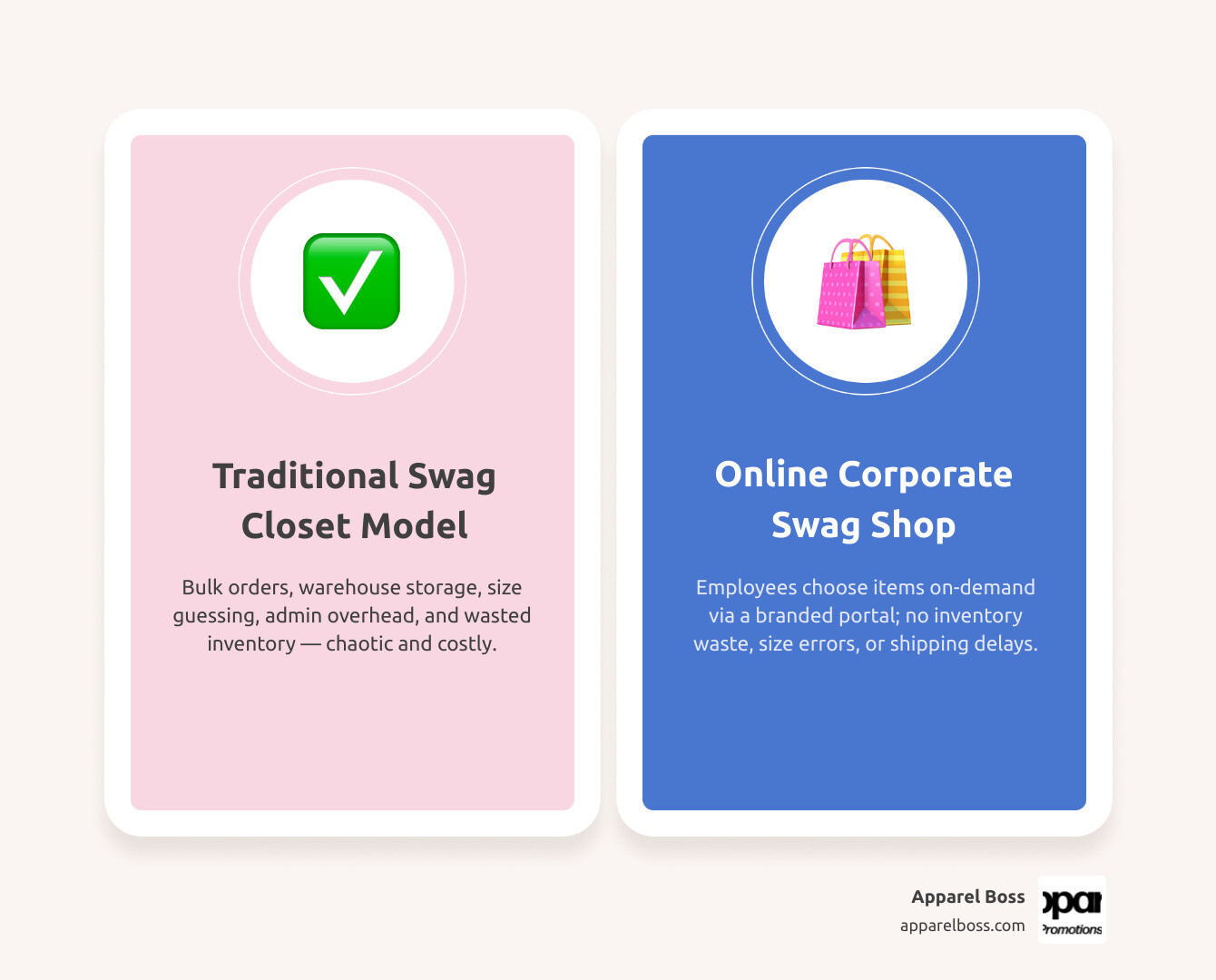
The Operational Pitfalls of Traditional Swag Programs
For years, corporate merchandise was managed through what I call the "swag closet" model. A company would place a massive bulk order of t-shirts, water bottles, and notebooks to get the lowest price per unit.
This traditional approach introduces severe operational friction:
- Wasted Inventory: You are forced to guess size runs. You inevitably end up with boxes of size Small and XX-Large that sit in a closet for years, eventually becoming obsolete when the company rebrands.
- Administrative Overhead: HR and administrative teams are forced to act as a fulfillment center. They spend hours collecting shirt sizes on spreadsheets, packing boxes, writing shipping labels, and handling returns.
- Shipping and Tracking Delays: Managing manual shipments often leads to lost packages, incorrect tracking numbers, and delayed deliveries, especially for distributed or remote teams.
When you transition to a digital storefront, you Stop the Swag Chaos with an Online Company Store. Moving the burden of size collection and address entry to the employee or recipient saves hundreds of hours of administrative work and ensures that only items that will actually be worn are produced.
Transitioning to an Online Corporate Swag Shop: On-Demand vs. Managed Inventory
When launching an online corporate swag shop, you must decide how your physical goods will be produced and stored. There are three primary fulfillment models:
- Print-on-Demand (POD): Products are decorated only after an order is placed. This completely eliminates upfront inventory costs, storage fees, and waste. It is highly flexible but typically limits decoration methods to digital printing.
- Managed Inventory (Warehousing): Premium retail-brand items are decorated in bulk, stored in a centralized fulfillment center, and shipped on demand when ordered through the portal. This ensures the highest decoration quality (such as premium custom embroidery) and faster shipping times, but requires upfront capital.
- Hybrid Model: The most balanced approach. You warehouse high-volume premium apparel and use print-on-demand for secondary lifestyle accessories.
Choosing between these models depends on your brand standards and scaling needs. If you want to understand how these systems compare to bulk ordering, check out The Complete Guide to Bulk Swag Ordering Platforms to map out your infrastructure.
Key Features to Look For in a Swag Store Platform
To find the right platform, look beyond the catalog of products. A successful enterprise store relies on software that integrates smoothly with your existing business systems. I advise decision-makers to evaluate platforms based on these critical features:
- HRMS Integrations: Connecting your store directly to platforms like Workday, BambooHR, or Rippling allows you to automate onboarding. When a new hire is added, the system automatically triggers a welcome kit email.
- Single Sign-On (SSO): Secure employee access via Okta or Microsoft Azure ensures that only active staff can access internal portals.
- Role-Based Access: Admins should have the power to set budgets, approve orders, and control product visibility, while employees only see the items available to them.
- Tax Compliance: The platform should automatically calculate and track tax implications, distinguishing between standard corporate gifts and taxable uniform allocations.
To help you compare the operational reality of these systems, I have mapped out the differences between basic self-service portals and fully managed programs:
| Feature | Self-Service Portals (Commodity Sites) | Managed Programs (Concierge Partners) |
|---|---|---|
| Setup Support | DIY templates and automated uploads | Dedicated account manager and custom design |
| Decoration Quality | Standard digital printing / heat transfers | Artisan-level custom embroidery and laser engraving |
| Inventory Options | Print-on-demand only | Hybrid (POD + warehoused bulk items) |
| Kitting Capability | Limited to pre-set boxes | Fully custom corporate kitting & custom packaging |
| Client Support | Ticket-based chat systems | Direct phone and email concierge support |
If you are currently looking at options, you can read our detailed guide on How to Evaluate Online Company Store Platforms for Your Business to refine your selection criteria.
Evaluating Corporate Swag Vendor Models
To choose the best partner for your business, it helps to understand how these vendor models function in practice.
Self-Service Transactional Portals vs. Managed Concierge Programs
Self-service portals like Swag.com or Printful are transactional carts. They are designed for quick, automated setups where you upload a logo, generate a digital mockup, and checkout. However, because these platforms rely on automated, high-volume production facilities, they often compromise on decoration quality.
A managed concierge program, like the ones we run at Apparel Boss, prioritizes brand standards. We do not use automated, low-end heat transfers that peel after three washes. Instead, we provide personal service, digital proofing, and artisan-grade custom embroidery to ensure your brand's prestige is maintained across every single garment.
Print-on-Demand Dropshipping vs. Managed Inventory Warehousing
Print-on-demand dropshipping is highly convenient for remote onboarding because it requires zero inventory management. However, because items are decorated one-off, production lead times can be longer, and you are often restricted to direct-to-garment (DTG) printing.
Managed inventory warehousing allows you to pre-decorate premium retail brands in bulk. When an employee places an order, the item is already sitting in our New York-based warehouse, ready to ship immediately. This model ensures flawless brand consistency and exceptionally fast shipping.
Custom Kitting and Managed Distribution Networks
If you are looking to send onboarding kits, holiday gifts, or milestone packages, look for a partner with strong physical kitting capabilities. Premium managed partners handle everything from custom-printed mailer boxes and tissue paper to handwritten note inserts. They manage the physical assembly and quality checks before shipping, ensuring a high-end unboxing experience for your recipients.
Global Production and Distribution Networks
For organizations with global workforces, shipping all merchandise from a single US warehouse can lead to high customs fees and long shipping delays. Some platforms utilize decentralized, local production networks to print items closer to the recipient, which can reduce shipping distances and customs friction. However, if your primary operations and team are concentrated in the New York, Long Island, or tri-state area, utilizing a centralized local partner like Apparel Boss ensures absolute control over decoration quality and rapid local delivery.
Frequently Asked Questions About Corporate Swag Stores
How do stipends and wallet-based funding models work?
Instead of requiring employees to enter a credit card, modern corporate swag stores use digital wallets or stipend allocations. Admins can assign a specific dollar value (e.g., $150 for a work anniversary or $50 per quarter) to an employee's account. The employee logs in, selects their preferred items, and checkout is paid for using their digital wallet balance. This allows companies to control budgets precisely while giving employees the freedom of choice.
Is company swag taxable for employees?
According to IRS guidelines, low-value, occasional corporate gifts are generally classified as a de minimis fringe benefit. This means that if the items are inexpensive and provided infrequently (such as a welcome t-shirt or a holiday mug), they are excluded from the employee's taxable income. However, if you are distributing high-value electronics or regular uniform allowances, it is important to consult your finance team to ensure proper tax reporting.
How do companies measure the ROI of their swag store?
You can measure the impact of your store by tracking key engagement metrics:
- Redemption Rates: Traditional bulk swag often sits unused. Choice-driven stores regularly achieve redemption rates above 90%, proving that employees actually value the items.
- Employee Retention and Pride: Use internal surveys to measure how branded apparel impacts team cohesion and brand pride.
- Brand Impressions: High-quality, retail-grade apparel is worn in public, creating continuous, low-cost brand impressions over its lifecycle.
Conclusion
Building a successful corporate merchandise program does not have to be an operational headache. By transitioning to a modern online store, you can eliminate wasted inventory, protect your brand standards, and delight your team with gear they actually want to wear.
At Apparel Boss, we bridge the gap between premium brand standards and operational scalability. Led by industry expert Salvatore Vento, we are the premium alternative to transactional, self-service cart platforms. Based in Long Island, NY, we specialize in artisan-level decoration, custom corporate kitting, and fully managed online storefronts for businesses that refuse to compromise on quality.
Ready to stop the swag chaos and elevate your brand's physical presence? Explore our Apparel Boss Company Stores or request a custom consultation to design a managed program built for your team.
A Practical Guide to Finding the Best Corporate Swag Vendors